
The history of automotive design is a narrative of slow liberation. For nearly a century, the motor car was a prisoner of its own heritage, a machine struggling to escape the vestigial forms of the equestrian era. In the mid-nineteenth century, the earliest horseless carriages were exactly that: carriages deprived of their horses but still beholden to the structural logic of the timber frame and the high-perched bench. The nomenclature of the time betrayed this identity crisis. Names like Phaeton and Cabriolet were not mere marketing whims; they were literal descriptors of horse-drawn archetypes. These early motor coaches were so tethered to tradition that the only discernible difference between a high-end carriage and a first-generation motor vehicle was the absence of a place to hitch a team.
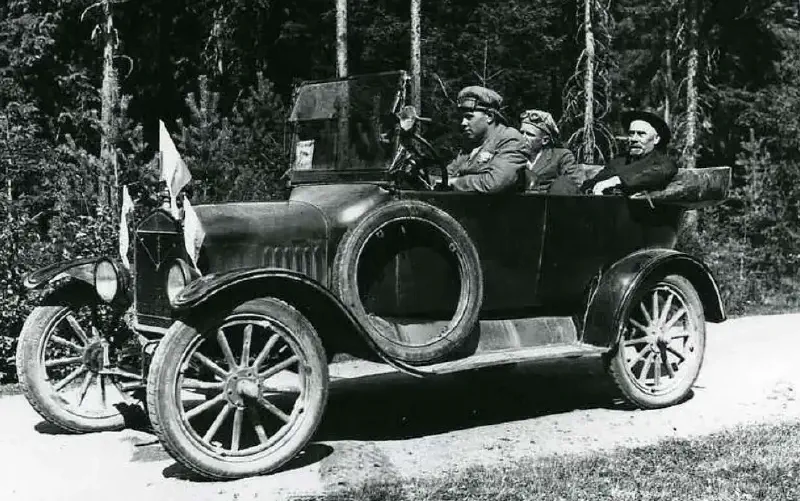
Gottlieb Daimler, in his early efforts, placed the engine at the rear of the coach. While this might have seemed logical to a man thinking in terms of pushing a cart, it proved to be a mechanical nightmare for the burgeoning class of early adopters. The engine was hidden away, making maintenance and repair an inconvenient theater of frustration. It was not until the mechanical reformation of 1890, led by the Panhard-Levassor company, that the automobile found its true posture. By mounting the engine at the front, Panhard-Levassor did more than just improve accessibility; they birthed the hood, or the bonnet. This change in architecture established the visual language of the twentieth century. A long hood became a surrogate for power, a signifier that something potent and vast resided beneath the steel skin. It was an aesthetic of intimidation, communicating performance to any observer on the street.
As speeds increased, the open-air vulnerability inherited from the carriage became untenable. The introduction of the windscreen was a pivotal necessity, though it remained a static, troublesome pane until the invention of the wiper in the 1920s. Before this, drivers were forced to use hinged screens that opened upward during rain, exposing themselves to the elements just to maintain a line of sight. By the 1930s, the roof had transformed from a temporary cloth covering into an integral structural component of the body. This evolution culminated in the three-box sedan: a front box for the engine, a central box for the human occupants, and a rear box for luggage. This cubic arrangement dominated the industrial landscape for decades, yet it was fundamentally at odds with the fluid reality of the world it traversed.
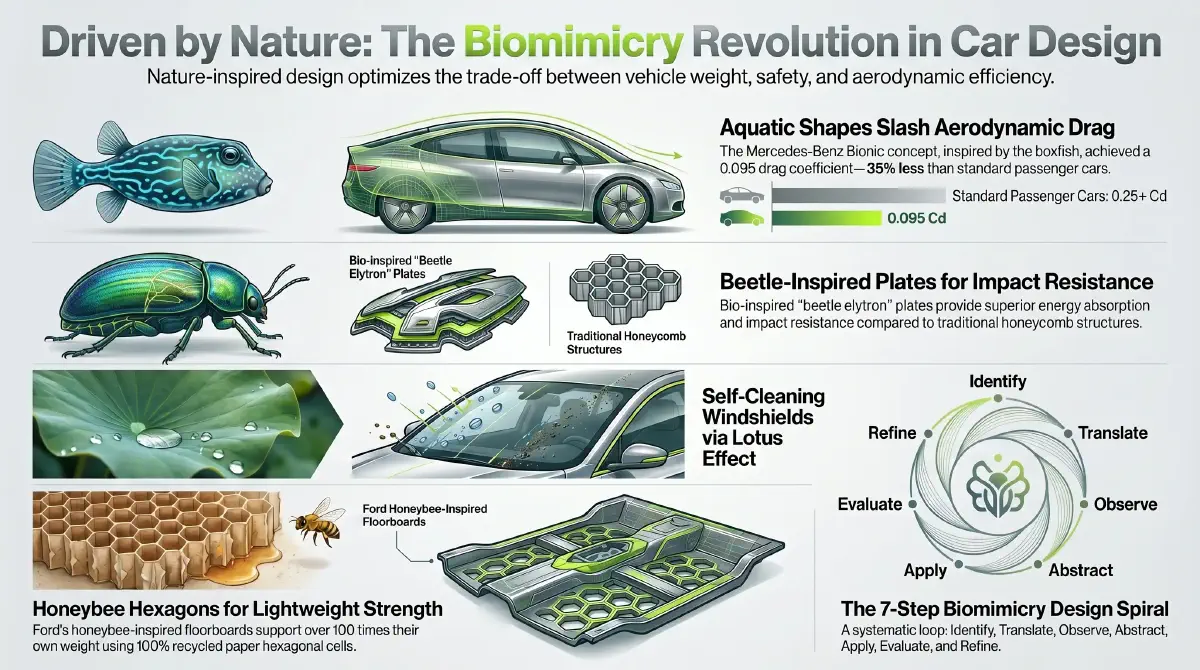
Modern car design is currently undergoing a second reformation, moving away from these rigid, cub-like structures toward a symbiotic relationship with nature’s proven geometries. This is the realm of bionics, the sophisticated intersection of biology and technology. It is a movement that rejects the arbitrary shapes of the industrial past in favor of the optimized, organic forms that have been refined by millions of years of evolutionary pressure. The automobile is no longer being designed as a brick to be forced through the air; it is being reimagined as a biological entity, a biomechanical symphony that learns from the efficiency of the natural world.
The Aerodynamics of Evolution#
The pursuit of the teardrop shape is the paramount obsession of the modern aerodynamicist. In the fluid dynamics of nature, the teardrop represents the ideal, a form that allows air to move around a body with minimal disruption. For a vehicle in an open flow, this shape yields a drag coefficient, or Cd value, of a mere 0.04. Early pioneers recognized this potential, but their attempts to translate it into steel and glass were often met with either mechanical failure or commercial indifference.
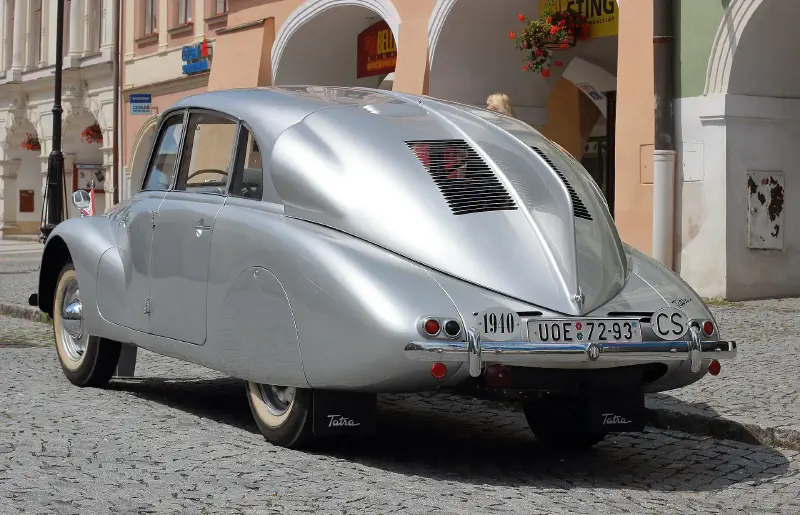
Hans Ledwinka, the brilliant Austrian designer at Tatra, was among the first to truly respect the laws of physics over the whims of the stylist. In 1937, he unveiled the Tatra T87, a car so radical in its streamlining that it appeared more like a fallen dirigible than a motor car. With its rear-mounted, air-cooled V8 and a finned tail, the T87 was a masterclass in reducing tractive power loss. However, its sophisticated form hid a lethal character. During the Second World War, the T87 earned a reputation as a secret weapon of the Czechs. Its handling proved too much for the occupying German officers, who were unaccustomed to its high-speed dynamics and rear-heavy weight distribution. It was rumored that the Nazi high command eventually banned its officers from driving the car due to the high number of fatal accidents. Despite this dark history, the Tatra T87 was the direct genetic precursor to the Volkswagen Beetle. While the Beetle, with its ladybird-like contours, may not seem exceptionally aerodynamic by the standards of a contemporary laboratory, it was a profound departure from the boxy, upright competitors of its day.

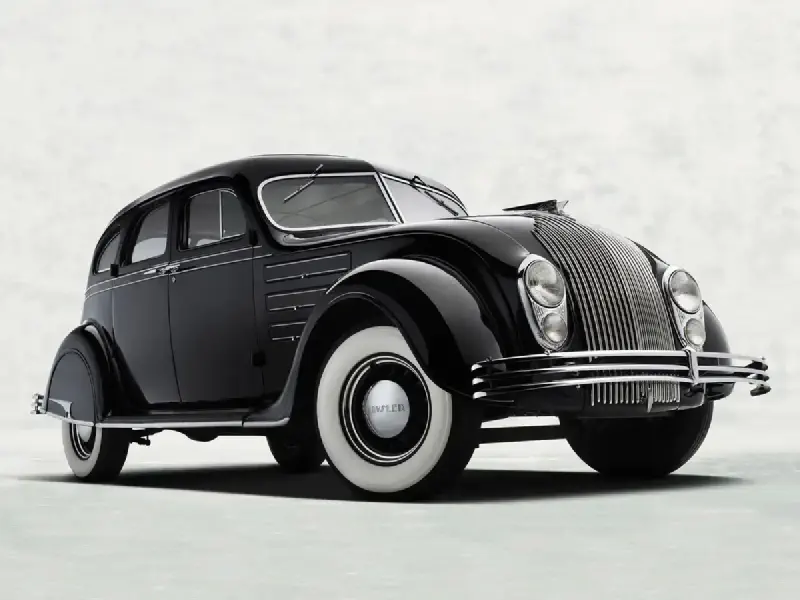
Contemporaneous to Ledwinka’s work was the Chrysler Airflow of 1934. In many ways, the Airflow was a commercial tragedy of being right too soon. Its designers gathered the headlights and grille into a singular, cast-like oval body, and the glass was directed forward to facilitate air movement. It was an attempt to turn the car into a single, cohesive unit. However, the manufacturing techniques of the 1930s were not prepared for such complexity. The curved shapes were difficult and expensive to produce, and the public, still enamored with the imposing presence of cars like the Bugatti 41 Royale with its massive, upright bonnet, found the Airflow’s softened nose to be unappealing. Aerodynamic styling was shelved by most major manufacturers as a hurdle to mass production, a luxury the industry could not afford during the Depression.
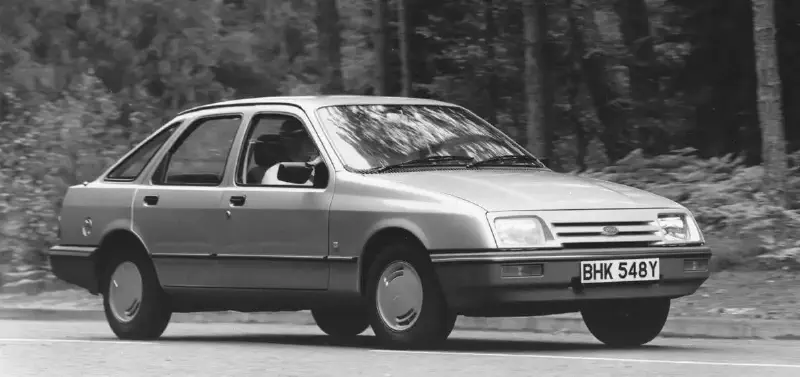
It took the oil crisis of the 1970s to force a permanent change in perspective. When the price of fuel skyrocketed, the industry was compelled to finally respect the laws of physics. The 1982 Ford Sierra served as the modern turning point, proving that aerodynamic shapes could be accepted by the mass market. This evolution reached its zenith with projects like the Mercedes-Benz Bionic car. Seeking a model for a safe, spacious, and efficient vehicle, engineers looked to the tropical boxfish. While the fish appears blocky, nature has sculpted it into an exceptionally efficient swimmer. Computer simulations revealed the boxfish achieved a Cd value of 0.06. When Mercedes-Benz translated this form into a full-scale vehicle, the car achieved a Cd value of 0.095. This remains an outstanding result, as the theoretical ideal for a ground-based vehicle, taking into account the friction of the road, is roughly 0.09.
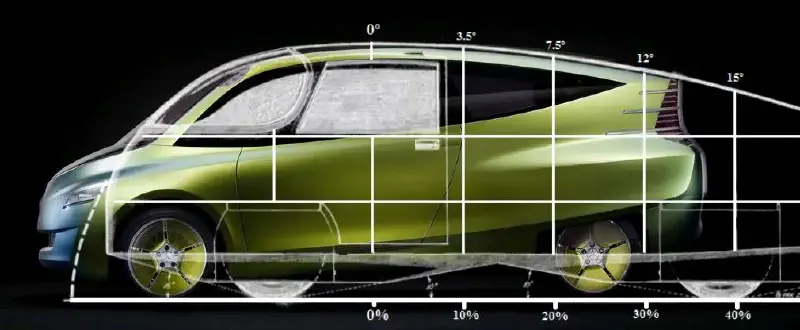

Today, this mimicry is supported by the rigor of computational fluid dynamics and wind tunnel testing. Modern researchers use simulation models to analyze six disparate forces: drag, lift, side force, rolling moment, pitching moment, and yawing moment. In these tests, engineers often use a blockage ratio of 0.25 percent and airflow velocities of 30 meters per second to mimic real-world conditions. This meticulous analysis ensures that the biological forms being used are not just aesthetic homages, but functional improvements that enhance stability in unpredictable crosswind conditions.
Structural Skeletons: Chassis and Suspension#
Beneath the aerodynamic skin, the automobile possesses a skeleton that has evolved from simple frames to complex, load-bearing structures. There are three primary chassis designs that define the modern era: the space frame or lattice, the monocoque, and the semi-monocoque. The space frame is a structural framework of interconnected metal tubes, typically steel, designed to provide maximum strength and rigidity while minimizing mass. This design is founded on the principles of the truss, a triangular arrangement that handles loads in either tension or compression. Every gram saved in a space frame chassis contributes to speed and agility, making it the preferred architecture for high-performance racing vehicles where the stiffness-to-weight ratio is the ultimate metric of success.
The monocoque, by contrast, is an integrated structure where the body and chassis are one. It is the standard for modern passenger vehicles because it distributes the stress produced during motion throughout the entire frame. This creates a balance of rigidity and weight efficiency that a simple ladder frame can never match. Some designers utilize a semi-monocoque approach, a hybrid that might use a space frame for the rear to accommodate complex engine packaging while using a monocoque for the front bulkhead.
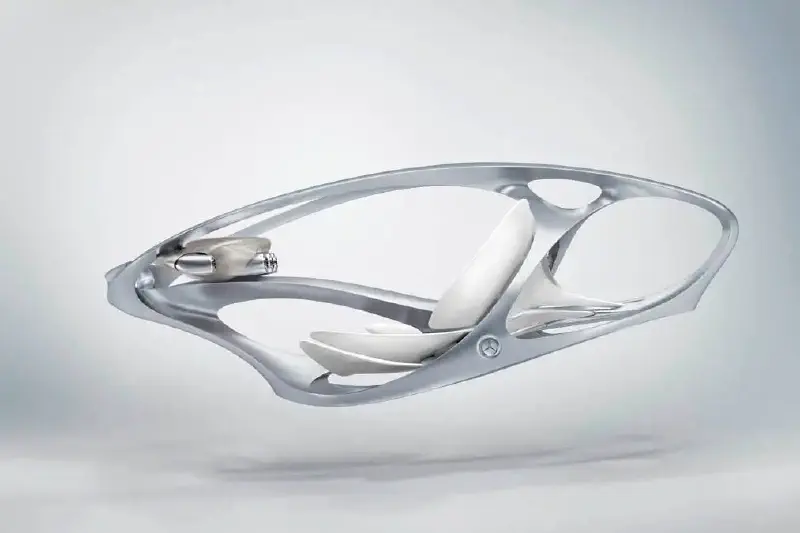
The beauty of these structural designs is increasingly inspired by organic skeletons. One of the most striking examples is the Mercedes-Benz Aesthetics No. 2 sculpture. This innovative framework was inspired by the skeleton of the fin whale, demonstrating how intricate, non-linear geometries can manage immense loads with minimal material. Gorden Wagener, the head of design at Mercedes-Benz, describes this as an artistic creation that learns from nature’s diversity without simply copying it. It is an exploration of the intricate, all-encompassing interplay of natural elements.

The relationship between this skeleton and the road is managed by the suspension, the car’s adaptive limbs. The first and most vital job of a suspension system is to ensure the tires never leave the ground. A tire in the air provides zero friction, and zero friction means zero control. Whether the car is rolling through a corner, pitching forward under braking, or diving, the suspension must move up and down to maintain contact.
This management of the contact patch is a game of angles and geometry, specifically negative camber. In a static state, a car may look symmetrical, but as the driver—the single heaviest component of the cockpit—enters the vehicle, the suspension compresses and the camber changes. Tire manufacturers often recommend a negative camber of 1.5 degrees because they understand that a tire is not a rigid object; it is a structure of rubber and string. Under the load of a corner, this carcass will deflect. A well-engineered suspension, such as the double wishbone design, uses its linkages to compensate for the roll of the chassis. As the body leans, the suspension adjusts the tilt of the tire to ensure the contact patch remains vertical to the pavement. Without this adaptive geometry, the vehicle would be a clumsy, skating object rather than a precision machine.
The Emotional Machine: Interior and Human Factors#
The automobile is not merely a transport device; it is a communication tool that engages with the human psyche. This is the discipline of emotional design, where shapes and proportions are calculated to evoke specific psychological responses. The Nissan Townpod serves as a primary example of this approach. Its front fascia was designed to resemble a smiling face, a choice rooted in the physiological theory that copying or observing an emotional expression can influence the actual mood of the observer. If the car appears jovial, the driver may feel a sympathetic shift in their own disposition.
This intersection of psychology and engineering is formalized in human factors engineering. The goal is to optimize the human-machine-environment system to be safe, efficient, and comfortable. Nowhere is this more apparent than in the choice of interior materials and colors. There is an age-grading to color preference that designers ignore at their peril. Children’s environments are often characterized by high-brightness, high-purity palettes. Consequently, a car designed for families might employ brighter, more primary colors to cater to the sensory needs of younger occupants.
Adults, conversely, tend to gravitate toward low-brightness, low-purity tones. Dark grays and muted palettes are favored for the sense of maturity and stability they provide. This is not just a matter of taste; it is a reflection of value expectations. The material world inside the car carries similar weight. Cotton seat covers are seen as practical, durable, and generous. They are easy to maintain and resist the shrinking and deformation often seen in lesser materials. Blended materials, which combine cotton with polyester, offer a high-grade feel while maintaining resilience.
Leather, however, remains the undisputed superstar of the automotive interior. It is prized for its high-grade status and its unique thermal properties—remaining cool in the summer and winter. This tactile comfort is a key component of what is known as Kansei engineering, a method of translating sensory feelings into design parameters. Even the most utilitarian components are subject to these human factors. Consider the drum brake. While disc brakes have replaced them on the front wheels due to superior performance, drum brakes are still commonly used for handbrakes. The mechanical challenge of designing a disc brake that can effectively hold a parked car on a steep incline means the older, simpler technology remains the most practical solution for a parking hold.
The Electrified Future: Sustainability and Innovation#
The transition toward electric vehicles is the most significant shift in automotive history since the introduction of the front-mounted engine. While the transition is driven by the need to reduce greenhouse gas emissions, it is a move fraught with technological challenges. A lifecycle analysis reveals a complex truth: electric vehicles have higher manufacturing emissions than internal combustion engines, primarily due to the energy-intensive production of lithium-ion batteries. However, this deficit is overcome during the vehicle's operation, as EVs have substantially lower operational emissions over their lifetime.
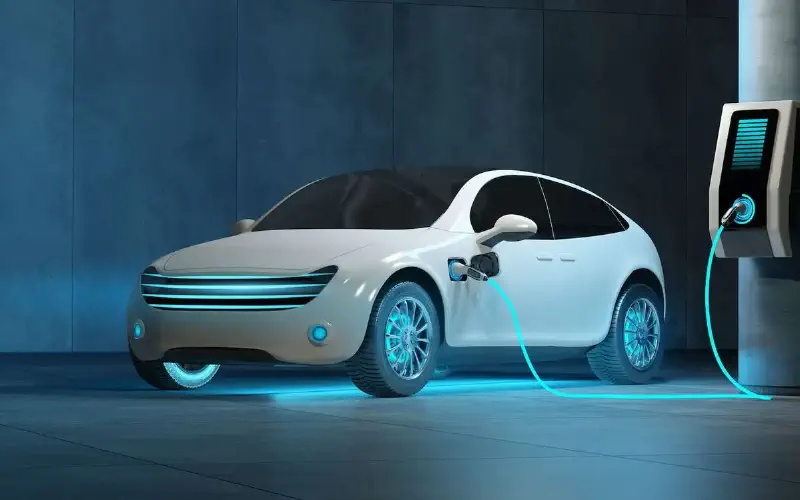
The evolution of battery technology has seen lithium-ion emerge as the preferred option due to its superior energy density and safety. This has helped mitigate range anxiety, though the inadequacy of charging infrastructure remains a significant hurdle to mass adoption. Government policies and strategic public-private partnerships are now the primary drivers in expanding these networks, attempting to make the electric car a practical reality for the global commuter.
Electrification has also enabled the emergence of steer-by-wire technology, a system that perfectly mirrors biological mimicry. In a traditional car, a rigid mechanical rod connects the steering wheel to the tires. In a steer-by-wire system, this is replaced by electrical signals, much like the way a biological system uses electrical impulses to signal a limb to move. The system is divided into two subsystems: the hardware module and the rear wheel subsystem. The hardware module uses sensors on the motor shaft to convert the driver’s intent into an electronic signal. This signal is then transmitted to the rear wheel subsystem, which adjusts the tire angle accordingly. This eliminates weight, saves space, and allows for greater design flexibility, as the steering wheel no longer needs to be physically tethered to the front axle.
Even the braking systems are evolving in this new landscape. While we have moved away from hazardous materials like asbestos to semi-metallic, ceramic, or non-asbestos organic compositions, the fundamental physics remains. The transition from drum brakes to disc brakes on the front wheels has improved safety, but the industry continues to innovate in material efficiency to ensure that the performance of these systems matches the increased weight of battery-heavy electric vehicles.
The Synthesis of Form and Function#
The design of the modern automobile is a delicate and often treacherous field of action. A designer must navigate a labyrinth of social context, physical space, and the specific needs of a diverse customer base. It is a task that requires more than just a talented hand; it requires an understanding of the intricate, all-encompassing interplay of elements that make a system successful.
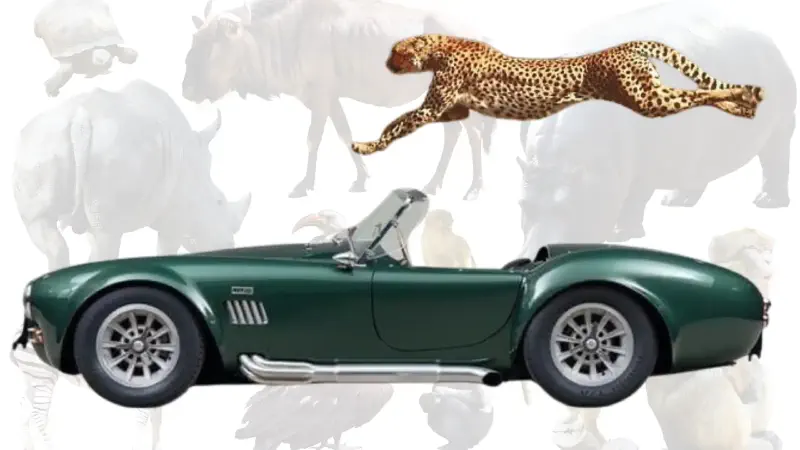
As we look toward the future, the car is shedding its identity as a simple machine. It is becoming a bio-mechanical entity that learns from the diversity and perfection of nature. Whether it is the skeletal efficiency of a space frame, the aerodynamic slip of a boxfish-inspired body, or the emotional resonance of a smiling front fascia, the automobile is returning to the organic world. By marrying the genius inventions of nature with the precision of modern engineering, the automotive industry is creating a transportation landscape that is more efficient, more emotional, and infinitely more sustainable.
References#
- Ahmed, M. I., et al. (2025). Review of Engineering Design of Electric Vehicles. Advanced Sciences and Technology Journal, 2(2).
- Stamov, T. (2017). On Some Principles of Vehicle Design and Styling: Character of the Forms. International Journal of Engineering and Applied Sciences, 4(3).
- Sun, W. (2018). Research on Automotive Interior Optimization Based on Human Factors Engineering. 8th International Conference on Mechatronics, Computer and Education Informationization.
- Zero To 60 Designs. (2025). Best Automotive Design Schools in the World: Top Colleges Ranked.
- Davis, Matt, Aesthetics No. 2 | Mercedes-Benz, https://www.arch2o.com/aesthetics-no-2-mercedes-benz/