
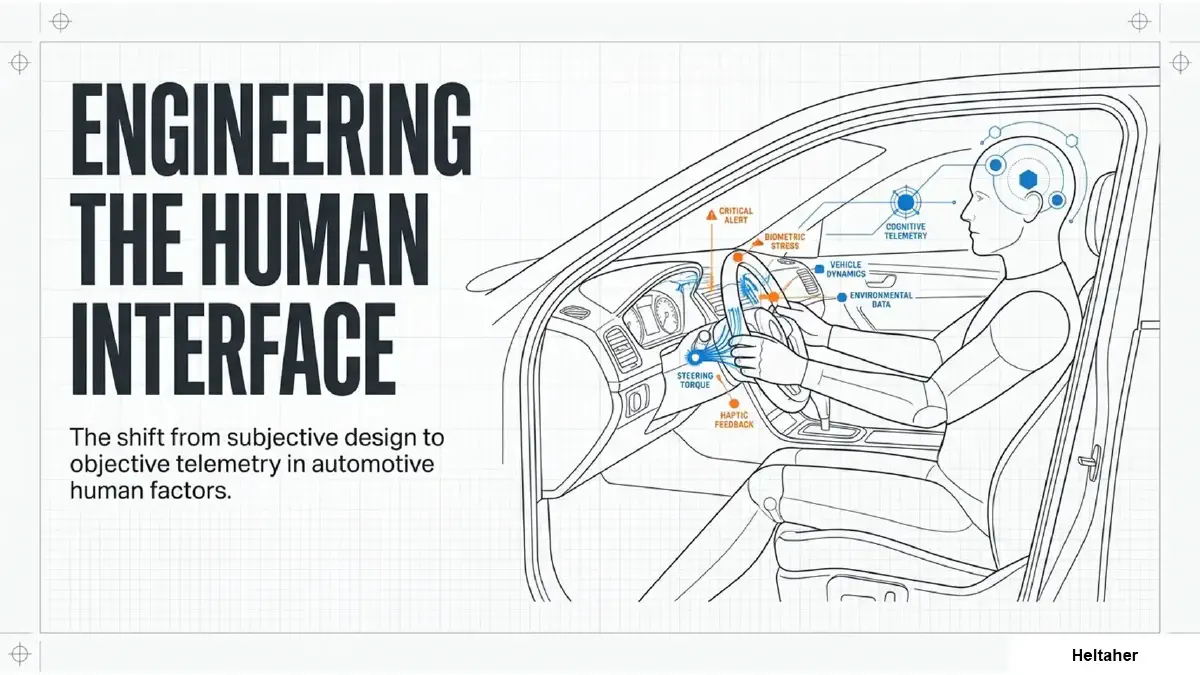
Beyond the nut behind the wheel#
For the better part of the twentieth century, the individual perched behind the steering wheel was regarded by the automotive establishment as a persistent, if unavoidable, nuisance. To engineers, the driver was the "nut behind the wheel"—a volatile, stochastic element whose lapses in judgment were attributed to a mix of moral failing, bad luck, or inherent recklessness. This era of road safety was characterized by a reactive stance, where the machine was a passive vessel and the human was an unpredictable agent of chaos. If a vehicle careened off a rural bend, the coroner’s report rarely interrogated the cognitive architecture of the pilot; it sufficed to blame the "road devil" for his lack of constitution.
However, a profound paradigmatic shift is currently unfolding within the laboratories of the global automotive industry. The driver is no longer treated as an external, erratic operator, but as a measurable, quantifiable, and increasingly predictable component within a hyper-complex socio-technical system. This transition marks the emergence of a new science of the driver—one that replaces the anecdotal observations of the past with the high-resolution, data-driven insights of neuroscience and artificial intelligence. By peering through the skull and into the autonomic nervous system, researchers are beginning to map the internal landscape of the human mind with a level of precision that would have been unthinkable a generation ago.
The central conceit of this new discipline is that the "ghost in the machine"—that unpredictable human spirit—is actually a series of biological algorithms that can be parsed, modeled, and eventually accommodated. As vehicles move toward higher levels of autonomy and interconnectedness, the industry is shifting from building mere tools for transport to constructing empathetic systems. These systems are designed to monitor the driver’s cognitive load, predict their emotional outbursts, and mitigate the physical limits of their perception. In this new world, the machine does not just obey the human; it understands them.
A history of blame#
The historical trajectory of road safety offers a fascinating mirror to our evolving understanding of human agency. Between 1900 and 1920, traffic incidents were viewed as "Chance Phenomena," the modern equivalent of an act of God. Collisions were matters of misfortune, and countermeasures were strictly ad hoc, as there was no conceptual framework to explain why two objects would occupy the same space at the same time. The early twentieth century preferred the comforting simplicity of the "road devil"—a moralizing lens that transformed systemic failure into a personal character flaw. Between 1920 and 1950, the paradigm of "Accident Proneness" dominated, suggesting that certain individuals were biologically destined for calamity. The remedy was punitive: legislation, education, and the occasional public shaming of those deemed unfit for the road.
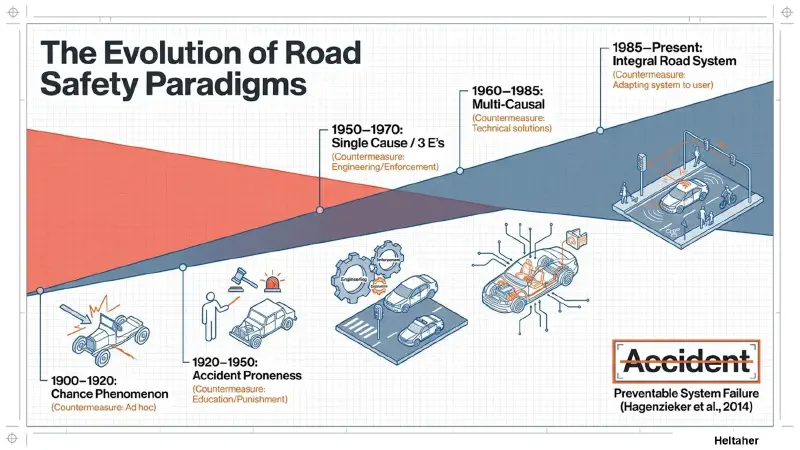
By the middle of the century, the lens widened to a "Single Cause" model, famously encapsulated by the "three Es": Engineering, Education, and Enforcement. Researchers began to ask whether the fault resided with the road user, the vehicle, or the infrastructure, but they rarely saw them as a single, breathing entity. It was not until the period between 1960 and 1985 that the "Multi-Causal Approach" took root, acknowledging that a crash is often the result of a constellation of contributing factors. This eventually birthed the modern "Integral Road System" or "Systems Approach" that defines current research.
The linguistic evolution of the field is perhaps most telling. Since the 1940s, the use of the term "accident" has precipitously declined in academic literature, replaced by the more clinical and accountable "crash." An accident is a shrug of the shoulders; a crash is a system failure. The modern systems approach recognizes that safety is an emergent property of the interactions between all components of the driving environment. It is a philosophy that moves away from the search for a scapegoat and toward the optimization of the system as a whole.
The self-explaining road#
The ultimate realization of this systems approach is the concept of the "self-explaining road." This is not merely an exercise in civil engineering but an experiment in behavioral heuristics. The goal is to create a driving environment and a vehicle interface so intuitive that they inherently guide the driver toward safe behavior while adapting to their natural cognitive limitations. A self-explaining road communicates its function through its design—a wide, straight lane whispers "speed," while a narrow, textured street screams "caution"—thereby reducing the cognitive effort required for navigation.
In such a system, the vehicle acts as a sympathetic buffer. It recognizes that human attention is a finite resource and that the modern driver is often at the brink of cognitive bankruptcy. To build this buffer, however, the industry must first master the hardware of the human mind. This requires moving beyond the "what" of driver behavior to the "how" of the neurophysiological process.
The metrics of mental workload#
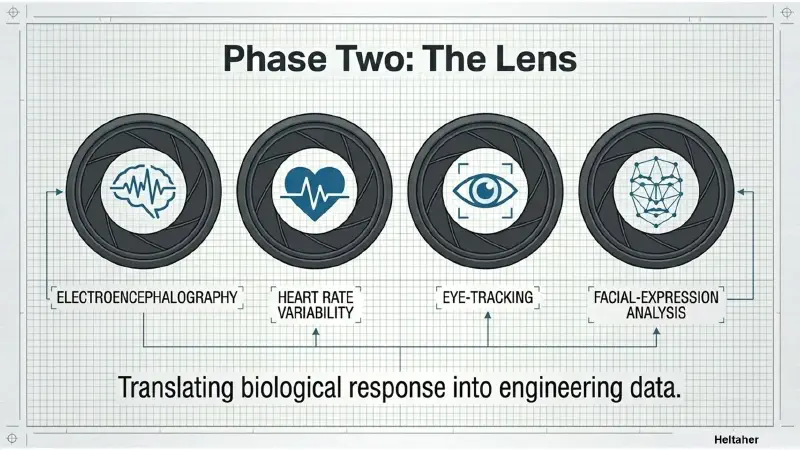
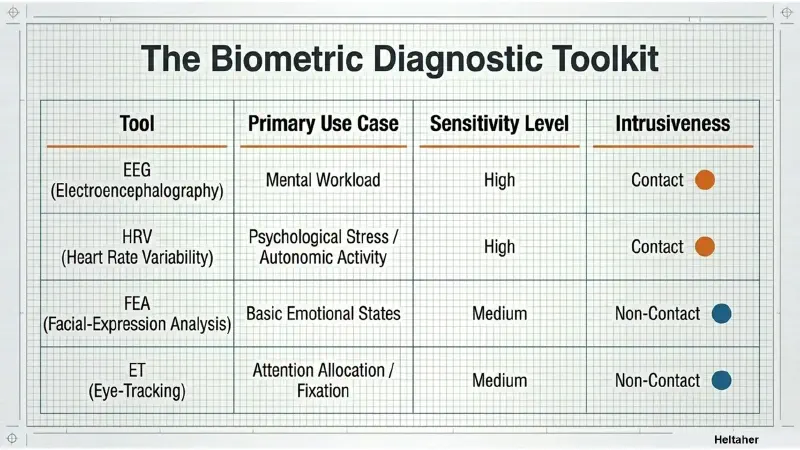
Quantifying the intangible state of mental workload has historically been a clumsy affair. Researchers relied heavily on subjective surveys like the NASA-TLX, which asks drivers to rate their perceived effort after the fact. The problem, of course, is that the human memory is a flawed narrator, prone to post-hoc rationalization and memory bias. To bypass the filter of consciousness, modern researchers have turned to Electroencephalography (EEG).
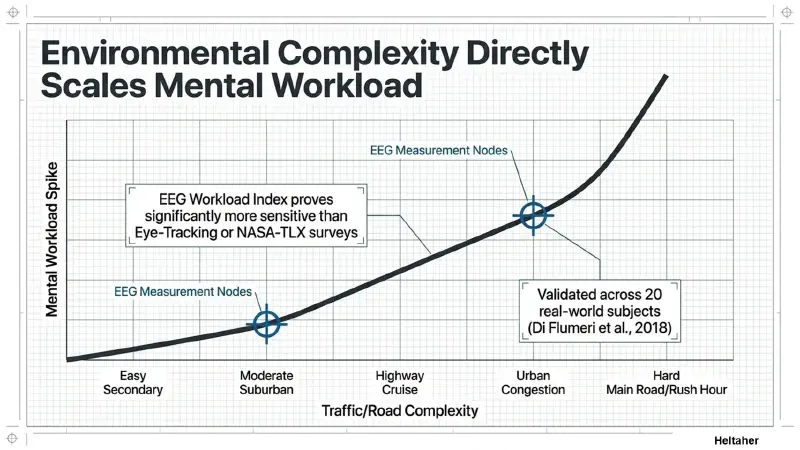
In a seminal study involving 20 subjects navigating real-world environments, researchers utilized an EEG-based Workload Index to detect changes in cognitive demand in real-time. The results provided a continuous, high-resolution narrative of the driver’s mental effort. The study compared "Hard" main roads with "Easy" secondary roads and contrasted normal driving hours with the high-intensity friction of rush hour. The findings were stark: traffic intensity and road complexity did not just subtly influence the driver; they caused objective, measurable spikes in cognitive demand.
Crucially, the EEG-based index was found to be significantly more sensitive than traditional eye-tracking (ET) data or subjective questionnaires. While an eye-tracker might show a driver looking at the road, the EEG reveals whether their brain is actually processing the information or if it is drowning in a "stochastic fog." This sensitivity is vital for engineers. If a dashboard interface increases mental workload by even a few percentage points during a high-complexity scenario, it could be the difference between a successful intervention and a catastrophic failure.
The heart of the matter: Stress and HRV#
While the brain provides the data on workload, the heart offers a window into the driver's psychological stress. Heart Rate Variability (HRV)—the millisecond-by-millisecond variation in the time between consecutive heartbeats—has emerged as a primary indicator of psychological load. It is the signature of the autonomic nervous system’s struggle to maintain equilibrium under pressure.
This metric has been particularly revealing in the study of Driver Fatigue Monitor Systems (DFMS). These systems, which use AI to scan the driver for signs of drowsiness, present a classic "fatigue paradox": the technology designed to ensure safety can itself become a significant stressor. Research into carsharing vehicles has shown that the mere presence and configuration of a DFMS can alter a driver’s HRV. For instance, a camera integrated directly into the steering wheel was found to induce a higher psychological load than one mounted independently. The steering wheel camera feels like a panopticon, an intrusive mechanical eye that the driver cannot escape.
The nature of the feedback also dictates the autonomic response. Voice-based warning prompts were found to be significantly less stressful than simple, ambiguous icons. A voice provides clarity and a sense of human-like partnership, whereas a flashing icon is a cold, demanding signal that can heighten a driver's sense of alarm without providing a clear path to resolution. This suggests that the future of human-machine interaction (HMI) must be tuned to the frequencies of human empathy, rather than just technical efficiency.
Facial expressions and emotional cartography#
Driving is a visceral, emotional experience, and yet for decades, the industry treated it as a purely task-oriented activity. To map this emotional territory, researchers now employ Facial-Expression Analysis (FEA). This involves using computer vision to classify subtle facial muscle movements into distinct emotional states such as joy, anger, surprise, or disgust.
A study of 21 drivers on a real-world circuit demonstrated that the road itself is an emotional architect. Major roads, characterized by high traffic density and often deteriorating conditions, elicited the highest frequency of emotional expressions—a surge of 11.15 percent above the average. These were predominantly expressions of disgust and anger, directed at both the environment and other road users. Rural roads, with their narrow lanes and sudden curves, increased expressions by 4.88 percent, primarily driven by surprise at limited visibility.
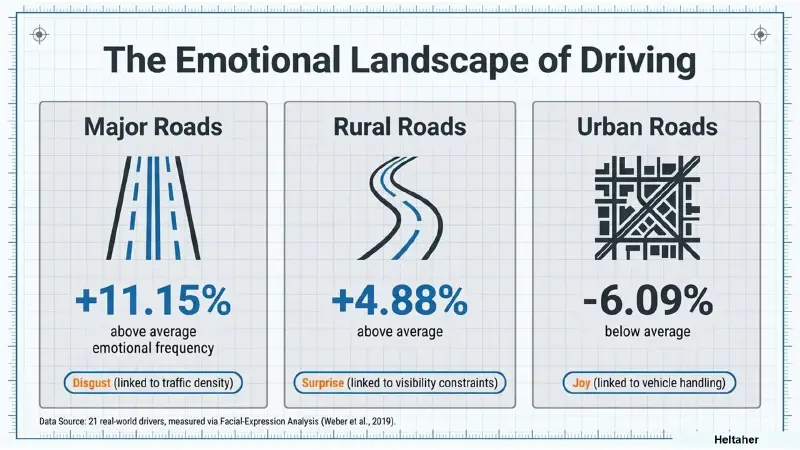
Urban roads, conversely, saw a 6.09 percent decrease in emotional expression, though they were frequently the site of "joy." Interestingly, this joy was often attributed not to the traffic but to the novelty of the test vehicle itself—a reminder that for many, the car remains an aspirational object. Perhaps most critically, the research identified the navigation device as a primary trigger for negative emotions across all environments. The friction between a driver's intuition and a device's cold, often delayed instructions remains a significant source of systemic stress.
Perception, comprehension, and projection#
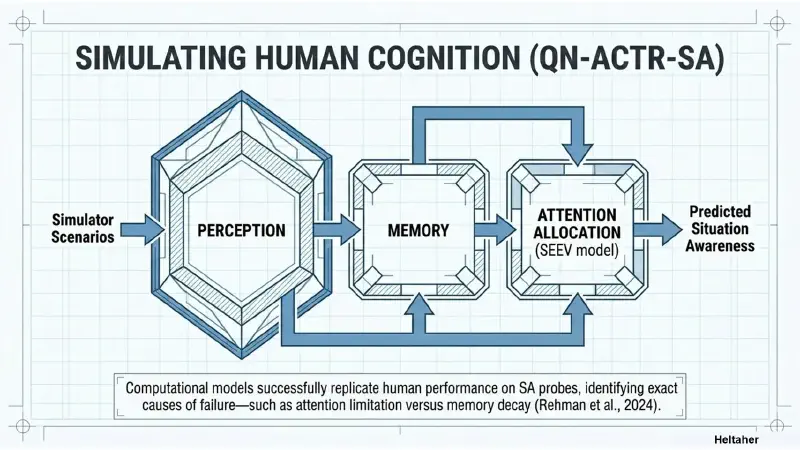
At the heart of the driving task lies Situation Awareness (SA). This is not a monolith but a three-tiered hierarchy: Level 1 is the perception of elements in the environment; Level 2 is the comprehension of their meaning; and Level 3 is the projection of their future status. When a driver fails to brake for a pedestrian, the failure is rarely a lack of physical strength; it is a collapse at one of these levels of awareness.
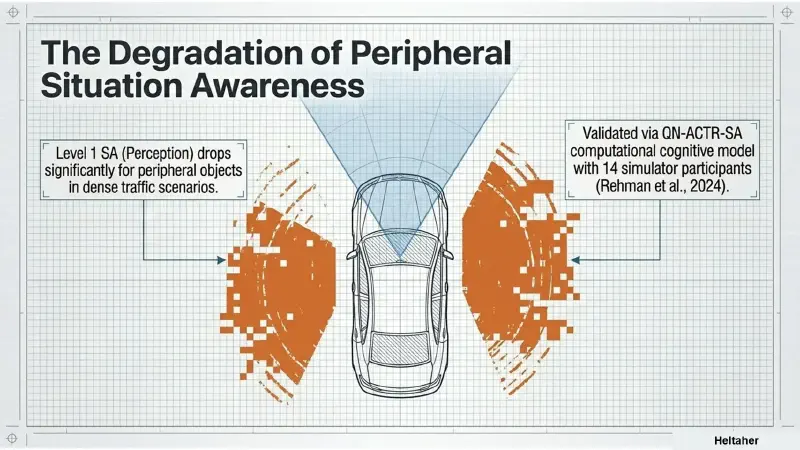
To study this, researchers have turned to computational cognitive architectures like the QN-ACTR-SA. This model integrates memory, perception, and attention allocation—specifically using the SEEV (Salience, Effort, Expectancy, Value) model to simulate where a driver looks and why. In simulator trials with 14 participants, the QN-ACTR-SA validated that SA degrades rapidly as traffic density and the number of road signs increase.
The most striking finding was the "tunneling" of awareness. Under high cognitive load, Level 1 SA—the basic perception of objects—suffered significantly in the driver's peripheral view. The human mind, overwhelmed by a flood of information from the front, essentially shuts down its lateral surveillance. We do not see what we do not expect to see, and when the environment becomes too loud, our "ghost" retreats to a narrow, forward-looking sliver of reality, leaving us vulnerable to the very hazards that a systems approach aims to mitigate.
Cognitive bottlenecks#
This degradation is the inevitable result of inherent cognitive bottlenecks. Foundational traffic psychology tells us that attention, memory, and spatial reasoning are not infinite wells but finite resources. Driving is an exercise in dual-task interference. When a driver engages in a conversation—even hands-free—they are competing for the same neural real-time required to estimate time-to-collision or navigate a complex junction.
The research emphasizes that human performance is limited by the "bandwidth" of these core functions. We can manage a certain amount of stochastic noise, but once a threshold is crossed, the system does not fail gracefully; it collapses. This is why the "road devil" era was so misguided. A driver does not crash because they are a bad person; they crash because their cognitive architecture reached its physical limit. The machine of the future must be designed to recognize when this bottleneck is forming and offload the cognitive burden before the human pilot is overwhelmed.
Kansei and the calculus of style#
The new science of the driver is not confined to the mechanics of safety; it has invaded the subjective world of aesthetics. Traditionally, the styling of a vehicle was a matter of artistic intuition, the "divine spark" of a designer in a Turin studio. Today, desire is being subjected to the rigor of the Analytic Hierarchy Process (AHP) and Kansei Engineering.
Kansei, a Japanese term for the psychological feeling or image a consumer has regarding a product, is used to translate vague emotions into mathematical weights. By using a filtered perceptual vocabulary—words like "futuristic," "elegant," and "robust"—designers can map these adjectives to specific physical features. This turns the "I know it when I see it" of automotive beauty into a precise calculus. It allows manufacturers to engineer an emotional response, ensuring that the curve of a fender or the texture of a dashboard is not just an artistic choice, but a calculated attempt to trigger a specific "Kansei" in the observer.
The anatomy of an electric vehicle#
Nowhere is this calculus more evident than in the burgeoning market for Chinese electric vehicles (EVs). A study of mainstream brands used the fusion of AHP and Kansei Engineering to deconstruct the factors that drive user impressions. The research revealed a fascinating hierarchy of influence that speaks to the pragmatism of the modern EV consumer.
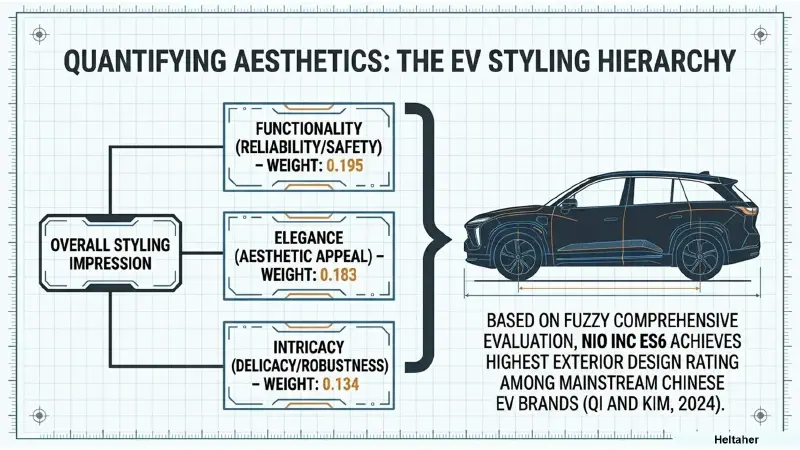
Even in a market ostensibly driven by "vague user feelings," functionality remains the ultimate arbiter. The top three influential factors were identified as: Functionality (reliability and safety) with a weight of 0.195; Elegance of Design with a weight of 0.183; and Intricacy of Structure with a weight of 0.134. This suggests that while consumers may be drawn to the "elegance" of an EV, their ultimate impression is rooted in the perceived reliability of the machine. The study utilized a fuzzy comprehensive evaluation to rate various models, finding that the Nio ES6 possessed the most successful exterior design among the brands tested. By quantifying these weights, manufacturers can move beyond stylistic guesswork and allocate resources to the design elements that yield the highest emotional return on investment.
Forecasting beyond the spreadsheet#
The predictive power of this data-driven approach is also transforming the business of the automotive industry. For decades, manufacturers relied on broad macroeconomic indicators—GDP growth, oil prices, interest rates—to forecast demand. However, these models are notoriously blunt instruments, unable to account for the volatile shifts of a modern market.
A new approach, utilizing the Stack Ensemble model, is proving far more adept. By combining multiple machine-learning learners—including Random Forests, Neural Networks, and SGD—into a single predictive engine, researchers have achieved an R-squared value of 0.901. This represents a significant leap in precision over traditional linear regression. This model does not just look at the world; it looks at the internal operations of the firm. It understands that a company's future is written in the data it generates today.
Hybrid data and the bullwhip effect#
The true power of these ensemble models lies in their use of hybrid data. They blend exogenous macroeconomic factors, such as the CSI house price index and the KOSPI stock index, with endogenous, firm-level operational data. The research indicates that test drive volume, wholesale numbers to dealers, and "stock months" are among the most potent predictors of future demand.
The precision of this forecasting is remarkable. The Stack Ensemble model achieved a mean absolute error (MAE) of just 76.6 units on an average monthly sales volume of 714 units. For a manufacturer, this level of accuracy is the only known antidote to the "bullwhip effect." In a global supply chain, a small fluctuation in consumer demand can be amplified as it moves upstream, leading to massive, costly volatility in production and inventory. By predicting demand with an R-squared of over 0.90, automakers can stabilize their supply chains, optimize their capital efficiency, and avoid the ruinous costs of overproduction.
From virtual prototypes to virtual showrooms#
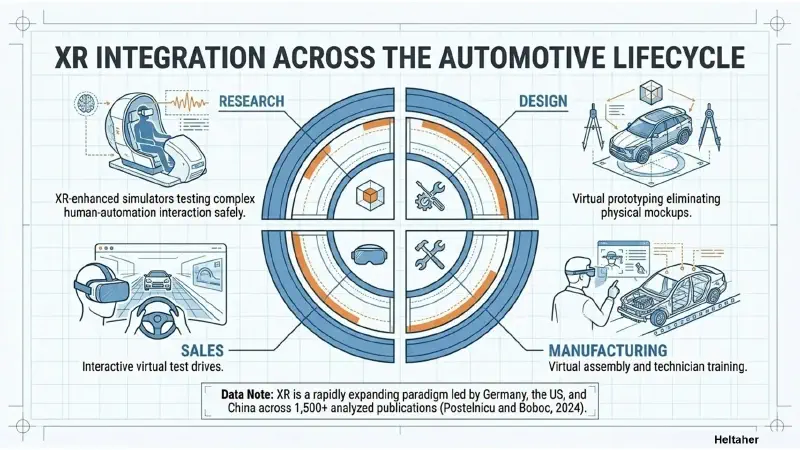
The rise of Extended Reality (XR)—an umbrella term for virtual, augmented, and mixed reality—is perhaps the most visible manifestation of this technological shift. XR is no longer a gimmick for video games; it has become an essential tool across the entire automotive lifecycle. In the design phase, it allows for the creation of virtual prototypes that can be reviewed and refined without the need for expensive physical clay models.
In manufacturing, XR is being used for virtual assembly training. Technicians can master the intricate steps of building a high-voltage battery system in a digital environment before they ever touch a physical component. This reduces errors, improves safety, and accelerates the time it takes to bring a new model to market. Even the sales experience is being transformed. Virtual test drives and interactive explorations allow customers to "experience" a vehicle in ways that a traditional showroom cannot match, offering a personalized, low-pressure path to purchase.
The simulator as a safety net#
Beyond the showroom, XR-enhanced driving simulators have become the primary safety net for human-machine interaction research. They allow scientists to study driver behavior in high-stakes scenarios—such as a sudden sensor failure or a black-ice skid—without the ethical or physical risks of a real-world crash.
These simulators are particularly vital for navigating the "uncanny valley" of autonomous driving. By simulating the hand-over process between the computer and the human, researchers can identify the cognitive lapses that occur when a driver is asked to re-engage with the vehicle after a period of passive observation. The simulator is where the industry tests the limits of trust, determining how much information a driver needs to feel safe without being distracted by a flood of irrelevant data.
The intrusive assistant: The future of HMI#
As vehicles become more intelligent, the relationship between the driver and the machine becomes increasingly fraught. The development of Driver Fatigue Monitor Systems (DFMS) is a prime example of this tension. These systems use AI-powered cameras to monitor the driver’s face for signs of exhaustion, but they must do so without becoming a source of the very fatigue they are meant to prevent.
As noted, the placement of the camera is a crucial determinant of psychological load. A camera integrated into the steering wheel can feel like an intrusive, judgmental eye, whereas an independently mounted camera is perceived as a helpful assistant. Similarly, the method of intervention matters. A simple icon is often ignored or misunderstood, while a voice prompt—the most effective configuration—provides a clear, human-centric guidance that minimizes stress. The challenge for future HMI design is to be helpful without being "creepy," maintaining a presence that is authoritative yet unobtrusive.
Trust and the transition to autonomy#
The ultimate frontier for the science of the driver is the transition to fully autonomous vehicles. This is not merely a technical hurdle for sensors and lidar; it is a psychological hurdle of trust and situation awareness. Interfaces must be designed to keep the driver "in the loop" even when the vehicle is doing the steering.
Researchers have even used Support Vector Machine (SVM) algorithms to classify which system configuration a driver is observing based solely on their physiological response—their HRV and eye movements—with an accuracy of 86.957 percent. This means the machine can now "read" the driver's level of stress and engagement with nearly 87 percent precision. This level of insight is essential for building trust. If a car knows you are stressed by its behavior, it can adjust its driving style or provide more reassuring feedback. The goal is a seamless interaction where the human and the machine are so well-attuned that the transition of control is invisible.
The humbler machine#
The overarching trend in automotive research is clear: the industry is no longer just building machines for transport. It is constructing sophisticated, empathetic systems that monitor, predict, and accommodate the human condition. The old image of the driver as a "road devil" to be disciplined has been replaced by a view of the driver as a biological system with fixed limits and predictable emotional patterns.
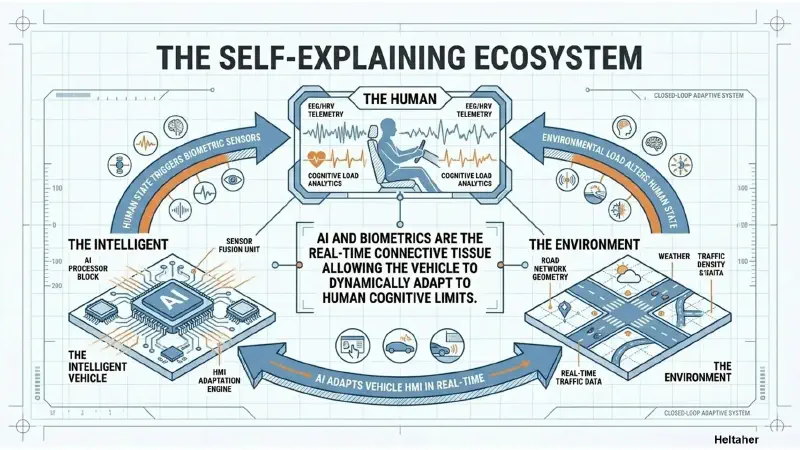
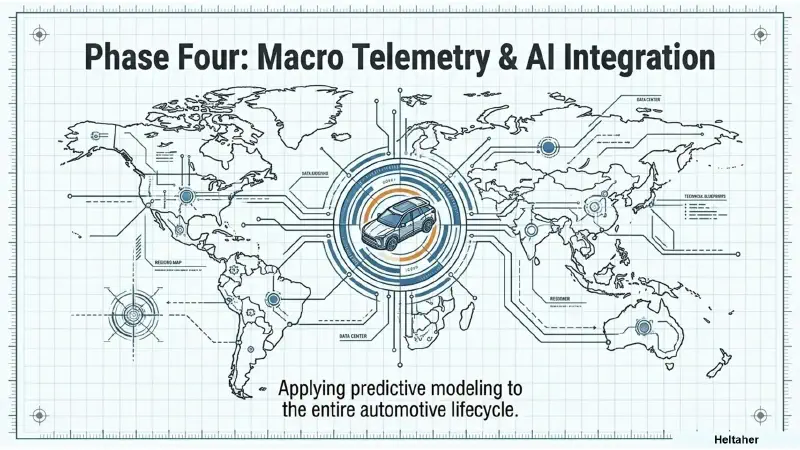
By using neuroscience to quantify workload, AI to forecast demand, and XR to test interactions, the industry is moving toward a humbler machine—one that recognizes its operator's limitations and works proactively to mitigate them. The ultimate goal is a world where the road and the vehicle are so perfectly adapted to the human that the technology and the human factors are indistinguishable. We are building a "self-explaining" future where the ghost and the machine finally speak the same language.
References#
- Di Flumeri, G., Borghini, G., Aricò, P., Sciaraffa, N., Lanzi, P., Pozzi, S., ... & Babiloni, F. (2018). EEG-based indicators for the assessment and monitoring of driver's cognitive workload in real-world environments. IEEE Transactions on Biomedical Engineering, 65(10), 2311-2320.
- Groeger, J. A., & Rothengatter, J. A. (1998). Traffic psychology and behavior. Transportation Research Part F: Traffic Psychology and Behaviour, 1(1), 1-9.
- Hagenzieker, M. P., Commandeur, J. J., & Bijleveld, F. D. (2014). A text-mining and bibliometric analysis of the road safety research literature (1900–2010). Accident Analysis & Prevention, 72, 146-154.
- Kim, H. (2023). A firm-level automobile demand forecasting model using a stack ensemble of machine learning learners. Journal of Open Innovation: Technology, Market, and Complexity, 9(1), 100021.
- Postelnicu, C. C., & Boboc, R. G. (2024). Extended reality in the automotive industry: A bibliometric analysis and systematic review. IEEE Access, 12, 15432-15451.
- Qi, J., & Kim, J. H. (2024). Evaluation of electric vehicle styling based on AHP and Kansei engineering. Machines, 12(2), 118.
- Rehman, U., Cao, S., & Li, Y. (2024). Modeling driver situation awareness using a computational cognitive architecture (QN-ACTR-SA). Human Factors, 66(4), 982-1001.
- Weber, F., Chmielewski, J., & Gießelmann, J. (2019). Analyzing driver emotions through facial expression in real-world driving. IEEE Intelligent Transportation Systems Magazine, 11(3), 133-144.
- Yang, Y., Zhang, X., & Wang, J. (2024). Impact of driver fatigue monitor system design on psychological load: A heart rate variability and eye-tracking study. Applied Ergonomics, 115, 104165.