
The two oil crises of the 1970s represent the most consequential sequence of external shocks in the history of the automobile. Before October 1973, the global oil order had been defined by stable, low, and declining real prices. Between 1961 and 1970, the average price of a barrel of crude oil was $1.80. The Organisation of Petroleum Exporting Countries, founded in 1960, was largely ignored by the consuming nations. The "Seven Sisters" — the Anglo-American oil majors — effectively administered the global supply. Cheap energy was treated as a permanent feature of the economic landscape, and vehicle design across the developed world reflected that assumption.
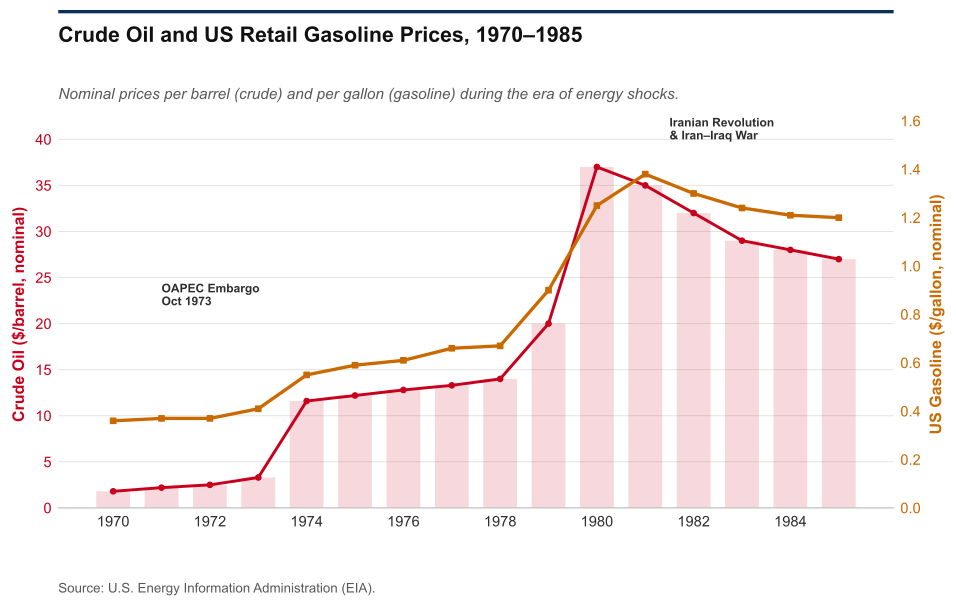
On 6 October 1973, Egypt and Syria launched a surprise attack on Israel — the Yom Kippur War. On 17 October, the Organisation of Arab Petroleum Exporting Countries (OAPEC) announced a total oil embargo targeting the United States, the Netherlands, and other nations perceived to support Israel. Simultaneously, OPEC members agreed to cut production. The result was the largest deliberate supply disruption in modern history. Crude oil prices nearly quadrupled: from $2.90 per barrel before the embargo to $11.65 in January 1974. By the end of the embargo in March 1974, the global price had settled at roughly $12 per barrel — a 300% increase in under six months.
The mechanism was not a geological shortage. Global production fell by only about 5%. What changed was the pricing power of the producing states. The embargo demonstrated that the consuming nations' entire infrastructure of mobility — their highways, their suburbs, their just-in-case inventory models — rested on a foundation of energy prices that could be rewritten by political decisions taken in Riyadh, Tehran, and Baghdad.
A second shock followed six years later, and it confirmed that the first had been no aberration. The Iranian Revolution of 1978–79 removed the Shah's regime and, with it, roughly 4.5 million barrels per day of Iranian production. A strike by 37,000 oil workers in November 1978 reduced output from 6 million barrels per day to about 1.5 million. Although the global supply disruption was proportionally smaller than in 1973 — roughly 4% of world output — the panic buying and speculative hoarding that followed drove crude to $39.50 per barrel by April 1980, more than doubling in 12 months. The Iran–Iraq War, which began in September 1980, compounded the disruption by removing both belligerents' production from the market.
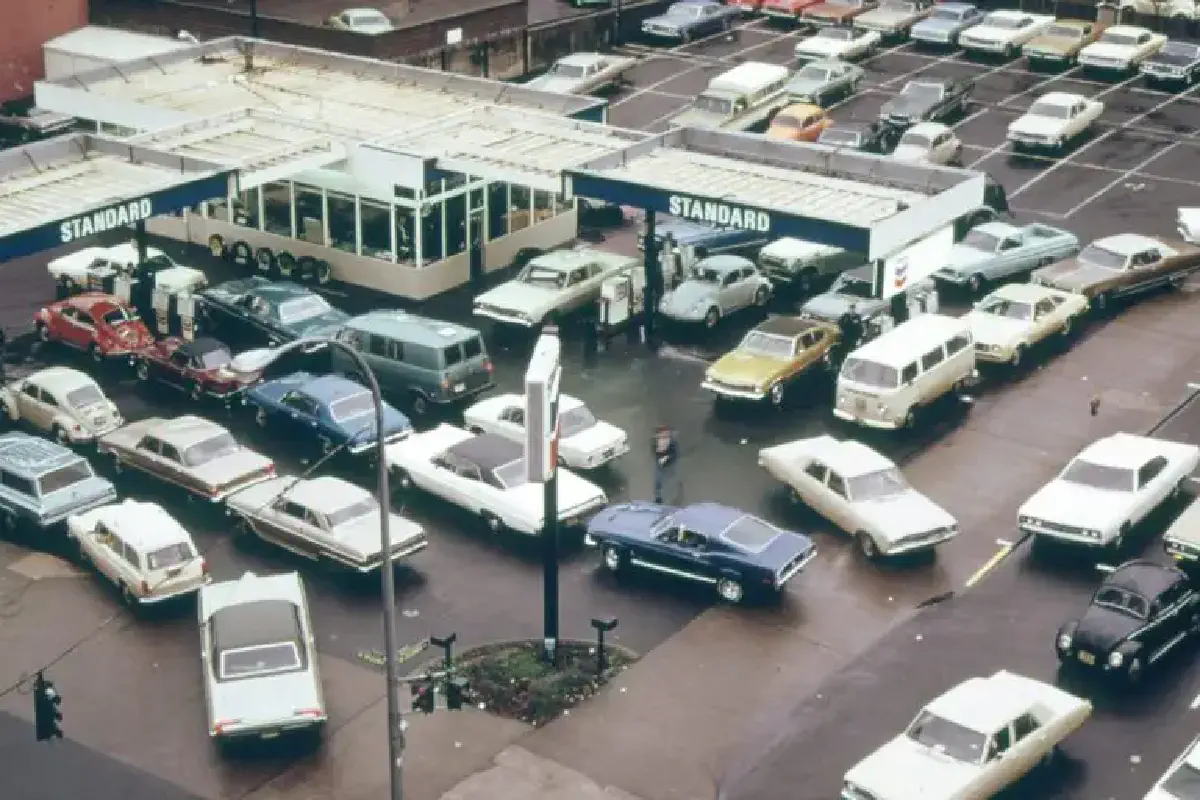
The effect on the American consumer was direct and visceral. The average retail price of a gallon of gasoline rose from $0.41 in 1973 to $0.55 in 1974, then to $0.90 in 1979 and $1.25 in 1980. Adjusted for inflation, the 1980 price of $1.25 equates to roughly $4.51 in 2023 dollars — comparable to the 2022 peak that triggered a global inflation crisis. Motorists faced rationing schemes, long queues at filling stations, and — for the first time since 1945 — a genuine sense of energy vulnerability.
These price signals triggered a cascade of second-order effects through the automotive system. The most immediate was a collapse in demand for the full-size, body-on-frame, V8-powered sedans that constituted the core of the American industry's product portfolio and profit structure. Between 1973 and 1974, Chrysler's auto production fell by 26%. GM's 1973 passenger-car fleet delivered an average fuel economy of approximately 12 mpg — a figure that became a market liability almost overnight. Consumers who had previously valued size, comfort, and acceleration above all else suddenly prioritised fuel efficiency. The shift was not marginal; it was existential.
In Europe, the first oil shock exposed the fragility of Britain's already-ailing motor industry. British Leyland, which in 1968 had held 40% of the UK car market, saw import penetration surge from 14.3% in 1970 to 27.4% in 1973 and 33.2% by 1975. The company, which employed 170,000 people at its peak, was partly nationalised in 1975 following the Ryder Report, which recommended £1,264 million in capital expenditure — effectively acknowledging that BL's entire model range and manufacturing base were unsuited to the new energy reality.
The critical insight, however, is not that oil prices rose. It is that they rose asymmetrically: they exposed which industrial systems could adapt and which could not. Japan's automotive sector absorbed the shocks not merely through lucky timing — although the 1973 arrival of the Honda Civic CVCC, capable of 40 mpg, was fortuitous — but through a production system that had been forged in resource scarcity. Toyota's just-in-time manufacturing, developed in the capital-starved postwar years, meant lower inventory costs and faster model-change capability when demand shifted suddenly. Japan's vehicle exports grew from 1.09 million units in 1970 to 2.0 million in 1973 and 5.97 million by 1980, when Japan surpassed the United States as the world's largest vehicle producer. The export ratio hit 54% that year.
The oil shocks thus functioned as a selection mechanism in the evolutionary sense. They did not create new industrial capabilities; they changed the fitness landscape so that capabilities that had been neutral or even disadvantageous — small-displacement engines, lightweight platforms, efficient supply chains — became decisive competitive advantages. The system had been reset. The question was which players would adapt and which would be selected out.