
The Big Three's pre-embargo business model rested on three interlocking assumptions, each of which the oil shocks invalidated in sequence.
Assumption 1: cheap and stable fuel prices. This was the foundation. As long as gasoline hovered around $0.36 per gallon (1970–72 levels), the marginal cost of driving a 4,500-pound, 12-mpg sedan was tolerable for the median American household. The vehicle itself was a durable good; the fuel to run it was an afterthought in household budgeting. The 1973 shock turned the afterthought into a central expenditure. When gasoline hit $0.55 in 1974, a motorist driving 12,000 miles per year in a 12-mpg car saw their annual fuel bill rise from approximately $360 to $550 — a 53% increase in a single year. By 1980, at $1.25 per gallon and with the same vehicle, the bill reached $1,250 — more than triple the 1973 level.
Assumption 2: predictable product cycles. American automakers operated on product-development timelines of four to six years. The full-size cars sold in October 1973 had been designed in the late 1960s, when fuel economy was not a design constraint. The engineering lead time meant that Detroit could not respond to the oil shock with new products for at least three to four years. The first genuinely downsized American cars — GM's B- and C-body full-size models — did not arrive until the 1977 model year, nearly four years after the embargo. When they did arrive, they were 12 inches shorter and 750–800 pounds lighter than their predecessors. But by then, Japanese competitors had already occupied the small-car segment that Detroit had never taken seriously.
The stopgap products rushed to market told their own story. The AMC Gremlin (April 1970), Ford Pinto (September 1970), and Chevrolet Vega (1971) were America's first subcompact cars — developed partly in response to the growing import threat and partly in anticipation of tightening emissions standards. Lee Iacocca famously mandated that the Pinto weigh under 2,000 pounds and cost less than $2,000. But these vehicles were designed by an industry that had spent decades optimising for size and power, not for smallness and efficiency. The Pinto's fuel-tank design flaw — which led to fatal fires in rear-end collisions and became the subject of the landmark Grimshaw v. Ford Motor Company lawsuit — came to symbolise an engineering culture that treated small cars as an unwelcome distraction rather than a core competency.
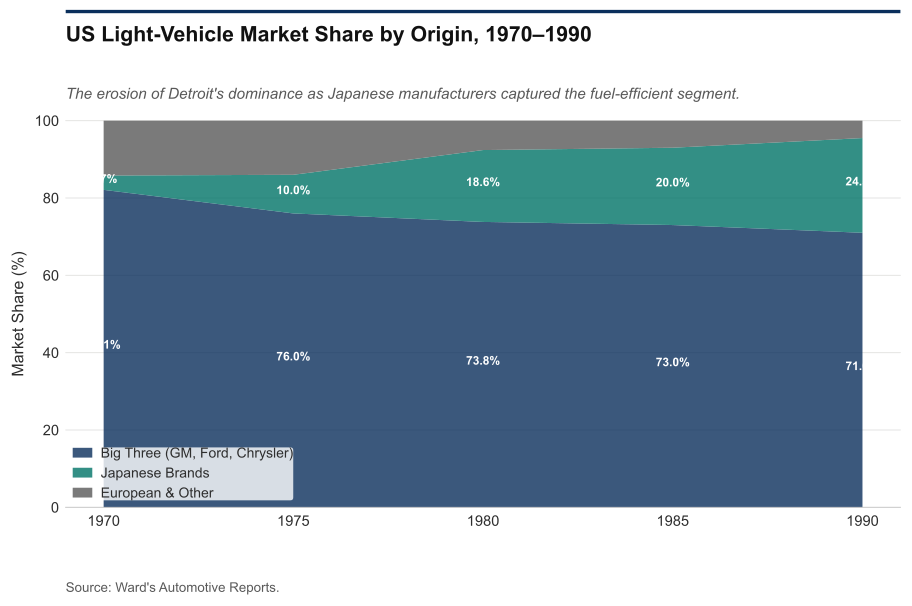
Assumption 3: captive domestic demand. In 1970, imports held just 15% of the US market, and Japanese brands collectively accounted for only 3.7%. The Big Three treated import competition as a niche phenomenon — Volkswagens for college professors, Toyotas for eccentrics. The oil shocks transformed the import proposition from a lifestyle choice into an economic calculation. By 1975, Toyota had overtaken Volkswagen as the top vehicle importer in the United States, selling 283,909 units — a 19.2% increase over 1974 — while Volkswagen's sales fell by 20%. Datsun (Nissan) sales rose 39.2% to 263,192 units. Honda, which had sold just 43,119 cars in the US in 1974, rocketed to 102,389 in 1975 — a 137.5% increase. By 1981, Japanese brands held 18.6% of the American market, a fivefold increase in barely a decade.
The financial consequences were devastating. Chrysler, always the weakest of the Big Three, lost $52 million in 1974 and a record $259.5 million in 1975. A brief recovery in 1976–77 — profits of $422.6 million and $163.2 million respectively — proved illusory. When the second oil shock hit, Chrysler was again holding a product line biased toward large cars and a dealer network starved of competitive small vehicles. By 1978, the company was back in the red with a $204.6 million loss. In 1979, Chrysler reported an annual loss of $1.1 billion, owed $4.75 billion to more than 400 banks and insurance companies, and held just 9.3% of the US market — down from 16.3% in 1968.
The employment consequences radiated far beyond the corporate balance sheets. Between 1979 and 1981, the Detroit metropolitan area lost over 90,000 auto-manufacturing jobs. At the peak of the 1980 downturn, indefinite layoffs in the US auto industry reached 262,074 workers — 36% of the industry's total workforce. The United Auto Workers, which had peaked at over 1.5 million members in 1979, would see its membership erode steadily for the next three decades.
General Motors, despite its greater financial resources, faced the same structural problem: a product portfolio mismatched to the new energy environment. GM's market share actually rose from 38.9% in 1970 to 44.2% in 1980 — not because GM was thriving, but because it was absorbing the customers fleeing Chrysler and, to a lesser extent, Ford. But the concentration of share masked deteriorating profitability and a chronic inability to compete with Japanese manufacturers on small-car quality and cost.
The deeper system failure was one of organisational logic. The Big Three were vertically integrated in an era when vertical integration meant rigidity. They owned their parts suppliers, their tooling operations, their steel mills. When demand shifted from large cars to small ones, the entire integrated apparatus had to be reconfigured — a process that took years and billions of dollars. Between 1980 and the mid-1980s, the Big Three would spend $42.8 billion retooling assembly lines and boosting productivity through computerised design and robotics. The investment was necessary but did not address the underlying problem: the American production system was optimised for a world that had ceased to exist.
In the UK, the parallel story was even bleaker. British Leyland, a conglomerate formed in 1968 from the merger of Leyland Motors and British Motor Holdings, held 40% of the UK market at its formation. By 1975, its share had fallen to 30%; by 1982, to a catastrophic 13.4%. Import penetration of the UK car market, which had been 14.3% in 1970, reached 33.2% in 1975 and 56.7% by 1980 — meaning that, for the first time in British history, the majority of new cars sold were foreign-made. The Ryder Report's 1975 recommendation of £1,264 million in government capital expenditure effectively acknowledged that BL was too large to fail but too dysfunctional to compete.
The oil shocks, in short, performed a stress test on the world's two largest automotive industries — the American and the British — and both failed. The failure was not one of engineering capability but of system design. Both industries had evolved in an environment of cheap, abundant energy and protected domestic markets. When those conditions were withdrawn, the institutional rigidities that had once been strengths — vertical integration, long product cycles, labour contracts that assumed permanent growth — became liabilities. The Japanese system, by contrast, had evolved under conditions of scarcity. It was built for the world that the oil shocks created, not the one they destroyed.