
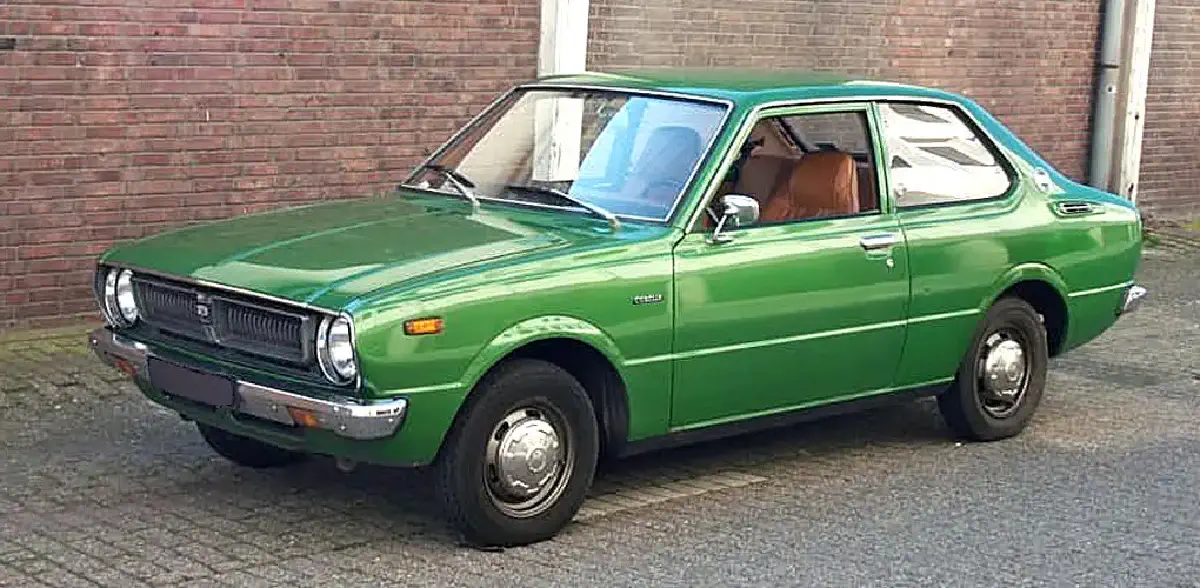
The conventional narrative of Japan's automotive rise in the 1970s attributes success to the right products at the right time: small, fuel-efficient cars that American and European consumers suddenly wanted. This is true as far as it goes. The Honda Civic CVCC, introduced in 1973, achieved roughly 40 mpg at a moment when the typical American car managed 12–14 mpg. Toyota's Corolla and Datsun's (Nissan's) B210 offered similar efficiency at competitive prices. But this product-centric explanation obscures a deeper truth: Japan's competitive advantage was not primarily in vehicle design but in production-system architecture.
The Toyota Production System (TPS) was built on two pillars: just-in-time (JIT) inventory management and jidoka — automation with a human touch, or the practice of stopping production immediately when a defect was detected. JIT was inspired, according to Toyota's own account, by the American supermarket: shelves restocked only when goods were taken, minimising warehousing costs. Applied to automobile manufacturing, this meant that components arrived at the assembly line not in bulk stockpiles but precisely when needed. The financial consequence was profound: Toyota carried dramatically less inventory than its American competitors, which meant less capital tied up in work-in-progress and greater flexibility to shift production mix in response to market signals.
The contrast with Detroit was stark. American automakers operated on a "push" production model: factories ran at constant speed to amortise high fixed costs, producing vehicles that were then "pushed" onto dealer lots through incentive programmes. When the 1973 oil shock caused demand for large cars to collapse, Detroit's dealer lots were filled with unsellable inventory. Toyota, by contrast, could adjust production mix relatively quickly because its supply chain and assembly system were designed for flexibility rather than volume optimisation.
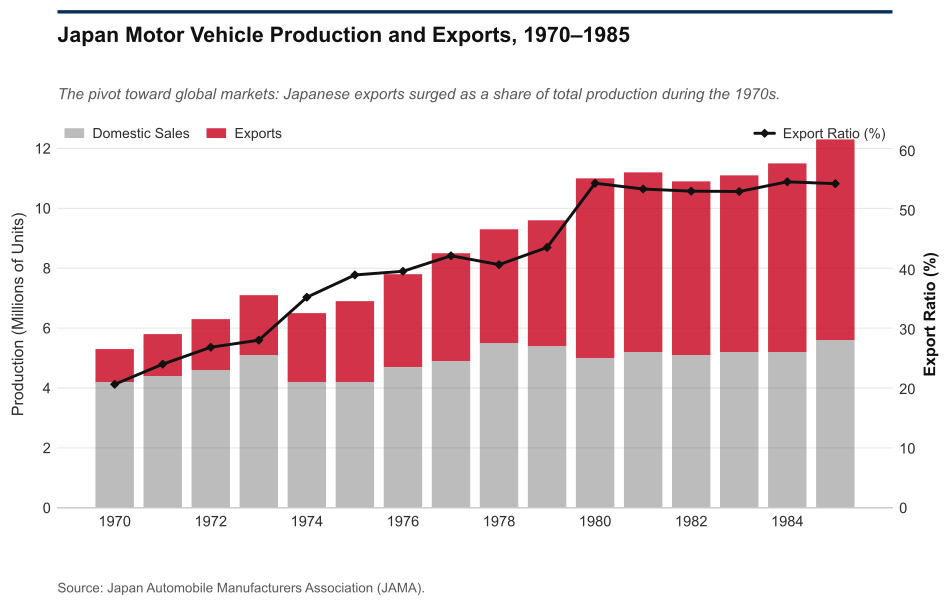
The quantitative results were unambiguous. Japan's total vehicle production rose from approximately 5.3 million units in 1970 to 7.1 million in 1973 and 11.04 million by 1980, when Japan surpassed the United States as the world's largest vehicle-producing nation. Exports grew even faster: from 1.09 million in 1970 to 2.0 million in 1973 to 5.97 million in 1980. The export ratio — the share of Japanese production sold overseas — reached a record 54% in 1980. Japanese manufacturers were no longer merely exporting cars; they were exporting an entire industrial logic.
The Japanese system also benefited from what might be called "latecomer advantage" in technology adoption. Japanese automakers embraced front-wheel drive (FWD) earlier and more comprehensively than their American competitors. The 1974 Volkswagen Golf (sold in North America as the Rabbit from 1975) had demonstrated that a FWD, water-cooled, transverse-engine layout could deliver superior packaging efficiency and fuel economy. Japanese manufacturers rapidly adopted this architecture. By the mid-1980s, most formerly rear-wheel-drive Japanese models had switched to front-wheel drive, while American manufacturers were only beginning their transition — the Chevrolet Citation (1979) and Ford Taurus (1986) being the landmark domestic FWD models. Chrysler did not go 100% front-wheel drive until 1990; GM's American car production followed by 1997.
The deeper structural advantage, however, was in supplier relations. The Japanese keiretsu system — networks of interlocking suppliers, often with cross-shareholdings and long-term relationships — enabled collaborative cost reduction and quality improvement that the adversarial, lowest-bidder procurement practices of American manufacturers could not replicate. When fuel economy became a market imperative, Japanese automakers could work with their supplier networks to reduce vehicle weight, improve engine efficiency, and integrate new technologies faster than their vertically integrated American competitors, who were often locked into internal supply arrangements with captive parts divisions.
Quality was the third dimension of advantage. The combination of jidoka (defect detection at source), kaizen (continuous incremental improvement), and long-term supplier partnerships produced vehicles with measurably fewer defects than their American counterparts. This quality differential — initially dismissed by Detroit as a temporary anomaly — compounded over time. A vehicle that was both more fuel-efficient and more reliable offered a value proposition that American manufacturers, with their legacy cost structures and adversarial labour relations, could not match at equivalent price points.
The macroeconomic environment reinforced Japan's advantage. The yen, held at a fixed rate of ¥360 to the dollar until the Smithsonian Agreement of 1971 and then allowed to float at levels that remained competitive through the 1970s, effectively subsidised Japanese exports. It was not until the Plaza Accord of 1985 — deliberately engineered by the G5 nations to weaken the dollar — that the yen appreciated sharply and began to erode the export cost advantage. By then, however, Japanese manufacturers had already begun establishing transplant production facilities in the United States, converting a trade-based competitive advantage into a structural industrial presence.
The voluntary export restraint (VER) agreement of 1981 — which capped Japanese car exports to the US at 1.68 million units per year, down from 1.82 million in 1980 — paradoxically strengthened the Japanese position. By limiting volume, the VER encouraged Japanese manufacturers to shift their product mix toward higher-margin, higher-content vehicles. It also accelerated the decision to build American factories — Honda's Marysville, Ohio, plant opened in 1982, followed by Toyota's NUMMI joint venture with GM in Fremont, California, in 1984. The VER was intended to protect Detroit; its primary long-term effect was to transform Japanese automakers from exporters into domestic manufacturers with an American workforce and an American supply base.
The oil shocks, in this reading, were not the cause of Japan's competitive success. They were the event that revealed the pre-existing superiority of a production system that had been optimised for resource efficiency, quality, and flexibility. The Toyota Production System was an adaptation to postwar Japanese scarcity; the oil shocks made scarcity a global condition. Detroit had evolved in an environment of abundance. When abundance gave way to constraint, the fitness landscape inverted, and the system that had been built for the harder world prevailed.