
The policy responses to the oil shocks fell into three broad categories: regulatory mandates (exemplified by CAFE), financial rescues (Chrysler, British Leyland), and trade interventions (the voluntary export restraint). Each operated through different mechanisms, but all shared a common feature: they were enacted as emergency measures and became permanent features of the automotive landscape.
CAFE: the regulatory ratchet. The Energy Policy and Conservation Act of 1975 created CAFE standards for passenger cars beginning with model year 1978. The initial standard was 18 mpg, rising in annual increments to 27.5 mpg by 1985. Light trucks were regulated separately beginning in model year 1979, with substantially lower standards: 17.2 mpg initially, rising to just 19.5 mpg by 1985. The differential was not an oversight. Light trucks — pickups, vans, and the emerging category of sport-utility vehicles — were treated as commercial vehicles, used by farmers and tradesmen. At the time the CAFE rules were drafted, SUVs were scarce, the minivan had not been invented, and most pickups were indeed used for work.
This differential — the so-called "light-truck loophole" — became the most consequential unintended consequence in American automotive regulation. As car standards rose toward 27.5 mpg, the less stringent light-truck standards (which eventually stabilised at 20.7 mpg) created a powerful incentive for manufacturers to develop and market vehicles classified as light trucks. The minivan (Chrysler's Dodge Caravan and Plymouth Voyager, launched in 1983) and the sport-utility vehicle (Ford Explorer, 1990) were not merely consumer-driven phenomena; they were products of a regulatory architecture that made it cheaper and easier to meet fleet fuel-economy targets by selling vehicles in the light-truck category. The market share of SUVs, small trucks, and vans grew from less than 20% of new vehicles sold in 1975 to nearly half of all new vehicles sold by the early 2000s. The CAFE law, designed to reduce petroleum consumption, had inadvertently subsidised the rise of the vehicle category that consumed the most.
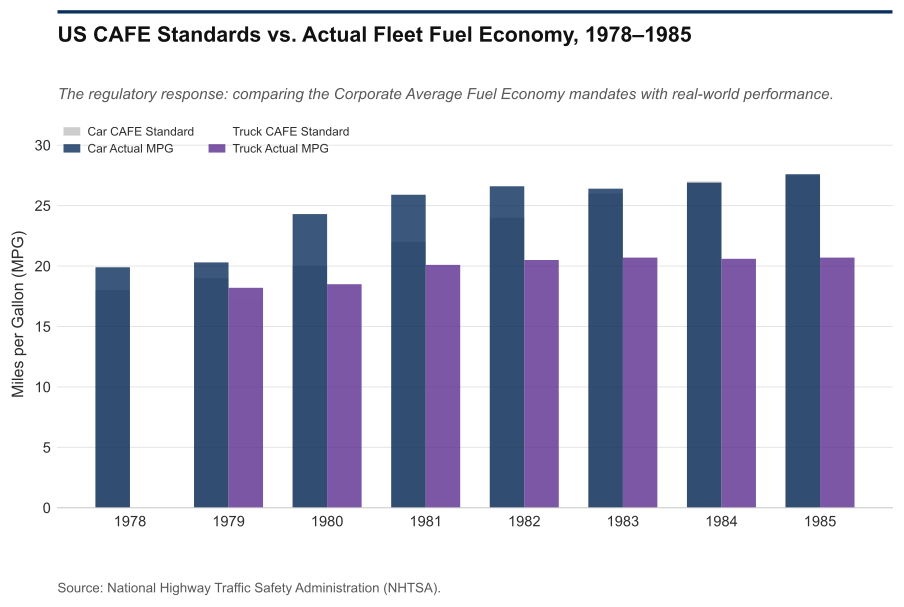
The data tell a story of compliance but also of strategic gaming. Passenger-car actual fuel economy improved dramatically, from 19.9 mpg in 1978 to 27.6 mpg in 1985 — slightly exceeding the 27.5 mpg standard. Light-truck actual fuel economy improved much more modestly, from 18.2 mpg in 1979 to 20.7 mpg in 1985. The overall fleet fuel economy improved significantly, but the improvement was driven overwhelmingly by changes in the passenger-car fleet, even as the composition of sales was shifting toward the less-regulated light-truck segment.
Chrysler: the bailout precedent. The Chrysler Corporation Loan Guarantee Act of 1979, signed by President Jimmy Carter on 21 December 1979, provided $1.5 billion in federal loan guarantees to prevent the company's bankruptcy. The political calculus was straightforward: Chrysler employed approximately 250,000 workers directly, and its collapse would eliminate an estimated 200,000 additional jobs among suppliers and dealers, concentrated in the already-deindustrialising Midwest. Lee Iacocca, who had become CEO after being fired from Ford, made the case to Congress in October 1979 that Chrysler's failure would cost the federal government far more in unemployment benefits, pension guarantees, and lost tax revenue than the loan guarantees would risk.
The bailout came with conditions that distinguished it from a simple handout. The loan guarantees required Chrysler to secure an additional $2 billion in commitments and concessions from stockholders, employees, dealers, suppliers, and state and local governments. The United Auto Workers agreed to wage concessions. Banks agreed to restructure debt. The federal government effectively acted as the coordinator of a multi-party negotiation, using the threat of bankruptcy to extract concessions from all stakeholders.
Chrysler survived. By 1983, it had repaid the guaranteed loans seven years early and was reporting record profits, driven in large part by the success of the minivan — a vehicle category that Chrysler had pioneered and that would dominate the American family-car market for two decades. But the bailout also had path-dependent consequences. By demonstrating that the federal government would intervene to prevent the collapse of a major automaker, it established a precedent that shaped expectations for decades. The 2008–09 bailouts of GM and Chrysler — far larger in scale — drew directly on the institutional memory of 1979.
British Leyland: nationalisation as life support. The Ryder Report, commissioned by the Labour government of Harold Wilson and delivered in March 1975, diagnosed British Leyland's condition with brutal clarity: decrepit machinery, a chaotic model range with immense overlap between marques, catastrophic industrial relations, and market share in freefall. The report recommended £1,264 million in capital expenditure over eight years, backed by £260 million in working capital — sums that reflected not a confidence in BL's viability but a calculation that allowing the company to collapse would put roughly one million people out of work across the supply chain.
The government became the majority shareholder. BL was restructured, rebranded, and recapitalised repeatedly over the following decade. None of it worked. The fundamental problem — a product range that was simultaneously too broad to be efficient and too narrow to be competitive, built with outdated tooling by a workforce engaged in perpetual industrial warfare — could not be solved by injections of public capital. By 1982, BL's UK market share had fallen to 13.4%. The company that had once dominated British motoring was now a permanent ward of the state, and would eventually be sold, in pieces, to foreign buyers: Jaguar to Ford (1989), Land Rover to BMW (1994) and later to Ford and then Tata, the remnants of the volume car business to BMW (1994) and then to a management buyout that became MG Rover, which collapsed in 2005.
The lesson of BL is not that state intervention fails. It is that state intervention cannot substitute for competitive product, efficient production, and cooperative labour relations. The oil shocks exposed BL's weaknesses; the Ryder response attempted to treat the symptoms (underinvestment) without addressing the disease (an industrial structure incompatible with the market conditions of the post-embargo world).
The VER: protectionism's paradox. In May 1981, under pressure from the Reagan administration, Japan agreed to limit passenger-car exports to the United States to 1.68 million units per year — a reduction from the 1.82 million exported in 1980. The voluntary export restraint was supposed to give Detroit breathing room to retool and recover. What it actually did was accelerate the Japanese strategy of moving production to the United States, upgrade the Japanese product mix toward higher-margin vehicles, and — by restricting supply — increase the prices that Japanese dealers could charge, thereby boosting Japanese manufacturer profits that could be reinvested in product development and American factory construction.
By 1990, just over one-third of Japanese-brand vehicles sold in the United States were produced domestically in North America. The VER had, in effect, incentivised the very outcome it was meant to prevent: the permanent establishment of Japanese manufacturing capacity on American soil, with American workers, serving American consumers, and — eventually — drawing on American supply chains. It was protectionism that accelerated the integration it was designed to slow.
The combined effect of these policy responses was to create a regulatory and competitive architecture that would define the global car industry for the next four decades. CAFE created the incentive structure that favoured light trucks over cars. The Chrysler bailout established the too-big-to-fail precedent. The Ryder nationalisation demonstrated the limits of state-led industrial rescue. The VER inadvertently accelerated the globalisation of Japanese production. None of these outcomes was foreseen by the policymakers who enacted them. All were logical consequences of the system-reset that the oil shocks had triggered.