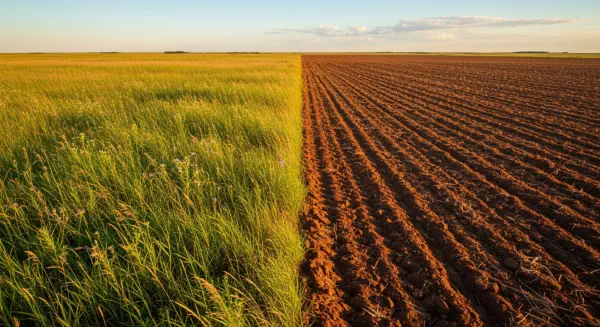
Topsoil is civilisation's most critical non-renewable resource — taking 200 to 1,000 years to form per centimetre and eroding at 10 to 100 times that rate under industrial agriculture. The Soil Capital Depletion Rate quantifies how fast we are spending this inheritance, and why the arithmetic threatens food security on a timescale that planning institutions consistently ignore.
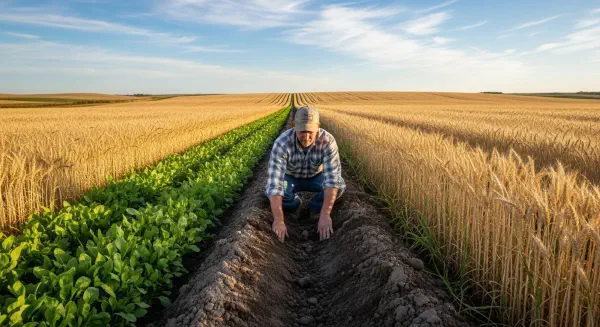
Documents the regenerative agriculture transition on Gabe Brown's North Dakota ranch, where SCDR fell from approximately 5 to below 0.5 over twenty years, providing data on how fast the soil account can be rebuilt and at what cost.
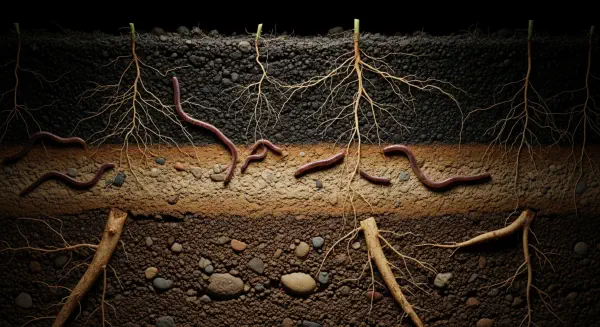
Quantifies the biological economy of productive topsoil — one billion bacteria and 25,000 nematodes per teaspoon — and traces what industrial tillage systematically destroys in the soil infrastructure that agriculture depends on.
Reconstructs the 1935 Dust Bowl as an agricultural accounting failure — the result of ignoring the Soil Capital Depletion Rate — and applies the same arithmetic to current soil erosion rates at larger geographic scale.
Introduces the Soil Capital Depletion Rate using Hans Jenny's soil formation theory, establishing that industrial agriculture is liquidating topsoil inherited over centuries at a rate 10–100× faster than formation.
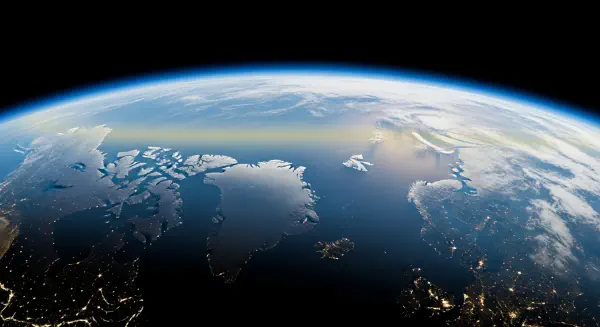
Proposed deliberate climate interventions — principally stratospheric aerosol injection — would modify the atmosphere intentionally, at scale, with substantial but unequally distributed climate effects. The Intervention Leverage Index measures the ratio of cooling benefit per unit of aerosol deployed against the probability of adverse regional precipitation disruption — and reveals why the most effective emergency lever humanity possesses is also the most politically ungovernable.
Surveys the complete absence of international governance for climate geoengineering: no treaty, no authorising institution, no compensation framework — despite the US National Academies recommending a research programme in 2021.
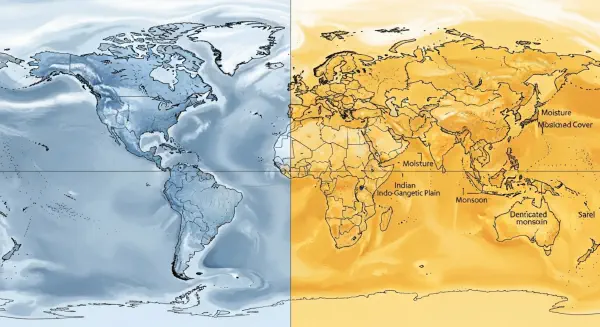
Documents modelling evidence that northern-hemisphere SAI reduces African and Asian monsoon rainfall by 5–10%, affecting the food security of 2.4 billion people in countries that are not among those most likely to initiate deployment.