
The Phonetic Schism of the Spoken Word#
In the early decades of the 20th century, the iconic playwright George Bernard Shaw popularised a famous linguistic riddle to expose the profound absurdity of English orthography. He argued that the word "fish" could logically be spelled as "ghoti"—using the "gh" sound from "tough," the "o" sound from "women," and the "ti" sound from "nation." While intended as a humorous exaggeration, Shaw’s riddle highlighted a frustrating daily reality for over 1.5 billion English speakers worldwide: the written English language is an absolute orthographic Frankenstein's monster, where letters and sounds regularly refuse to align.
+-------------------------------------------------------------------------+
|                  THE DISCONNECT OF ENGLISH ORTHOGRAPHY                  |
|                                                                         |
|   Letter Combination "ough" ──► Pronounced 8 Different Ways:           |
|                                                                         |
|   1. [ʌf]  as in "rough"         2. [ɒf]  as in "trough"                |
|   3. [oʊ]  as in "though"        4. [uː]  as in "through"               |
|   5. [ɔː]  as in "thought"       6. [aʊ]  as in "bough"                 |
|   7. [ʌp]  as in "hiccough"      8. [ə]   as in "thorough"              |
+-------------------------------------------------------------------------+
To this day, children and non-native learners must spend years memorizing arbitrary spelling patterns that seem to defy all rational, systematic rules. We write "knight" but pronounce it as "nite," preserve a silent "l" in "walk," and pronounce the letter combination "ough" in eight completely different ways across words like "rough," "though," "through," and "bough."
This orthographic chaos was not the result of a deliberate, malicious plot to confuse future generations, nor was it a natural, inevitable feature of linguistic evolution. Instead, English spelling is the direct consequence of a massive, historical system-wide car crash—a catastrophic temporal collision between a rapid, radical shift in spoken pronunciation and the sudden, rigid standardization of the printing press. This structural misalignment frozen in time is known to historical linguists as the Great Vowel Shift.
The Mechanics of a Silent Linguistic Revolution#
To map how English orthography became so thoroughly broken, we must analyze the linguistic mechanisms that governed the transition from Middle English to Early Modern English between 1400 and 1700. This transition operated on two parallel, uncoordinated tracks that ultimately locked the language into a permanent state of internal contradiction.
     SPOKEN TRACK: THE GREAT VOWEL SHIFT (1400-1700)
     Long vowels migrate upwards in the mouth:
     [a:] (name) ──► [e:] ──► [i:]
     [e:] (meet) ──► [i:]
     [i:] (bite) ──► [ai] (Diphthongization)

                           VS.

     WRITTEN TRACK: THE PRINTING PRESS (1476)
     William Caxton imports Flemish printing tech.
     Spelling is frozen using medieval standards (e.g., "knight", "bite")
     to maximize commercial profit across regional markets.
Explaining the System: The Upward Migration of Long Vowels#
The Great Vowel Shift was a massive, systematic phonetic revolution that occurred over a three-hundred-year period, completely restructuring how English speakers pronounced all long vowels. Prior to this shift, Middle English speakers pronounced their vowels in a manner very similar to modern Spanish, Italian, or German. The word "bite" was pronounced as "beet" [biːt], "meet" was pronounced as "mate" [meːt], "mate" was pronounced as "maht" [maːt], and "house" was pronounced as "hoos" [huːs].
During the Great Vowel Shift, however, a strange phonetic chain reaction occurred: all long English vowels migrated upward in the human vocal tract. As the lower vowels raised their tongue positions, they pushed the higher vowels even further upward. The highest long vowels, [iː] (as in "beet") and [uː] (as in "hoos"), had nowhere higher to go in the mouth and were forced to split into two-part sounds, or diphthongs, transforming into [aɪ] (as in "bite") and [aʊ] (as in "house").
This shift occurred gradually but relentlessly across generations. Had this spoken revolution occurred in isolation, written spelling would have naturally evolved alongside it, slowly adapting to reflect the new pronunciations.
The Crucible of Context: Flemish Typesetters and Print Capitalism#
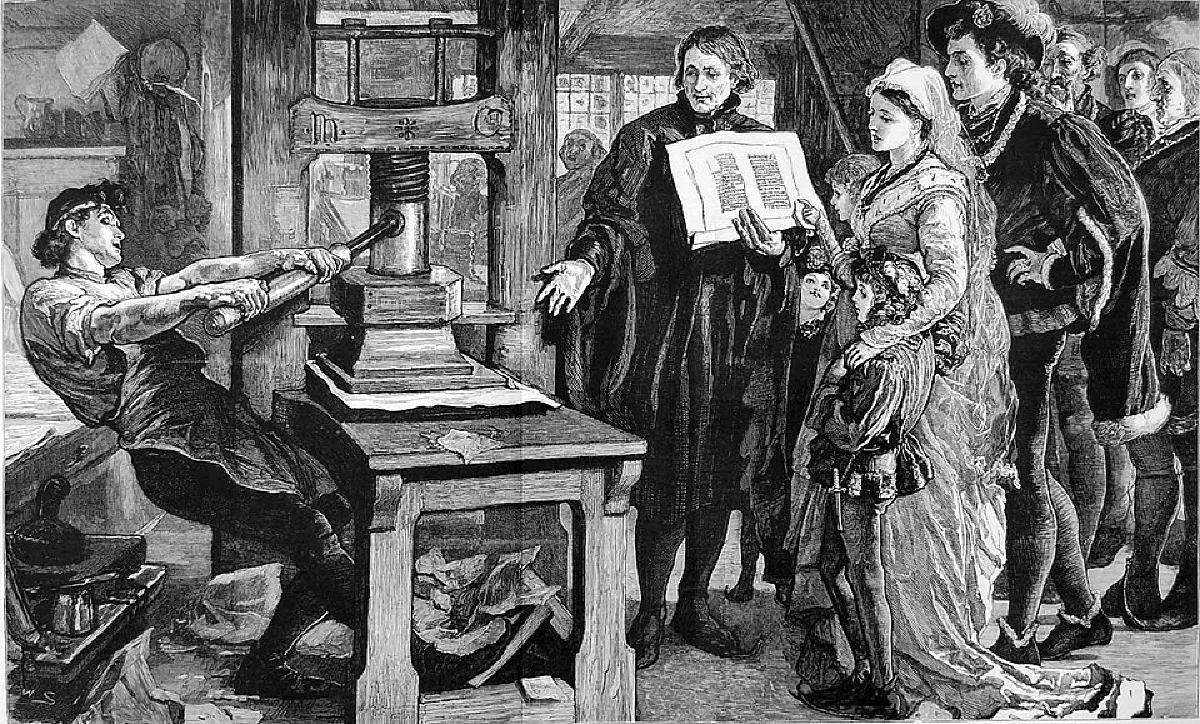
The fatal complication that broke the system was the sudden introduction of the movable-type printing press to England by William Caxton in 1476. Before Caxton, English spelling was highly localized, fluid, and phonetic; scribes simply wrote words how they sounded in their specific regional dialects. Caxton’s printing press transformed the written word from a slow, bespoke craft into a mass-market, capitalistic industry.
To maximize his commercial profits, Caxton needed to standardize English spelling so that his books could be easily read across all regional markets. However, the standardization process occurred precisely when the Great Vowel Shift was in its absolute infancy. Caxton’s early typesetters were largely recruited from the Low Countries (modern-day Belgium and the Netherlands). These foreign workers spoke little to no English and possessed no understanding of the shifting vowel pronunciations occurring in London streets.
  [Medieval Spoken English] ──────► [Radical Phonetic Shift] ─────► [Modern Spoken English]
              │                                                                 ▲
              ▼                                                                 │
  [Phonetic Spelling Standards] ──► [FROZEN BY PRINT PRESS (1476)] ─────────────┘
                                    (Spelling locked mid-transition)
Faced with a chaotic array of English manuscripts, these Flemish typesetters standardized spellings based on historical, medieval orthographic conventions that were already becoming obsolete. They locked silent letters like the "gh" in "night" and "right" into print because they associated them with the Germanic "ch" sounds of their native tongues. By the time the Great Vowel Shift completed its phonetic migration in the late 17th century, print technology had already stamped millions of books with spelling conventions that reflected the spoken pronunciation of the 14th century.
Cascade of Effects: The Permanent Orthographic Schism#
The consequences of this historical misalignment were profound, structural, and permanent. Unlike languages like Spanish, Finnish, or Korean, which possess highly shallow orthographies where one letter consistently maps to one sound, English developed a deep orthography. This deep orthography created a massive cognitive barrier to literacy, requiring English-speaking children to spend an average of two to three times longer learning to read and write compared to their peers in nations with phonetic writing systems.
Furthermore, this orthographic fragmentation transformed spelling into a powerful, class-defining social weapon. Because spelling no longer tracked natural speech, correct writing could not be learned by ear. It required formal, elite education and intense, rote memorization. During the 18th and 19th centuries, standardizing orthography became a primary tool for social gatekeeping, where minor spelling errors were weaponized by the upper classes to instantly identify, dismiss, and exclude self-taught, working-class individuals from economic and political opportunities.
The Modern Suture of Fossilized Systems#
The orthographic car crash of the Great Vowel Shift serves as a brilliant systemic metaphor for a common structural failure in modern societies: the peril of premature technological lock-in.
In the design of modern infrastructure—whether it is the QWERTY keyboard layout, the underlying architecture of the internet (IPv4), or legacy national power grids—societies frequently freeze a rapidly evolving process into a rigid, standardized format to capture early commercial profits. Once a standard is embedded across millions of physical or digital nodes, the transaction cost of updating the system to reflect modern realities becomes completely prohibitive. We remain trapped in sub-optimal systems, spending billions of dollars in cognitive or financial "taxes" to maintain a structural mismatch designed by historical actors who could not possibly foresee the future.
To avoid this systemic trap, modern designers, policymakers, and engineers must build flexibility directly into foundational standards. When deploying new technologies or regulatory frameworks, we must resist the urge to prematurely lock in protocols during periods of high, volatile change. By creating adaptive, open-ended systems that allow for gradual, synchronized updates, we can ensure that our tools continue to serve our current needs, rather than forcing future generations to spend centuries navigating the fossilized, confusing debris of our historical shortcuts.