
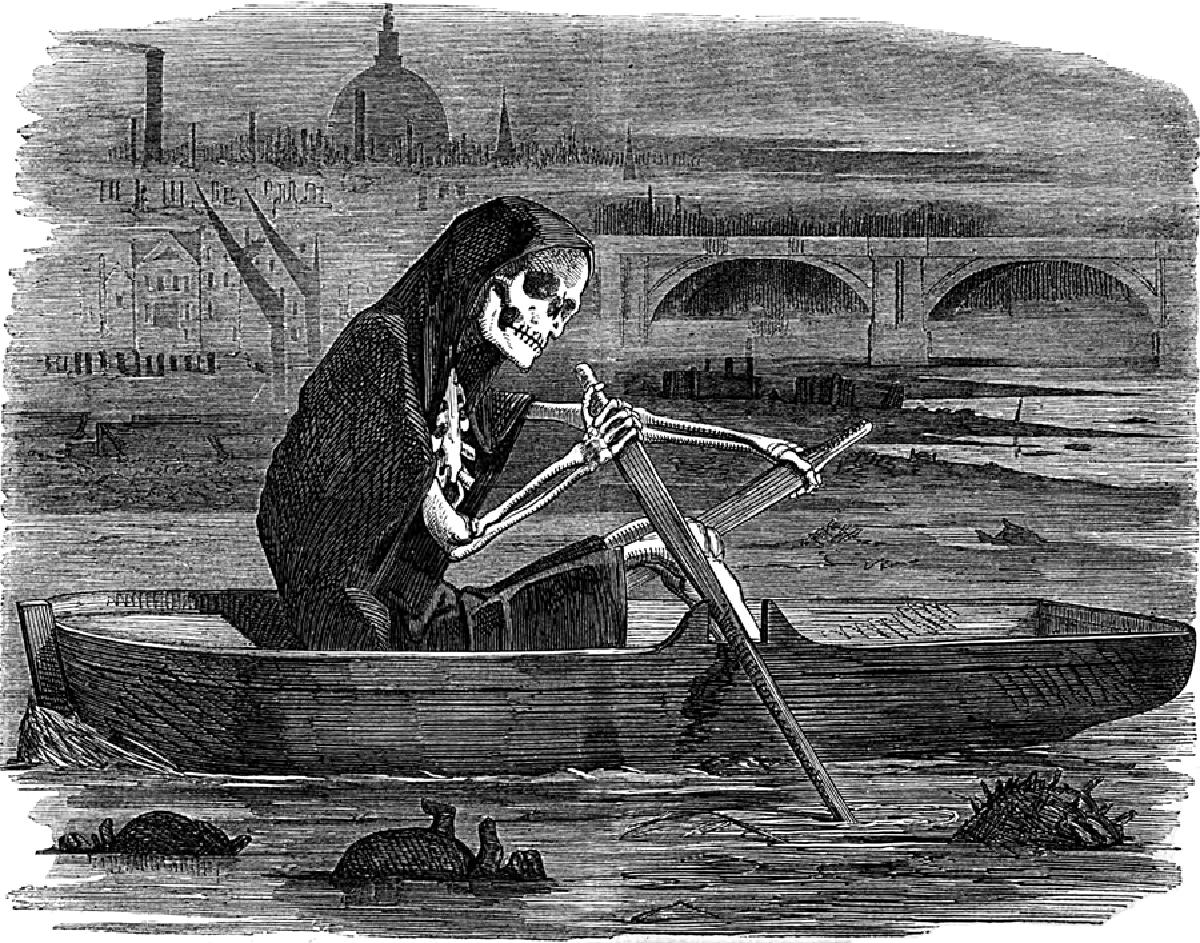
The Toxic Summer of the Thames#
In the sweltering July of 1858, London—the undisputed capital of the global British Empire—was brought to a grinding halt by an invisible, overwhelming enemy: an intolerable, all-consuming stench. For centuries, the River Thames had served as the city’s primary drinking source, its main commercial highway, and its unchecked municipal dumping ground. By the mid-19th century, the rapid growth of London’s population to over 2.5 million, combined with the widespread adoption of the flush toilet, had overwhelmed the city’s outdated cesspools and brick drains. Every single day, over 250 tons of raw, untreated human sewage were discharged directly into the sluggish, tidal waters of the Thames, turning the historic river into a bubbling, thick, and putrid open sewer.
When a record-breaking heatwave struck the city in the summer of 1858, the stagnant, sewage-choked river began to cook under the intense sun. The resulting odor was so incredibly foul that it became a national crisis, immortalized as the "Great Stink."
The business of the world's most powerful empire was paralyzed. In the Houses of Parliament, situated directly on the banks of the river, politicians choked on the air, soaked their curtains in chloride of lime to neutralize the smell, and desperately debated relocating the entire government to Oxford. Courtrooms shut down, businesses closed, and citizens stayed indoors, terrified that the sickening odor was a harbinger of a massive, lethal outbreak of cholera.
               [2.5 Million Citizens + Flush Toilets]
                                  │
                                  ▼
               [Outdated Cesspools Overwhelmed]
                                  │
                                  ▼
               [250 Tons of Daily Sewage to Thames]
                                  │
                                  ▼
               [Heatwave of 1858 / The Great Stink]
                                  │
                                  ▼
               [Political Paralysis & Olfactory Trauma]
                                  │
                                  ▼
  [Miasma Theory (Smell=Disease) vs. John Snow's Waterborne Truth]
                                  │
                                  ▼
               [Emergency Funding for Joseph Bazalgette]
                                  │
                                  ▼
         [82 Miles of Intercepting Sewers / Saved London]
This massive olfactory trauma accomplished what decades of scientific advocacy and public health warnings had failed to do: it shattered the political inertia of a gridlocked government. Within a record-breaking eighteen days of the crisis peaking, Parliament passed emergency legislation, bypassing years of bureaucratic red tape to provide unlimited funding to a brilliant civil engineer named Joseph Bazalgette. His mission was to construct a revolutionary subterranean system that would fundamentally reshape the urban environment of London and save its citizens from their own waste.
The Thermodynamics of Urban Decay and Political Transformation#
The Great Stink of 1858 was not an isolated environmental mishap, but a classic systemic crisis born from a mismatch between rapid technological advancement (the flush toilet) and archaic infrastructure (medieval cesspools), compounded by a fundamental scientific error regarding the nature of disease transmission.
+------------------------------------------------------------------------+
|                     THE INFRASTRUCTURE MISMATCH HOOK                   |
|                                                                        |
|  [Flush Toilet Innovation]  ──► (10x Increase in Household Water Runoff)|
|                                               │                        |
|                                               ▼                        |
|  [Medieval Cesspools]       ──► (Overflows into Local Soil / Basements)|
|                                               │                        |
|                                               ▼                        |
|  [Thames Dumping Outlet]    ──► (Concentrated Sewage Tidal Loop)       |
+------------------------------------------------------------------------+
Explaining the System: The Mechanics of Urban Sanitation and Miasma Theory#
To understand how London became a toxic basin, one must trace the physical flow of waste through the city's built environment. The introduction of the household flush toilet in the early 19th century was hailed as a major sanitary triumph. However, this technology increased the volume of household water runoff by nearly tenfold.
London's infrastructure was built around old, brick-lined cesspools designed solely to collect solid waste, allowing liquid to seep into the surrounding soil. The massive influx of flushed water caused these cesspools to rapidly overflow, flooding residential basements and streets. To alleviate this immediate crisis, the city authorities ordered that all cesspools be connected directly to the rainwater drains, which emptied straight into the Thames.
This short-sighted intervention solved the local odor problem in residential areas by concentrating the entire city's sewage into a single, slow-moving tidal river. When the heatwave struck, the water level of the Thames dropped, exposing vast mudflats of rotting organic material. This material underwent anaerobic decomposition, releasing massive volumes of hydrogen sulfide and methane gases directly into the atmosphere.
The Crucible of Context: Laissez-Faire Governance versus Scientific Error#
The resolution of the crisis was severely delayed by the dominance of "miasma theory"—the scientific consensus that diseases like cholera were transmitted through the inhalation of "bad air" or noxious odors. While John Snow had empirically demonstrated in 1854 that cholera was a waterborne pathogen transmitted through contaminated drinking water, the medical establishment and the Metropolitan Commission of Sewers largely dismissed his findings.
This scientific error, combined with a rigid political culture of laissez-faire governance and fragmented municipal administration, created a complete policy paralysis. For decades, multiple competing local boards argued over who was responsible for sanitation, refusing to raise taxes to fund a centralized solution because they believed that as long as they could not smell the sewage, they were safe from disease.
The Great Stink shattered this localized complacency. By bringing the horrific smell directly into the chambers of Parliament, the physical environment forced the political elite to confront the reality of their failure. Even though they acted on a false scientific premise—believing they had to clean the river to stop "miasmatic" disease—their emergency response built the exact infrastructure required to eliminate the true, waterborne transmission vectors of cholera.
Cascade of Effects: The Birth of Modern Subterranean London#
The result of this emergency legislation was one of the greatest civil engineering marvels of the Victorian era. Joseph Bazalgette designed and constructed a massive, interconnected network of 82 miles of main brick-lined intercepting sewers running parallel to the Thames, backed by 1,100 miles of street sewers. This system utilized gravity and massive, steam-powered pumping stations to redirect London's entire sewage output eastward, far past the city's boundaries, where it could be safely discharged into the sea.
       [Olfactory Trauma Forces Centralized Authority]
                      │
                      ▼
       [Joseph Bazalgette's Intercepting Sewers]
                      │
                      ▼
       [Municipal Cholera Eradication (1866 Outbreak Blocked)]
                      │
                      ▼
       [Establishment of Centralized Urban Planning]
The construction of this subterranean network had a profound, transformative effect on London. When the final major cholera outbreak struck the East End in 1866, the areas connected to Bazalgette's system remained completely unaffected, proving the absolute success of the infrastructure.
Beyond public health, Bazalgette’s sewers reshaped the physical geography of the city, reclaiming the marshy banks of the Thames to construct the Victoria, Albert, and Chelsea Embankments, which housed subterranean railway lines and modern gas mains. This massive, centralized project marked the birth of modern municipal public works, establishing the precedent that a state has a fundamental duty to design, fund, and maintain public health infrastructure to protect its citizens from systemic environmental failure.
The Modern Suture of Infrastructure and Collective Action#
The Great Stink of 1858 offers a critical, sobering lesson for modern societies facing slow-moving, systemic threats like climate change, cyber-infrastructure decay, or emerging public health vulnerabilities. It demonstrates that as long as a crisis remains invisible or localized to marginalized populations, democratic political systems will almost always default to short-term patches and bureaucratic inertia.
In contemporary policy design, we frequently wait for a "Great Stink" moment—a catastrophic, unavoidable crisis that directly impacts the comfort and safety of the ruling elite—before we are willing to bypass partisan gridlock and fund structural, long-term solutions. Whether it is a major power grid failure during a heatwave, a massive supply chain collapse, or an unavoidable climate disaster, we consistently underfund preventative maintenance and systemic resilience in favor of cheap, short-sighted compromises.
To build a resilient future, we must move beyond reactive, crisis-driven governance. We must establish robust, independent public authorities with the mandate and funding to build for fifty or one hundred years in the future, rather than the next election cycle. By treating public infrastructure not as a costly burden, but as the foundational bedrock of collective survival, we can proactively address systemic vulnerabilities before they cook under the sun of a future crisis, ensuring our societies remain healthy, prosperous, and secure.