
The Iberian Monopoly#
To understand why the English turned to the sea, it is necessary to grasp the scale of Iberian dominance in the 16th century. The Treaty of Tordesillas (1494), blessed by a Spanish pope, had divided the non-European world between Spain and Portugal along a line 370 leagues west of the Cape Verde islands. Spain claimed the Americas; Portugal took Africa, Asia and Brazil. To enforce this division, the Casa de Contratación in Seville operated a tightly controlled monopoly over transatlantic trade, complete with a register of every ship, passenger and cargo. The silver mines of Potosí and Zacatecas fed a treasure fleet—the flota—that sailed annually from Vera Cruz and Cartagena to Havana, then east across the Atlantic under naval escort. By the mid-16th century, Spanish silver was the lubricant of European commerce and the sinew of Spain’s armies. Portugal’s carracks, meanwhile, brought pepper and spices from the East Indies. For a northern Protestant kingdom like England, the world’s sea lanes were essentially locked doors.
The wealth was staggering. Estimates suggest that between 1500 and 1650 Spain imported about 181 tonnes of gold and 16,000 tonnes of silver from the Americas. The English economy, by contrast, was a minnow: primarily agricultural, with a primitive financial system and negligible foreign credit. Its monarchs lived from one parliamentary subsidy to the next. Yet the appetite for luxury imports, the need for strategic metals and the sheer prestige of trans-oceanic enterprise made Iberian success impossible to ignore. English statesmen and merchants began to ask a heretical question: what if the pope’s division of the world was not binding in the eyes of God—or of cannon?
Privateering as Proto-Empire#
The answer was privateering. A privateer was not a pirate in the simple sense of an outlaw, but a shipowner operating under a letter of marque—a licence from the Crown to attack enemy shipping in wartime and keep most of the proceeds. For much of Elizabeth’s reign, England was either formally at war with Spain or conducting an undeclared naval insurgency. The line between commerce and warfare blurred. Investors in a privateering voyage included courtiers, Privy Councillors, and even the queen herself, who supplied ships and took a generous slice of the profits. This turned privateering into a peculiar kind of joint-stock enterprise, one in which risk was shared and returns—if a rich prize was taken—could be spectacular.
Figure 1 shows the geography of the silver hunt. The dashed lines trace the route of the Spanish treasure fleet from Cartagena to Havana and on to Seville. The crimson circles mark major English attacks, their area scaled to the value of captured cargo. The pattern is clear: English privateers targeted chokepoints—the Azores, Cape St Vincent, the approaches to Havana—where the Spanish convoy system was predictable and the rewards were immense. Drake’s 1587 raid on Cádiz, for example, destroyed over 30 ships and disrupted the Spanish fleet’s preparations for the Armada. The prize money from a single successful capture could exceed the annual income of a great landed estate.
Figure 1: The Silver Hunt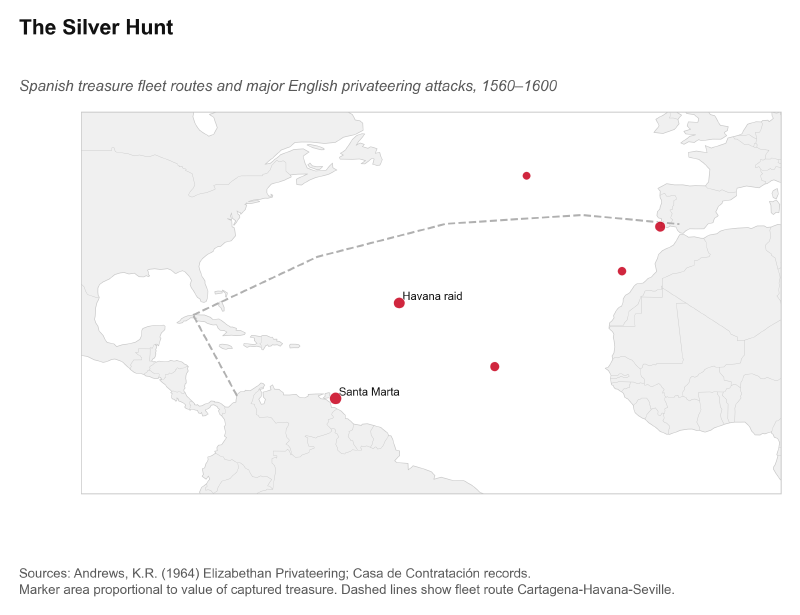
Spanish treasure fleet routes and major English privateering attacks, 1560–1600. Marker area ∝ value of captured treasure. Sources: Andrews (1964); Casa de Contratación records.
Privateering, however, was a volatile basis for imperial ambition. Profits fluctuated wildly; the loss of a ship, crew or patron could wipe out years of gains. Moreover, it depended on Spanish success—a paradox that haunted English policy. If the treasure fleets stopped sailing, there would be nothing to plunder. Privateering taught the English a great deal about navigation, naval logistics and Caribbean geography, but it offered no territorial foothold. It was a parasitic, not a productive, form of imperial activity. For a more permanent form of expansion, English eyes turned first to a much nearer shore.
The Irish Laboratory#
Long before Jamestown or Plymouth, the English attempted to colonise Ireland. The Tudor conquest of the island, which intensified in the 1560s and reached its apogee in the Nine Years’ War (1594–1603), was a brutally instructive episode. English administrators like Sir Henry Sidney and the poet-soldier Edmund Spenser regarded the Gaelic Irish as not merely rebellious subjects but as a pagan, semi-nomadic people in need of total transformation. The solution was the plantation: the confiscation of land from Irish chieftains and its redistribution to English and Scottish settlers, who would bring with them “civility”, Protestantism and English law.
The Munster plantation of the 1580s, intended to be a model colonial settlement, was a disaster. Undercapitalised, poorly defended and beset by guerrilla resistance, it was overrun during the rebellion of 1598. Thousands of English planters were killed or driven back to the Pale. Yet the experience left a deep imprint on the English imagination. The vocabulary of Irish colonisation—terms like “undertakers”, “planters” and “natives”—travelled directly to North America. The conviction that indigenous peoples could be dispossessed because they failed to cultivate the land in a recognisably “English” manner was rehearsed in Ireland before it was applied in Virginia. Ireland, as the historian Nicholas Canny has argued, was the “laboratory of empire”. It taught the English that colonies were not merely trading posts; they required military force, settlers and the systematic subjugation of local populations.
Roanoke and the Limits of Private Enterprise#
The first English attempt to plant a colony in North America, at Roanoke Island in present-day North Carolina, was conceived not by the state but by a courtier, Sir Walter Ralegh. Ralegh received a royal charter in 1584 to establish settlements on the North American coast, but the queen provided no funds. The venture was financed privately, through a syndicate that included Ralegh, his friends and a few merchant investors. The 1585 and 1587 expeditions were under-supplied and poorly timed; relations with the local Algonquian peoples soured over shortages of food. When John White, the colony’s governor, returned in 1590 after a three-year absence enforced by the Armada crisis, he found the settlement abandoned and the word “CROATOAN” carved into a post. The “lost colony” simply vanished.
Roanoke’s failure exposed the limitations of relying on private adventurers for imperial expansion. A colony required sustained investment, garrison troops, reliable food supplies and a strategic purpose that justified the long-term costs. None of these were present. Yet Roanoke also planted a seed of a different kind: the idea that England’s destiny lay on the far side of the Atlantic, not just in raiding Spanish ships. The promotional literature written by Ralegh’s associates, especially Thomas Harriot’s A Briefe and True Report of the New Found Land of Virginia (1588), depicted the region as a temperate paradise, abundant in timber, fish and docile natives. Even as the colony itself disappeared, the propaganda machine that would fuel later migration was being built.
Protestantism and the Anti-Spain Doctrine#
Underpinning all these ventures was a powerful ideological engine: militant Protestantism. From the 1570s onward, English writers and preachers portrayed Spain not simply as a geopolitical rival but as the Antichrist’s empire. The “Black Legend”—the catalogue of Spanish atrocities in the Americas compiled from the writings of Bartolomé de las Casas and others—was translated into English and widely circulated. Spain’s rule, it was argued, was tyrannical, idolatrous and genocidal. By contrast, English colonisation would be gentle, lawful and aimed at the “propagation of the Gospel”. This was self-serving, but it was also sincerely believed by many. The Puritan divine Richard Hakluyt, the most influential promoter of English overseas enterprise, compiled a vast collection of travel narratives, The Principal Navigations (1589), to demonstrate God’s providential design for England to break the Spanish monopoly and spread the reformed faith.
Protestant identity also shaped how Englishmen conceived of the territories they hoped to occupy. The land was God’s gift, to be granted to those who would use it productively and worship him correctly. Idle or “savage” peoples had no legitimate claim. This was the intellectual bridge between the confiscation of Gaelic lands in Ireland and the future dispossession of Native Americans. It gave English expansion a moral purpose that was entirely compatible with commercial and strategic motives. When the great Armada was defeated in 1588, the victory was interpreted as a divine vindication of England’s Protestant cause, a sign that the winds and waves themselves had chosen sides.
The Open Question#
When Elizabeth died in 1603, England had no permanent overseas colony. The Roanoke settlement was lost; the Irish plantations remained unstable; privateering was winding down as peace negotiations with Spain proceeded. Measured by territory, the English empire was non-existent. Yet the Elizabethan era had provided three essential ingredients for the expansion that followed. It had demonstrated that the Iberian monopoly could be punctured by audacious naval action. It had created a financial model—the joint-stock company—that could pool capital and risk, later perfected in the Virginia Company and the East India Company. And it had forged an ideological synthesis of Protestantism, nationalism and economic interest that could motivate settlers and justify conquest.
The empire that emerged over the next two centuries was not a state-driven masterplan. It was an improvised, often chaotic, amalgam of piracy, plantation and piety. But the improvisation had begun to acquire a grammar. The next chapter would be written not in the Atlantic but in the Indian Ocean, by a corporation that started as a small syndicate of London merchants and ended up ruling a subcontinent.
Next in the series: “The Company That Owned a Continent”—how the East India Company built a parallel empire in the East.