
The Factory, Not the Fort#
When the East India Company received its royal charter from Elizabeth I in 1600, it was a modest affair. A syndicate of 218 merchants subscribed £68,373 to finance a handful of ships to the spice islands of the East Indies. The Company was a monopoly trading corporation, designed to pool capital and spread risk over long-distance voyages. Unlike the Spanish and Portuguese empires, it had no desire to conquer territory. Its preferred form of presence was the “factory”—a fortified warehouse where goods could be stored and Company servants could live under local rulers’ protection. Factories in Surat, Madras, Bombay and Calcutta were diplomatic compounds as much as commercial depots. The Company paid rent, taxes and customs duties to the Mughal emperor and his provincial governors; in return, it received trading rights and a measure of judicial autonomy. For more than a century, this arrangement worked. The Mughal empire, at its 17th-century zenith, was one of the wealthiest and most militarily powerful states on earth. The East India Company was a supplicant, and a profitable one.
The trade that made the Company rich was not in spices, which the Dutch had largely cornered, but in Indian textiles. Calicoes, chintzes and muslins from Gujarat, Bengal and the Coromandel Coast flooded European markets, creating such alarm among English woollen manufacturers that Parliament eventually banned the wearing of Indian cottons. The Company’s profits were ploughed back into the business or paid out in dividends that averaged a healthy 8–10%. Yet the entire edifice depended on the goodwill of the Mughal authorities. When the Mughal empire began to crumble after the death of Aurangzeb in 1707, the Company found itself operating in a world of rival warlords, French competitors and collapsing public order. The factory needed a fort, and the trading company needed an army.
The Balance Sheet Turns to Bayonet#
The shift was gradual but inexorable. As Mughal authority waned in the early 18th century, provincial governors—Nawabs—became de facto independent rulers. They still expected the Company to pay for its privileges, but they also saw its fortified settlements as threats. The French Compagnie des Indes, with its own governor Joseph François Dupleix, had demonstrated how a European trading company could become a territorial power by allying with Indian princes and training sepoy regiments in European drill. The British followed suit. By the 1740s, the East India Company was maintaining a private army, funded by its commercial revenues, to protect its factories and, increasingly, to expand its influence.
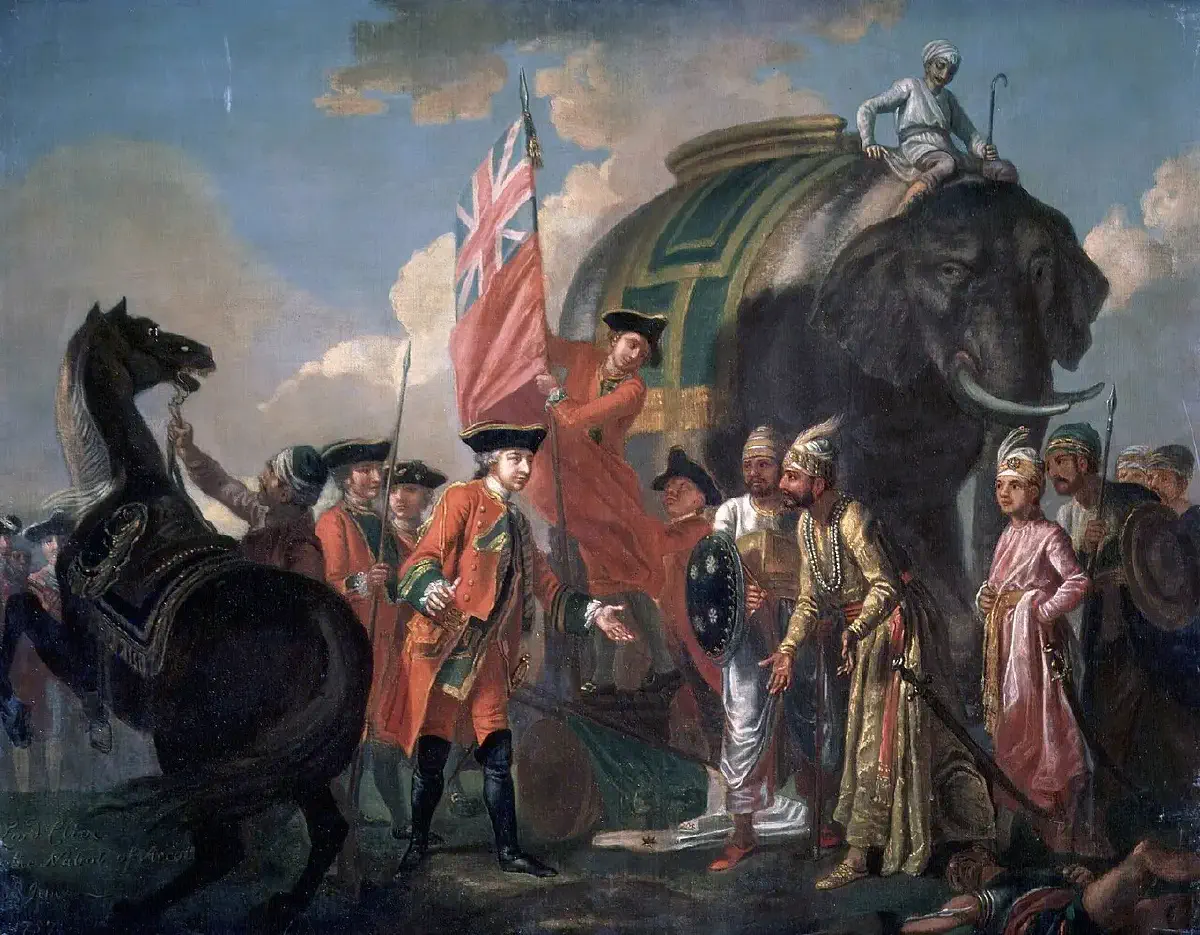
The moment of transformation came with the Seven Years’ War (1756–63). In Bengal, the young and impetuous Nawab Siraj-ud-Daulah seized Calcutta in 1756, an act that led to the infamous “Black Hole” incident. Clive, dispatched from Madras, recaptured the city and then, through a mixture of bribery, intrigue and battlefield audacity, defeated the Nawab at Plassey. The battle itself was hardly a military masterpiece; it was won because the Nawab’s commander, Mir Jafar, had been secretly bought by the Company. But its consequences were epochal. The Company installed Mir Jafar as a puppet Nawab, extracted vast sums of “compensation” and, crucially, acquired the diwani—the right to collect taxes in Bengal—from the Mughal emperor in 1765. The trading company had become the revenue department of a sub-continent-sized province.
Figure 2 captures the financial transformation. The stacked area chart shows Company revenues from 1700 to 1800. For the first half of the century, the blue band—trade and customs—dominates. After 1757, the crimson band of land-tax and tribute swells dramatically, overtaking commercial income by the 1780s. The shift was not merely quantitative; it altered the very nature of the Company. Its profits no longer depended primarily on the vagaries of commodity markets but on the coercive extraction of peasant surplus. The business of empire had become territorial.
Figure 2: From Trade to Tribute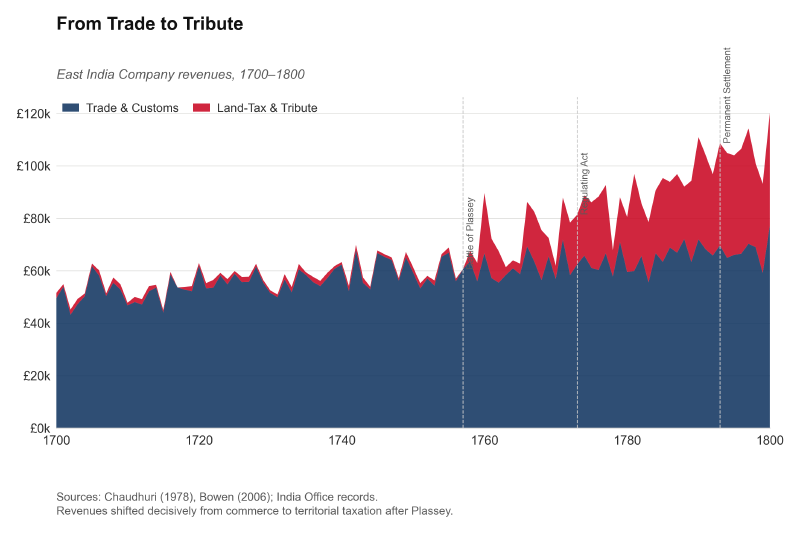
East India Company revenues, 1700–1800. After the Battle of Plassey (1757), territorial taxation eclipsed trading profits. Sources: Chaudhuri (1978), Bowen (2006); India Office records.
Private Fortunes, Public Bailouts#
The capture of Bengal unleashed a feeding frenzy among Company servants. Clive himself returned to Britain with an estimated £234,000—a colossal fortune for the age—much of it derived from “presents” extracted from Indian princes. The line between Company business and private enterprise blurred to the point of invisibility. Senior officials used Company ships and troops to advance their own commercial interests, while junior servants survived on low salaries and expected to make their fortunes through “country trade” within Asia. Corruption was not a bug but a feature of the system. When Clive faced parliamentary inquiry in 1772, he defended himself with a mixture of wounded pride and genuine bewilderment: “By God, Mr Chairman, at this moment I stand astonished at my own moderation.”
The Company’s new role as a territorial power brought it into repeated conflict with neighbouring Indian states—the Marathas, Mysore, the Sikhs. Wars were expensive. The Company’s finances, fattened by the Bengal revenues, were also stretched by military expenditure, shareholder dividends and the need to pay off London creditors. The result was a recurring pattern of liquidity crises. In 1772, the Company’s near-bankruptcy forced it to seek a £1.4 million loan from the British government. The price was parliamentary regulation. The Regulating Act of 1773 brought the Company’s affairs under greater state scrutiny and created the post of Governor-General of Bengal. The state was, belatedly, beginning to rein in the corporation it had accidentally spawned.
The Corporate Sovereign#
The East India Company in its 18th-century pomp was a hybrid that defied all conventional categories. It paid dividends to private shareholders; it operated a military establishment larger than that of many European kingdoms; it collected taxes from millions of subjects; it conducted its own foreign policy, making and breaking treaties with Indian rulers. Edmund Burke, in his magnificent speeches during the impeachment of Warren Hastings, the first Governor-General, captured the paradox with surgical precision. The Company, he argued, was not a state and could not claim the prerogatives of sovereignty. Yet by acting as a sovereign—waging war, levying taxes, administering justice—it had forfeited the protections of a mere commercial entity. Hastings was acquitted, but the trial defined the central question of the age: could a corporation be trusted to govern an empire?
Adam Smith, in The Wealth of Nations (1776), supplied the economic answer. Chartered monopolies like the East India Company, he argued, were inherently inefficient and oppressive. Their monopoly rents stifled competition; their distance from market discipline bred mismanagement and corruption. Smith’s critique applied most powerfully to the Company’s second, territorial phase. By becoming a revenue-extracting machine rather than a trading enterprise, the Company had distorted the natural course of commerce and locked itself into a cycle of military expansion and fiscal crisis. The remedy, Smith implied, was either full state control or free trade—not the murky hybrid that existed.
A Model of Its Own#
By the end of the 18th century, the East India Company had created a model of corporate imperialism that would leave a lasting imprint on the British empire as a whole. The concept of “indirect rule”—governing through local princes and existing institutions—was not invented in Africa in the 19th century; it was perfected in Bengal, Awadh and Hyderabad in the late 18th. The Company’s sepoy army, with its combination of European officers and Indian soldiers, became the template for the British Indian Army, the instrument of Victorian imperialism from the Punjab to the Persian Gulf. Even the British state’s later method of financing empire—through a combination of private capital, Crown guarantees and territorial revenues—owed much to the Company’s pioneering experiments in public-private partnership.
Yet the Company remained, at heart, an anomaly. By the time it was finally dissolved in 1858, after the Indian Rebellion, it had been a cipher for British rule for a century. The handover to the Crown was a formal acknowledgment of what had long been true: that the corporation’s empire had become too big to be run by a board of directors, too strategically vital to be left to shareholders, and too morally compromised to be sustained without the alibi of parliamentary accountability. The little syndicate of 1600, founded on pepper and hope, had ended by ruling one-fifth of humanity. The arc from factory to fort to fiscal-military state was not planned by anyone; it emerged, step by step, from the logic of commerce colliding with the realities of power. The Company did not so much own a continent as discover that a continent had taken ownership of it.
Next in the series: “The Sugar Engine”—how the Caribbean plantations built modern Britain and broke millions of bodies.