
The Sweet Revolution#
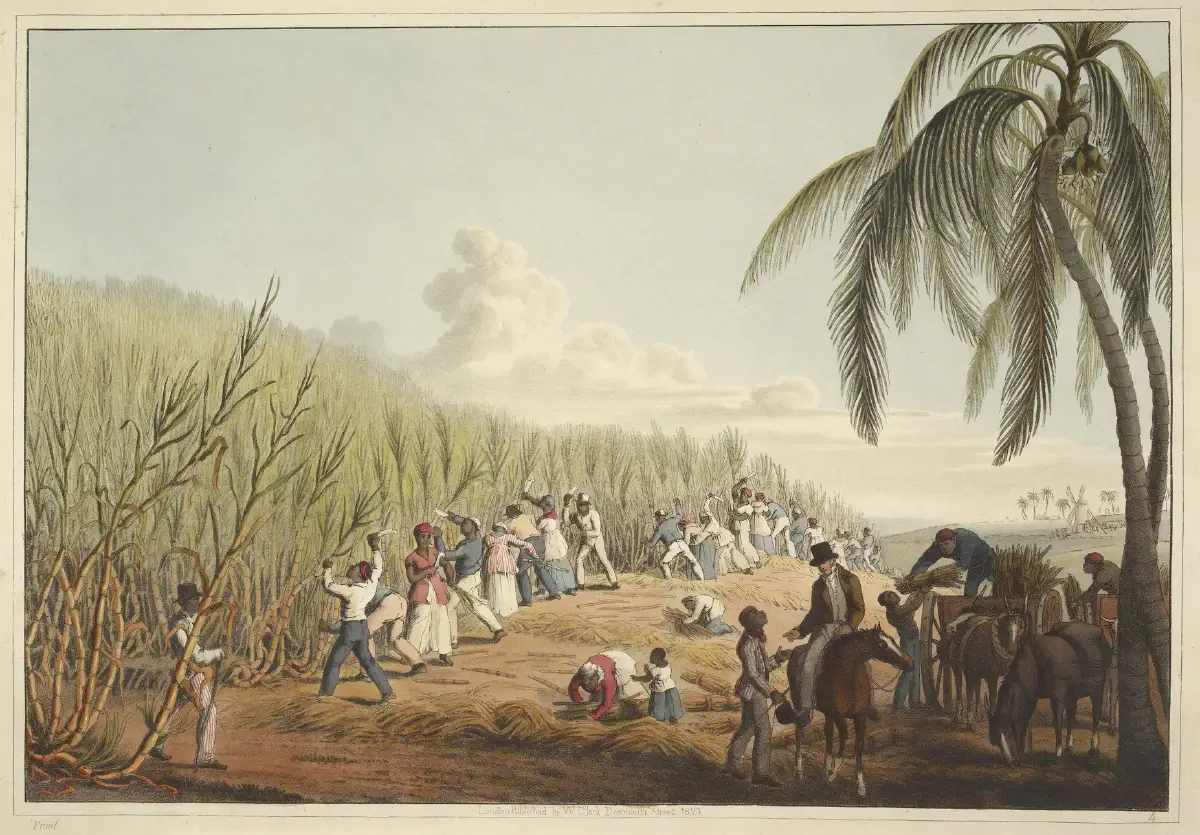
When English colonists first settled Barbados in 1627, they planted tobacco, cotton and indigo, relying on indentured servants from Britain and Ireland. The island was a modest, quarrelsome outpost. Then, in the 1640s, a group of Dutch merchants expelled from Portuguese Brazil arrived, bringing with them the techniques of large-scale sugar cultivation, the enslaved Africans to work it, and the capital to finance it. Within a generation, Barbados was unrecognisable. Its landscape was remade into a checkerboard of cane fields and boiling houses; its population flipped from a white majority to an overwhelming black majority; its wealth soared. A sugar planter in 1680 could expect profits of 15–20% per annum, a rate of return virtually unknown in the agrarian economy of England. The “sugar revolution” spread rapidly to Jamaica, captured from Spain in 1655, and to the Leeward Islands of Antigua, St Kitts and Nevis.
What made sugar so spectacularly profitable was not merely the European sweet tooth—though that was insatiable—but the plantation system’s fusion of agriculture and industry. A sugar plantation was a factory in the fields. The cane had to be cut at precisely the right moment, crushed within hours in wind- or animal-powered mills, and the juice boiled and crystallised in a continuous, time-sensitive process. This required a disciplined, synchronised labour force, working under harsh supervision, often through the night. Planters quickly concluded that indentured European labour, with its contracts and rights, was unsuitable. Enslaved Africans, bought outright and subjected to a legal system that treated them as chattel, offered a permanent, heritable and infinitely coercible workforce. Race became the organising principle of Caribbean society because it was the most efficient way to legitimise unfreedom.
The Triangle and Its Circuits#
The sugar trade did not operate in isolation; it was the dynamo of a vast Atlantic system of exchange that involved Europe, Africa and the Americas. The classic image of the “triangular trade” is a simplification—actual commercial routes were more complex—but it captures an essential truth. British ships carried manufactured goods, especially textiles, guns and iron bars, to the coast of West Africa. There they were exchanged for enslaved people, purchased from African merchants and rulers who had long been part of regional slave-trading networks but whose commerce was now massively expanded and distorted by European demand. The enslaved were then transported across the Atlantic in the notorious Middle Passage, a voyage that killed roughly one in eight of its victims. Those who survived were sold in the slave markets of Bridgetown, Kingston or St John’s. The ships then loaded sugar, rum and molasses for the return voyage to Britain, where the produce was consumed, re-exported or distilled. At every stage, value was extracted, taxed and reinvested.
Figure 3 visualises the scale of these flows over the 18th century. The Sankey diagram traces the movement of enslaved Africans from the Gold Coast and the Bight of Biafra into the British Caribbean, the onward flow of sugar and molasses to Britain, and the return flow of British manufactured goods to Africa. The thickness of the ribbons corresponds to the volumes involved. What is immediately striking is the sheer magnitude of the slave trade: approximately 2.4 million Africans were carried in British ships to the Caribbean between 1700 and 1807, more than to any other destination in the Americas. The sugar colonies devoured human beings on an industrial scale.
Figure 3: The Atlantic Triangle, 1700–1800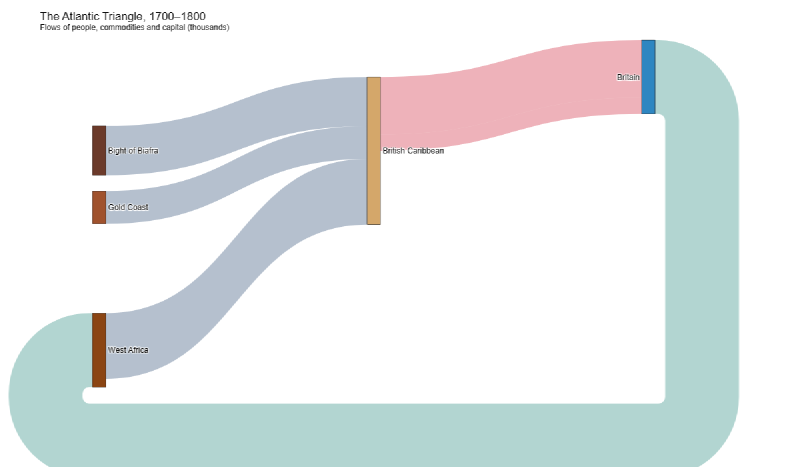
Flows of enslaved Africans, sugar and manufactured goods in the British Atlantic economy. Source: Trans-Atlantic Slave Trade Database; Davis (1979).
Financing an Empire on Sweetness#
The profits of sugar radiated far beyond the plantation gate. The West India merchants of London, Bristol and Liverpool formed one of the most powerful lobbies in British politics, deploying their wealth to secure favourable sugar duties, protect the slave trade and shape imperial policy. The banking and insurance industries grew, in part, to service the plantation economy. Barclays, for instance, traces its origins partly to Quaker merchants involved in Caribbean trade; Lloyd’s of London insured slave ships and sugar cargoes. The mortgage market for slave property became a crucial element of British credit networks. Planters raised loans from London financiers using their enslaved people as collateral, creating a web of financial claims that stretched from the cane fields to the counting houses of the City.
This capital found its way into the fabric of British life. The great country houses of the 18th century—Harewood House, Dodington Park, the Codrington properties in Gloucestershire—were built or expanded with West Indian fortunes. Investments in canals, turnpikes and early factories drew on the same pool of capital. The port cities that handled sugar and slaves boomed: Liverpool quadrupled in size during the 18th century, its wealth built as much on the slave trade as on the cotton that later became its symbol. Eric Williams, the historian and future prime minister of Trinidad and Tobago, argued in his groundbreaking 1944 book Capitalism and Slavery that the profits of the Caribbean plantations were a necessary precondition for the Industrial Revolution. That claim remains debated, but there is no doubt that the sugar engine provided a massive injection of liquid capital, entrepreneurial experience and consumer markets at a critical juncture.
The World the Slaves Made#
Behind the ledgers and the trade statistics lay an ocean of suffering. The plantation was a regime of systematic violence. Field slaves worked from dawn to dusk under the whip, six days a week, with the punishing “crop season” demanding round-the-clock labour. Mortality rates were appalling: in the worst sugar islands, an enslaved African could expect to live perhaps seven to ten years after arrival. Planters found it cheaper to work their labourers to death and buy new ones than to sustain a reproducing population. The demographic arithmetic was stark: despite importing millions of Africans, the Caribbean slave population did not sustain itself naturally until the late 18th century. Sugar was a machine for consuming black lives.
Resistance was constant. Enslaved Africans ran away, sabotaged equipment, feigned illness, and occasionally rose in revolt. Jamaica experienced multiple major uprisings, the most serious of which was Tacky’s Revolt in 1760, an insurrection that spread across several parishes and took months to suppress. In the maroon communities of the Jamaican interior—settlements of escaped slaves—Africans maintained a precarious but real autonomy, negotiating treaties with the colonial government that granted them freedom in exchange for returning future runaways. The maroons were a permanent rebuke to the plantation order, a reminder that even within the most coercive system, human agency could carve out spaces of liberty.
The Moral Accounting#
By the 1780s, the sugar engine was beginning to sputter. Overproduction drove down prices; soil exhaustion and hurricane damage reduced yields; competition from French Saint-Domingue, the world’s richest colony, threatened British market share. At the same time, a new and profoundly unsettling movement was gathering force: abolitionism. The Quakers had long condemned slavery as a sin; now Anglican evangelicals like William Wilberforce and Thomas Clarkson joined them in a campaign that was at once moral and political. They circulated images of slave ships and accounts of plantation brutality, mobilised public opinion through petitions and boycotts, and pressed Parliament to act.
The abolitionists faced ferocious opposition from the West India lobby, which warned of economic ruin. But the arguments were shifting. Adam Smith’s critique of slave labour as inherently inefficient—because the slave had no incentive to work beyond avoiding the whip—gained ground. The slave revolt in Saint-Domingue from 1791, which erupted into the Haitian Revolution, sent a shock of terror through the planter class. If slaves could liberate themselves by force, the entire edifice looked dangerously fragile. When Parliament voted to abolish the British slave trade in 1807, it was a triumph of humanitarian campaigning, but also a recognition that the sugar engine had become politically untenable and, perhaps, economically obsolescent. Full emancipation followed in 1833, with a £20 million compensation package—paid not to the enslaved, but to their former owners.
The British Empire that had been built, in no small part, on sugar and slavery would now repurpose itself as the world’s moral policeman against the trade it had once dominated. The memory of what that engine had cost was quietly buried. The plantations continued to produce sugar with indentured labour, and the financial structures they had created lived on. But the millions of bodies that had been broken to sweeten the tea cups of Europe remained, as they largely remain today, an uncomfortable footnote to the story of Britain’s rise. The sugar engine had made the empire rich; it was the empire that now chose to forget the price.
Next in the series: “The Paper Empire”—how ledgers, laws and letters of credit knitted the British world together.