
The Scaffolding of Trade#
The Navigation Acts, first passed under the Commonwealth in 1651 and refined over the next half-century, are usually remembered as the legislative spine of British mercantilism. They required that trade with the colonies be carried in English or colonial ships, that certain “enumerated” goods—sugar, tobacco, cotton, indigo—be shipped only to England, and that European manufactures bound for the Americas pass through English ports first. The point was to build a self-contained imperial economy that would starve rivals, especially the Dutch, of carrying trade and re-export profits. Measured by shipping tonnage, the Acts worked spectacularly: the British merchant fleet tripled in size between 1660 and 1700, and London’s docks became the entrepôt of the Atlantic world.
But the law was only the visible framework. The real texture of imperial commerce was woven from private contracts, promissory notes and insurance policies. A sugar planter in Jamaica could not wait for the next fleet to pay for his supplies; he issued bills of exchange drawn on his London agent, which circulated among merchants as a form of money. A slave-ship captain in Liverpool financed his voyage with a complex network of loans, secured against the future sale of his human cargo in the Caribbean. A Philadelphia grain exporter settled his debts in Bristol through a chain of endorsements that never involved a single coin crossing the Atlantic. Trust was the lubricant, and trust had to be built. The empire’s commercial success depended on a shared language of accounting and law, on the reputation of individual houses, and on the courts that stood ready to enforce obligations even across oceanic distances.
The Price of Power#
If trade provided the empire’s sinews, war finance provided its bones. The British state fought five major wars against France between 1689 and 1815. Each required sums that dwarfed anything an early-modern monarchy could raise from land taxes or Crown lands. The answer, arrived at in the 1690s and refined ever after, was a set of interlocking institutional innovations: a national debt, a central bank willing to manage it, and a parliament that guaranteed repayment through predictable taxation.
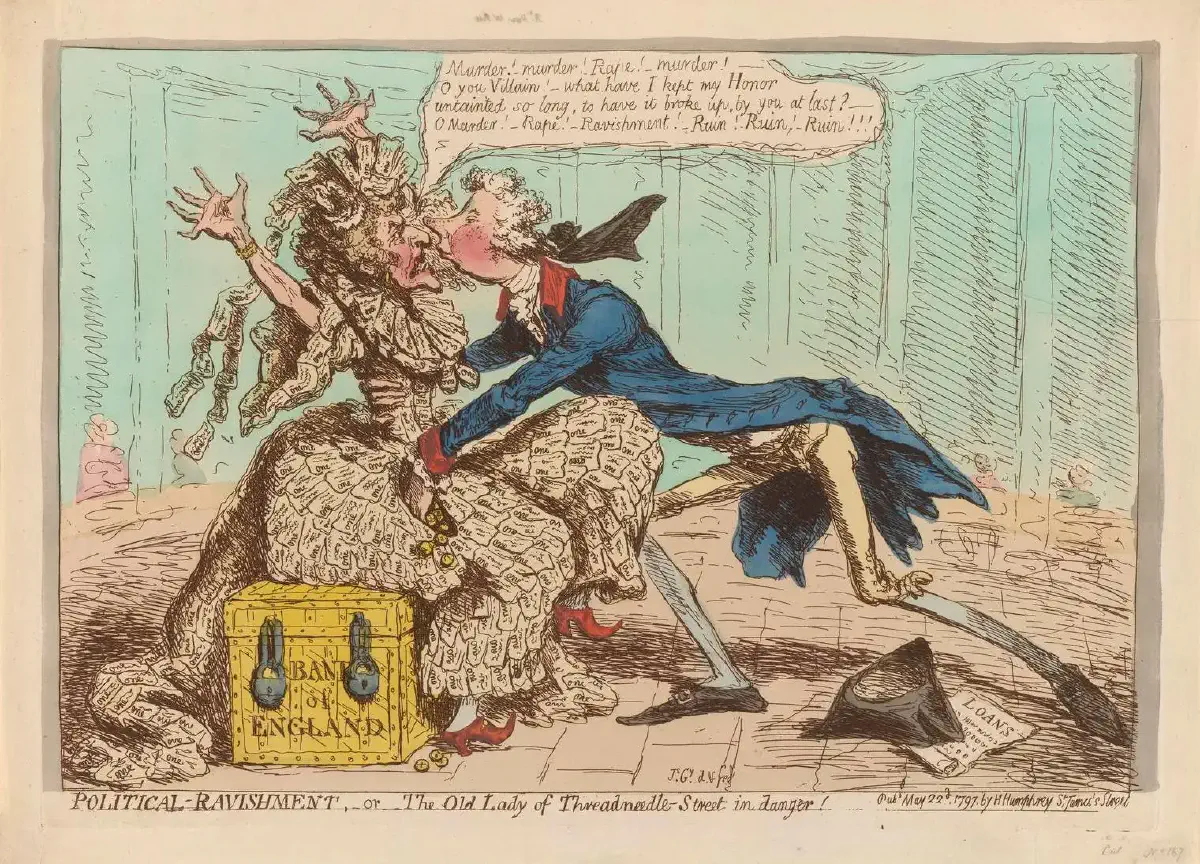
In 1694 the Bank of England was founded to raise a £1.2 million loan for the war against Louis XIV. It was not the first public bank in Europe—the Dutch had the Wisselbank—but it was the first to fuse state borrowing with a permanent, chartered institution that could also manage private credit. The national debt, which the Bank administered, allowed the government to smooth the immense costs of war over time rather than choking the economy with emergency taxes. Crucially, the debt was backed by specific streams of customs and excise revenue, voted by Parliament and collected by an increasingly professional Treasury. This gave British government securities—the famous “consols”—a credibility that the bonds of absolute monarchs could not match. An investor who lent money to the British state could be reasonably confident of being repaid with interest. An investor who lent to the French king relied on the monarch’s whim.
Figure 4 makes the consequences starkly visible. The chart plots sovereign bond yields—the effective interest rate the government had to pay to borrow—for Britain and France from 1690 to 1815. British yields were consistently lower, often by two or three percentage points. In wartime the gap widened dramatically; during the Seven Years’ War French yields spiked above 8% while British yields barely flickered above 3.5%. The shaded bands show the wars that punctuated the long 18th century. Each time, France was forced to borrow at ruinous rates, diverting resources from ships and troops to debt service. Britain, by contrast, could raise huge sums cheaply and channel them into the Royal Navy. The inset chart tells the naval story: from rough parity in 1700, British tonnage grew to double that of France by 1800. The “price of power” was literally priced in the bond market, and Britain won the bidding war.
Figure 4: The Price of Power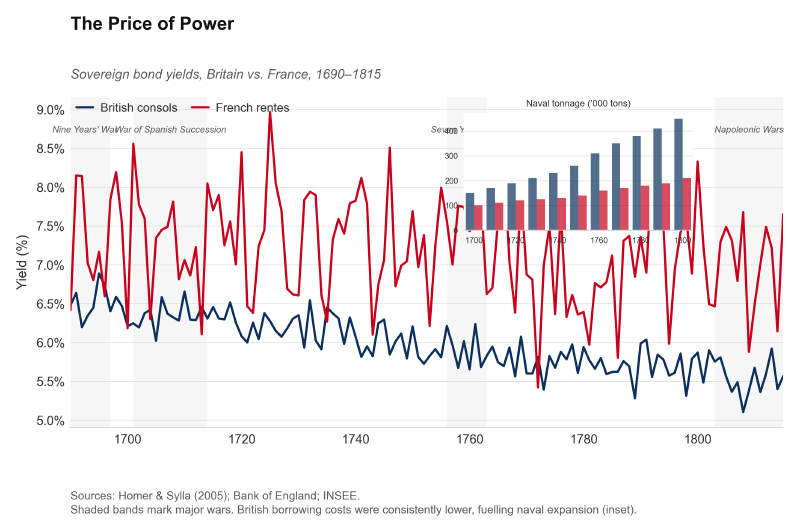
Sovereign bond yields, Britain vs. France, 1690–1815. Shaded bands mark major wars. British borrowing costs were consistently lower, fuelling naval expansion (inset). Sources: Homer & Sylla (2005); Bank of England; INSEE.
Law Across the Seas#
Credit required enforcement, and enforcement required courts. The British Empire spawned a patchwork of legal institutions—common-law courts in the American colonies, mayor’s courts in the Caribbean, the Supreme Court of Judicature in Bengal—that shared a family resemblance and a common ultimate authority in the Privy Council. But the day-to-day work of imperial law was often more mercantile than constitutional. The colonial vice-admiralty courts, scattered from Halifax to Antigua, handled disputes over shipwrecks, insurance claims and seamen’s wages. Their procedures were Roman-Dutch in origin, faster and more flexible than common-law courts, and they operated without juries—a feature that made them unpopular among American colonists but highly effective for merchants who needed rapid resolution of commercial disputes.
Bills of exchange, the lifeblood of long-distance trade, were governed by a merchant-developed lex mercatoria that was remarkably uniform across the empire. A bill drawn in Glasgow and endorsed in Kingston was governed by the same customary rules as one drawn in London. This legal predictability lowered transaction costs and allowed credit networks to span the globe. A merchant in Calcutta could be confident that a dishonoured bill would be pursued through the courts, and that the insolvency of a London correspondent would trigger a cascade of legal remedies that protected distant creditors. The empire was, in this sense, a single juridical space long before it was a single administrative unit.
The Information Revolution#
Paper without information is worthless. The British Empire ran on a circulatory system of letters, newspapers and official dispatches that steadily accelerated during the 18th century. The packet boat—a small, fast vessel dedicated to carrying mail—became a regular sight on the Atlantic and Indian Ocean routes. The Post Office’s packet service, inaugurated in the 1660s and expanded thereafter, linked Falmouth to New York, Lisbon, the West Indies and eventually Bombay. By the 1760s a letter could travel from London to Calcutta in four to five months, slow by modern standards but a predictable rhythm that merchants and officials could plan around.
Coffee houses were the nodes where this information was consumed and converted into action. Lloyd’s Coffee House in the City of London became the world’s leading insurance market because it was the place where ship captains, merchants and underwriters gathered to exchange news of sailings, storms and prizes. The Lloyd’s List, a shipping gazette first published in 1734, distilled those conversations into print, allowing traders in Liverpool or Glasgow to track the fate of their cargoes. Colonial newspapers, many of them founded by printers who doubled as postmasters, reprinted London news and advertised the arrival of goods, the departure of ships and the sale of slaves. The empire was imagined, to adapt Benedict Anderson’s phrase, through the daily rituals of reading the same commercial intelligence.
The Law of Prize and Booty#
War, in the 18th century, was a paying proposition for those who knew how to work the rules. The admiralty courts did not merely resolve disputes; they were also engines of wealth redistribution. When a Royal Navy frigate or a privateer captured an enemy merchant ship, the vessel and its cargo became a “prize”. Legally, the prize belonged to the Crown until it was condemned by an admiralty court. Once condemned, it could be sold, and the proceeds distributed among the captors according to a fixed formula: the captain got a share, the crew got shares, and the government took nothing. This system, governed by the prize acts and the decisions of judges like the formidable Sir William Scott (Lord Stowell), turned naval warfare into a form of state-sanctioned plunder, governed by elaborate legal ritual.
The sums involved were staggering. During the Seven Years’ War alone, British privateers and naval vessels captured over 1,100 French prizes worth an estimated £10 million—equivalent to several years of government revenue. The prize courts adjudicated every capture with a punctilious attention to the rules of war: was the ship properly condemned? Had it been in a neutral port? Was the cargo genuinely enemy property? The formality was both genuine and strategic. By wrapping plunder in legal procedure, the British state legitimised its seizures and reduced the risk of retaliation or diplomatic crisis. The paper trail of prize law was as important as the gunpowder that enabled the capture. The empire was, once again, built on ledgers.
The Invisible Foundation#
The British Empire of the 18th century was, to a casual observer, a collection of disparate territories strung across the oceans and defended by a blue-water navy. But its true coherence came from the paper infrastructure that bound it together: the bond market that financed its wars, the bills of exchange that financed its trade, the courts that enforced its contracts, the packets that carried its news, and the prize system that turned naval victories into liquid capital. Without these, the redcoats and the ships would have been helpless, stranded in distant places without money, supplies or coordination.
This paper empire was not a conscious design but an accumulation of pragmatic solutions, each adapted from earlier practices—Dutch finance, Italian commercial law, the ancient customs of the sea. It proved extraordinarily resilient. When the American colonies were lost in 1783, the paper networks simply reconfigured themselves; British capital and British merchants continued to dominate the Atlantic economy long after the Union Jack was lowered at Yorktown. The true architecture of empire was never just territorial. It was, and remains, a set of institutions and habits of thought that outlasted the flags and the forts. The ledgers have had a longer life than the colonies.
Next in the series: “The Protestant Internationale”—how religion, diaspora and shared loyalty shaped the first British Empire.