
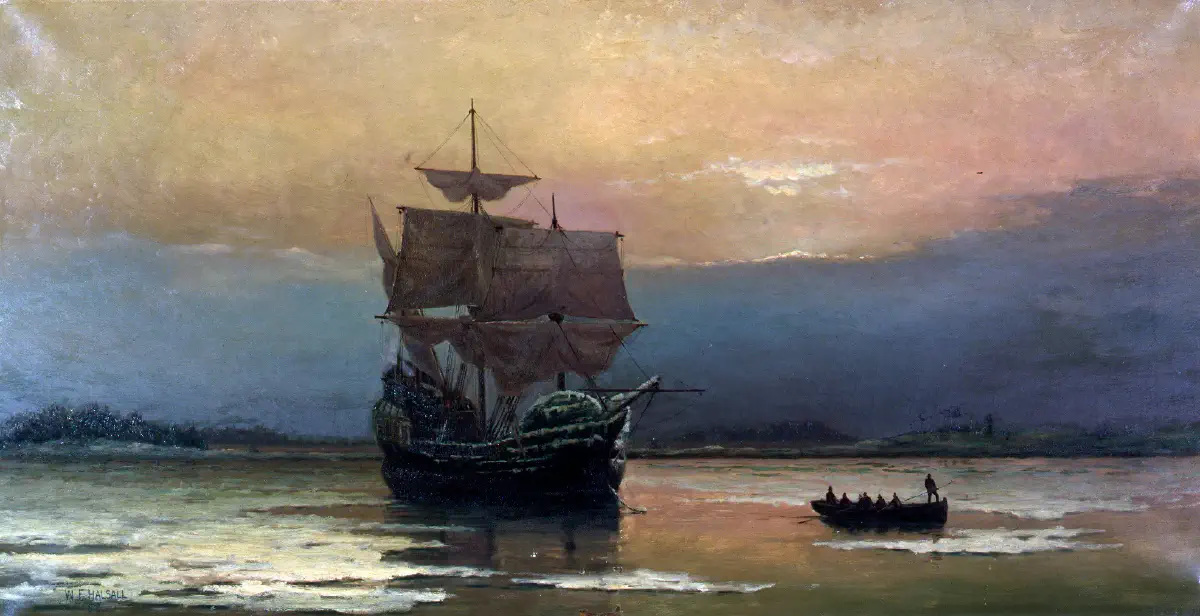
On a chill April morning in 1630 the Arbella, flagship of a small fleet, slipped out of Cowes on the Isle of Wight and set course for Massachusetts Bay. Aboard were some 300 men, women and children, most of them Puritans, led by a stern and cultivated Suffolk gentleman named John Winthrop. As the English coast sank below the horizon, Winthrop delivered a lay sermon that would become one of the foundational texts of American identity. “We shall be as a city upon a hill,” he declared. “The eyes of all people are upon us.” The colony they would found was not, in their own minds, an escape from England but an improvement upon it—an attempt to build a godly commonwealth in the American wilderness that would serve as a model for the reformation of the sinful homeland they had left behind. Winthrop’s little ship was not a repudiation of empire but a different kind of imperial project: a Protestant one, driven by the conviction that the Atlantic world was a providential stage on which the drama of salvation was to be played out.
For much of the 17th and 18th centuries, the British Empire was held together not only by fleets and financial paper but by a shared, if often fractious, Protestant identity. The empire was a confessional space, a Protestant Internationale that linked dissenters in England, Presbyterians in Scotland, Huguenots in France, and a kaleidoscope of sects in the American colonies. This religious dimension provided settlers, supplied a language of loyalty, and framed political conflicts, including the American Revolution itself, as theological dramas. It also, crucially, marked the boundaries of who could be trusted and who must be ruled. Catholic Ireland and Quebec were permanent reminders that the Protestant empire had enemies within its own gates.
Godly Migrations#
The Puritans who migrated to New England in the Great Migration of the 1630s—some 20,000 people in a single decade—were the vanguard of a much larger movement of religiously motivated settlers. They were not fleeing persecution in the simple sense; the England of Charles I and Archbishop Laud was repressive but not genocidal. Rather, they were “withdrawing” from a church that they believed had betrayed the Reformation, and doing so with the conscious purpose of constructing a new polity. Massachusetts Bay was a commonwealth of the godly, where church membership defined political rights and the Bible shaped law. Its ministers, men like John Cotton and Increase Mather, maintained a voluminous correspondence with likeminded divines in England, Scotland and the Netherlands, creating a transatlantic republic of letters that sustained a common identity.
But the Puritans were only the first wave. The Edict of Fontainebleau in 1685, by which Louis XIV revoked the religious toleration that the Huguenots had enjoyed since 1598, triggered a diaspora of French Calvinists that scattered across the Protestant states of northern Europe and into the British colonies. Perhaps 50,000 Huguenots settled in England, Ireland and the Americas, bringing with them advanced skills in silk-weaving, watchmaking, finance and wine-trading. In London, the Huguenot chapel in Spitalfields became a centre of both piety and commerce. In New York and Charleston, Huguenot families—DeLanceys, Manigaults, Faneuils—built merchant houses that would dominate Atlantic trade for generations. The Huguenot migration enriched the empire not only with human capital but with a narrative of Catholic tyranny that reinforced the ideological foundations of Protestant rule.
The 18th century brought fresh waves. Scots-Irish Presbyterians, squeezed between the pressures of Anglican landlordism in Ulster and the allure of cheap land in the Americas, poured into the backcountry of Pennsylvania, Virginia and the Carolinas. By 1776 perhaps a quarter of a million Scots-Irish had crossed the Atlantic, the largest single migrant stream from the British Isles. They were famously clannish, militantly Protestant and deeply suspicious of government power—a combination that would shape the frontier culture of the early United States. Alongside them came German-speaking Anabaptists, Moravians and Lutheran Pietists, seeking refuge from war and conscription in the Rhineland. They spread through the rich farmland of southeastern Pennsylvania, building compact, German-speaking communities that preserved their language and faith for generations. The Protestant Atlantic was not a monolith; it was a mosaic of sects, each with its own version of the godly society.
Figure 5 captures the scale and direction of these movements. The flow map traces the main trajectories: Puritans to New England, Huguenots to the seaboard cities, Scots-Irish from Scotland to Ulster and onward to the colonial backcountry, German Pietists to Pennsylvania. The thickness of the lines represents estimated migrant numbers. What the map cannot show, but what any visitor to a colonial port would have sensed immediately, was the shared atmosphere of intense, disputatious, Bible-soaked religiosity that these movements deposited across the Atlantic littoral.
Figure 5: The Protestant Internationale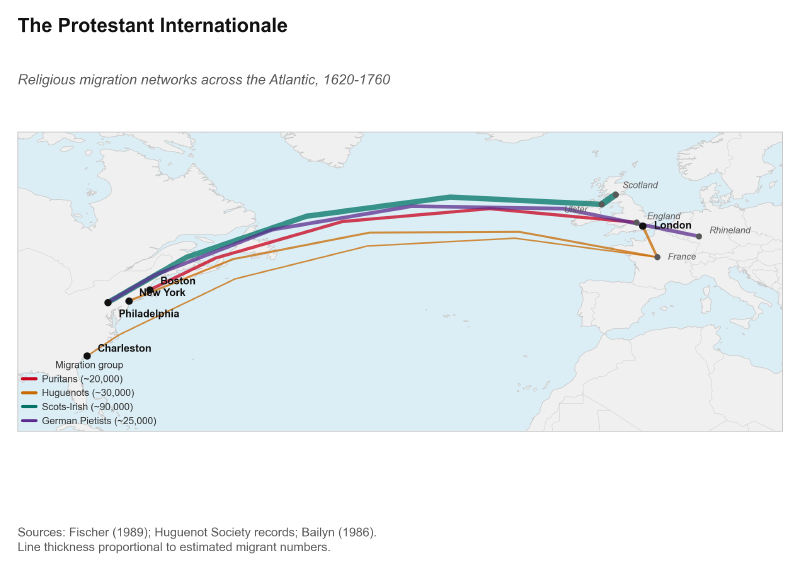
Religious migration networks across the Atlantic, 1620–1760. Line thickness ≈ estimated number of migrants. Sources: Fischer (1989); Huguenot Society records; Bailyn (1986).
The Glorious Revolution as Imperial Unifier#
If migration created the demography of the Protestant empire, the Glorious Revolution of 1688–89 gave it a political creed. When the Catholic James II fled England and William of Orange took the throne, the event was celebrated across the Protestant Atlantic as a deliverance from popery and arbitrary power. Colonists in Massachusetts, who had endured the revocation of their charter under James, seized and imprisoned the royal governor, Sir Edmund Andros, and revived their old charter under the slogan “King William and Queen Mary”. In New York, a German-born merchant named Jacob Leisler led an armed rebellion in the name of Protestant succession, holding power for nearly two years before he was executed for treason. In Virginia and Maryland, the fear of a Catholic conspiracy—real or imagined—prompted a tightening of anti-Catholic legislation.
The Glorious Revolution did more than change the monarch; it established a set of political principles that became integral to imperial identity. The Declaration of Rights affirmed parliamentary sovereignty, the rule of law and the illegitimacy of standing armies without consent. These principles were not merely English; they were Protestant. They rested on the conviction, articulated by John Locke and a host of Whig pamphleteers, that Catholicism was inherently incompatible with political liberty because it demanded allegiance to a foreign prince—the pope. The empire of toleration that the Whigs proclaimed was, in practice, an empire of anti-Catholicism. The Toleration Act of 1689 granted freedom of worship to Protestant dissenters, but Catholics remained under civil disabilities. The Protestant succession became the shibboleth of loyalty. To be a good subject of the British Empire was to be a Protestant, or at least to accept Protestant rule.
The Great Awakening and the Birth of Imperial Humanitarianism#
By the 1730s the established churches of the empire—the Church of England, the Congregational churches of New England, the Presbyterian churches of Scotland—had grown, in the eyes of many, complacent and formalistic. The response was an explosion of evangelical energy that historians call the Great Awakening. It began in the American colonies, where the itinerant preaching of Jonathan Edwards in Massachusetts and George Whitefield’s barnstorming tours from Georgia to New England ignited a wave of conversions, schisms and new denominations. Whitefield, an Anglican clergyman who preached with the theatrical intensity of a modern revivalist, was the first truly transatlantic celebrity. He crisscrossed the ocean thirteen times, drawing crowds of tens of thousands, and his published journals were bestsellers on both sides of the Atlantic.
The Awakening had profound imperial consequences. It created new networks of communication and solidarity that bypassed the established hierarchies. Evangelicals in Boston, Bristol and Edinburgh corresponded about theology, but also about slavery, the treatment of Native Americans and the duties of Christian empire. The same religious fervour that produced emotional conversion experiences also produced the first organised humanitarian movements. The anti-slavery campaigns of the 1780s and 1790s grew directly from the evangelical soil prepared by the Awakening. Figures like William Wilberforce in Britain and Samuel Hopkins in America articulated a vision of empire as a moral trust, a providential instrument for spreading the Gospel and eradicating the sins of paganism and slavery alike. The Protestant Internationale had acquired a conscience.
The Limits of Solidarity: Ireland and Quebec#
Yet the confessional solidarity of the Protestant empire was always incomplete, and its limits were most starkly visible in the territories where Catholics formed a majority. Ireland was the oldest and deepest wound. The Protestant Ascendancy, imposed after the Williamite conquest of 1691, rested on the systematic exclusion of Catholics from land, office and full legal rights. The Penal Laws, as they were called, were designed not so much to convert Catholics as to render them politically impotent. The great majority of Ireland’s population remained Catholic, poor and deeply resentful of the Protestant landlord class. The empire’s Protestant identity, far from integrating Ireland, reinforced a sectarian division that would poison Anglo-Irish relations for centuries. The same Whig ideology that celebrated liberty in England and America was compatible, in Ireland, with a garrison state.
Quebec posed a different kind of challenge. When the conquest of New France was formalised in 1763, the British state acquired some 70,000 French Catholic subjects. The question of how to govern them divided British policy-makers. Should the Quebecois be subject to the Penal Laws, as in Ireland, and barred from public office unless they abjured Catholicism? Or should their religion and legal system be tolerated in the interests of stability? The Quebec Act of 1774 chose toleration, granting the Catholic Church legal recognition and preserving French civil law. The decision was pragmatic—the British government feared that Quebec would otherwise join the rebellious American colonies—but it infuriated the Protestant colonists to the south. The Quebec Act was listed among the grievances of the Declaration of Independence. The empire that was supposedly founded on Protestant principles was now, in the eyes of American patriots, in league with popery.
The Theological Rupture of 1776#
The American Revolution was not, in its origins, a religious war. But it was saturated with religious language and fought, on both sides, by people who understood the conflict in theological terms. For the American patriots, the struggle against George III was a replay of the Glorious Revolution: a defence of Protestant liberty against the encroachments of arbitrary power, personified by a king who, many believed, was secretly in league with the Catholic powers of Europe. The Quebec Act, the stationing of British troops in Boston, the claim of parliamentary sovereignty—all could be read as signs of a popish plot. The Congregationalist clergy of New England were among the fiercest advocates of independence, their sermons portraying the revolutionary cause as a sacred duty.
For the British, the rebellion was an act of impiety as well as treason. Loyalists, many of them Anglicans, argued that resistance to the king was a sin against God’s ordained order. The king was the Defender of the Faith; rebellion against him was rebellion against providence. The theological argument mattered because it touched the deepest loyalties of ordinary people. The American Revolution was, in part, a civil war within the Protestant Internationale, a schism that divided congregations, families and friendships. When the United States was born, it inherited the providentialism of the old empire but turned it to new ends: America, not Britain, was now the city upon a hill, the vanguard of human liberty. The Protestant empire had split, but its ideological DNA lived on in both successor states.
The first British Empire was a confessional construction, held together by a shared sense of divine mission and a common fear of Catholic power. It provided settlers, justified conquest and animated the first stirrings of humanitarian conscience. But it also contained the seeds of its own dissolution. The very religious energies that had built the empire could be turned against its rulers when those rulers were perceived to have betrayed the cause. The Protestant Internationale was always a coalition of the fervent, and fervour is not easily disciplined. The empire learned, at great cost, that a city upon a hill could also be a fortress under siege.
Next in the series: “Empire Without End?”—what the making of the British Empire tells us about power today.