
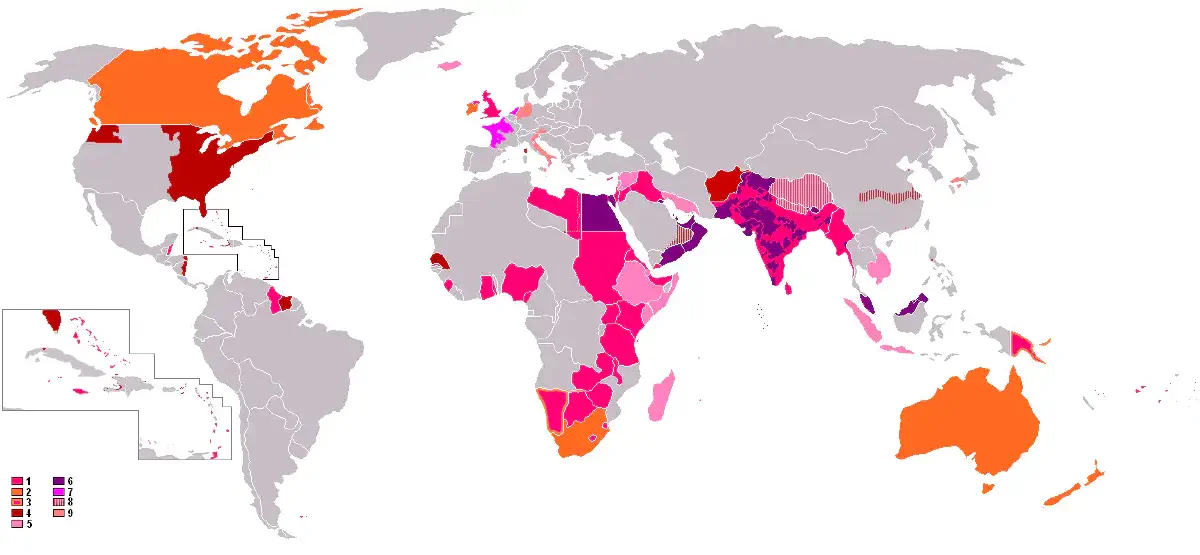
The Swelling and the Shrinking#
The territorial story is the most visible one. Between 1660 and 1815, the area of the earth’s surface under formal British sovereignty grew roughly twentyfold. The stacked area chart in Figure 6 makes the pattern clear. The pale blue band of North America swells through the early 18th century, surges after the Seven Years’ War, and then abruptly collapses in the 1780s. Even before the ink was dry on American independence, the green band of Asia—the territories administered by the East India Company—had begun its vertiginous climb. By the end of the Napoleonic Wars, British India accounted for a third of the empire’s land area and the overwhelming bulk of its subject population. The Caribbean islands, tiny in acreage, remained disproportionately valuable as sugar producers well into the 19th century, but their relative weight was shrinking. The empire had already pivoted east, a generation before the phrase “swing to the east” was coined.
Figure 6: Empire Without End?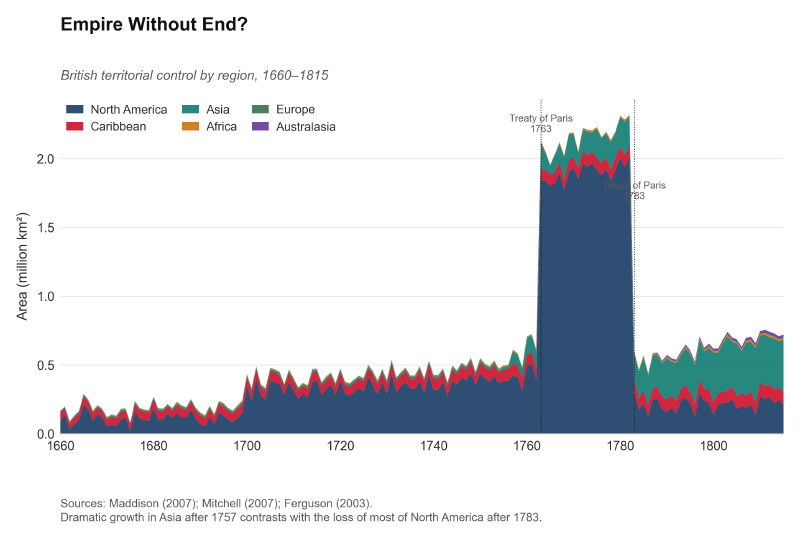
British territorial control by region, 1660–1815. Dramatic growth in Asia after 1757 contrasts with the loss of most of North America after 1783. Sources: Maddison (2007); Mitchell (2007); Ferguson (2003).
This territorial flexibility was not a sign of weakness but a survival mechanism. The British Empire was never a fixed territorial state; it was a system for managing resources, markets and strategic chokepoints. When one node of the system became ungovernable or too expensive, resources could be redirected. The American colonies, by the 1770s, were costing more to administer and defend than they yielded in tax revenue; their loss was a fiscal relief, as some Treasury officials quietly acknowledged. The empire, like a healthy organism, shed a limb and grew another. The true continuity was not territorial but institutional: the financial system of the City of London, the legal principles of the common law, the engineering of the Royal Navy’s global basing network. These outlasted any particular colony.
The American Rupture and the Second Empire#
The American Revolution was the first great crisis of the British Empire, and it is best understood not as a simple war of liberation but as an imperial civil war. Many of the grievances that drove the colonists—taxation without consent, the quartering of troops, the imposition of an established church—were grievances that had been rehearsed in Britain’s own constitutional struggles of the 17th century. The revolutionaries saw themselves as defenders of a British tradition of liberty that the Hanoverian state had betrayed. The loyalists, who fled north to Canada or east to Britain in their tens of thousands, saw themselves as the true guardians of order and allegiance. The conflict was a family quarrel, and its resolution produced two distinct heirs of the Protestant Internationale: a republican United States and a chastened British Empire that had learned to rule with a lighter hand.
The “second empire” that emerged after 1783 was less dependent on settler colonies and more focused on the commercial and military control of strategic nodes. The loss of America accelerated the move towards direct rule in India and the expansion of informal influence in Latin America, West Africa and later China. The British state, chastened by the American experience, became wary of provoking settler populations but increasingly willing to use force against non-European peoples. The racial hierarchies that had been implicit in the slavery-based empire of the Caribbean now became formalised in the bureaucratic empire of India and Africa. The empire was learning to govern without representation, and to justify that governance through a language of civilisational tutelage that would reach its full flower in the Victorian era.
The Afterlife of Institutions#
When the formal empire did finally dissolve, in the decades after the Second World War, it left behind a dense institutional residue. The sterling area, created in the 1930s and reinforced by wartime controls, maintained London’s position as the financial centre for dozens of newly independent states well into the 1970s. The common law, exported through colonial courts and codified in Indian and African legal systems, still governs the commercial relations of a third of the world’s population. The English language, carried by traders, missionaries and administrators, became the de facto global language of business and science. The governance habits of the Indian state—the steel frame of the Indian Civil Service, the military traditions of the sepoy army, the census and the revenue survey—were inherited wholesale by the post-colonial republics of South Asia and, in modified form, by much of Africa.
These institutions were not neutral tools; they carried within them the assumptions and interests of the empire that had built them. The common law’s emphasis on property rights and contract enforcement, for example, was well-suited to the needs of commercial capitalism but less concerned with the communal land-tenure systems that existed in many colonised societies. The English language, for all its cosmopolitan utility, embedded a cultural hierarchy that devalued indigenous knowledge and expression. The bureaucratic structures of the colonial state were designed for extraction and control, not for democratic accountability. The afterlife of empire is not a benign inheritance but a contested one, the subject of fierce historical debate and contemporary political mobilisation.
Lessons for Today’s Great Powers#
The making of the British Empire offers a mirror, however imperfect, for thinking about power in the 21st century. Empires do not always announce themselves as such. They operate through debt, standards and alliance structures as much as through territorial conquest. China’s Belt and Road Initiative, with its web of infrastructure loans, port acquisitions and digital standards, is often described as a new form of informal empire, one in which sovereignty is not extinguished but constrained by dependency. The United States, for its part, has long maintained an imperial system of bases, trade agreements and currency dominance—the dollar zone—that provides many of the benefits of formal empire without the costs of colonial administration.
The British experience suggests that such informal arrangements can be highly durable, but they also carry hidden fragilities. The British Empire learned, repeatedly, that debt could become a source of leverage for creditors but also a source of risk for lenders; that local elites could become clients one year and insurgents the next; that the legal and financial infrastructure of power required constant maintenance and periodic re-legitimation. The most successful empires are those that disguise their own operations, that make their dominance seem natural, inevitable, even benevolent. The British were masters of this art for much of the 19th century, but the contradictions of their position—liberal rhetoric paired with illiberal rule, free trade at home and monopolies abroad—eventually caught up with them.
Imperial Amnesia#
Perhaps the most striking legacy of the British Empire is the forgetting that has surrounded it. In Britain itself, the empire has largely disappeared from public memory, recalled only in nostalgic fragments or in fierce academic disputes. The history taught in schools until recently skipped from the Tudors to the World Wars, bypassing the centuries of global engagement that shaped the modern world. This amnesia is not accidental; it is the product of an uncomfortable relationship with a past that resists easy moral categories. The empire was at once a vehicle of commerce, science and law, and an engine of exploitation, slavery and violence. To acknowledge both dimensions is to accept a history that is complex, uncomfortable and unresolved.
The same amnesia afflicts the successor states of the empire. In the United States, the imperial origins of the republic—the shared British traditions of law, religion and political thought—are often submerged beneath a narrative of exceptionalist rupture. In India, the colonial state is alternately condemned as a rapacious foreign imposition and acknowledged as the bureaucratic and legal framework within which the modern nation was built. Across the former colonial world, the British Empire is simultaneously a memory and a present reality, embedded in institutions that cannot simply be wished away.
The series you have just read has traced the making of this empire: from the privateering raids of the Elizabethan era to the corporate conquests of the East India Company, from the sugar plantations of the Caribbean to the bond markets of the City of London, from the Protestant migrations that peopled the Atlantic to the paper infrastructure that bound it together. That history is not a morality tale, though it is filled with moral consequence. It is an account of how power operates—improvised, contradictory, always adapting—and of how the institutions that power creates can outlive the power itself. The British Empire, in its formal sense, is gone. Its habits of mind, its legal codes, its financial circuits, its languages and its patterns of trade remain. We live, whether we recognise it or not, in the empire’s long afterlife. The city upon a hill has many foundations, and not all of them are visible above ground.
This concludes the series “The Accidental Empire”. Previous articles: “Pirates, Protestants and Plantations”, “The Company That Owned a Continent”, “The Sugar Engine”, “The Paper Empire”, “The Protestant Internationale”.