
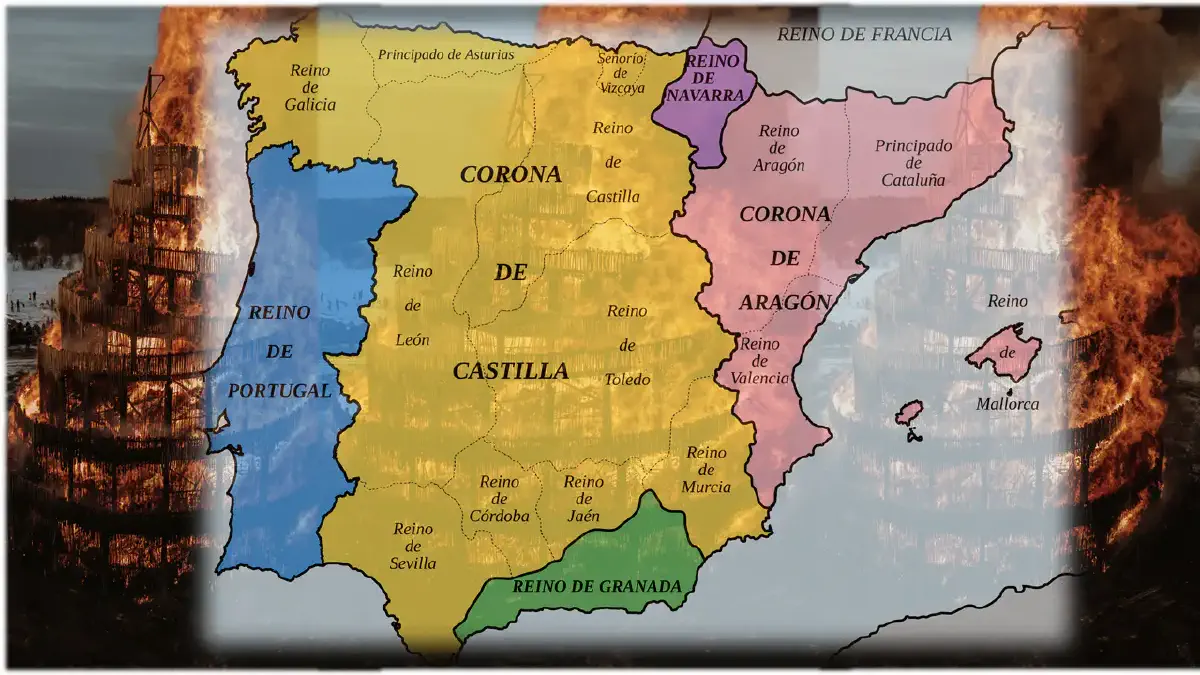
Pedro de Meneses was born into the smoke and ash of a kingdom tearing itself apart. The year was likely 1370, and Portugal was hurtling toward the abyss. King Ferdinand I, the last of the legitimate Burgundian line, was dying without a male heir. His only child, Beatriz, had been married to King Juan I of Castile, a union that threatened to swallow Portugal whole, reducing it from an independent kingdom to a mere province of its ancient rival. The nobles of the realm faced an impossible choice: honor the treaty and accept Castilian rule, or defy the law and back an unlikely rebel—the king's illegitimate half-brother, the Master of the Order of Avis, a man named John.
The House of Teles de Meneses chose Castile.
It was a rational decision, the sort that great families make to preserve their lands and titles through the chaos of dynastic storms. The Teles de Meneses were not just any nobles; they were among the most ancient and illustrious in the kingdom, cousins to the crown itself. Pedro's grandmother, Leonor Teles, had been the scandalous and brilliant queen of the late King Ferdinand, a woman whose political cunning was matched only by her capacity for making enemies. When the crisis broke in 1383, the family threw its considerable weight behind Queen Beatriz and her Castilian husband. Pedro's father, Dom Rui de Meneses, and his uncle, Gonçalo Teles, the Count of Neiva, fought under the Castilian banner. They gambled that legitimacy, backed by Castile's overwhelming military might, would crush the rebellion of the bastard Master of Avis.
They gambled, and they lost everything.
The boy Pedro, perhaps thirteen or fourteen years old, watched from the margins as his world collapsed. On August 14, 1385, on a dusty plain called Aljubarrota, the rebel army of John of Avis—outnumbered, out-armored, and armed with little more than desperate courage and English longbows—shattered the flower of Castilian chivalry. It was a slaughter that would echo through Portuguese memory for centuries. The Castilian dead lay in heaps on the sun-scorched earth, and with them died the pretensions of the Teles de Meneses. John of Avis became King John I of Portugal, founder of a new dynasty, and his vengeance against those who had opposed him was swift, methodical, and absolute.
The new king's men came for the estates. The ancestral lands of the Teles de Meneses, accumulated over generations of service and marriage, were declared forfeit to the crown. The great houses, the fertile valleys, the villages that had paid rents to the family since time out of memory—all of it was seized. The Count of Neiva, Pedro's uncle, fled to Castile, joining the court of the enemy king. Pedro's father, Dom Rui, followed. The family was broken, branded as traitors, their name spoken only in whispers or in the formal language of royal decrees of confiscation.
Pedro grew up in exile, a Castilian by circumstance, a Portuguese by blood and longing. He was raised in a court where his family's name was a badge of shame, the poor relations of a failed adventure, dependent on the charity of a foreign king whose own treasury was drained by the disaster at Aljubarrota. He learned to speak the language of diplomacy and survival, to bow to patrons who regarded him with a mixture of pity and suspicion. Every glance reminded him of what had been lost. Every night, looking out from the walls of whatever borrowed castle housed him, he could imagine the lands across the border—the hills of his ancestors, now occupied by men who had fought for the bastard John.
But exile is a forge. It burns away innocence and leaves behind something harder. Pedro was not a nostalgic; he was a calculator. He studied the art of war with an intensity born of necessity, because a landless noble has nothing else to offer. He learned to read men's ambitions, their weaknesses, the hidden levers of power. He understood, with a clarity denied to those who inherit their fortunes, that the world is built on force and opportunity, not on parchment rights. His family's legal claim to their estates was perfect, and it had been worth precisely nothing against the sharp edge of a battlefield loss.
Sometime around 1403, Pedro made his move. He returned to Portugal. The records are sparse on the exact circumstances—perhaps a negotiated pardon, perhaps a quiet crossing of the border with a handful of loyal retainers. What is certain is that he arrived as a supplicant, not a victor. King John I, secure on his throne after two decades, could afford to be magnanimous. The crown allowed Pedro to return, but the estates were not restored. He was a noble in name only, a man with a lineage that stretched back to the founders of the kingdom but without a single acre to his name.
He was given a place at court, but it was the place of a marginal figure, a reminder of a vanquished faction. The sons of the men who had won at Aljubarrota looked at him with a guarded courtesy that masked contempt. He was tolerated, but never trusted. He could attend the councils, stand in the antechambers, and smile at the great lords whose fathers had killed his father's cause. Every day he was forced to swallow the bitter taste of his family's ruin. Every night he went to sleep a man with a burning debt to his ancestors and no means to pay it.
This was the man who, twelve years later, would stand in a conquered city on the coast of Africa and watch every highborn commander in the kingdom refuse its governorship. While the Constable Nuno Álvares Pereira, the hero of Aljubarrota, shook his head and walked away. While the flower of Portuguese chivalry looked at Ceuta's walls and saw only a death trap. Pedro saw something different.
He saw his inheritance.
He saw a chance to win back, not the lost estates of his grandfathers, but something far greater. A fortune carved from the enemy's hide, a domain won not by dusty legal claim but by the sword. He saw a kingdom's unwanted burden and recognized it for what it truly was: the last, desperate opportunity of a ruined man.
The boy who had learned betrayal in the ashes of a civil war was now a man in his forties, hardened by exile, hungry for restoration, and utterly without alternatives. He had spent his entire life waiting for a door to open. In the shattered husk of a Muslim city, surrounded by enemies on every side, that door was about to swing wide.
All he had to do was walk through it, and he would never look back.