
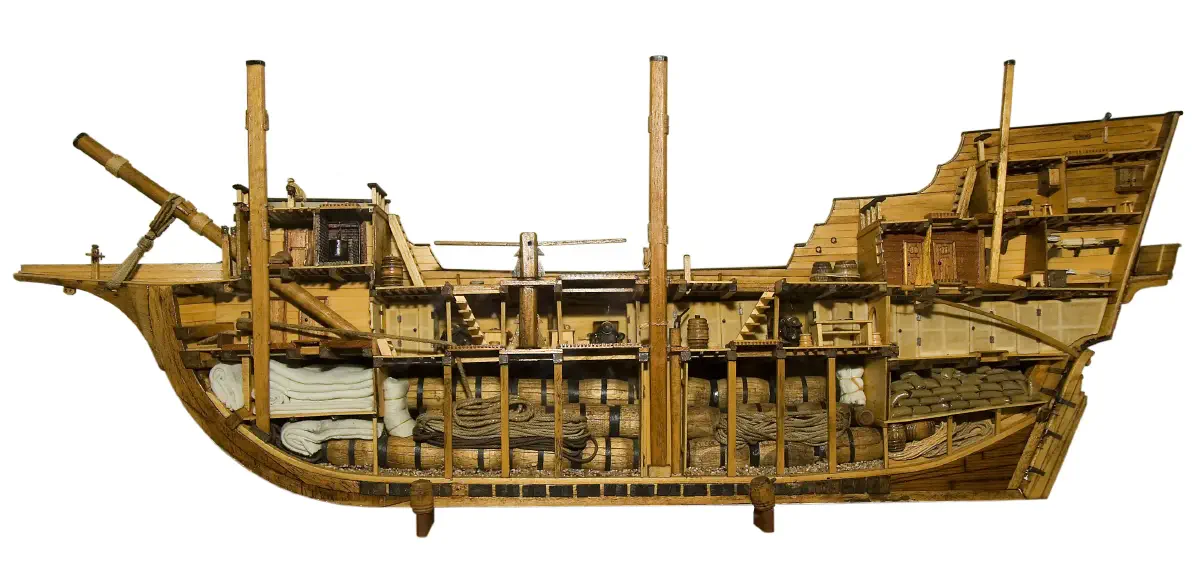
In the spring of 1415, a fleet of extraordinary size was taking shape in the shipyards and estuaries of Portugal. In the royal yards at Lisbon, the ring of hammers on oakum and the scent of hot pitch drifted across the Tagus. In Porto, where the city's merchant guilds had been persuaded—or compelled—to open their coffers, the shipwrights labored through the night by torchlight. All along the coast, from the Algarve to the Minho, the kingdom was quietly building an armada. But ships require timber, and timber requires gold; ropes require hemp, and hemp requires gold; biscuits require wheat, and wheat requires gold. For a small kingdom on the edge of Europe, a kingdom that did not mint its own gold currency and whose treasury was perpetually drained by the demands of defense and court, the question that loomed over the secret council was not simply how to conquer a city, but how to pay for the attempt without alerting a single spy.
King John I understood that the moment he summoned the Cortes—the traditional assembly of nobles, clergy, and townsmen who held the kingdom's purse strings—his secret was dead. The Cortes met in public. It debated. It argued over every bag of silver. Representatives from a dozen fractious towns would demand to know why the king needed funds for a fleet, and any answer he gave would be carried by merchants and travelers across the peninsula within weeks. The Castilian court, with its network of informants, would hear of the preparations. The Marinid sultan in Fez would hear of them. The element of surprise, upon which the entire enterprise depended, would evaporate. The spies would have risked their lives for nothing. The sand map on the floor of Sintra would become a memorial to a doomed fantasy.
So the king did something radical. He bypassed the Cortes entirely. The conquest of Ceuta would be financed by a web of private loans, secret charters, and quiet, coercive patriotism, all woven together in the shadows.
The first strand was the royal credit, extended through a network of Italian bankers who had no loyalty to any Iberian kingdom but an unerring instinct for a profitable venture. Genoese and Florentine financiers, operating out of their counting houses in Lisbon and Seville, were approached through intermediaries whose lips were sealed by the promise of lucrative interest. These were men who had financed crusades before, who understood that war is a business like any other, with risks to be calculated and returns to be harvested from plunder and trade concessions. They lent gold against the future spoils of a city they could not yet name. The king's officers, speaking in careful hypotheticals, secured lines of credit that would have been impossible through public channels.
The second strand was the municipal wealth of the kingdom's cities. Here, the king used a lighter touch, but one backed by the immense gravitational force of royal favor. The great port of Porto, the second city of the realm, was induced to fund over a third of the fleet's armament. The guild masters and aldermen were summoned to private audiences, where the broad outlines of a "holy enterprise" were sketched in language designed to stir crusading fervor and civic pride. They were promised a share of the glory, a place in the chronicles, and the more tangible reward of future trading rights in whatever lands might fall to Portuguese arms. Porto's merchants, savvy and hard-headed, likely suspected more than they were told. But the king's will was a tide that was difficult to resist. They opened their treasuries and prayed that their investment would not end at the bottom of the sea.
The third strand was the most audacious: the chartering of foreign vessels. Portugal's own merchant marine, while robust, could not carry fifty thousand men and their horses. Scores of ships would need to be hired from the great trading cities of northern Europe. But to approach the Hanseatic towns, the Flemish ports, or the merchant princes of Brittany with a sudden, unprecedented demand for dozens of large transports would set off exactly the kind of alarm the king was trying to avoid. The solution was a masterpiece of misdirection.
A false embassy was dispatched to Holland.
Its announced purpose was to negotiate a marriage alliance with the court of the Count of Hainaut, a plausible and diplomatically unremarkable errand. The real purpose, hidden beneath layers of courtly protocol, was to serve as a cover for the massive ship-chartering operation. Portuguese agents, traveling with the embassy or in its wake, fanned out across the ports of the Low Countries. They spoke to ship owners in Bruges, in Sluys, in the harbors of Zeeland. They hired vessels not for a crusade but, ostensibly, for a campaign against Dutch rebels—a tale vague enough to be plausible, dull enough to discourage probing questions. The Flemish and Dutch captains who signed the charters did so believing they were renting their ships for a routine punitive expedition in the cold, grey waters of the North Sea. The contracts were signed in languages they understood, and the gold that sealed them was real.
By the time the truth was revealed—when the fleet was already gathering and the soldiers were marching to the embarkation points—the foreign captains had little choice but to honor their agreements. Some were furious, feeling they had been tricked into a far more dangerous venture than they had bargained for. Others, smelling the possibility of plunder on a scale that a minor Dutch campaign could never offer, shrugged and counted their advance payments. Either way, their ships were now lashed to the Portuguese enterprise. The conspiracy had grown so large that it could no longer be contained, but by then, it was too late for anyone to stop it.
The assembly of provisions was a slow, grinding miracle of logistics. The royal factors, operating under instructions that were passed by word of mouth, began to accumulate mountains of food. Wheat was purchased from the Alentejo plains and milled into biscuit, a hard, dry ration that could survive weeks at sea without spoiling. Salt fish was brought in from the northern coasts, wine from the Douro valley, olive oil from the sun-baked hills of the south. Livestock was requisitioned—herds of cattle and flocks of sheep that would travel with the fleet to provide fresh meat for the army. All of this was stored in warehouses that were guarded by men who did not know what they were guarding, only that the penalty for theft was death.
And through it all, the secret held. It held because the circle of those who knew the full truth remained terrifyingly small. It held because the false narratives—the Dutch campaign, the Sicilian embassy, the routine naval exercises—were consistent and mutually reinforcing. It held because the king's agents moved with a quiet competence that left no paper trail for a spy to follow. The Castilian ambassador in Lisbon, the Marinid merchants who traded in the Algarve, the Genoese captains who passed through the strait with news of the world—all of them saw a kingdom at peace, a king occupied with the unremarkable business of governance. None of them saw the sword being sharpened in the dark.
The human cost of this secrecy was borne by the thousands who were drafted into the enterprise without knowing its destination. Soldiers drilled in camps far from the coast, told only that a great expedition was coming, a crusade that would win them salvation and riches. Sailors repaired ships whose names they did not know, loading stores that were labeled in code. Wives watched their husbands march away to mustering points, ignorant of whether they were going to Castile, to Granada, or to some place beyond the edge of the known world. The tension must have been unbearable, a kingdom holding its breath, a nation of families suspended in a state of anxious uncertainty while the king and his sons played their cards one by one, waiting for the perfect moment to reveal their hand.
That moment came in early June 1415. The final logistical pieces were in place. The fleet, assembled from a dozen ports, was ready to converge on the great harbor of Lisbon. The supplies were loaded, the foreign captains were briefed, and the soldiers were told, at last, that their true destination was Africa. The news must have rippled through the camps like an electric shock—fear and exhilaration in equal measure. The secret council, after years of silent planning, had pulled off the impossible. They had built an invasion force of two hundred ships and fifty thousand men under the very noses of their enemies.
The dam had not just cracked. It was about to shatter entirely.
On the docks of Lisbon, the foreign ships were now assembling in a great, chaotic forest of masts. The Genoese galleys, the Flemish transports, the Breton carracks—all of them riding at anchor, their hulls creaking with the weight of men and horses. The noise must have been deafening: the shouts of stevedores, the neighing of terrified horses being winched aboard, the chanting of priests blessing the fleet, the clatter of armor being stowed in heaps. The air was thick with incense, sea salt, and the sweat of an army preparing for a voyage from which many of them would not return.
In the royal palace at Sintra, the king looked out over the hills and saw the distant gleam of the Tagus, dotted with the sails of his secret armada. His sons—Duarte the careful, Pedro the restless, Henry the burning—stood at his side. They had done everything humanly possible to prepare. They had mapped the city, financed the fleet, deceived their enemies, and prayed for divine favor. Now only the sea, the wind, and the courage of their men remained between them and the walls of Ceuta.
And in the shadows of the court, still watching, still waiting, was a man who had no ships to command and no fortune to lose. Pedro de Meneses had sensed the coming storm and secured a place in the expedition, likely through the quiet patronage of a prince who saw some use in a landless, desperate noble. He was not a commander, not a planner, not a voice in the secret council. He was just one more knight among thousands, boarding a ship with his armor and his sword, sailing toward a city he had never seen.
But he was sailing toward his destiny. And the sea, indifferent to all human ambition, awaited them all.