
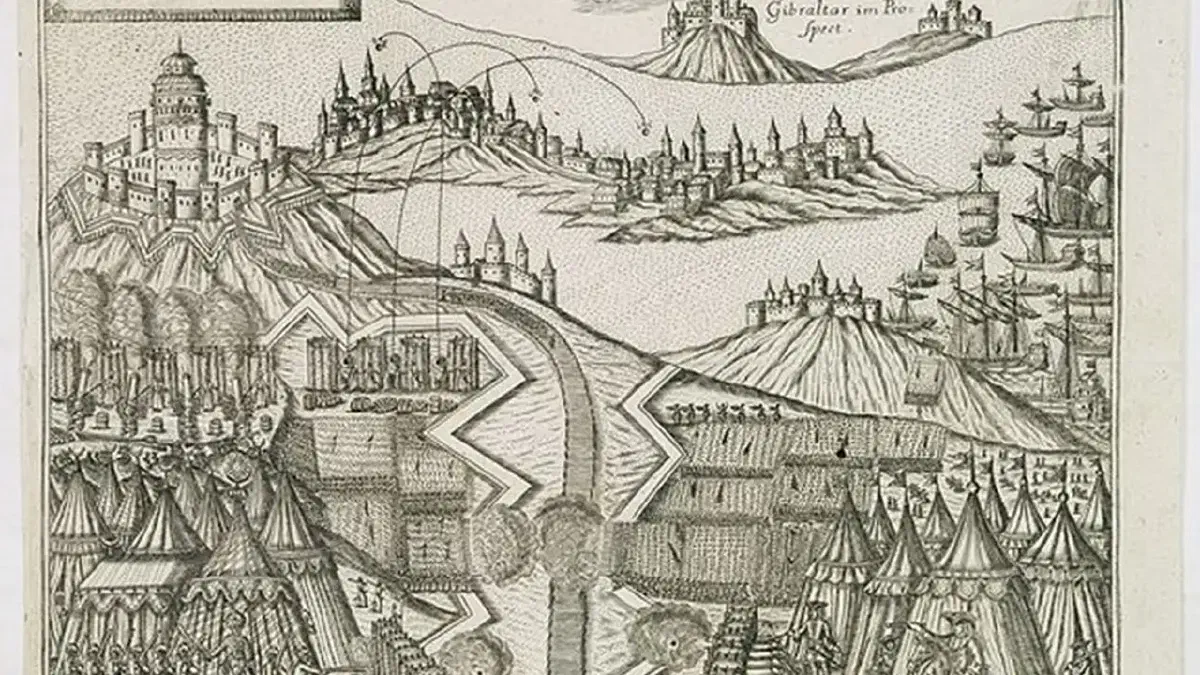
In the late summer of 1419, four years after the Portuguese had seized Ceuta, the hills beyond the city walls began to fill with men. At first it was a trickle—scouts reported small encampments, the glint of cookfires at dusk, the distant sound of drums carried on the night wind. Then the trickle became a stream, and the stream became a flood. The Marinid Sultan of Morocco, Abu Said Uthman III, had finally assembled the army that the refugees of Tétouan had been demanding since the day their city fell. He had called in allies from the mountain tribes, secured the support of the Emirate of Granada, and gathered a force that, by the time the siege lines were drawn, numbered in the tens of thousands. The Portuguese garrison, thinned by disease and desertion, could muster barely two thousand men.
Dom Pedro de Meneses stood on the highest tower of the citadel and watched the enemy host settle into the valley like a great, dark stain spreading across the land. Tents sprouted in neat rows, each one a declaration of intent. Banners snapped in the hot wind—the red and gold of the Marinids, the green and white of Granada, the geometric symbols of the Rif tribes. The noise must have been extraordinary, a low, continuous rumble of men and animals and the clang of smithies sharpening blades. This was not a raiding party. This was a full-scale royal army, the kind of force that had crushed rebellions and toppled dynasties. And it had come, at last, to reclaim the city that the Portuguese had stolen.
Inside the walls, the garrison prepared for the end. Men who had survived four years of skirmishes and privation looked out at the sea of enemy campfires and made their peace with God. The priests heard confessions in the converted mosque. Soldiers wrote letters to families they would never see again, letters that would be burned rather than delivered because no ship could now leave the harbor. The bell that usually tolled for raids fell silent. There was no need for an alarm when the threat was already at the gates, visible and vast and utterly undeniable.
Pedro convened his war council in the great hall of the citadel. It was a grim assembly. His captains, hardened men who had followed him through countless raids, sat in a circle of exhausted silence. The arithmetic of their situation was brutal, and every man in the room had done it. Two thousand against twenty thousand. A single city against two kingdoms. A supply line cut by a naval blockade that Granada's galleys had thrown across the strait. The walls were strong, but walls could be breached. The men were brave, but bravery could be overwhelmed. The only question, the one that hung unspoken in the heavy air, was how long they could hold out before the inevitable.
Some of the captains urged negotiation. The enemy, they argued, might accept a surrender. The garrison could march out with their arms, sail back to Portugal, and live to fight another day. There was no dishonor in yielding to overwhelming force. The king himself, if he could see their predicament, would absolve them. Pedro listened to these arguments in silence, his face unreadable. The aleo lay on the table before him, the olive-wood stick that had become the symbol of his command. He had sworn to defend Ceuta with it alone. Now that oath was being tested to its breaking point.
He refused to surrender. He refused to negotiate. He told his captains, in words that the chronicler Azurara would later record with awe, that he had not taken this command to give it up at the first sight of a large army. The enemy was numerous, yes, but numbers did not win battles. Surprise won battles. Audacity won battles. The enemy was camped in the valley with the arrogance of a host that believed victory was already assured. They did not expect the Portuguese to do anything but cower behind their walls. They were wrong.
Pedro had been watching the enemy camp for days, not with the passive gaze of a defender, but with the predatory eye of a hunter. He had noted the disposition of the tents, the location of the Sultan's pavilion, the gaps between the different contingents. The Marinid and Granadan forces, though nominally allied, were camped in separate sectors, their sentries facing outward but their lines of communication thin. The siege was still being established, the siege engines still being assembled, the circumvallation not yet complete. The enemy was overconfident. And an overconfident enemy makes mistakes.
Pedro's plan was simple in conception and terrifying in execution. He would not wait for the assault. He would not sit behind his walls and let the siege grind toward its inevitable conclusion. He would take the garrison, or as much of it as could be spared, and he would ride out of the city gates at dawn, directly into the heart of the enemy camp. It was a gamble of the kind that Pedro had been making his entire life, a bet placed on the single, slender chance that shock and speed could achieve what numbers and walls could not. If it failed, every man who rode with him would die, and Ceuta would fall before sunset. If it succeeded, it would be a legend.
The night before the sortie was a vigil of terror and preparation. Men sharpened their swords with the obsessive care of those who know they may be sharpening them for the last time. Horses were fed the last of the good grain, their hooves wrapped in cloth to muffle the sound of their movement. Pedro moved through the ranks, speaking quietly to his soldiers, his presence a calm, steady flame in the darkness. He did not promise victory. He promised only that they would sell their lives at a price the enemy would remember. The men, who had followed him through years of hardship, who had seen him share their rations and fight at their side, believed him. They were afraid, but they were ready.
The dawn of the appointed day broke grey and damp, a thin fog rolling in from the sea and blanketing the valley. It was a gift, that fog, an unexpected ally that shrouded the Portuguese as they assembled in the great square before the land gate. The cavalry was in front, perhaps five hundred horsemen, their mounts restless and snorting, the knights in full armor with lances couched. Behind them came the infantry, crossbowmen and swordsmen, moving as silently as so many men could. The gate, which had been sealed since the siege began, was unbarred. The hinges, freshly greased, swung open without a sound.
Pedro, mounted on a great black warhorse, raised the aleo above his head. In the grey half-light, it was a silhouette of unmistakable command. He did not give a speech. He gave a single word.
"Now."
The Portuguese cavalry burst from the gate like a thunderclap. The fog muffled the sound of the hooves until the last moment, so that the first warning the Marinid camp received was the sight of armored horsemen materializing out of the mist, already at full gallop, already among the tents. The effect was apocalyptic. Men who had been sleeping, eating, or simply waiting for another dull day of siege warfare found themselves staring into the face of sudden, screaming death. The Portuguese lances punched through cloth and flesh. Swords rose and fell. The horses, trained to bite and kick, became weapons in themselves, trampling men who threw themselves to the ground in panic.
Pedro led the charge directly toward the Sultan's pavilion, a great crimson tent that rose above the sea of smaller shelters. His target was not the common soldiers but the commanders, the nobles, the men whose death or flight would unravel the cohesion of the enemy host. The Marinid guards, caught utterly by surprise, fought with desperate courage but no coordination. They were cut down in clusters, their resistance fragmented and futile. The Sultan himself, Abu Said Uthman III, was dragged from his tent by his bodyguards and bundled onto a horse. He fled, riding hard for the safety of the hills, his royal banners trampled in the mud behind him.
The flight of the Sultan was the turning point. In the logic of medieval warfare, an army whose leader has abandoned the field is an army that has lost. The Granadan contingent, camped on the far side of the valley, saw the panic spreading through the Marinid lines and made a cold calculation. They had come to support a siege, not to die in a rout. They struck their tents and withdrew in good order, leaving their allies to their fate. The mountain tribesmen, who had joined the campaign for plunder rather than loyalty, melted away into the hills from which they had come. By midday, the great army that had encircled Ceuta had disintegrated into a chaos of fleeing men and abandoned equipment.
The Portuguese, having driven the enemy from the field, did not pursue. Pedro was too shrewd a commander to risk his exhausted men against an enemy that might regroup. He called the garrison back to the city, and the gates swung shut behind them. The battle had lasted perhaps three hours. The siege was over.
The cost, in Portuguese lives, was remarkably light. The chroniclers recorded a handful of dead and a larger number of wounded, men who would carry the scars of that day for the rest of their lives. The cost to the enemy was incalculable. The valley was littered with corpses, with abandoned weapons, with the detritus of a shattered army. The Portuguese spent the next day collecting the spoils—horses, armor, tents, and the precious siege engines that the enemy had labored for weeks to build, now reduced to kindling.
But the true cost was political, and it was borne by the man who had fled. Sultan Abu Said Uthman III had staked his throne on the recapture of Ceuta, and he had lost. The news of the disaster rippled across Morocco like an earthquake. In Fez, the capital of the Marinid realm, the viziers and nobles who had long resented the Sultan's rule saw their opportunity. Within weeks of the failed siege, a conspiracy formed in the palace. The Sultan was seized by his own courtiers and assassinated, his body dumped in a shallow grave, his name cursed by the same men who had knelt before him. A child was placed on the throne, a puppet whose strings would be pulled by the factions that had orchestrated the coup. Morocco, already fractured, descended into a chaos of civil war that would last for years.
The death of a Sultan and the implosion of a kingdom were, for Dom Pedro de Meneses, a vindication of everything he had gambled. The man who had been a landless exile, the man who had volunteered for a posting that every other lord had refused, had not only held the city. He had broken the enemy's power to threaten it for a generation. The aleo that had been a symbol of his desperate pledge was now a relic of a miracle. He had ridden out of the city gates into certain death, and he had returned alive, his legend sealed in the blood of his enemies.
The news traveled to Portugal on the fastest ship that could be found. When it reached the court at Lisbon, King John I, now an old man but still possessed of the warrior's instinct that had won him his crown, received it with a joy that was only partly royal. The conquest of Ceuta, which had been a drain on the treasury and a source of quiet anxiety, was now an unqualified triumph. The governor he had appointed in a moment of desperation had turned out to be the greatest captain of the age. The garrison, forgotten and abandoned, had written a chapter of glory that would echo through the chronicles.
And Pedro de Meneses, the Warlord of Ceuta, sat once more at his desk in the governor's palace, the ledgers of his enterprises open before him, the aleo resting in its place of honor. He had survived the greatest threat the enemy could muster. He had built a fortune, a reputation, and a dynasty. The boy who had learned betrayal in the ashes of a civil war had become a man who trusted nothing but force and gold and the audacity to use both. The city was still a fortress under siege, the sea still glittered with enemy sails, and the hills of Africa still hid a thousand enemies. But Pedro de Meneses had ridden out into the fog and returned to tell the tale. And as long as he held the aleo, Ceuta would stand.
The bell in the tower, silent during the siege, began to toll again. Not in alarm, but in celebration. The garrison of ghosts had become the garrison of legends. And their captain, the landless knight with the olive-wood stick, had become immortal.