
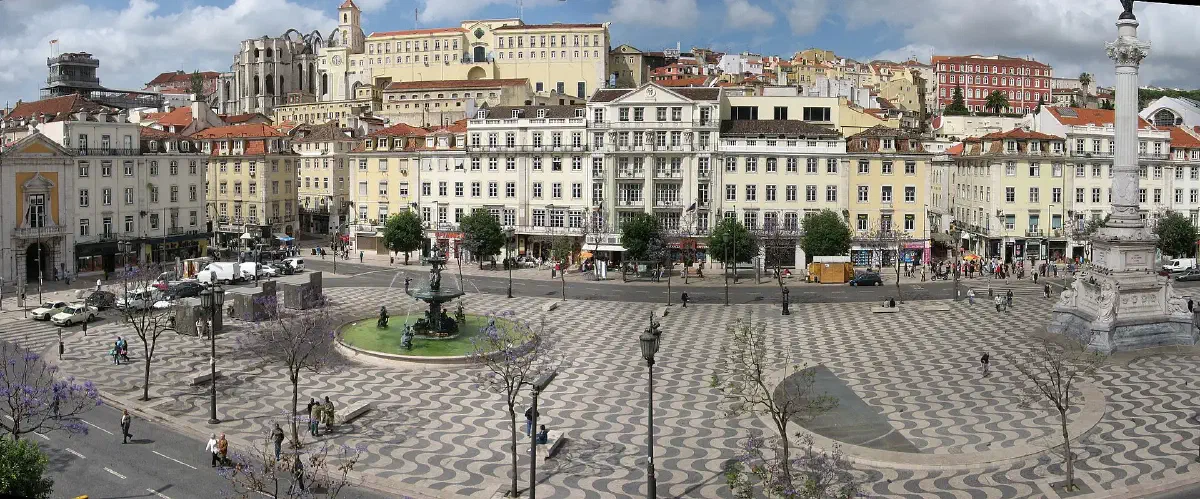
Lisbon, August 1641. The city was still drunk on the heady wine of revolution. Eight months earlier, a conspiracy of nobles had stormed the royal palace and declared the restoration of Portuguese independence. The Spanish Habsburgs, who had ruled the kingdom for sixty years, were expelled. A new king, John IV of the House of Braganza, sat on the throne. The old loyalties were being tested, the old scores settled. And in the Rossio, the most public stage in the realm, the final act of one of Portugal's greatest families was about to be performed.
Two men knelt on the scaffold. The first was Dom Miguel de Meneses, the 7th Marquis of Vila Real and Duke of Caminha, a man whose titles spanned a third of the kingdom's noble honors. The second was his son, Dom Francisco de Noronha e Meneses, the young Duke of Caminha. They were accused of high treason, of conspiring with Castile to assassinate the new king and return the crown to Madrid. The evidence, extracted through the brutal alchemy of the rack and the strappado, was damning. The sentence was death by beheading, the punishment reserved for nobles, a final, cold courtesy extended to men whose blood had once been the most exalted in the realm.
The executioner, a hooded figure whose name was kept secret to spare his family from vengeance, raised his heavy sword. The younger man died first, his body crumpling onto the blood-slicked boards. The Marquis, an old man who had once commanded armies and sat in the councils of kings, watched his son fall. Then he knelt forward, his neck exposed to the blade, and it was over. The heads were mounted on spikes above the city gates. The estates, accumulated over two centuries of ruthless ambition and strategic marriage, were forfeit to the crown. The name of Vila Real, which had inspired awe and envy for generations, was struck from the rolls of the Portuguese nobility.
And then, in a gesture that was not strictly necessary, an act of symbolic destruction that spoke louder than any decree, King John IV ordered the aleo to be brought before him. The olive-wood stick that Dom Pedro de Meneses had brandished on the walls of Ceuta two hundred and twenty-six years earlier, the talisman that had become the totem of his dynasty, had been preserved in the family's treasury as a sacred relic. Now it was produced in the palace of the new king, a length of dark, polished wood that had witnessed the birth of an empire. John IV, a man not given to theatrical cruelty, understood the power of symbols. He took the aleo in his hands and broke it over his knee. The crack of the snapping wood echoed through the hall. The dynasty of the Meneses was not merely deposed. It was unmade.
To understand how a family that had been founded by a desperate gambler with nothing to his name came to this bloody end, one must trace the long, glittering arc of its ascent. Pedro de Meneses had died in 1437, having returned to Portugal a hero, his fortune secure, his legend etched into the chronicles of the kingdom. But his true masterpiece was not the wealth he had extracted from the corsairs and captives of Morocco. It was the dynastic machinery he had set in motion before his death. He had left no legitimate son, but he had left a plan.
His legitimized natural son, Duarte de Meneses, inherited the title of Count of Viana do Alentejo, continuing the family name in a cadet line. But the core of Pedro's fortune, the vast estates and the governorship of Ceuta, passed to his daughter Beatriz de Meneses and her husband, Dom Fernando de Noronha. Pedro, with the meticulous foresight that had characterized his entire career, had constructed a legal straitjacket known as a majorat. Any heir who wished to inherit his wealth was required to adopt the surname Meneses and to bear the family's coat of arms. The Noronha name, ancient and proud as it was, would be subsumed. The brand of Meneses, forged in the crucible of Ceuta, would endure.
And so, through this brilliant piece of legal engineering, the dynasty continued. Beatriz and Fernando became the 2nd Count and Countess of Vila Real. Their son, Pedro II de Meneses, would rise even higher. A man of immense political skill and vaulting ambition, he navigated the treacherous currents of the Portuguese court with the same cold precision that his grandfather had applied to ransom negotiations. In 1489, King John II elevated him to the rank of Marquis, a title that placed the family in the rarefied air of the grandees of the realm. The House of Vila Real had arrived at the pinnacle of Portuguese aristocracy.
The century that followed was a golden age. Successive generations of the family served as governors of Ceuta, that African fortress which had become a hereditary fief, a symbol of their lineage's origin and a source of continued wealth. They accumulated more titles: Duke of Vila Real, Duke of Caminha. They married into the royal bloodlines of Portugal and Castile, their veins carrying the illegitimate but potent blood of kings. They built palaces in Lisbon and estates in the countryside. They commissioned tapestries, chapels, and tombs. When foreign ambassadors visited the Portuguese court, the Marquis of Vila Real was among the handful of men whose presence was required, whose opinion was sought, whose power was palpable.
But power, as Pedro de Meneses himself would have understood, is a wager. And the House of Vila Real, in the fullness of its arrogance, placed a bet that would destroy everything.
In 1580, the Aviz dynasty of Portugal died with the young King Sebastian, lost in the sands of Morocco at the disastrous battle of Alcácer Quibir—a battle that, with grim irony, had been fought to conquer more territory in the land that Pedro had first pierced. The throne was claimed by Philip II of Spain, the powerful Habsburg monarch who marshaled an army and a plausible genealogical argument. The Portuguese nobility was divided. Some resisted, some acquiesced, and some, like the Marquises of Vila Real, embraced the new order. They pledged loyalty to the Spanish crown, served as viceroys and counselors in the new administration, and cemented their position as pillars of the Habsburg regime in Portugal. For sixty years, this loyalty brought them stability and favor. They were the collaborators, the pragmatists, the men who had bet that the Spanish Empire was the future and that Portugal's brief, glorious independence was a relic of the past.
The bet soured in the winter of 1640. Across the Iberian peninsula, the Spanish monarchy was reeling under the weight of revolts in Catalonia and the endless, draining wars in Europe. In Lisbon, a group of conspirators saw their moment. On December 1st, they struck the royal palace, arrested the Spanish vicereine, and proclaimed the Duke of Braganza as King John IV of an independent Portugal. The revolution was swift, bloodless, and devastating to those who had tied their fortunes to Madrid. The nobles who had served the Habsburgs faced a terrible choice: abandon their loyalties and curry favor with the new regime, or remain true to their oaths and risk everything.
The 7th Marquis of Vila Real chose loyalty—to Spain. He had spent his life in the Habsburg service. His son, the young Duke of Caminha, was married to a Spanish noblewoman. Their world, their identity, their honor were bound to the fate of the Spanish crown. They refused to recognize John IV. They began to conspire.
The details of the plot that emerged in the subsequent trials were murky, amplified by torture and political necessity. But the core accusation was that the Marquis and his son had planned to assassinate the new king and open the gates of Lisbon to a Spanish army. The conspiracy was uncovered, the evidence extracted, and the fate of the two men sealed. The new dynasty, still insecure on its throne, needed to demonstrate its power and its ruthlessness. The House of Vila Real, the greatest collaborators of the old regime, was the perfect target. The trial was a formality. The execution was a spectacle.
The breaking of the aleo was the final, poetic act of erasure. King John IV, a scholar and a musician by temperament, was not a vindictive man. But he understood that the new Portugal he was building required the annihilation of the old symbols. The stick that had defended Ceuta, that had built a fortune from the spoils of war, that had passed through the hands of twelve generations of the family, was snapped like a dry branch. The gesture said everything. The dynasty was not merely dead. It had been retroactively unmade, its origins symbolically shattered, its memory consigned to the ashes.
Yet even a broken stick cannot be wholly destroyed. The House of Vila Real, extinguished in Portugal, survived in a Spanish branch. A daughter of the family, married into the Spanish nobility of the House of Medinaceli, carried the bloodline and some of the titles across the border. The descendants of Dom Pedro de Meneses, the landless exile who had gambled everything on an African fortress, still live today, their names inscribed in the rolls of the Spanish grandees. The aleo itself, the physical object, was lost. But its shadow, the idea of it, the story of a man who took a wooden gaming stick and turned it into a scepter, proved harder to break.
The square of the Rossio emptied after the execution. The crowd, sated with blood and spectacle, dispersed to their homes and their taverns. The bodies were taken down and buried in unmarked graves. The heads on the spikes slowly decayed, picked at by gulls and bleached by the sun. The new king returned to his palace, to the immense task of rebuilding a kingdom that had been a province for two generations. The House of Vila Real joined the long list of noble families that had risen on a tide of ambition and been dashed against the rocks of history.
But on the coast of Africa, the walls of Ceuta still stood. The fortress that Pedro de Meneses had held with a stick and a will of iron remained Portuguese, and would remain so for centuries after the dynasty that had been born there had crumbled to dust. The garrison still scanned the hills for the smoke of enemy fires. The bell still tolled in the tower. The sea still glittered in the Mediterranean sun, indifferent to the rise and fall of princes, the snap of broken wood, the endless, grinding cycle of fortune and ruin.
The gamble of Dom Pedro de Meneses had paid out for two hundred and twenty-six years. And then, as all gambles must, it came to an end. The aleo was broken. But the story—the story endures.