
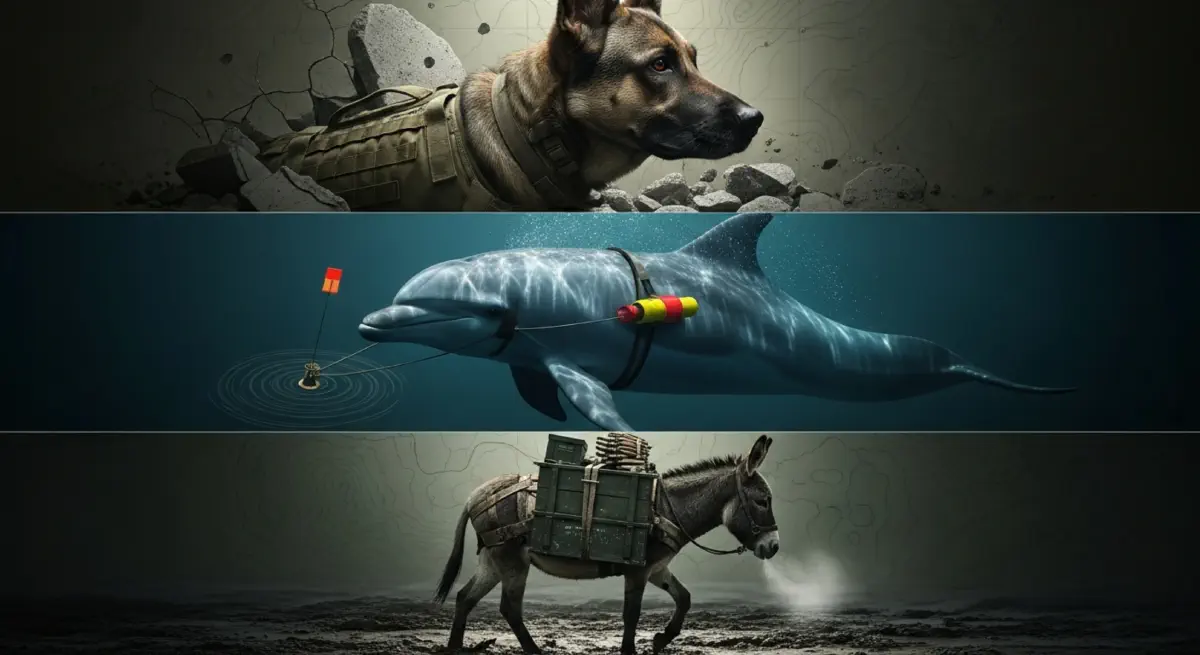
Why, in an age of artificial intelligence and hypersonic missiles, the world's most sophisticated armed forces still go to war with dogs, dolphins, and donkeys
In the spring of 2025, Ukrainian drone operators near Avdiivka spotted something that seemed to belong to a different century: Russian soldiers leading strings of donkeys through the mud, laden with ammunition crates and mortar shells. The images, beamed across social media within hours, prompted a mixture of ridicule and bewilderment. Here was a conflict defined by satellite-guided artillery, autonomous quadcopters, and cyber sabotage—and yet one of its belligerents had apparently been reduced to the logistical methods of the Napoleonic era.
The mockery missed the point. Across the world's battlefields, from the rubble of Gaza to the waters off Crimea, animals are not a vestige of pre-modern warfare but a quietly indispensable component of it. They detect explosives with greater speed and accuracy than any machine. They navigate terrain that defeats the most advanced all-terrain vehicles. They form bonds with their human handlers so operationally significant that academic researchers now study them as a distinct category of military capability. And they do all of this at a fraction of the cost of their technological alternatives.
This is the living toolbox of modern warfare: an ecosystem of species conscripted not despite the age of AI but, in important respects, because of its limitations. The first article in this series examines its contents.
The Canine Vanguard#
No animal exemplifies the modern military's reliance on biology more than the dog. The United States Department of Defense maintains approximately 1,600 military working dogs (MWDs) stationed around the world, with roughly 700 deployed overseas at any given time. The British armed forces sustain a pack of over 500. The Israel Defense Forces' Oketz unit alone procures around 70 dogs annually, sourced almost exclusively—99%—from European breeders. These are not mascots. They are operational assets integrated into combat formations at every level.
The modern MWD performs three broad roles: explosive-ordnance detection, patrol and attack, and search and rescue. In Gaza, the IDF has pushed the boundaries of all three, deploying dogs trained specifically for subterranean warfare in Hamas's tunnel networks, alongside animals working in explosive detection and assault above ground. The operational tempo has been punishing; attrition rates have averaged several dozen dogs per week. In Ukraine, the Armed Forces of Ukraine employ MWDs primarily in unexploded-ordnance detection, often using remote-handling systems that allow the handler to maintain stand-off distance from the search area.
The investment is considerable. Training a single MWD can cost up to $150,000, with roughly half of all candidate dogs failing to complete the programme. The British Ministry of Defence recently awarded a £3.1 million contract—extendable to seven years—for protective equipment including canine goggles, hearing protection, and flotation devices. The US military-animal market is projected to grow at a compound annual rate of 7.6%, reaching $67.4 million by 2030.
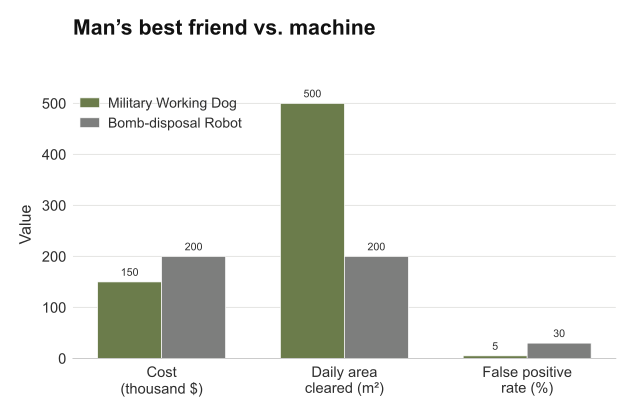
Yet the return on this investment has been extraordinary. During the Vietnam War, approximately 4,000 war dogs are credited with saving over 10,000 American lives. In the post-9/11 era, MWDs have been responsible for over 31,000 tactical explosives detections. The most comprehensive academic review of the field concludes that "detector dogs still represent the fastest, most versatile, reliable real-time explosive detection device available"—a judgement that encompasses all instrumental methods developed to date. A recent large-scale study found that explosive-detection dogs achieved an average 80% success rate in field conditions, with researchers arguing that improved access to training materials could push that figure towards a target of 90%.
The advantage is not merely olfactory. Unlike machines, dogs "make decisions, use intuition, and think outside of the realm of algorithmic predictions," as a US Army lessons-learned report observed in 2024. They can be sent into tunnels, dense vegetation, and trench networks where drones lose connectivity and wheeled robots cannot follow.
The Cetacean Sentries#
If dogs are the army's nose, dolphins are the navy's sonar. Since 1959, the US Navy's Marine Mammal Program has trained bottlenose dolphins and California sea lions to detect underwater mines, recover lost equipment, and intercept unauthorised swimmers near harbours and naval vessels. The programme currently maintains 77 dolphins and 47 sea lions at its San Diego facility, supported by a budget of approximately $40 million per year, of which roughly $21 million covers food, medicine, veterinary care, and husbandry.
The biological capabilities that justify this expenditure are not easily replicated. Dolphins possess a biosonar system that can detect objects buried under several inches of sediment on the ocean floor—a task that challenges even the most sophisticated electronic sonar, particularly in the cluttered acoustic environment of a shallow harbour. Sea lions, for their part, have directional hearing of extraordinary precision, enabling them to locate and mark underwater objects that human divers might miss. Both species can make repeated deep dives without suffering decompression sickness, a physiological constraint that limits human divers. As Drew Walter, deputy assistant secretary of defence for nuclear matters, noted in 2024: "Millions of years of evolution have given these animals exceptional skills and detection capabilities that cannot be replaced by any technology we have today and probably cannot be replaced by new technology we're going to have for a long time".
The operational record is substantive. During the 2003 invasion of Iraq, eight dolphins helped military divers locate over 100 mines and explosive devices in the port of Umm Qasr. In the 1991 Gulf War, marine mammals provided harbour defence after Iraqi mines damaged several US warships. Congress has been sufficiently convinced of their irreplaceability that it used the 2023 defence authorisation bill to prevent the Navy from phasing out the programme until replacement mine-countermeasure systems can demonstrate "as good or better" performance than the dolphins.
Russia, for its part, has expanded its own marine-mammal operations. Satellite imagery from June 2023 showed that the number of dolphin pens at the entrance to Sevastopol harbour in occupied Crimea had nearly doubled, from 3-4 to 6-7. British military intelligence assessed that the animals are "highly likely intended to counter enemy divers"—specifically, Ukrainian special forces combat swimmers who might infiltrate the Black Sea Fleet's anchorage. The Soviet programme, from which the Russian effort descends, also deployed beluga whales and seals in Arctic waters.
The Ungulate Logistics Corps#
In February 2025, videos began circulating on Russian social-media channels showing soldiers from frontline units posing with donkeys. The animals, Russian sources explained, were being used to ferry ammunition, supplies, and even wounded personnel across the drone-infested "grey zone" near Avdiivka. Viktor Sobolev, a member of the Russian Duma's defence committee, offered a characteristically blunt defence: "If some methods such as donkeys, horses, and so on are used to deliver ammunition and other supplies to the front line, this is normal".
The practice is neither as anomalous nor as desperate as it appeared. Pack animals have never fully disappeared from modern military logistics, and there are sound operational reasons for their persistence. A donkey or mule can carry roughly a quarter of its own body weight as cargo—typically 50-80 kg—across terrain that would immobilise a wheeled vehicle. They require no fuel, emit no detectable electronic signature, and are sufficiently low to the ground and slow-moving that they present a less conspicuous target to drone operators scanning for vehicles. The Lieber Institute at West Point, reviewing the phenomenon in 2025, noted that these animals "are less conspicuous than motorised vehicles" and therefore "less likely to be targeted by enemy drones operating at or near the front".
The US military has quietly maintained pack-animal capabilities throughout the drone age. The Marine Corps Mountain Warfare Training Centre in California continues to teach animal packing, and Marines deployed to Afghanistan routinely used mules to carry communications equipment, targeting systems, and other heavy gear into terrain inaccessible to vehicles. The Army and Marine Corps are both pursuing robotic "mules"—the Multi-Utility Tactical Transport—but these remain developmental, and their battery life, noise profile, and cost have yet to match the original biological version. India, meanwhile, maintains double-humped camels for high-altitude logistics in Ladakh, where the capabilities of drones and all-terrain vehicles "have not yet been proven on the required scale".
The Bond#
Underpinning the effectiveness of every animal system is a factor that military procurement documents struggle to capture: the psychological bond between handler and animal. A 2024 qualitative study of French military canine teams, published in the journal Military Psychology, identified trust as the central variable in operational effectiveness—"a dynamic, constructed process, based on experience, and involving both members of the team". The research found that trust emerged from individual, relational, technical, and experiential factors: the bonds formed during training, the handler's knowledge of their dog's behaviour, and the accumulated record of mission successes.
This bond has operational consequences that extend well beyond the deployment phase. A 2025 study analysing US military working dogs from 2019 to 2021 found that the Department of Defense requires a service life of eight years for each MWD, but that a variety of factors—including behavioural issues traceable to the intensity of combat exposure—frequently result in early discharge. Retired MWDs lose all government benefits upon decommissioning; there is no federal programme for their ongoing veterinary care, a gap that non-profit organisations such as Paws of Honor have attempted to fill, having provided over $2 million in care to 250 retired dogs across 17 states.
The handler, for their part, frequently describes the relationship in terms that blur the line between equipment and comrade. "The relationship between a military working dog and a military dog handler is about as close as a man and a dog can become," one handler told researchers. Another, reflecting on the post-9/11 deployment of search dogs at Ground Zero, observed: "These dogs become more than just their family members… They're on the front line. They're in the Super Bowl, saving people's lives".
The Avian Archivists#
The most unexpected entry in the living toolbox is also the most ancient. At the Mont Valérien fortress, just minutes by train from Paris, the French Army maintains Europe's last operational flock of military carrier pigeons—over 150 birds housed in six dovecotes with a view of the Eiffel Tower. The unit is officially part of the 8th Signal Regiment, and its keeper, a 43-year-old non-commissioned officer who previously served as a drone operator, raises each generation himself.
The persistence of military pigeons in a country that also operates nuclear submarines and aircraft carriers is not merely ceremonial. China has invested in a "reserve pigeon army" of 10,000 birds, explicitly maintained as a backup communication system in the event that electronic warfare renders modern networks inoperable. The logic is straightforward: pigeons emit no radio-frequency signal, cannot be jammed, and their message payload—a micro-SD card or lightweight capsule—is not vulnerable to cyber interception. In an era when electronic warfare has become a central feature of near-peer conflict, the carrier pigeon represents a communications system that is, by design, entirely offline.
The Logic of the Living#
What unites these disparate programmes is not nostalgia but a hard-headed recognition of technology's limits. Electronic sonar still struggles in shallow, cluttered waters; dolphins do not. Wheeled robots cannot navigate the scree slopes of a mountain pass; mules can. The best explosive-detection equipment available cannot match a trained dog's combination of speed, sensitivity, and mobility. And no machine, however advanced, replicates the intuitive decision-making that emerges from a handler-animal bond forged over months of shared danger.
The living toolbox is not cheap. The US Navy's marine mammal programme costs $40 million annually. A single military working dog represents an investment of up to $150,000 in training alone, with lifetime care costs potentially doubling that figure. But the alternatives are frequently more expensive and less capable. A Boston Dynamics Spot robot costs $74,500 for the base unit, with bomb-disposal configurations reaching $270,000—and it cannot yet match a dog's olfactory sensitivity or its ability to pursue a moving target through a rubble-strewn alleyway.
The deeper question—the one that the rest of this series will explore—is whether this calculus of utility fully captures the moral and legal relationship between the military and the animals it conscripts. For now, the Pentagon, the Kremlin, and every major military power have reached the same operational conclusion: in the right circumstances, the living tool outperforms the machine. The toolbox remains open.
References#
Furstenberg, S. (2025, January 1). The dogs of (urban) war: Lessons from Oketz, the Israel Defense Forces' specialized canine unit. Modern War Institute, United States Military Academy West Point. https://mwi.westpoint.edu/the-dogs-of-urban-war-lessons-from-oketz-the-israel-defense-forces-specialized-canine-unit/
Spook, A., & Campbell, J. (2024, August 30). Employing military working dogs in large-scale combat operations. Center for Army Lessons Learned, U.S. Army. https://www.army.mil/article/279352/employing_military_working_dogs_in_large_scale_combat_operations
U.S. Department of Defense. (2024, May 23). Marine Mammal Program contributes to national security. WAR.GOV. https://www.war.gov/News/News-Stories/Article/Article/3785968/marine-mammal-program-contributes-to-national-security/
Naval Information Warfare Center Pacific. (n.d.). Marine Mammal Program. U.S. Navy. https://www.niwcpacific.navy.mil/About/Departments/Intelligence-Surveillance-and-Reconnaissance/Marine-Mammal-Program/
British Ministry of Defence. (2023, June 23). [Intelligence update on Russian combat dolphins in Sevastopol]. https://twitter.com/DefenceHQ/status/1672118745991397376
Militarnyi. (2026, April 4). Russians increase the number of dolphins to protect the Sevastopol Bay. https://militarnyi.com/en/news/russians-increase-the-number-of-dolphins-to-protect-the-sevastopol-bay/
SOFX. (2023, February 15). The Navy trained dolphins: Underwater guardians. https://www.sofx.com/the-navy-trained-dolphins/
Furton, K. G., & Myers, L. J. (2001). The scientific foundation and efficacy of the use of canines as chemical detectors for explosives. Talanta, 54(3), 487–500. https://doi.org/10.1016/S0039-9140(00)00546-4
DeGreeff, L., et al. (2025). Effectiveness of quality-control aids in verifying K-9 team explosive detection performance. Frontiers in Veterinary Science, 12, 1668317. https://www.frontiersin.org/journals/veterinary-science/articles/10.3389/fvets.2025.1668317
Michenaud, S., Bovet, D., Lamour, T., & Laguette, V. (2024). Human-dog trust and cohesion within French military canine teams. Military Psychology. https://doi.org/10.1080/08995605.2024.2390253
Monn, J. (2024, November 14). France is breeding Europe's last military carrier pigeons. Neue Zürcher Zeitung. https://www.nzz.ch/english/france-is-breeding-europes-last-military-carrier-pigeons-ld.1857265
Lieber Institute for Law and Land Warfare. (2026, February 20). Military animals in armed conflict. United States Military Academy West Point. https://lieber.westpoint.edu/military-animals-armed-conflict/
Phillips, G. (2017). Animals and the military. In Oxford Bibliographies in Military History. Oxford University Press. https://doi.org/10.1093/obo/9780199791279-0001
Express. (2025, October 2). Desperate Putin prepares to send Russian troops into battle on horseback. https://www.express.co.uk
U.S. Department of Defense. (2022, December 29). JBSA-Randolph dog handlers continue the mission. https://www.jbsa.mil
Independent. (2024, November 8). Pictures show military dogs wearing new equipment after £3.1m MoD contract. https://www.independent.co.uk
DVIDS. (2021, October 29). 21st SFS retires seven, honors one fallen MWD. https://www.dvidshub.net
GlobalSecurity.org. (2011). Marine Mammal Systems (MMS). https://www.globalsecurity.org/military/systems/ship/mms.htm
DVIDS. (2007, July 4). 'Sentinels of the Sea' featured in new Pentagon Channel documentary. https://www.dvidshub.net
Youngblood, B. (2022, April 21). Honoring Paws of Honor. dvm360. https://www.dvm360.com/view/honoring-paws-of-honor
DVIDS. (2023, February 20). From fear to love: A military working dog's story. https://www.dvidshub.net
Vietnam Veterans Memorial Fund. (2020, May 15). Dogs of the Vietnam War. https://www.vvmf.org
Forces News. (2025, September 5). Exclusive: Behind the scenes at US Military Mule School where mules out-perform modern tech. https://www.forcesnews.com
U.S. Naval Institute. (2022, April 1). Marines need a few good mules. Proceedings. https://www.usni.org
NDTV. (2024, October 12). Hoof patrol? How 2-humped camels are being trained as 'soldiers' in Ladakh. https://www.ndtv.com
The Moscow Times. (2025, March 3). Russian army's use of donkeys in Ukraine underscores a staggering equipment shortage. https://www.themoscowtimes.com
Havok Journal. (2025, April 2). Pentagon declares war on cybersecurity breaches with carrier pigeons. https://havokjournal.com
National Interest. (2020, July 25). The real U.S. Navy 'SEALs'—as in sea lions, dolphins and whales. https://nationalinterest.org
U.S. Department of Veterans Services, Arizona. (2023, March 13). National K9 Veterans Day. https://dvs.az.gov
Grand View Research. (2026). U.S. military animal market size, share & trends analysis report. https://www.dri.co.jp
Frontiers in Veterinary Science. (2025). United States military working dogs from 2019 to 2021: Analysis of causes of service discharge and decreased service life. PMC. https://pmc.ncbi.nlm.nih.gov
This is the first article in a six-part series, "The Animal Proxies," examining the role of animals in modern warfare. The next instalment will explore the emerging frontier of bio-hybrid warfare, from mine-detecting rats to cyborg insects.