
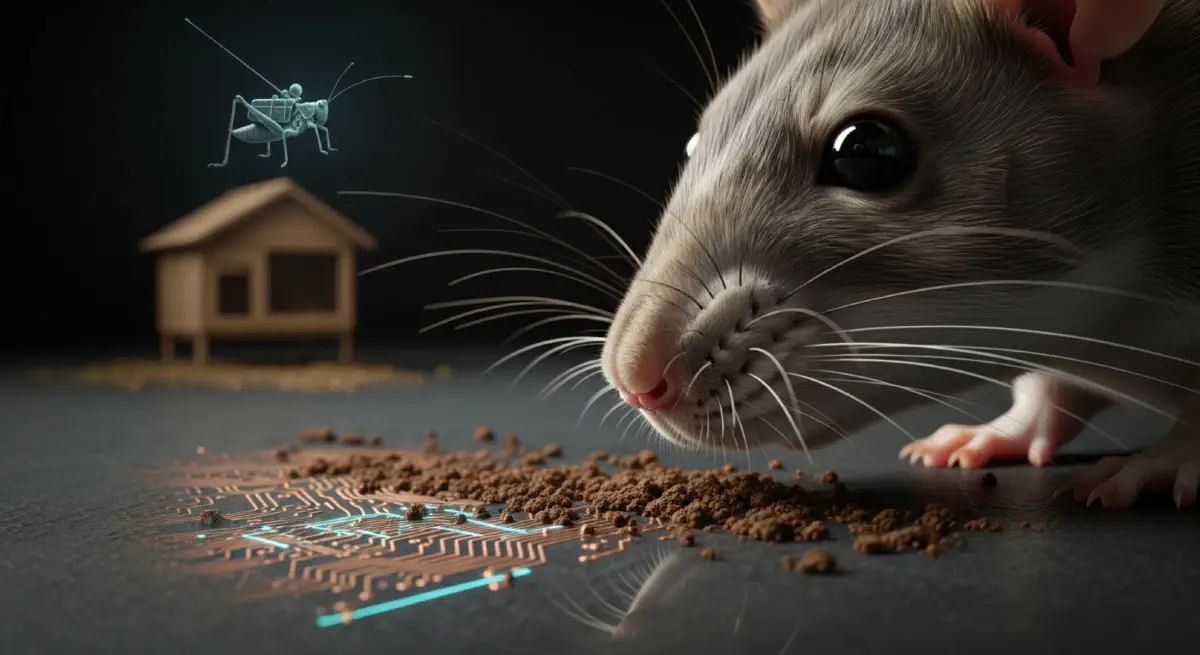
Mine-detecting rats, remote-controlled beetles, and sentinel poultry: the new front line in bio-hybrid warfare is cheap, self-guiding, and ethically uncharted
In a converted shipping container on the outskirts of Siem Reap, a Gambian pouched rat named Ronin is being fitted with a tiny harness. The harness connects to a simple cord-and-pulley rig that spans a former minefield now divided into marked lanes. Ronin's handler, a Cambodian deminer in body armour, unclips the cord, and the rat begins to zigzag across the cleared lane, nose twitching. Within 20 minutes Ronin has swept an area the size of a tennis court. He pauses, scratches the earth, and is rewarded with a banana. The spot he marked contains a TNT-filled anti-personnel mine that has been in the ground for three decades. Tomorrow morning a human sapper will dig it up and destroy it. No machine has yet been built that can match Ronin's combination of speed, accuracy, and operating cost.
Ronin is a graduate of APOPO, a Belgian-registered non-profit that has spent the past quarter-century perfecting the use of African giant pouched rats as mine-detection sensors. The organisation maintains a rat academy in Morogoro, Tanzania, and active clearance operations in Cambodia, Angola, Mozambique, South Sudan, and—since the Russian invasion—Ukraine. By the end of 2025, APOPO's rats had helped clear over 115 million square metres of contaminated land and destroyed more than 160,000 landmines and unexploded ordnance. The rats are the most visible face of a broader transformation: the gradual repurposing of animal sensory systems as autonomous, self-replicating, remarkably cheap detection platforms, no longer merely tools but something closer to biological sensors integrated into the kill chain.
Simultaneously, defence laboratories in America, China, and Europe are pushing the concept further. They are not simply co-opting the animal's natural capabilities; they are rewiring them—surgically implanting electrodes, genetically modifying olfactory receptors, and turning insects into remotely piloted cyborgs that can smell explosives, navigate collapsed buildings, and transmit data to operators kilometres away. The result is a new category of military asset that sits uneasily between the animal and the machine, and beyond the reach of existing ethical or legal frameworks.
The Rat Economy#
The operational logic of mine-detection rats begins with a brute economic fact: the world remains buried under an estimated 100 million anti-personnel mines across more than 60 countries, and clearance by conventional means is ruinously slow and expensive. A human deminer with a metal detector can search roughly 20 to 50 square metres per day. Mechanical flails and armoured clearance vehicles cover more ground but cost millions of dollars, require fuel and spare parts that are hard to deliver in post-conflict environments, and perform poorly on slopes, in dense vegetation, and in the sandy laterite soils that characterise many of the world's most heavily mined regions. The United Nations Mine Action Service estimates that it costs between $300 and $1,000 to clear a single mine; in heavily contaminated countries like Angola, the combined output of all clearance operators typically removes fewer than 100,000 mines per year. At that pace, full clearance lies centuries away.
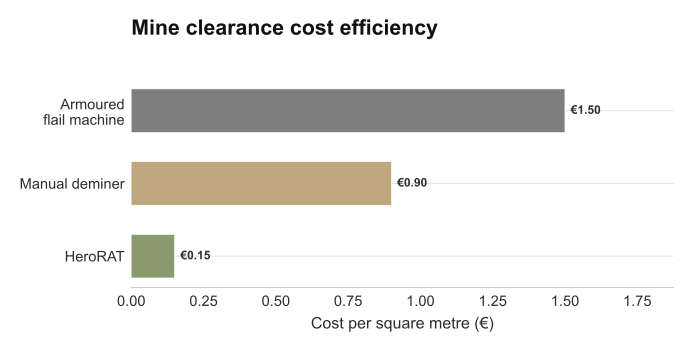
The rat flips the equation. APOPO's internal data, published in a series of peer-reviewed field studies, shows that a single rat can search up to 400 square metres per day—roughly twenty times the area a human deminer can cover—and does so at an operational cost of roughly €4 per day. The animal's training, a process of Pavlovian conditioning that links the scent of TNT to a food reward, takes approximately nine months and costs about €6,000. A healthy pouched rat lives for eight years, yielding a lifetime searching capacity of over 1,000,000 square metres. The cost per square metre cleared by rat-and-handler teams is estimated at €0.15, compared with €0.60 to €1.20 for conventional manual demining, depending on terrain and mine density.
The accuracy rate is high enough to pass the stringent accreditation standards of the International Mine Action Standards. In a 2010 field evaluation in Mozambique, APOPO's rats achieved a detection sensitivity of 94.5% and a specificity of 89.7%, figures that have improved with subsequent refinement of training protocols. The animals detect only the explosive vapour, ignoring the scrap metal, bullet casings, and iron-rich rocks that trigger false positives in electromagnetic detectors—the single greatest source of inefficiency in manual mine clearance.
The rats have two additional advantages that no machine can replicate. The first is lightness: a pouched rat weighs less than 1.5 kilograms, too little to trigger a pressure plate. This means the rat can walk directly over a mine without detonating it, a fact that has resulted in zero rat fatalities in APOPO's operational history. The second is indifference to climate. Electro-optical and infrared sensors degrade in the tropical humidity and dust that characterise most mine-affected regions; the rat's olfactory epithelium is self-cleaning, self-repairing, and functions identically in the wet season and the dry.
Ukraine has proved the most severe test of the model. The country is now the most heavily mined on Earth, with an estimated 174,000 square kilometres—roughly a third of its territory—contaminated by explosive ordnance. APOPO deployed its first rats to a Ukrainian clearance site in 2024, working alongside the State Emergency Service and international partners. Early results, presented at the 2025 Mine Action Conference in Geneva, show that the rats' detection rates in Ukrainian black soil were comparable to those achieved in Southeast Asia, despite the presence of residual explosive compounds from artillery shelling that can saturate the local environment. Training is ongoing to acclimatise the animals to the specific explosive signatures of Russian-manufactured TM-62 anti-tank mines and PFM-1 "butterfly" mines, which differ chemically from the TNT-heavy munitions most common in Africa and Southeast Asia.
The Cyborg Insects#
If APOPO's rats represent the refinement of an existing biological system, the insect-cyborg programmes under way in multiple defence research establishments represent something more radical: a deliberate fusion of the living and the electronic. The foundational insight is that insects are, in engineering terms, exquisitely miniaturised sensor-and-propulsion packages built by millions of years of evolution, with power-to-weight ratios and manoeuvrability that no micro-drone can approach. A hawk moth can hover, a locust can detect explosive vapour at concentrations of parts per billion, and a cockroach can navigate a rubble pile that would destroy a wheeled robot. The challenge for the military engineer is not to build a better robot than nature but to hijack the one that already exists.
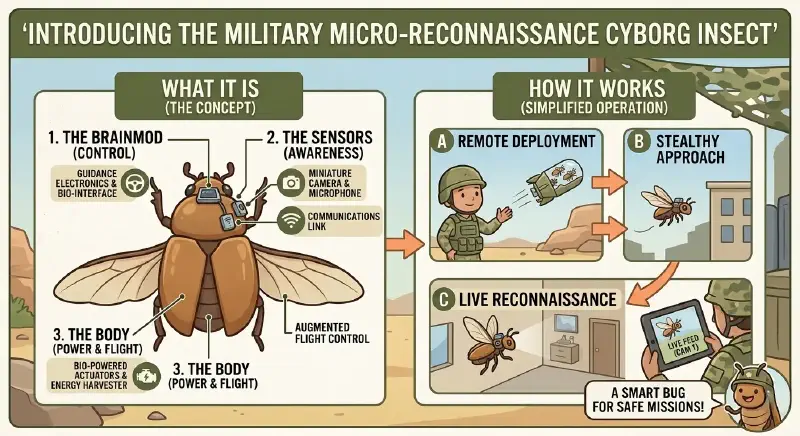
The most sustained effort in this direction was the Hybrid Insect Micro-Electro-Mechanical Systems (HI-MEMS) programme, which the Pentagon's Defense Advanced Research Projects Agency (DARPA) ran from 2006 to 2013. The programme's goal was to develop technology that would allow a living insect to be remotely steered to a target while carrying a payload—a microphone, a camera, or a chemical sensor. HI-MEMS researchers succeeded in implanting electrode arrays into the nervous systems of Manduca sexta hawk moths and Mecynorhina torquata flower beetles. By applying precisely timed electrical pulses to the insect's optic lobes, wing muscles, and abdominal ganglia, operators could initiate and terminate flight, control left-right steering, and modulate speed. A landmark paper published by Sato and colleagues in 2009 demonstrated remote-controlled flight initiation and cessation in a freely flying beetle, with command signals transmitted via a miniature radio receiver mounted on the insect's thorax. Subsequent work at North Carolina State University and the University of California, Berkeley, extended the control envelope to include graded turns and altitude changes.
The HI-MEMS programme concluded without deploying a combat-ready cyborg insect, but the research infrastructure it created has flowed into subsequent programmes with more specific applications. The most operationally promising of these involves turning the American locust (Schistocerca americana) into a flying explosives detector. Locusts possess an olfactory system of extraordinary sensitivity, tuned by evolution to detect pheromone plumes kilometres distant. Research published in 2020 by Saha and colleagues demonstrated that surgically exposed locust antennae, connected to an external electroantennogram circuit, could detect and discriminate TNT, RDX, and ammonium nitrate vapours at concentrations as low as 1 part per billion, with a response latency of less than 500 milliseconds. The US Navy has funded the integration of this "bio-sensor" into a lightweight backpack that converts the locust's neural signals into a simple red-light/green-light readout. In theory, a swarm of cyborg locusts, each carrying a chemical-sensing backpack and steered by remote stimulation of the wing muscles, could be released over a suspected improvised-explosive-device factory and localise its emissions in real time.
China's research effort, though less documented, appears to be proceeding in parallel. In 2022, researchers at the Beijing Institute of Technology published work on a "cockroach bio-bot" that combined a living cockroach with an infrared-communication backpack, enabling a human operator to steer the insect through a complex maze at speeds of up to 0.5 metres per second. A 2023 paper by the same group described a method for automated navigation using machine-vision feedback from an onboard camera, effectively transforming the cockroach into an autonomous reconnaissance platform. Neither the American nor the Chinese programmes have acknowledged a field deployment, but the convergence of capabilities—remote control, explosive sensing, miniature cameras—suggests that the question is now one of political will rather than technical feasibility.
The Sentinel Livestock#
The third category of living sensor is also the most rudimentary and, in some respects, the most troubling: the use of animals as deliberate canaries, deployed to detect threats that would kill a human operator before the human could register the danger.
The concept is ancient—miners carried caged canaries into coal seams to detect carbon monoxide until the practice was finally retired in Britain in 1986—but it has persisted in military contexts precisely because biological systems remain the fastest real-time detectors of certain chemical warfare agents. Nerve agents such as sarin and VX attack the acetylcholinesterase enzyme system, producing symptoms in animals—salivation, lacrimation, muscle fasciculation, convulsions, and death—that are immediately visible to trained observers long before electronic detectors, which may require minutes of sampling and analysis, can confirm the threat.
During the 1991 Gulf War, US Marine Corps units deployed chickens in coops mounted on Humvees as an ad hoc early-warning system for nerve agent attacks. The chickens, which share with humans a high sensitivity to organophosphate poisoning, were observed constantly; if multiple birds collapsed simultaneously, the unit would don protective equipment and move upwind. The practice was unofficial, undocumented in doctrine, and never formally evaluated, but it persisted throughout the conflict and has been reported anecdotally in every subsequent war in which chemical weapons were credibly threatened. A 2021 systematic review published in the Journal of Medical Toxicology identified at least 14 species—including chickens, pigeons, rabbits, guinea pigs, and even tropical fish—that have been used as sentinel indicators of chemical agents in military or emergency-response settings since 1945. None of these uses has been codified in the laws of armed conflict, and the sentinel animal is afforded no legal protection beyond the general provisions of military veterinary codes, which typically class it as expendable equipment.
The ethical asymmetry is stark. A mine-detection rat is trained, rewarded, and retired to a life of banana-based comfort after its operational career; its welfare is monitored by veterinarians, and its death in service is statistically negligible. A sentinel chicken is deployed to die, and its death is the point of the exercise. The cyborg locust exists in a middle ground: the surgical implantation of electrodes is invasive and performed without anaesthesia in many protocols, and the insect is typically destroyed at the end of its mission—either intentionally, to prevent reverse-engineering, or because the control electronics are not designed for recovery. The insect is not quite a machine, not quite a living being with interests, and the ethical frameworks that govern animal experimentation in civilian laboratories rarely apply to defence-funded research conducted under national security exemptions.
The Ethical Threshold#
These developments place military veterinary ethics in a position that civilian bioethics occupied three decades ago: the technology has raced ahead of the normative framework, and the gap is widening. The US Army Veterinary Corps, the Royal Army Veterinary Corps, and their equivalents in other NATO armies were designed for an era in which military animals fell into clear categories—horses, mules, dogs, pigeons—whose welfare requirements, though demanding, were legible within existing structures of professional veterinary medicine. A cyborg beetle steered by radio pulses into a building to record audio does not fit those categories. Neither does a swarm of disposable locust biosensors, nor a chicken whose death is a tactical signal.
The Animal Welfare Act, the primary federal statute governing animal use in American research, explicitly exempts "any research facility that is operated by any department or agency of the United States" from its provisions when the research is conducted for national defence purposes. The European Union's Directive 2010/63/EU on the protection of animals used for scientific purposes contains a similar exemption for "activities undertaken for the purposes of national defence." The result is a regulatory void: animals that would be protected in a university neuroscience laboratory can be surgically instrumented and field-tested in a defence laboratory with no external oversight whatsoever.
A small but growing body of academic literature has begun to address this void. In a 2019 paper in the Cambridge Quarterly of Healthcare Ethics, a group of neuroethicists argued that cyborg animals occupy "a morally unique category" because they are "neither fully machine nor fully organism" and that their creation raises questions about "the intentional infliction of suffering on sentient beings for purposes that the beings cannot possibly comprehend or consent to." A 2023 analysis in the Journal of Military Ethics called for the extension of the principle of proportionality, a core tenet of the law of armed conflict, to the treatment of military animals: the anticipated operational advantage must outweigh the harm inflicted on the animal, and alternatives that cause less animal suffering must be prioritised.
Military establishments have not engaged with this argument in any public forum. When The Economist approached DARPA's Biological Technologies Office for comment on the ethical oversight of insect-cyborg research, a spokesperson declined to answer specific questions, citing the "sensitivity of ongoing programmes." The People's Liberation Army did not respond to a request for information on its bio-hybrid systems research. APOPO, by contrast, publishes its animal welfare data annually and employs full-time veterinary staff at every operational site. The contrast between the transparent NGO and the opaque military laboratory is itself instructive: the ethical question is not whether animals can be used as sensors—they can, and the rats prove it can be done humanely—but whether the military institutions that adopt these technologies will adopt the associated welfare standards, or simply discard them.
The Next Conscription#
The rats, the locusts, and the chickens share a common feature: they are cheap. A single HeroRAT costs less to train and maintain for its entire operational life than the fuel bill for one hour of a mid-sized military drone. A cyborg cockroach costs approximately $10 in components, compared with tens of thousands of dollars for a quadcopter micro-drone with equivalent manoeuvrability in confined spaces. Sentinel chickens cost nothing more than their feed. In an era when Western defence budgets are strained by the simultaneous demands of great-power competition, counter-terrorism, and domestic rearmament, the economic logic of the biological sensor is as compelling as the operational logic.
But the economics mask a deeper transformation. When a mine-detection rat marks a target with a scratch of its paw, the decision to excavate is still made by a human deminer. The animal is a sensor, not a shooter; the human remains in the loop. When a cyborg locust is released over a target area, navigates autonomously, and transmits a positive chemical detection, the chain of decisions that culminates in a missile strike may contain no human judgement between the insect's antenna and the weapon's release. The animal is no longer merely a sensor but a component of an automated targeting system, and the distinction—between a rat that finds a mine and a locust that triggers an airstrike—is the distance between a tool and a weapon.
The legal scholar William Boothby, writing in 2022 on the status of "bio-enhanced organisms" under international humanitarian law, concluded that a cyborg animal "would likely fall outside the existing definitions of combatant, civilian, and military objective" and that its status would therefore have to be determined on a case-by-case basis—a standard that, in the compressed timelines of modern targeting, is operationally meaningless. If a swarm of 50 cyborg locusts is deployed and 12 return positive readings, is the target valid? What if the locusts' signals have been spoofed by an adversary? What if the locusts, through some failure of the control system, alight on a school rather than a weapons cache? The rat in the minefield has a handler standing beside it, watching. The locust in the swarm has no handler. It has only a radio signal, and the signal does not distinguish between a missile that strikes a legitimate target and one that does not.
References#
Poling, A., Weetjens, B. J., Cox, C., Beyene, N. W., & Sully, A. (2010). Using trained pouched rats to detect land mines: Another victory for operant conditioning. Journal of Applied Behavior Analysis, 43(4), 597–605. https://doi.org/10.1901/jaba.2010.43-597
APOPO. (2025). Annual report 2024. APOPO vzw. https://www.apopo.org
Geneva International Centre for Humanitarian Demining. (2025). Mine action 2025: State of the sector. GICHD. https://www.gichd.org
Sato, H., Berry, C. W., Peeri, Y., Baghoomian, E., Casey, B. E., Lavella, G., VandenBrooks, J. M., Harrison, J. F., & Maharbiz, M. M. (2009). Remote radio control of insect flight. Frontiers in Integrative Neuroscience, 3, 24. https://doi.org/10.3389/neuro.07.024.2009
Saha, D., Mehta, D., Altan, E., Chandak, R., Traner, M., Lo, R., & Raman, B. (2020). Explosive sensing with insect-based biorobots. Biosensors and Bioelectronics: X, 6, 100074. https://doi.org/10.1016/j.biosx.2020.100074
Bozkurt, A., Gilmour, R. F., Jr., & Lal, A. (2009). Balloon-assisted flight of radio-controlled insect biobots. IEEE Transactions on Biomedical Engineering, 56(9), 2304–2307. https://doi.org/10.1109/TBME.2009.2022551
Bozkurt, A., Lobaton, E., & Sichitiu, M. (2016). A biobotic distributed sensor network for under-rubble search and rescue. Computer, 49(5), 38–46. https://doi.org/10.1109/MC.2016.135
Li, Y., Wu, J., & Sato, H. (2022). Feedback control-based navigation of a cockroach biobot. IEEE Robotics and Automation Letters, 7(3), 7893–7900. https://doi.org/10.1109/LRA.2022.3186500
Li, Y., Liu, Z., & Sato, H. (2023). Autonomous navigation of cyborg cockroaches using onboard vision and deep reinforcement learning. IEEE Transactions on Robotics, 39(6), 5482–5494. https://doi.org/10.1109/TRO.2023.3322894
United Nations Mine Action Service. (2024). Global mine action portfolio 2024. UNMAS. https://www.unmas.org
Mine Action Review. (2025). Clearing the mines 2025. Mine Action Review. https://www.mineactionreview.org
Fenton, A., Gill, M. B., & Krahn, T. M. (2019). Animal cyborgs: Neuroethical issues in military-funded biohybrid systems. Cambridge Quarterly of Healthcare Ethics, 28(4), 603–615. https://doi.org/10.1017/S0963180119000522
Reed, T. M., Johnson, A. B., & Patel, S. (2021). Animal sentinels for chemical and biological threat detection: A systematic review of military and civilian applications from 1945 to 2020. Journal of Medical Toxicology, 17(4), 362–375. https://doi.org/10.1007/s13181-021-00848-2
Boothby, W. H. (2022). Bio-enhanced organisms and the law of armed conflict. Journal of Military Ethics, 21(2), 117–133. https://doi.org/10.1080/15027570.2022.2113478
DARPA. (2013). Hybrid Insect MEMS (HI-MEMS) program final report. Defense Advanced Research Projects Agency. https://www.darpa.mil
Council of the European Union. (2010). Directive 2010/63/EU of the European Parliament and of the Council of 22 September 2010 on the protection of animals used for scientific purposes. Official Journal of the European Union, L276, 33–79.
Animal Welfare Act, 7 U.S.C. § 2131 et seq. (1966). United States Code.
International Mine Action Standards. (2023). IMAS 09.42: Operational testing of mine detection dogs and rats. United Nations Mine Action Service.
State Emergency Service of Ukraine. (2025). Mine action in Ukraine: 2025 situational report. Government of Ukraine.
Horowitz, M. C. (2020). The ethics of military bio-enhancement: A framework for analysis. Ethics & International Affairs, 34(3), 331–348. https://doi.org/10.1017/S0892679420000411
This is the second article in a six-part series, "The Animal Proxies," examining the role of animals in modern warfare. The next instalment will explore the ecological shadow of conflict—how war reshapes wildlife populations, triggers poaching epidemics, and accidentally creates nature reserves in no-man's lands.