
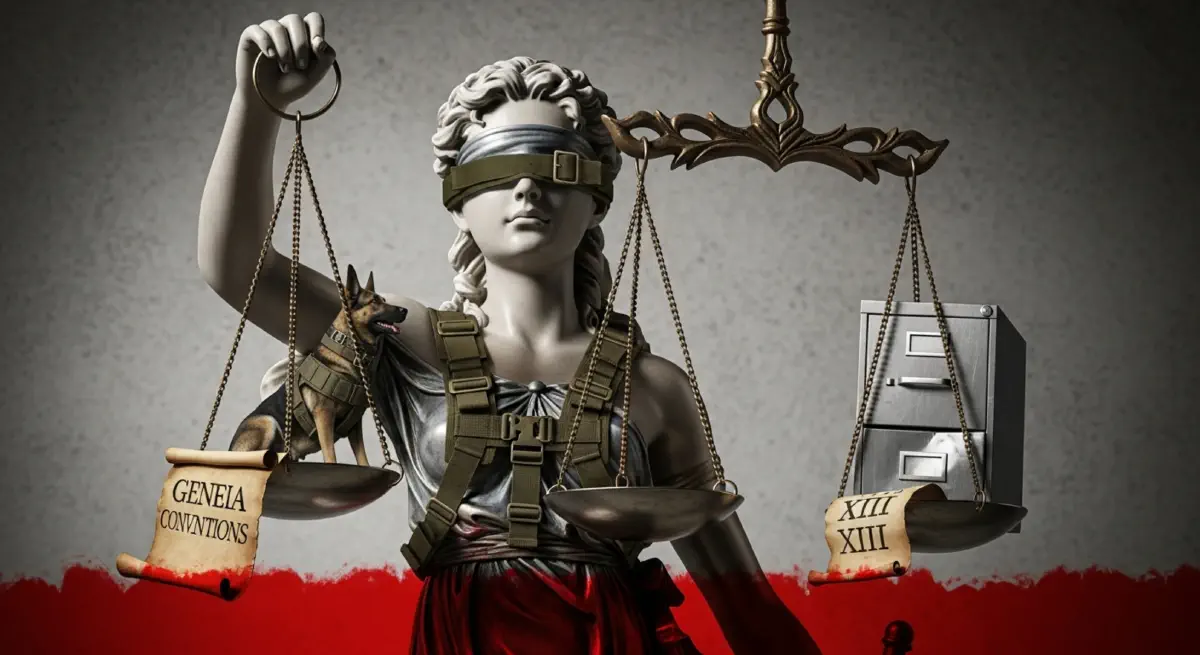
A combat dog is equipment, a dolphin a weapons system, and a zoo animal collateral damage. International humanitarian law was written for humans, and its silence on the sentient victims of war is becoming deafening.
On the morning of April 5th 2022, as Russian artillery pounded the outskirts of Kharkiv, a volley of shells struck Feldman Ecopark, a much-loved zoo and rehabilitation centre on the city’s northern edge. The facility had housed roughly 6,000 animals—lions, tigers, bears, monkeys, and hundreds of birds—before the invasion. In the weeks that followed, keepers who had stayed behind to feed the survivors reported finding enclosures shredded by shrapnel, big cats bleeding out in the snow, and terrified primates huddled in the ruins of their night houses. By the time a partial evacuation was organised, hundreds of animals were dead. Ukraine’s prosecutor-general opened a war-crimes investigation into the shelling, and the episode joined the grim catalogue of charges levelled against the Russian military.
No one expects that investigation to result in a conviction for what happened to the animals. Under the existing architecture of international humanitarian law (IHL), the destruction of a zoo in an active combat zone occupies a legal void. If the zoo was a military objective—a sniper’s nest, an ammunition store—its damage is lawful, regardless of the collateral suffering inflicted on its inhabitants. If it was not, the animals fall under the general protection of civilian property. They are not, as a matter of law, victims in their own right. They are, at best, items on a balance sheet of material damage. At worst, they are invisible.
This is not an oversight. It is the logical consequence of a body of law that was drafted by and for human beings at a time when the sentience of animals was barely on the diplomatic agenda. The resulting silence is now a structural feature of the rules of war, and it is generating increasingly acute tensions as the roles that animals play in conflict—as combatants, as sensors, as companions, as keystone species—multiply and diverge.
Objects or Beings?#
The legal status of an animal in armed conflict is, to a first approximation, identical to that of a filing cabinet. Both fall into the residual category of “civilian objects” unless they make an effective contribution to military action and their destruction, capture, or neutralisation offers a definite military advantage, at which point they become military objectives. The distinction between sentient creature and inanimate property is irrelevant to the legal analysis. As a 2024 review by the International Institute of Humanitarian Law (IIHL) concluded bluntly, “IHL does not consider animals as they are, that is as sentient beings that might also experience pain, stress, suffering, nor does it consider their needs during conflicts.”
The roots of this ontology lie deep in the treaties. The 1907 Hague Regulations protect “property,” a term that, at the time, unproblematically encompassed livestock, horses, and the pigeons that carried messages across the trenches. The four Geneva Conventions of 1949, for all their expansive humanitarian ambition, mention animals only in passing—Article 35 of the First Convention permits the use of the red cross emblem on “personnel, material, [and] animals” of veterinary units, an oblique acknowledgement that animal healers existed but not that their patients possessed independent moral worth. Additional Protocol I of 1977, the primary treaty governing the conduct of hostilities in international armed conflicts, contains two articles on the natural environment (35 and 55), but these prohibit only “widespread, long-term and severe” damage—a threshold so forbiddingly high that it has never, in the protocol’s half-century of existence, been found to have been breached.
The Rome Statute of the International Criminal Court (ICC), which entered into force in 2002, replicated that threshold almost verbatim as the sole environmental war crime within the court’s jurisdiction. Damage that is “clearly excessive in relation to the concrete and direct overall military advantage anticipated” is prohibited, but again only when it is “widespread, long-term and severe.” The same statute criminalises intentional attacks on civilian populations and civilian objects, but animals, unless owned and valued as property, are neither. A species driven to local extinction by conflict-related poaching is not a victim of a crime. A dolphin killed by naval sonar is not even a data point in a legal filing.
The Combat Dog Conundrum#
If civilian animals fare poorly under IHL, their military counterparts fare worse. The military working dog (MWD) is simultaneously one of the most valuable assets on the modern battlefield and one of the least legible to the law. A Belgian Malinois that detects explosives, pursues fleeing combatants, and is protected by custom-fitted body armour costing thousands of dollars is, in the eyes of the Pentagon’s logistics system, a piece of equipment with a serial number. When that dog is killed in action, the loss is recorded as a materiel write-off. When it is captured, the question of its legal status becomes sufficiently tangled that most military lawyers prefer not to ask it.
The leading scholarly treatment of the subject, a 2015 article by Major Chris Jenks published in the US Naval War College’s International Law Studies, concluded that MWDs occupy a “hybrid status” that the law does not recognise. They are not combatants: the Third Geneva Convention applies exclusively to human beings, and a dog cannot be accorded prisoner-of-war status or the protections that flow from it. They are not medical personnel. They are not civilians accompanying the armed forces. They are, Jenks argued, “a unique category of military property”—but property with an operational lifespan, a training record, and a handler who would describe them, without irony, as a partner.
The operational consequences of this ambiguity are not hypothetical. If a MWD is captured by an adversary, is the detaining power obliged to provide veterinary care? Can the dog be lawfully interrogated—its behaviour studied, its training exploited—in the same way that a piece of communications equipment might be? Can it be booby-trapped and returned, as a horse might have been in the 18th century? Jenks’s answer was that the law, as it stands, provides no clear rules, and that states would be well advised to develop them before a crisis forces the issue. To date, no state has done so.
The Russian military’s reported deployment of combat dolphins in the Black Sea raises the same questions in an aquatic register. If a dolphin trained to detect enemy divers is itself attacked, is the attacker targeting a combatant or destroying equipment? If the dolphin is captured, can it be lawfully “reprogrammed”—retrained to serve a new master—or is that a form of unlawful seizure? The Lieber Institute at West Point, in a 2026 analysis of military animals in armed conflict, noted that “the status of marine mammals under the law of naval warfare is entirely undeveloped,” and that the animals are “technologically irreplaceable, operationally sensitive, and legally invisible.”
The Zoo as Battleground#
The shelling of Feldman Ecopark was not an isolated event. Zoos and wildlife parks have been struck, besieged, or abandoned in virtually every major armed conflict of the past three decades: Sarajevo’s zoo during the Bosnian War, Baghdad’s during the 2003 invasion, Gaza’s during the 2014 and 2023 hostilities, and now those across Ukraine. In each case, the legal analysis that follows is the same: the zoo is a civilian object, and unless it is being used for military purposes, attacking it is prohibited. The animals inside are not, in themselves, a factor in the proportionality equation that determines whether an attack is lawful. Collateral damage is assessed in terms of human casualties and property destruction. The animal is, legally speaking, not a casualty at all.
This is, on one level, an unremarkable application of anthropocentric law. But it has begun to chafe against a growing body of scientific evidence—and public sentiment—that recognises many animal species as capable of suffering, fear, and psychological trauma in ways that are morally relevant. The neuroscientific consensus that mammals, birds, and even some cephalopods are sentient was formally endorsed by the Cambridge Declaration on Consciousness in 2012. National legislation in dozens of countries, including the United Kingdom’s Animal Welfare (Sentience) Act 2022, now recognises animal sentience as a matter of law. The gap between what is known about animal minds and what international humanitarian law is willing to recognise has widened to the point where it is visible even to the lawyers who operate within the system.
The IIHL review cited above called explicitly for “a paradigm shift in the way IHL considers animals,” arguing that they should be protected “not only because of their value to humans, but because of their intrinsic sentience.” The editors of the 2022 Cambridge University Press volume Animals in the International Law of Armed Conflict, the most comprehensive treatment of the subject ever published, argued that “wildlife populations usually decline during warfare, with disastrous repercussions on the food chain,” while “livestock, companion, and zoo animals, highly dependent on human care, are direct victims of hostilities.” The book’s 26 chapters map a lacuna so extensive that the authors, collectively, call for a new generation of treaty-making.
The Fragile Framework: ENMOD and the Environment#
The one treaty that explicitly addresses the environmental dimension of warfare—the Convention on the Prohibition of Military or Any Other Hostile Use of Environmental Modification Techniques, or ENMOD, adopted in 1977—illustrates the problem rather than solving it. ENMOD prohibits the use of techniques that modify the environment as a weapon, but it was drafted in the shadow of Vietnam-era weather manipulation experiments and is narrowly focused on deliberate, large-scale geophysical manipulation: inducing earthquakes, triggering tsunamis, changing weather patterns. It says nothing about the destruction of forests by herbicides, the poisoning of rivers by munitions residue, or the deliberate burning of oil fields. The latter acts are covered, if at all, by the general environmental provisions of Additional Protocol I, whose “widespread, long-term and severe” threshold has proved, in the words of a 2016 ICC policy paper, “very difficult to meet in practice.”
The ICC’s Office of the Prosecutor has made sporadic efforts to signal that environmental crimes will be taken seriously. A policy paper published in September 2016 promised that the Office would “give particular consideration to prosecuting Rome Statute crimes that are committed by means of, or that result in, inter alia, the destruction of the environment, the illegal exploitation of natural resources or the illegal dispossession of land.” But the paper was careful to tie environmental harm to the existing categories of war crimes and crimes against humanity, none of which recognises ecological damage as a standalone offence. No environmental war crime has ever been prosecuted at the ICC, and the court’s docket, stretched as it is by the demands of genocide, crimes against humanity, and conventional war crimes, offers little reason to believe that a prosecution for killing zoo animals is imminent.
Toward Ecocide and Sentient Protections#
The most promising avenue for closing the legal gap runs through the concept of ecocide. In 2021, a panel of independent legal experts convened by the Stop Ecocide Foundation published a draft definition of ecocide as a crime that could be added to the Rome Statute by amendment. The panel’s text proposed criminalising “unlawful or wanton acts committed with knowledge that there is a substantial likelihood of severe and either widespread or long-term damage to the environment being caused by those acts.” The definition deliberately lowered the threshold from “widespread, long-term and severe” to “severe and either widespread or long-term,” and it was drafted to apply in peacetime and wartime alike.
The ecocide campaign has achieved more political traction than any previous effort to extend international criminal law to the environment. The European Union incorporated a form of ecocide into its revised Environmental Crime Directive in 2024, requiring member states to criminalise “qualified offences” that cause “widespread and substantial damage which is either irreversible or long-lasting.” Several states, including Vanuatu, Bangladesh, and Samoa, have formally called for ecocide to be added to the Rome Statute. The ICC itself, in its 2016 policy paper, noted that the existing environmental war crime provision “may need to be revisited.”
Yet even the ecocide framework, as currently drafted, stops short of recognising individual animals as victims. It is concerned with ecosystems, not sentient beings. A prosecution for the destruction of a mangrove forest would be conceivable; a prosecution for the killing of a specific elephant would not. The law of armed conflict, even in its most ambitious reformist moment, remains structurally incapable of seeing the animal.
The scholars who have engaged most deeply with this problem propose a dual-track approach. The first track would extend ecocide to cover the deliberate or reckless destruction of wildlife populations, recognising that species-level harm is, in ecological terms, a form of environmental damage. The second track would develop a new set of protocols, either within the Geneva framework or as a standalone instrument, that explicitly accord a protected status to animals in armed conflict, particularly those that are dependent on human care or are used as military assets. The IIHL’s 2024 analysis proposed a tiered system: companion and zoo animals would receive heightened protection as “dependent beings”; military working animals would be recognised as a distinct category subject to specific rules on capture, treatment, and retirement; and free-living wildlife would fall under strengthened environmental provisions.
No state has adopted such a framework. No major military power has even tabled a draft. The law’s blind eye remains blind, and the animals of war—combat dogs, sentinel chickens, shell-shocked zoo bears, and the dolphins circling the Sevastopol harbour—continue to fall through the gaps that the treaties left for them.
The Missing Chapter#
When the history of 21st-century armed conflict is written, the legal treatment of animals will occupy a footnote at best. The Geneva Conventions, for all their extraordinary achievement in humanising war, belong to a tradition that draws a sharp line between the human and the non-human, and that line has not moved since the age of the cavalry charge. The most advanced military powers in the world now deploy animals as biosensors, integrate them into kill chains, and mourn them when they fall—while simultaneously insisting, as a matter of legal doctrine, that they are nothing more than tools.
The contradiction is no longer sustainable. A legal regime that cannot distinguish between a rifle and a dog, between a filing cabinet and a dolphin, and between a factory and a zoo is a regime that has lost touch with the battlefield it purports to govern. The animals are already there, in the trenches and the minefields and the rubble. The law has simply refused to look at them.
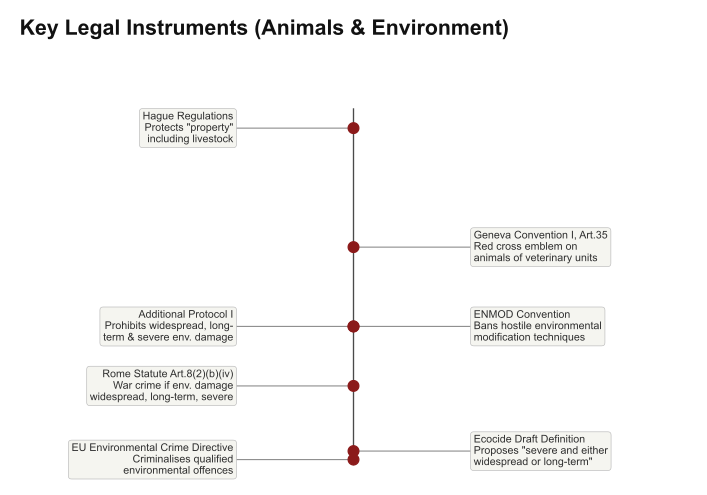
Treaty Provisions Mentioning Animals: A Timeline#
| Year | Instrument | Provision |
|---|---|---|
| 1907 | Hague Regulations | Protects "property" including livestock |
| 1949 | Geneva Convention I, Art. 35 | Permits red cross emblem on "animals" of veterinary units |
| 1977 | Additional Protocol I, Arts. 35 & 55 | Prohibits "widespread, long-term and severe" environmental damage |
| 1977 | ENMOD Convention | Prohibits hostile use of environmental modification techniques |
| 1998 | Rome Statute, Art. 8(2)(b)(iv) | War crime of causing "widespread, long-term and severe" environmental damage |
| 2021 | Ecocide Draft Definition (panel) | Proposes "severe and either widespread or long-term" damage as a crime |
| 2024 | EU Environmental Crime Directive | Criminalises "qualified" environmental offences |
No instrument in force explicitly protects animals as sentient beings.
graph TD
    R["Animals in Armed Conflict"]
    M["Military Animals"]
    C["Civilian Animals"]
    M1["Combat Animals
(dogs, dolphins)"]
    M2["Sentinel Animals
(chickens)"]
    C1["Companion Animals"]
    C2["Livestock"]
    C3["Wildlife"]
    S1["Military Equipment
/ Objective"]
    S2["Expendable Equipment"]
    S3["No special protection;
civilian property"]
    S4["Civilian property;
economic loss"]
    S5["Protected only by env. law
(high threshold)"]

    R --> M
    R --> C
    M --> M1
    M --> M2
    C --> C1
    C --> C2
    C --> C3
    M1 --> S1
    M2 --> S2
    C1 --> S3
    C2 --> S4
    C3 --> S5

    classDef root fill:#4A4A4A,stroke:#333333,color:#ffffff
    classDef cat fill:#6B7C4B,stroke:#333333,color:#ffffff
    classDef milAnimal fill:#8B9A6E,stroke:#333333,color:#ffffff
    classDef civAnimal fill:#BEA67D,stroke:#555555,color:#333333
    classDef status fill:#D4C5A0,stroke:#BBBBBB,color:#333333

    class R root
    class M,C cat
    class M1,M2 milAnimal
    class C1,C2,C3 civAnimal
    class S1,S2,S3,S4,S5 status
References#
Vultaggio, G. (2024, September 27). The unknown victims of armed conflicts. International Institute of Humanitarian Law. https://iihl.org/the-unknown-victims-of-armed-conflicts
Peters, A., Kolb, R., & de Hemptinne, J. (Eds.). (2022). Animals in the international law of armed conflict. Cambridge University Press. https://www.cambridge.org/core/books/animals-in-the-international-law-of-armed-conflict/DA9EA3AF4F252F1DC0ECAFD8016B6406
Jenks, C. (2015). The law of the dog: The status and treatment of military working dogs under the law of armed conflict. International Law Studies, 91, 255–289. https://digital-commons.usnwc.edu/ils/vol91/iss1/10
Lieber Institute for Law and Land Warfare. (2026, February 20). Military animals in armed conflict. United States Military Academy West Point. https://lieber.westpoint.edu/military-animals-armed-conflict/
International Committee of the Red Cross. (1977). Protocol Additional to the Geneva Conventions of 12 August 1949, and relating to the Protection of Victims of International Armed Conflicts (Protocol I), 8 June 1977. https://ihl-databases.icrc.org/en/ihl-treaties/api-1977
Convention on the Prohibition of Military or Any Other Hostile Use of Environmental Modification Techniques (ENMOD), Dec. 10, 1976, 1108 U.N.T.S. 151.
Rome Statute of the International Criminal Court, July 17, 1998, 2187 U.N.T.S. 90.
International Criminal Court, Office of the Prosecutor. (2016). Policy paper on case selection and prioritisation. https://www.icc-cpi.int/sites/default/files/itemsDocuments/20160915_OTP-Policy_Case-Selection_Eng.pdf
Stop Ecocide Foundation. (2021). Independent expert panel for the legal definition of ecocide: Commentary and core text. https://www.stopecocide.earth
European Union. (2024). Directive (EU) 2024/1203 on the protection of the environment through criminal law. Official Journal of the European Union. https://eur-lex.europa.eu/eli/dir/2024/1203
Cambridge Declaration on Consciousness. (2012). Francis Crick Memorial Conference, Cambridge, UK. https://fcmconference.org/img/CambridgeDeclarationOnConsciousness.pdf
United Kingdom. (2022). Animal Welfare (Sentience) Act 2022, c. 22. https://www.legislation.gov.uk/ukpga/2022/22
The Guardian. (2022, April 6). Russians shell Kharkiv zoo, killing animals and wounding staff. https://www.theguardian.com/world/2022/apr/06/kharkiv-zoo-shelled-russian-forces-feldman-ecopark
Reuters. (2022, April 21). Ukrainian zoo animals evacuated under shelling. https://www.reuters.com/world/europe/ukrainian-zoo-animals-evacuated-under-shelling-2022-04-21/
International Committee of the Red Cross. (2020). Guidelines on the protection of the natural environment in armed conflict. ICRC. https://www.icrc.org/en/document/guidelines-protection-natural-environment-armed-conflict
Schmitt, M. N., & Watts, S. (2022). The environmental law of armed conflict. Yearbook of International Humanitarian Law, 24, 1–32. https://doi.org/10.1007/978-94-6265-535-9_1
Sykes, K. (2023). Animals in war: A legal lacuna. Journal of International Wildlife Law & Policy, 26(1), 1–24. https://doi.org/10.1080/13880292.2023.2187125
This is the fifth article in a six-part series, “The Animal Proxies,” examining the role of animals in modern warfare. The final instalment will explore the memory and the moral: how we commemorate—or entirely forget—the animal contribution and suffering in war, and what that says about our moral accounting.