
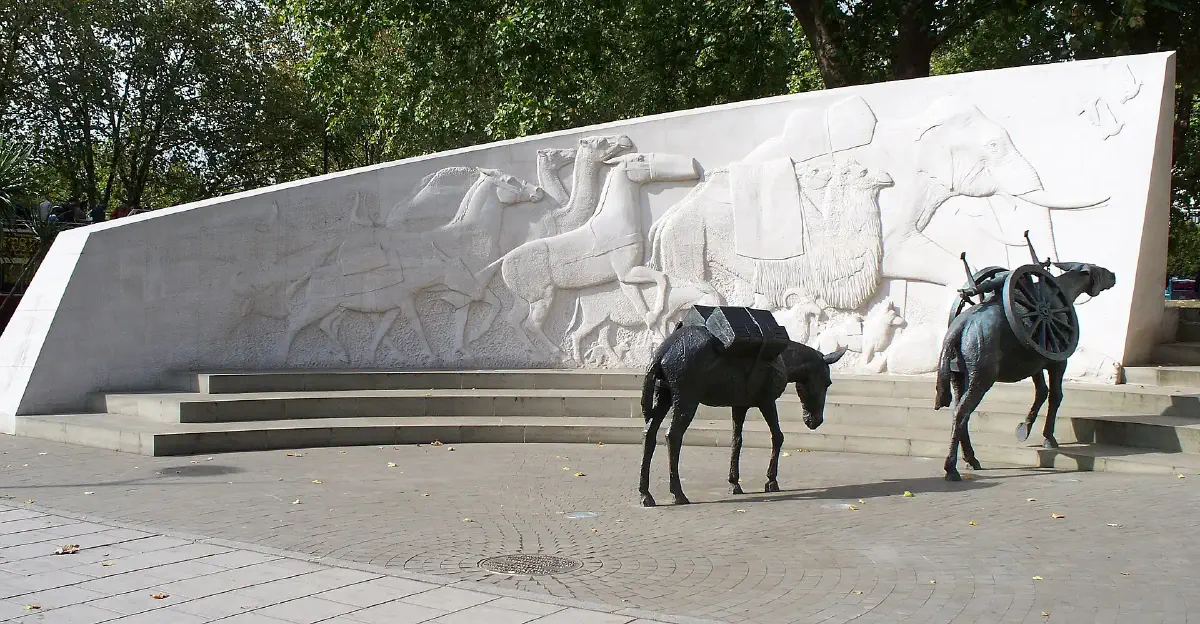
A monument on Park Lane honours the animals who served and died. But for every sculpted horse, there are millions of unmarked graves that force a deeper question: can a morality built for humans ever do justice to the casualties of another species?
On a winter morning in London, a small group gathers at a curved Portland stone wall at the edge of Hyde Park. They lay wreaths, observe a silence, and read the inscription carved into the frieze: “They had no choice.” The Animals in War Memorial, unveiled in 2004, is the most prominent monument of its kind—a tribute to the millions of horses, mules, dogs, pigeons, elephants, camels, and even glow-worms that have served, suffered, and died in human conflicts. The bronze sculptures that flank the wall depict two heavily laden mules struggling through a gap in a shattered wall, while a dog and a horse look on. They are moving, dignified, and entirely exceptional.
For every animal commemorated in bronze, uncounted millions have vanished without record. The Somali camel herd incinerated by a drone strike, the Ukrainian dairy cows machine-gunned in a barn, the Syrian stray dogs that starved in the rubble of Aleppo—these dead are not tallied, not named, and not mourned by any official ritual. Their erasure is not accidental. It is the logical endpoint of a moral and legal framework that has never known what to do with the suffering of creatures that are neither human nor property, neither combatants nor civilians, but something in between. This final article examines what we choose to remember about the animals of war, and what that choice reveals about the limits of our ethical imagination.
The Memorial Landscape#
The London memorial was the product of a 14-year campaign by a retired English teacher and a television producer, backed by donations from the public and a handful of animal-welfare charities. It cost £2 million, all of it privately raised. The British government contributed nothing. The monument’s message is one of sorrowful recognition: the animals were conscripted, they had no choice, and they deserve our gratitude. The design was vetted by the Imperial War Museum, the Royal Fine Art Commission, and the Westminster City Council, and its unveiling was attended by Princess Anne. It is, by any measure, an establishment tribute.
And yet it stands almost alone. A survey of the global memorial landscape reveals a pattern that is both narrow and revealing. The most common memorials commemorate the animals that were closest to the human experience of organised warfare: horses and mules that carried cavalry charges and supply columns, dogs that served as sentries and messengers, pigeons that flew through artillery barrages. The Australian War Animal Memorial, dedicated at the Australian War Memorial in Canberra in 2009, features a bronze horse head and plaques listing the thousands of horses sent to the First World War. The United States dedicated the Military Working Dog Teams National Monument at Joint Base San Antonio-Lackland in 2013, honouring dogs from every conflict since the Second World War. France’s memorial to war pigeons at the Mont Valérien fortress, next to the dovecotes that still house the last military pigeon flock in Europe, recognises the birds as “heroes” of the nation. Each of these is, in its own way, a serious act of remembrance.
The pattern is instructive. Every memorialised animal was a military asset. They served a function: carrying ammunition, detecting mines, delivering messages. The memorials express gratitude for service, not sorrow for suffering. The distinction is subtle but profound. A horse that charged into machine-gun fire is remembered as a hero; a horse that was requisitioned by an occupying army and eaten by starving civilians is forgotten as an economic loss. The memorial landscape is, in effect, an extension of the military utility logic that has governed the treatment of animals throughout this series. We remember the ones who worked for us. The rest we let slip into the unrecorded past.
The Dickin Medal#
Nowhere is the service paradigm clearer than in the PDSA Dickin Medal, the “animal Victoria Cross” instituted in 1943 by Maria Dickin, the founder of the People’s Dispensary for Sick Animals. The medal has been awarded 75 times since its creation: 38 dogs, 32 pigeons, 4 horses, and 1 cat. The recipients’ citations read like dispatches from a parallel war in which the combatants could not speak but acted with extraordinary courage. A pigeon named GI Joe saved the lives of over 1,000 British troops by delivering a message that prevented an American bombing raid on an Italian village that had already been captured. A dog named Rifleman Khan rescued a drowning soldier during the Battle of the Scheldt. A collie named Rob made over 20 parachute descents with the SAS in North Africa and Italy.
The Dickin Medal is, by design, a mirror of the Victoria Cross. It takes the categories of human martial virtue—courage, devotion to duty, self-sacrifice—and applies them to animals without modification. The problem with this framing, as the philosopher Lori Gruen has noted, is that it distorts the moral reality of the animal’s situation. The animal did not volunteer, does not understand the cause, and cannot consent to the risk. To speak of “courage” is to import a human intentionality that the animal does not possess. To honour “devotion to duty” is to dignify a relationship that is, at root, one of enforced servitude. The Dickin Medal honours the animal, but it does so by pretending the animal is something it is not. It is a beautiful lie.
The Silent Losers#
The real gap in the memorial landscape is not between species but between functions. The animals that are commemorated are the ones that served in the organised military forces of industrialised states. The animals that are forgotten are the livestock, the companion animals, and the wildlife that were caught in the crossfire or systematically exploited without ever wearing a harness or delivering a message.
Consider the Somali pastoralist. In the arid rangelands of south-central Somalia, a camel is not simply an animal. It is a source of milk, transport, and wealth; a store of value in an economy without banks; a marker of social status and a component of bride-wealth; and, in a nomadic culture that moves across a landscape defined by drought and conflict, the basis of survival. When a camel herd is destroyed, the pastoralist loses not just a financial asset but a way of life. Yet when an American drone strikes a suspected al-Shabaab encampment and kills the camels that happen to be grazing nearby, the loss is recorded, if at all, as “civilian property damage.” The herder may be compensated, or not, depending on the Pentagon’s ex gratia payment process and the availability of credible evidence. The camel enters no memorial, receives no medal, and is not counted in any database of war casualties.
The scale of such losses is vast and almost completely undocumented. The United Nations Food and Agriculture Organisation estimated in 2023 that the war in Ukraine had killed 350,000 cattle and 1.7 million pigs in the first year of the full-scale invasion, with millions more poultry destroyed by shelling, the collapse of commercial supply chains, and the abandonment of farms near the front lines. These animals died of direct violence, of starvation when their owners fled, of cold when heating systems failed, of disease when veterinary services collapsed. Their deaths were not counted as war casualties. They were tallied as economic losses, entries in a spreadsheet of agricultural damage that was used to calculate reconstruction costs. The moral significance of those 2 million individual deaths was, in the official accounting, zero.
The stray dogs of Baghdad, the subject of the mass cull described in the fourth article of this series, make the point even more starkly. The 58,500 dogs shot and poisoned by Iraqi government teams in 2010 were the indirect casualties of a war that had destroyed the municipal services that once kept their population in check. They did not serve. They did not belong to anyone. They were a public health hazard, and they were eliminated as such. Their death toll exceeds the number of British soldiers killed in the entire Iraq War by a factor of three hundred, but no monument commemorates them, and no historian has written their names.
Infographic: A comprehensive data analysis of non-human operational assets, ecological trauma, and international frameworks#
The Moral Calculus#
The philosopher Peter Singer opened his landmark 1975 book Animal Liberation with an argument that has never been adequately answered: if a being can suffer, its suffering matters, and it matters whether the sufferer is a human or a non-human animal. The moral circle, in Singer’s framework, should be drawn not around species membership but around the capacity for pain, fear, and distress. That argument, radical when it was made, has now been absorbed into the mainstream of ethical thought and is reflected in legislation across the democratic world. The United Kingdom’s Animal Welfare (Sentience) Act 2022 formally recognises that “animals are sentient beings” and requires ministers to consider their welfare when making policy. The Cambridge Declaration on Consciousness, signed by a group of prominent neuroscientists in 2012, stated that “the weight of evidence indicates that humans are not unique in possessing the neurological substrates that generate consciousness,” and that this extends to all mammals and birds and some other creatures.
What would it mean to take this insight seriously in the context of armed conflict? It would mean, at a minimum, that the suffering of animals is not morally equivalent to the destruction of equipment or buildings, and that the laws of war should reflect that difference. It would mean that the proportionality calculus—the assessment of whether a military attack’s expected civilian harm is “clearly excessive” in relation to its anticipated advantage—should include not only the deaths and injuries of human civilians but the deaths and suffering of sentient animals that are dependent on human care. It would mean that the deliberate or reckless killing of large numbers of animals, whether through the destruction of a factory farm, a zoo, or a pastoralist’s herd, should be treated as a moral wrong that demands justification, not as a footnote to an economic damage assessment.
The philosopher Jeff McMahan, one of the most influential contemporary theorists of just war, has argued that the traditional distinction between combatants and non-combatants—the principle of distinction that is the foundation of the law of armed conflict—could logically be extended to non-human animals. If a military working dog is trained to attack enemy soldiers, McMahan suggests, it has, in a morally relevant sense, forfeited its immunity from attack in a way that a pet dog or a farm animal has not. The moral difference between the German shepherd that guards a checkpoint and the goat that grazes behind a farmhouse is not that one is a dog and one is a goat; it is that one has been made an instrument of war and the other has not. The law, as it stands, draws no such distinction because it draws no distinctions among animals at all. They are all, in its eyes, objects.
The gap between what moral philosophy can articulate and what international law can enforce is vast, and it will not be closed in a single treaty cycle. But the direction of travel is clear. The ecocide campaign, the growing body of academic work on animals in armed conflict, the European Union’s recognition of animal sentience, and the quiet, stubborn work of the volunteer networks that rescue abandoned pets from war zones—all of these are expressions of a moral intuition that is slowly, unevenly, reconfiguring the boundaries of our concern. The challenge, as the philosopher Lori Gruen frames it, is to extend the concept of “moral injury”—the damage done to a person’s conscience by participating in acts that violate their ethical beliefs—to the treatment of animals in war. A soldier who is ordered to abandon a military dog to an advancing enemy, a drone operator who watches a camel herd scatter under a missile strike, a refugee who must leave a cat behind in a besieged apartment: each of these individuals may carry a wound that no medal can heal and no memorial can acknowledge.
The Uncounted Casualties#
The series set out to trace the animals of war—the living toolbox, the bio-hybrid sensors, the ecological shadow, the abandoned companions, the legal void, and the memorial silence. The unifying thread is not sentiment but accounting. We do not count what we do not value, and we do not value what we do not see. The failure to count animal casualties is not a technical oversight; it is a moral strategy, a way of preserving the fiction that war is a purely human affair.
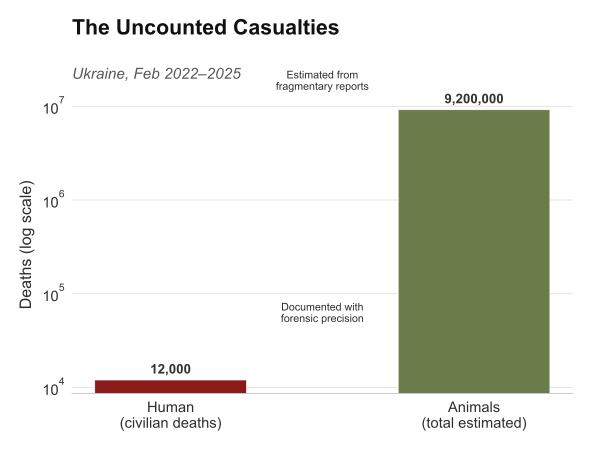
The numbers that do exist are fragmentary, scattered across decades and continents, and assembled from sources that were never designed to produce a comprehensive picture. They are, nonetheless, the only ledger we have. What follows is an attempt, necessarily incomplete and methodologically provisional, to set some of those numbers alongside their human counterparts for a single conflict: the war in Ukraine, from February 2022 to the end of 2025.
| Category | Estimated Animal Deaths | Human Equivalent |
|---|---|---|
| Livestock (cattle, pigs, sheep, goats) | 2.1 million (FAO/Ministry of Agrarian Policy, 2023-2025) | Civilian deaths: ~12,000 (UN OHCHR, verified minimum) |
| Poultry | 6.5 million (FAO, 2024 estimate) | - |
| Companion animals (dogs, cats) abandoned or killed | 750,000 (Four Paws/CEPA estimates, 2023-2025) | Internally displaced: ~5 million (IOM) |
| Zoo and captive wild animals | 2,000 (Feldman Ecopark, Nikolaev Zoo, others) | - |
| Marine mammals (Black Sea dolphin strandings) | 2,500+ (Ukrainian Academy of Sciences, preliminary) | - |
| Stray dogs culled in conflict-affected areas | Data unavailable (excluded from official reports) | - |
The numbers are rough, the categories provisional, and the comparison with human casualties is not intended to equate the value of a human life with that of an animal—the moral weight of a single civilian death is not comparable to the death of a thousand chickens. But the comparison exposes the asymmetry of our moral attention. The human toll of the war in Ukraine has been documented with forensic precision by international organisations, investigated by war-crimes prosecutors, and mourned in ceremonies around the world. The animal toll has been pieced together from agricultural damage reports, stray-dog rescue tallies, and the records of a handful of NGOs. It is a footnote to a war that has killed hundreds of thousands of people, and that is precisely the point: the animal deaths are a footnote not because they are insignificant but because we have chosen not to assign them significance.
The Ledger#
The final task of the series is to widen the lens beyond a single conflict. Across the wars of the 21st century, the uncounted casualties mount with a regularity that would constitute a humanitarian crisis if they were human. The culled dogs of Baghdad: 58,500. The elephants lost from the Okapi Reserve during the Congolese civil war: roughly 2,500, representing half the pre-war population. The 700,000 to 900,000 tonnes of oil spilled into the Persian Gulf in 1991, killing an estimated 30,000 seabirds and blanketing seagrass beds that supported dugongs and turtles. The 155 million landmines and unexploded ordnance still buried in the earth, killing and maiming uncountable numbers of wild animals, livestock, and companion species every year.
The philosophical point is not that these numbers should be added to the human toll to create a single, undifferentiated casualty count. It is that the existence of these numbers—and the near-total absence of any institutional mechanism for recording, investigating, or commemorating them—reveals a hole in our moral imagination that is large enough to contain entire species. The animal proxies of war are everywhere, if we are willing to look. The memorials are few, the laws are silent, and the ledger is blank. The question the series leaves on the table is whether a generation that has begun to recognise animal sentience in its peacetime legislation, its food systems, and its philosophical debates will have the courage to extend that recognition to the most violent of human activities, or whether the animals of war will remain, as they have always been, the invisible conscripts of a conflict they cannot understand.
References#
Animals in War Memorial. (n.d.). The Animals in War Memorial. https://www.animalsinwar.org.uk
PDSA. (n.d.). Dickin Medal. People’s Dispensary for Sick Animals. https://www.pdsa.org.uk/what-we-do/animal-awards-programme/pdsa-dickin-medal
Australian War Memorial. (2009). Australian War Animal Memorial. https://www.awm.gov.au/commemoration/customs-and-ceremony/war-animals
U.S. Department of Defense. (2013, October 28). Military working dog teams national monument dedicated. https://www.defense.gov/News/News-Stories/Article/Article/617462/
French Ministry of Armed Forces. (2024). Les colombiers militaires du Mont Valérien [The military dovecotes of Mont Valérien]. https://www.defense.gouv.fr
Singer, P. (1975). Animal liberation: A new ethics for our treatment of animals. New York Review Books.
Cambridge Declaration on Consciousness. (2012). Francis Crick Memorial Conference on Consciousness in Human and Non-Human Animals. https://fcmconference.org/img/CambridgeDeclarationOnConsciousness.pdf
United Kingdom. (2022). Animal Welfare (Sentience) Act 2022, c. 22. https://www.legislation.gov.uk/ukpga/2022/22
McMahan, J. (2009). Killing in war. Oxford University Press.
Gruen, L. (2015). Entangled empathy: An alternative ethic for our relationships with animals. Lantern Books.
Food and Agriculture Organization of the United Nations. (2023). Ukraine: Impact of the war on agriculture and rural livelihoods. FAO. https://www.fao.org/documents/card/en/c/cc4844en
Reuters. (2023, March 15). War kills over 7 million animals in Ukraine, government says. https://www.reuters.com/world/europe/war-kills-over-7-million-animals-ukraine-government-says-2023-03-15/
Intergovernmental Authority on Development. (2022). The impact of conflict and drought on pastoralist livelihoods in the Horn of Africa. IGAD. https://www.igad.int
Bureau of Investigative Journalism. (2022). Drone warfare: Civilian harm in Somalia. https://www.thebureauinvestigates.com
UN Office for the Coordination of Humanitarian Affairs. (2025). Ukraine civilian casualty update. OCHA. https://www.ochaopt.org
Four Paws International. (2023). Stray animal crisis in Ukraine: Assessment report. https://www.four-paws.org
Meyers, R. (2025, August 21). Landmines have become the greatest protectors. The Guardian. https://www.theguardian.com/environment/2025/aug/21/north-south-korea-war-demilitarised-zone-dmz-ecology-endangered-wildlife-aoe
ICRC. (2020). Guidelines on the protection of the natural environment in armed conflict. International Committee of the Red Cross. https://www.icrc.org/en/document/guidelines-protection-natural-environment-armed-conflict
Lieber Institute for Law and Land Warfare. (2026). Military animals in armed conflict. United States Military Academy West Point. https://lieber.westpoint.edu/military-animals-armed-conflict/
Stop Ecocide Foundation. (2021). Independent expert panel for the legal definition of ecocide: Commentary and core text. https://www.stopecocide.earth
This is the final article in the six-part series, “The Animal Proxies.” The full series is available at economist.com/animals-at-war. The series examined the living toolbox of military animals, the rise of bio-hybrid warfare, the ecological shadow of conflict, the abandonment of companion animals, the law’s blind eye, and the contested memorials that shape our memory—and our forgetting.