
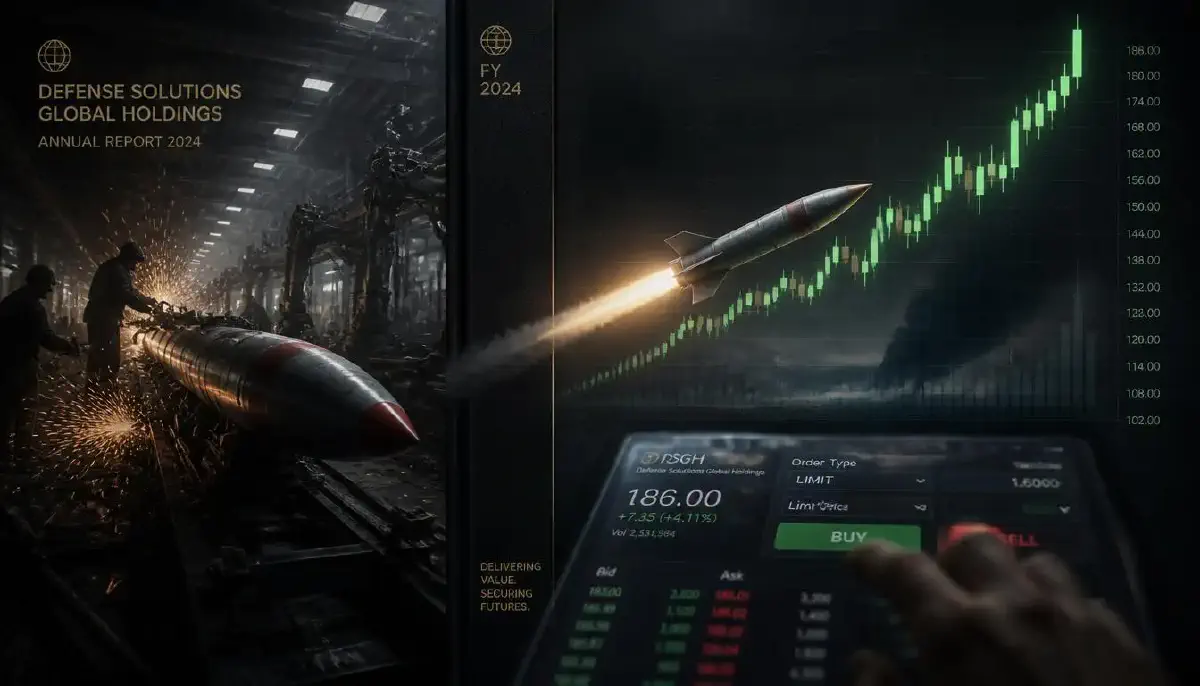
In the febrile weeks after Russia’s tanks rolled into Ukraine, as artillery cratered Kharkiv and missiles rained on Kyiv, a quieter invasion was gathering pace thousands of miles away. Not of soldiers, but of capital. In the first month of the war, the world’s 100 largest arms producers added roughly $100bn to their combined market value. By the time the guns fell silent—temporarily—in Gaza two years later, the same companies were posting record backlogs and opening new production lines. War, it turns out, is not merely a continuation of politics by other means. It is also a vast, state-subsidised profit centre.
The modern arms trade bears little resemblance to the Cold War caricature of dodgy middlemen and secret warehouses. Today’s merchants of death are listed on the New York Stock Exchange, their shares held in pension funds and ESG-screened index trackers, their quarterly earnings calls attended by analysts from Goldman Sachs. The transformation from smokestack industry to financialised juggernaut is now so complete that the outbreak of a major land war in Europe is treated by the markets as a buy signal. This article, the first in a series on the hidden economics of conflict, examines who owns the means of destruction—and how they have turned organised violence into a growth industry.
A world awash with arms#
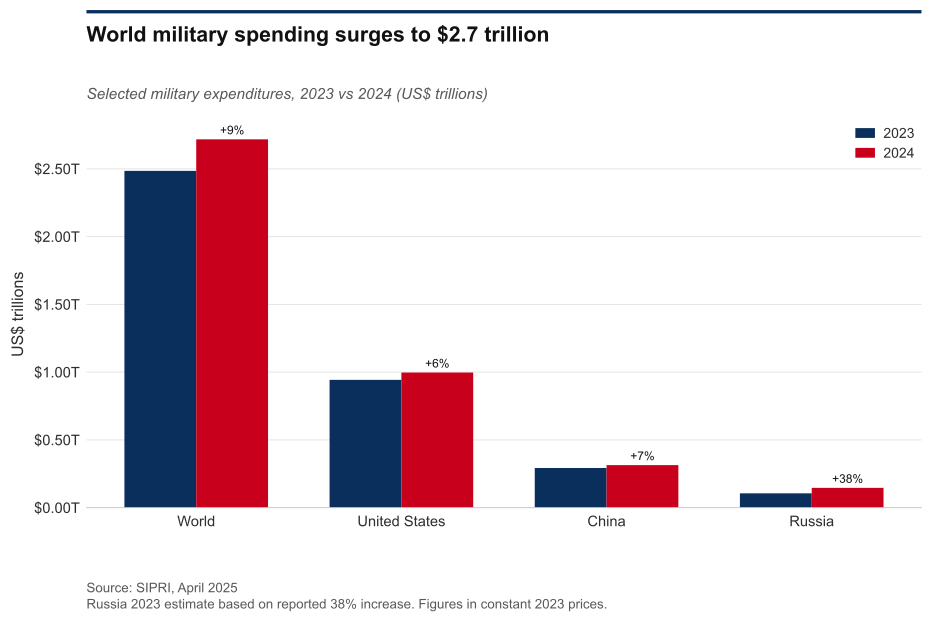
Global military expenditure surged to a vertiginous $2.718 trillion in 2024, a jump of 9.4% in nominal terms from the year before and the steepest increase in a generation (see Figure 1). The world now spends roughly $334 on soldiers, shells and satellites for every man, woman and child on the planet—or 2.5% of global GDP, a share not seen since the immediate aftermath of the Cold War. In aggregate, the planet’s defence budgets now exceed the entire economic output of Canada.
The expansion is broad-based. America’s $997bn spend—two-thirds of which flows through private contractors—is merely the anchor. China quietly added 7% to reach $314bn. Russia, re-arming at a furious pace, saw an estimated 38% increase, though the precise figure is obscured by the opacity of its wartime budget. In Europe, the shock of the Ukraine invasion has finally dislodged the post-Cold War complacency: the number of NATO members hitting the 2%-of-GDP spending target rose from 11 to 17 in a single year.
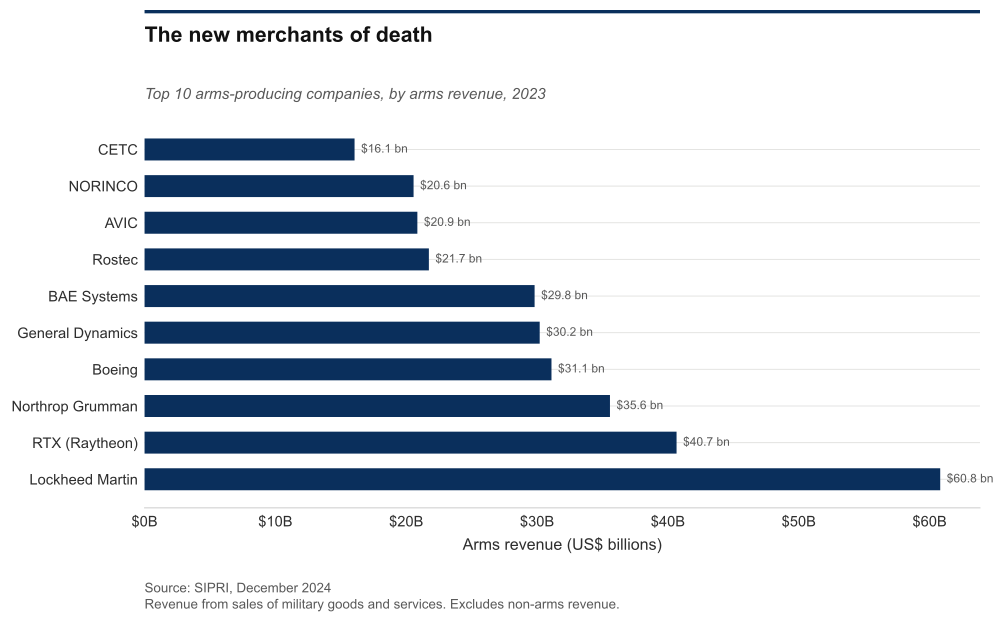
This torrent of taxpayer money is not, primarily, going to soldiers’ salaries or barracks maintenance. It is being channelled, via procurement contracts, into a handful of extraordinarily concentrated industrial conglomerates. The top 100 arms manufacturers raked in $679bn in revenues from military goods and services in 2024, a 5.9% real increase on the previous year. The five largest American firms alone—Lockheed Martin, RTX, Northrop Grumman, Boeing and General Dynamics—account for nearly a third of the total (see Figure 2). These are no longer mere defence contractors; they are, in effect, publicly traded utilities of violence, as indispensable to the modern state as the electricity grid and almost as resistant to competitive pressure.
The geographic distribution of this revenue tells its own story. American companies, with 41 of the top 100, collected $334bn in 2024. European firms, fired by the Ukraine wake-up call, boosted their collective take by 13% to $151bn. Russian producers, led by the state-owned behemoth Rostec, posted $31.2bn—a 23% jump that almost certainly undercounts the true scale of the Kremlin’s rearmament machine. Notably, Israeli firms saw a 16% increase, driven by the Gaza conflict and the relentless demand for tested battlefield technologies.
The investor windfall#
For shareholders, these numbers have translated into spectacular returns. An investor who bought Lockheed Martin on the morning of February 24th 2022 would, by the summer of 2024, have enjoyed a capital gain of 41%. Northrop Grumman delivered 24%, General Dynamics 32%. These are not the returns of a staid industrial sector; they are Silicon Valley multiples applied to factories making fighter jets and artillery shells.
Academic research confirms that the market treats the outbreak of hostilities as unambiguously good news for defence stocks. A study by Martins, Correia and Gouveia (2024) examined the share prices of the world’s 100 largest listed defence firms around the start of the Ukraine war and found “positive and statistically significant stock price reaction at and around the beginning of the military conflict”. Companies with a higher share of revenue from defence sales, and those with deeper R&D pipelines, outperformed. European defence stocks, which had been trading at a peacetime discount, saw particularly “high positive abnormal returns”. In the dry language of financial economics, war is classified as an exogenous shock that enhances the earnings prospects of a clearly defined cohort of firms.
This is not a new phenomenon, but its scale and speed in the digital age has amplified the uncomfortable optics. The moment a missile strikes an apartment block, algorithms reprice the net present value of the company that manufactured the guidance system. There is no mechanism—moral, regulatory or otherwise—that separates the grief of the victims from the gain of the shareholders. The two are, as it were, opposite entries on the same ledger.
The venture-capital invasion#
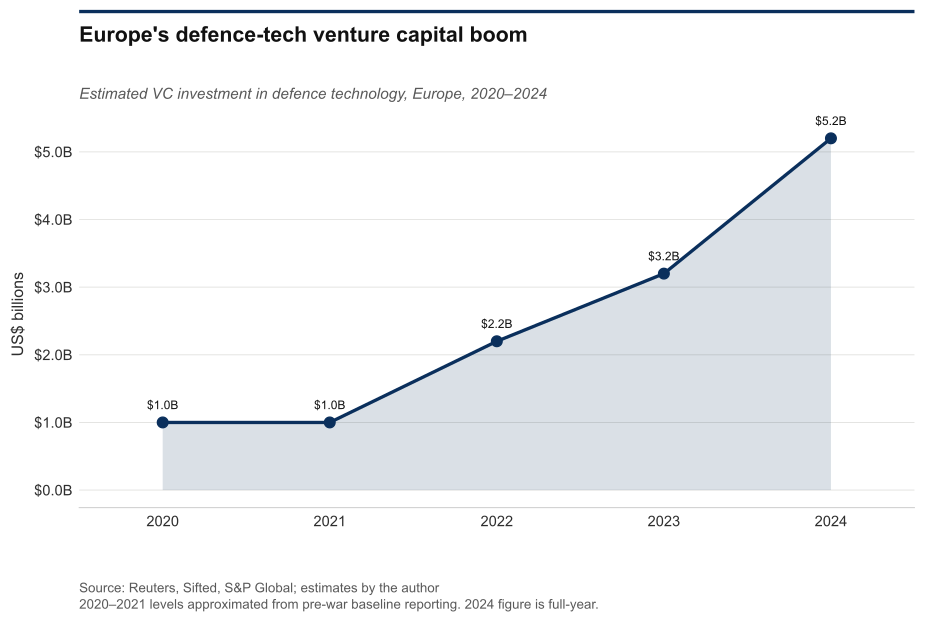
The most striking development of the past two years is the flood of speculative capital into defence technology. Venture capital, long wary of the sector’s long sales cycles and reputational taint, has rushed in with a fervour not seen since the dotcom era. European VC investment in defence tech reached an estimated $5.2bn in 2024, a more-than-fivefold increase from pre-war levels (see Figure 3). In America, private-equity and venture funds poured $2.6bn into the sector in the first three quarters of the year alone.
Much of this money is chasing autonomous systems and artificial intelligence. Anduril, the American anti-drone and surveillance startup founded by a former Oculus VR designer, raised $1.5bn at a $12.5bn valuation. Helsing, a German firm specialising in AI-enhanced battlefield software, secured €450m in a Series C round that valued it at nearly €5bn. Such sums are being wagered on companies that, in many cases, have yet to generate meaningful revenue. The logic is that warfare, like every other domain of modern life, will be transformed by software—and that whoever writes the code will own the future. Whether the economics ultimately justify the valuations is a question that the current euphoria is conspicuously not asking.
The shifting geography of supply#
For all the dominance of the American-European duopoly, the arms trade is undergoing a geographical rebalancing. The Bayraktar TB2 drone, produced by the privately held Turkish firm Baykar, has become the Chevrolet of modern air power: affordable, effective, and exported to more than 30 countries. Its battlefield success in Ukraine, Nagorno-Karabakh and Libya has made Selçuk Bayraktar, the company’s chief technology officer and son-in-law of President Erdoğan, a national hero and an international player.
Meanwhile, China’s NORINCO and AVIC, and Iran’s Shahed drone programme, are providing lower-cost alternatives to Western systems, often with fewer strings attached. The result is a two-tier market: a premium tier dominated by NATO-standard equipment, and a discount tier that is rapidly improving in quality and proliferating in quantity. The West’s sanctions on Russia have, perversely, accelerated this trend by demonstrating that access to American-made components can be revoked at any time—and that a domestic or non-aligned alternative is a strategic necessity.
The untouchable asset class#
The defence industry’s transformation into a financialised growth sector has made it, politically, almost impossible to restrain. The same pension funds that campaign for net-zero emissions and boardroom diversity are now, by proxy, significant shareholders in the companies that profit from the destruction of Gaza, the burning of Kharkiv, and the mining of the Black Sea. Divestment campaigns have made almost no headway, because the returns are too attractive and the alternatives—ceding the defence technology race to China or Russia—are too unpalatable.
The sector’s advocates argue, with some justification, that the ability to produce weapons at scale is a prerequisite of deterrence, and that profitable defence companies are better placed to innovate than sclerotic state arsenals. The counter-argument, less often heard in the investor calls, is that a system in which the outbreak of war reliably boosts share prices creates a structural incentive for conflict—or, at the very least, for the prolongation of the conditions that make conflict thinkable. The merchants of death, in the 21st century as in the 17th, do not pull the trigger. But they do provide the ammunition, and they are paid handsomely for every round that is fired.
This is the first article in a six-part series, “The Balance Sheet of Battle,” examining who truly profits from war, who foots the bill, and how the ledger reshapes global capitalism. The next instalment will explore the sovereign-debt traders and vulture funds that feed on the carcasses of war-torn states.