

On a frosty afternoon in December 2025, a small group of creditors in London, New York and Abu Dhabi cast their votes on a financial instrument that most of the world had never heard of. The instrument was a GDP warrant—a derivative-like bond that pays out when Ukraine’s economy grows faster than a set threshold—and the vote was to determine whether its holders would accept a restructuring that would slash their potential returns. The warrants, originally issued in 2015 as a sweetener for a previous debt workout, had become a textbook case of how war creates toxic financial legacies. For Ukraine, they were a ticking time-bomb that threatened to siphon off billions in future recovery dollars. For the warrant holders, they were a lottery ticket with an uncertain expiry date.
The deal that emerged—99% approval, $3.5bn in new bonds, the cancellation of most of the old warrants—was hailed by Kyiv as a diplomatic triumph. But the episode illuminated a darker reality of modern warfare: a country fighting for its survival is simultaneously a capital-market asset to be traded, restructured and, in some cases, litigated to the bone. This article, the second in our series, traces the money that flows into the sovereign debt of war zones, and profiles the investors who profit from the aftermath of devastation.
The borrow-and-bomb cycle#
Sovereign debt is the original sin of war finance. Governments have borrowed to fund armies since the Medicis, but the scale and complexity of modern conflict borrowing is unprecedented. Ukraine entered the war in February 2022 with a public debt stock of around $97bn. Three years of full-scale invasion later, its state and state-guaranteed debt had ballooned to nearly 7 trillion hryvnias—roughly $166bn at the prevailing exchange rate—and its fiscal deficit had widened to a cavernous 25.7% of GDP (see Table 2.1). The country was spending more on debt service than on many categories of social provision, even as its cities burned.
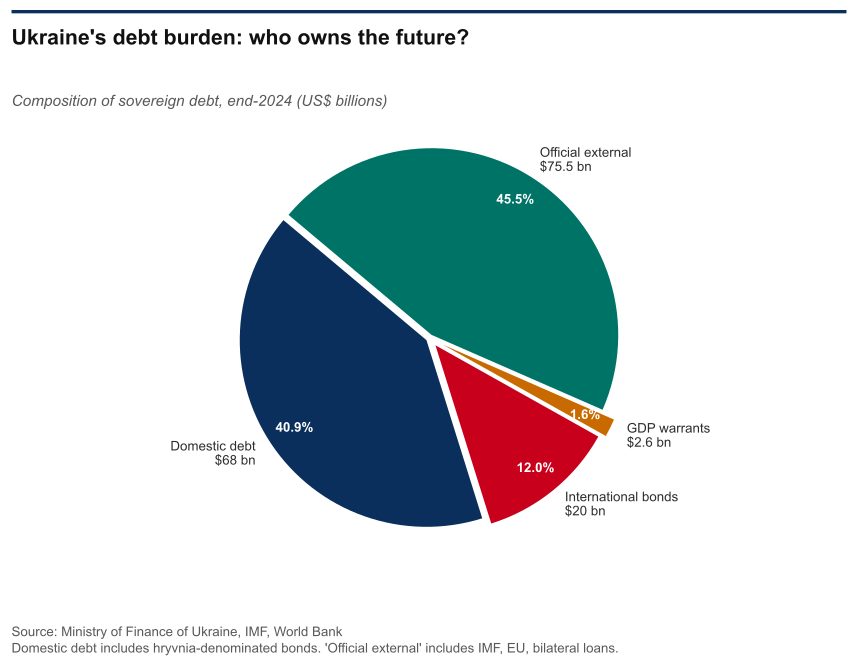
The pie chart (Figure 4) shows how Ukraine’s obligations splintered into a mosaic of domestic bonds, official-sector loans from the IMF and the European Union, and international bonds held by a diffuse universe of asset managers, hedge funds and retail investors. Each of these creditor classes has different interests, different legal rights, and a different appetite for forcing a restructuring. The IMF, as a preferred creditor, is almost never written down. The official bilateral lenders—the EU, the United States—can be patient. But the holders of international bonds, and especially the quirky GDP warrants, are bound by no such forbearance. They are in it for the money, and they will use every tool of contract law to get paid.
The toxic warrants#
The GDP warrants that came to a head in 2025 were a relic of a previous crisis. In 2015, after Russia’s annexation of Crimea and the first Donbas incursion, Ukraine restructured its debt and, as part of the deal, issued warrants that would pay out if nominal GDP exceeded $125.4bn and then ratcheted up on a sliding scale. The terms were extraordinarily generous—some analysts calculated that if Ukraine had grown at the rates projected before the 2022 invasion, the warrants could have paid out as much as $20bn over their life. Even in the midst of war, the warrants traded at substantial fractions of their notional value, because investors bet that a post-war reconstruction boom would trigger massive payouts.
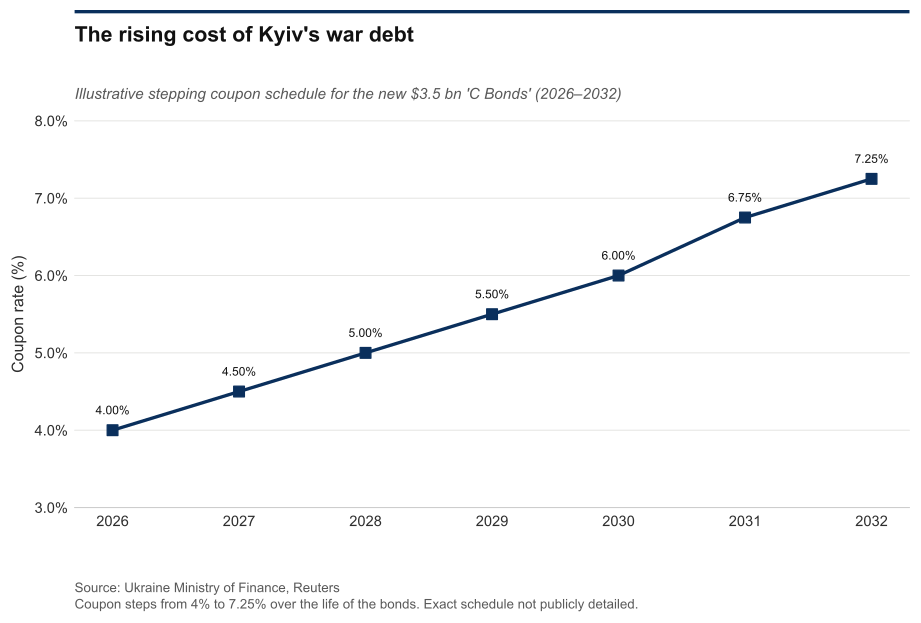
The restructuring deal of December 2025 sought to neutralise this threat. In exchange for the old warrants, holders received new “C Bonds” with a face value of $3.5bn, maturing in 2032, and a coupon that steps up from 4% to 7.25% over time (see Figure 5). The step-up is a concession to reality: investors demanded a higher yield to compensate for the risk that Ukraine might not survive, let alone repay. Fitch rated the new bonds CCC, deep in junk territory, but the deal was oversubscribed. The warrant holders had taken a haircut on their maximum upside, but they had swapped a contingent claim for a hard bond with a known maturity and a rising income stream.
What makes instruments like GDP warrants so pernicious is that they are the financial equivalent of a war profiteer’s option. They are small enough to be easily restructured—the outstanding warrants were just $2.6bn in notional terms—but large enough, if left untouched, to drain a significant fraction of a recovering economy’s tax revenues. In Ukraine’s case, the warrants would have triggered payments just as the country was trying to rebuild its infrastructure. The restructuring was a hard-nosed victory for the government, but it came at the cost of issuing new debt that will burden future generations. The war may end, but the bonds will not.
The vulture ecosystem#
If Ukraine represents the mainstream of war-debt restructuring—a multilateral negotiation among largely cooperative creditors—the other end of the spectrum is inhabited by a much less diplomatic species: the vulture fund. These are hedge funds that specialise in buying defaulted sovereign debt at deep discounts and then suing the debtor for the full face value plus accumulated interest. The economics can be extraordinarily lucrative. The African Development Bank has documented recovery multiples—the ratio of the fund’s eventual payout to its purchase price—ranging from 3x to a staggering 20x (see Figure 6).
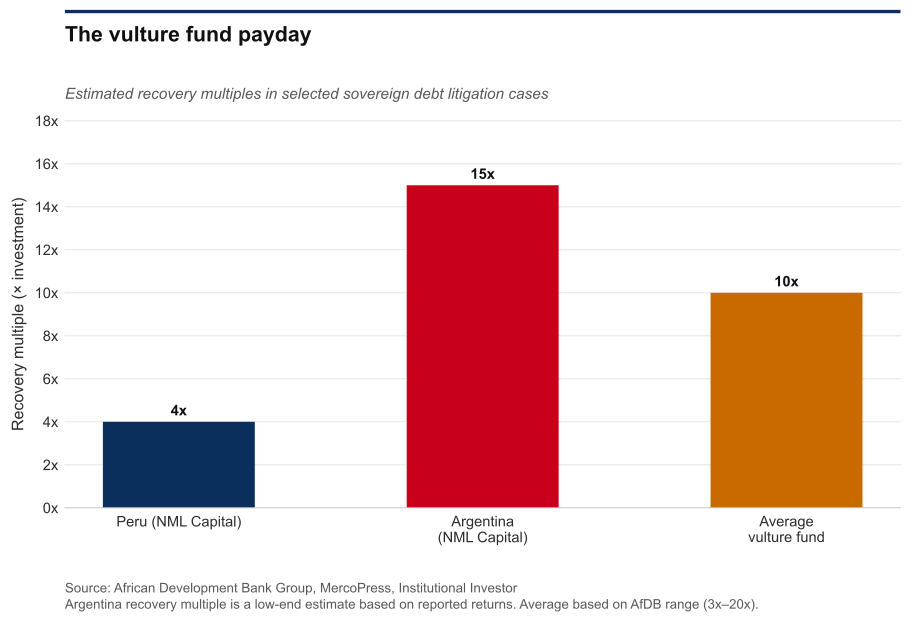
The most famous case remains Argentina’s $100bn default in 2001. A fund called NML Capital, an affiliate of Paul Singer’s Elliott Management, bought Argentine bonds for cents on the dollar and then spent a decade litigating in New York courts. It eventually won a judgment that forced Argentina to settle for roughly $2.4bn—a return estimated at over 10 times the fund’s original investment. In Peru, the same fund recovered 400% of what it had paid for defaulted debt from the 1990s. Liberia was pursued for years by vulture funds that had bought its debt for a few million dollars and sought full repayment with interest.
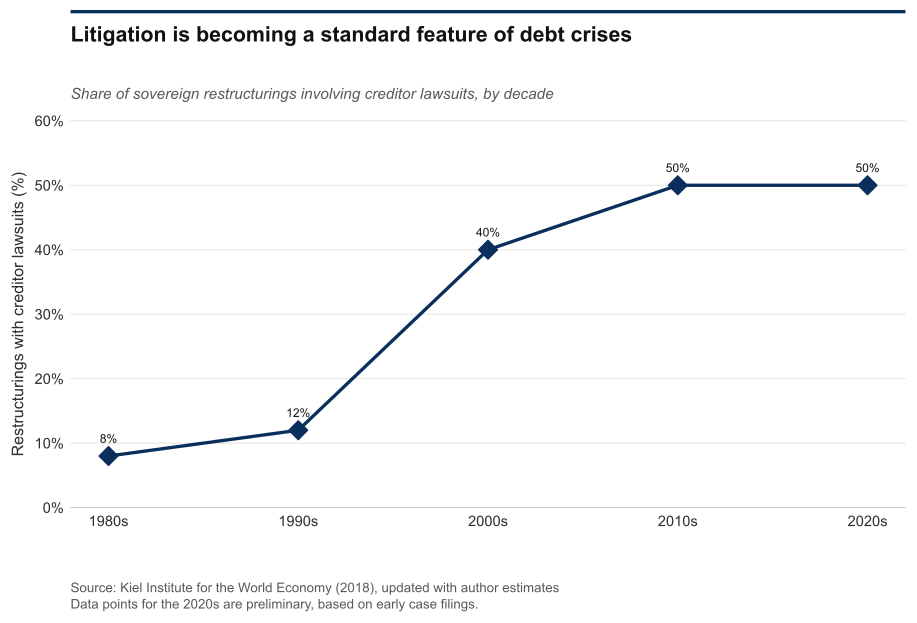
These cases are not marginal. Litigation is now a standard feature of sovereign debt crises. Research from the Kiel Institute shows that while fewer than 10% of restructurings in the 1980s involved creditor lawsuits, by the 2020s that share had risen to roughly half (see Figure 7). The weapon of choice is a quirk of sovereign bond contracts: most are governed by New York law, and New York courts, unlike their English counterparts, have historically given creditors a relatively free hand to pursue sovereign assets. A New York judgment can be enforced against any dollar-denominated payments the debtor receives, including those from official-sector lenders like the IMF—a mechanism that, in Argentina’s case, effectively held the entire global financial system hostage until the debtor capitulated.
New York’s statutory pre-judgment interest rate of 9%—far higher than market rates—adds a perverse incentive. The longer a debtor resists, the larger the judgment grows. In effect, the law rewards intransigence on both sides and penalises the populations of defaulted countries, who bear the cost of the mounting bill.
The moral and economic hazard#
The rise of the sovereign-debt litigation industry poses a profound challenge to the international financial architecture. On one hand, the threat of lawsuits deters excessive borrowing and imposes discipline on profligate governments. The existence of a credible enforcement mechanism is, in theory, what makes lending to sovereigns possible at all. On the other hand, vulture funds can hold up necessary restructurings, forcing countries to divert scarce resources to litigation while their populations suffer. The IMF and World Bank have tried to develop statutory frameworks—the Sovereign Debt Restructuring Mechanism, the contractual “collective action clauses” now embedded in most modern bonds—but these are imperfect defences. A determined creditor can still find ways to disrupt a deal.
War amplifies both the stakes and the iniquities. When a country is under bombardment, its capacity to negotiate a fair debt restructuring is severely diminished. The government is simultaneously fighting for its territorial integrity and for the future of its bond prices. The creditors, by contrast, are sitting in offices in Mayfair and midtown Manhattan, running discounted cash-flow models on spreadsheets. The asymmetry is not just financial; it is existential.
Yet, for all its perversity, the system is not about to change. The investors who buy the debt of war-torn states are doing what capital markets are designed to do: pricing risk, allocating capital, and seeking returns. They are not breaking any laws—indeed, they are often operating in the letter of the law, even as they hollow out its spirit. The war bond vigilantes, like the arms manufacturers in the first article of this series, are not the cause of conflict. But they are among its most reliable beneficiaries. And as the next article will show, once the shooting stops, the battle for the reconstruction dollar begins.
This is the second article in a six-part series, “The Balance Sheet of Battle.” The next instalment will examine the reconstruction racket: the contractors, consultants and local elites who turn post-war rebuilding into a private profit centre.