
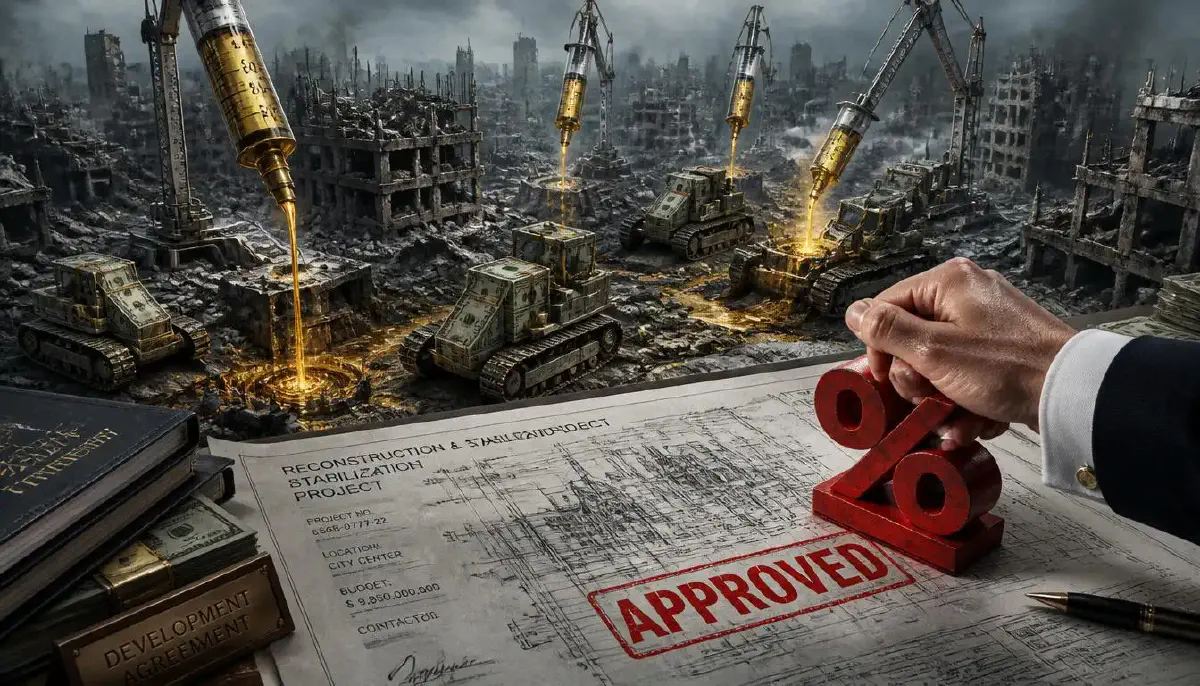
In the marble-clad lobbies of Warsaw’s convention centres, the men in suits have been gathering with increasing frequency. They carry glossy brochures promising “integrated post-conflict urban renewal solutions,” “resilient infrastructure delivery,” and “capacity-building frameworks.” They sip coffee from tiny cups and exchange business cards with government officials, each of whom controls a sliver of what will be the largest reconstruction project since the Marshall Plan. The unofficial estimate for rebuilding Ukraine, last updated in February 2026, now stands at $587.7 billion—a sum roughly equivalent to three times the country’s pre-war annual economic output. To put that in perspective, it is more than the combined GDP of all the Balkan states.
This money, when and if it arrives, will not be spent by the Ukrainian government alone. It will be channelled through an intricate web of multilateral development banks, bilateral aid agencies, international NGOs, and—most lucratively—private contractors. The reconstruction industry is a sprawling ecosystem of engineering conglomerates, logistics specialists, security consultants, and legal advisors, all of whom take a cut before the first brick is laid. And if the recent history of Iraq and Afghanistan is any guide, the gap between what is pledged and what reaches the ground will be measured not in percentages but in orders of magnitude.
This article, the third in our series, opens the books on the reconstruction racket: the consultants who get rich, the local elites who capture the contracts, and the systematic waste that turns post-war recovery into a private profit centre.
The destruction dividend#
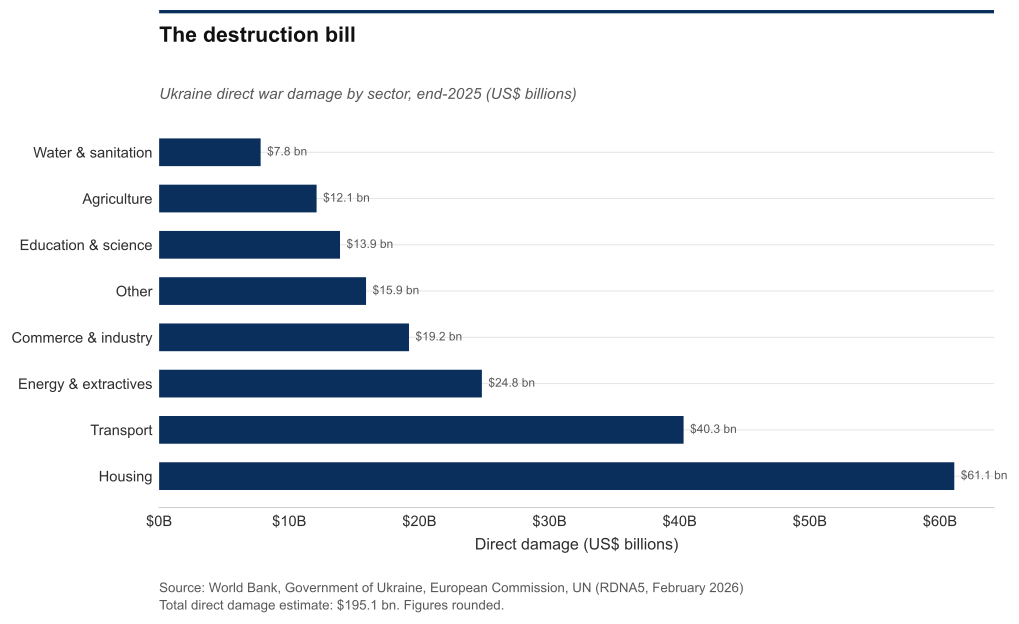
The sheer scale of the damage in Ukraine is staggering. According to the fifth Rapid Damage and Needs Assessment (RDNA5), compiled by the World Bank, the Ukrainian government, the European Commission, and the United Nations, the direct physical damage from the invasion had reached $195.1 billion by the end of 2025. That figure—compiled from satellite imagery, on-the-ground surveys, and statistical extrapolation—covers the bombing of apartment blocks, the cratering of roads and railways, the demolition of power stations, and the gutting of schools, hospitals, and factories. It does not include the lost economic output, the displacement, or the psychological trauma. Those are counted in a separate, even larger tally of “losses,” which the same assessment puts at $666.7 billion.
The biggest single line item, accounting for nearly a third of the total, is housing. Over 60 billion dollars’ worth of homes have been destroyed or rendered uninhabitable. Transport infrastructure—roads, bridges, railways, ports—comes next, with $40.3 billion in damage. Energy and extractive industries, commerce and industry, and agriculture each account for $10–25 billion more (see Figure 8). Even the water and sanitation sector, a grimly mundane category, has suffered nearly $8 billion in destruction.
To rebuild all of this will take a decade and cost, by the estimate of Deputy Minister Riabykin, over $90 billion for energy alone, $96 billion for transport, and comparable sums for construction and industry. Yet the money actually mobilised so far is a tiny fraction of the need. In the first four years of the war, a little over $20 billion in recovery financing has been delivered—enough to patch up emergency services and begin some critical repairs, but nowhere near the $15.25 billion that the government estimates it needs just for priority projects in 2026.
This gap between rhetoric and reality is not a Ukrainian peculiarity. It is a structural feature of post-conflict reconstruction, and it stems from a system that is far better at pledging money than at spending it effectively.
The missing billions: lessons from Afghanistan#
To understand where the money goes—or, more precisely, where it vanishes—it is helpful to look at the most thoroughly documented reconstruction failure in modern history: the American-led effort in Afghanistan. Between 2002 and 2021, the United States Congress appropriated approximately $145 billion for Afghan reconstruction, making it one of the largest nation-building exercises ever attempted. A significant portion of this money was channelled through ad hoc bodies like the Task Force for Business and Stability Operations (TFBSO), which was supposed to attract private investment and create jobs.
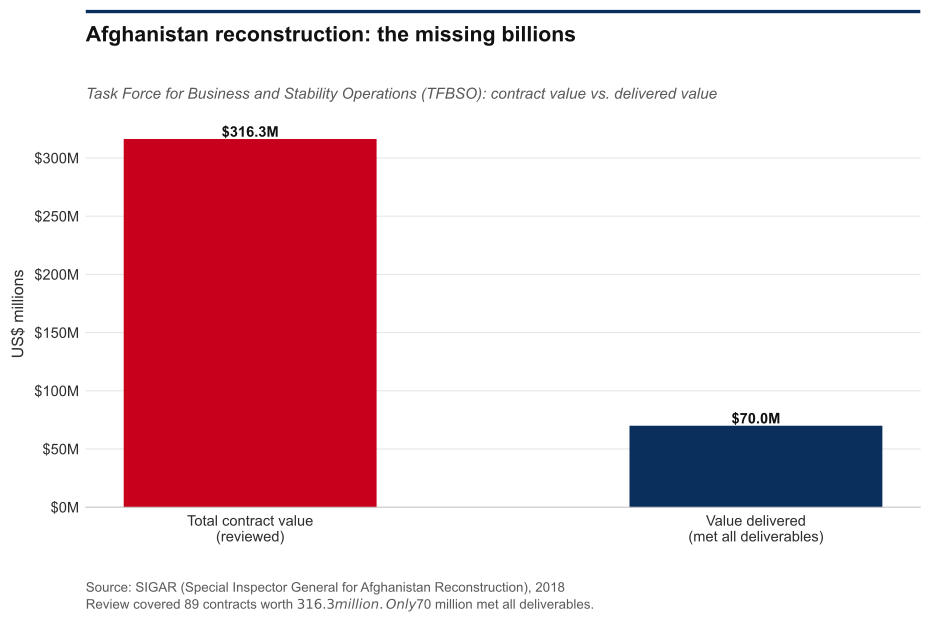
The results, as documented by the Special Inspector General for Afghanistan Reconstruction (SIGAR), were catastrophic. An exceptionally critical audit, released in early 2018, examined 89 TFBSO contracts worth a combined $316.3 million. The auditors found that only $70 million—barely 22%—was spent on contracts that met all their deliverables. The remaining 78%, totalling $246.3 million, partially or fully failed to deliver (see Figure 9).
What happened to the rest? Some of it was lost to outright fraud. Some was absorbed by the staggering overheads of operating in a war zone, where security costs routinely consumed 25–40% of project budgets. But much of it was simply wasted on poorly designed programmes, awarded through sole-source or limited-competition contracts to firms that had little incentive to perform. In seven cases, contracts worth $35.1 million were handed to companies that employed former TFBSO staff—a classic revolving-door arrangement that blurred the line between oversight and self-dealing.
The SIGAR auditors concluded that “the precise amount lost to fraud and waste can never be known.” But the overall picture is clear: in the Afghan reconstruction, the primary beneficiaries were not the Afghan people but a constellation of American and international contractors, subcontractors, and the security and logistics firms that orbited them.
The pattern was not unique to Afghanistan. In Iraq, the Office of the Special Inspector General for Iraq Reconstruction (SIGIR) questioned more than $635 million in costs by the time it closed its doors in 2013. Its final report offered a similarly bleak judgment: the true scale of the waste was unknowable. As in Afghanistan, the contractor class had been the invisible victors of a war that officially failed.
The local capture#
If the international contractors siphon off the largest share, they do not operate alone. In every post-conflict economy, a class of local intermediaries emerges: politically connected businessmen, often with ties to the ruling party or a dominant militia, who secure subcontracts, import licences, or monopolies over key commodities. These “cement cartels,” as they are sometimes called, thrive on the lack of transparency and the urgency of rebuilding. When the state is weak and the money is flowing, the incentive to rig the procurement process is irresistible.
In Iraq after 2003, the reconstruction effort was famously hobbled by the rise of sectarian power-brokers who diverted contracts to their own patronage networks. In the Balkans, post-war reconstruction in the 1990s saw a similar dynamic: the warlords of one era became the construction magnates of the next, cementing their political influence through control of rebuilding contracts. Syria, when the conflict there eventually subsides, will almost certainly follow the same script, with the various factions that carved up the country positioning themselves to reap the rewards of reconstruction.
What makes this form of capture so pernicious is that it is often legal, or at least indistinguishable from the normal operation of a crony-capitalist state. The contracts are awarded through official channels, the invoices are submitted, and the reports are filed. The fact that the firm receiving the contract is owned by the nephew of the defence minister, or that the cement it imports is priced at three times the market rate, is not something that a multilateral lender’s standard audit procedures are designed to detect. The result is a reconstruction that rebuilds the structures of power as surely as it rebuilds the bridges and the power lines.
The insurance trap#
A less visible but equally significant drag on reconstruction comes from the insurance industry. In any war zone, the cost of insuring construction projects is astronomical. War-risk insurance premiums can add double-digit percentages to project costs, making some forms of rebuilding commercially unviable without substantial government subsidies. After a conflict, the legal battles over who bears the cost of damage—the original insurer, the reinsurer, the property owner, or the government—can drag on for years, leaving buildings in their bombed-out state while lawyers argue over liability.
This is more than a nuisance. In Iraq, disputes over insurance payouts delayed the reconstruction of critical infrastructure for years. In Ukraine, Western companies seeking to participate in the rebuilding effort are already grappling with the challenge of securing affordable coverage, a problem that will only intensify as the scale of the work expands. As the fifth article in this series will explore in detail, the war-risk insurance market exerts a quiet but powerful influence on where and how quickly rebuilding can proceed.
The aid curse#
Economists have a term for the paradox of post-conflict reconstruction: the “aid curse.” The influx of large amounts of external assistance can, perversely, undermine the very recovery it is meant to foster. It drives up the prices of local labour and materials, making the economy uncompetitive. It draws talent away from productive private-sector jobs and into donor-funded projects. It strengthens the state’s dependence on external finance, weakening the domestic tax base and the social contract between citizens and government. And it creates a powerful constituency of aid-funded professionals—both local and international—who have a vested interest in the continuation of the reconstruction effort, even if it no longer serves the broader population.
The World Bank’s research on post-conflict economies consistently finds that the countries that recover fastest are those that manage to rebuild their own institutions rather than relying on imported ones. But the incentives embedded in the reconstruction system push in the opposite direction. The contractors want large, multi-year programmes with complex specifications that only they can meet. The donor agencies want visible, measurable results that they can report to their funders. The local elites want a share of the spoils. No one, in this constellation of interests, has a strong incentive to ask whether the money is being spent wisely, or whether the reconstruction is creating the conditions for a durable peace rather than simply papering over the cracks with fresh concrete.
The balance sheet of reconstruction, when it is finally drawn up, will show a small fraction of what was pledged reaching the people for whom it was intended. The rest will have evaporated in a fog of overheads, corruption, and incompetence—not because the system is broken, but because it is working exactly as designed. The rubble, as it turns out, is not just the legacy of war. It is a business opportunity, and one that the men in suits in the Warsaw convention centres have every intention of exploiting.
This is the third article in a six-part series, “The Balance Sheet of Battle.” The next instalment will descend into the shadow ledgers: the hawala networks, crypto rails, and ghost fleets that keep money moving when formal finance has collapsed.