
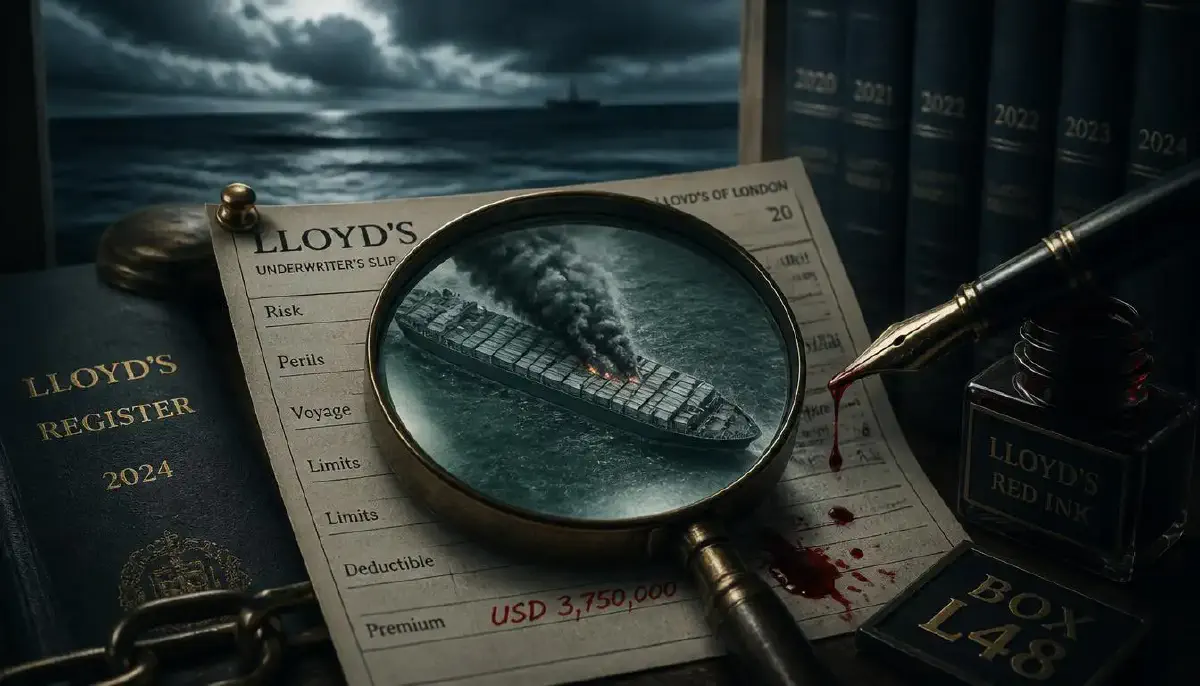
On a grey November morning in the City of London, a marine underwriter at a Lloyd’s syndicate—call him James—sits before a bank of screens reviewing a submission that would have seemed preposterous three years ago. A shipping company wants to send a container vessel through the Bab el-Mandeb strait, the narrow chokepoint at the southern entrance to the Red Sea that has become a shooting gallery for Houthi drones and anti-ship missiles. The vessel is flagged in Liberia, owned by a Greek family office, and chartered to a French logistics giant. The underwriter’s task is to name a price for the risk that it will be struck by a projectile travelling at three times the speed of sound.
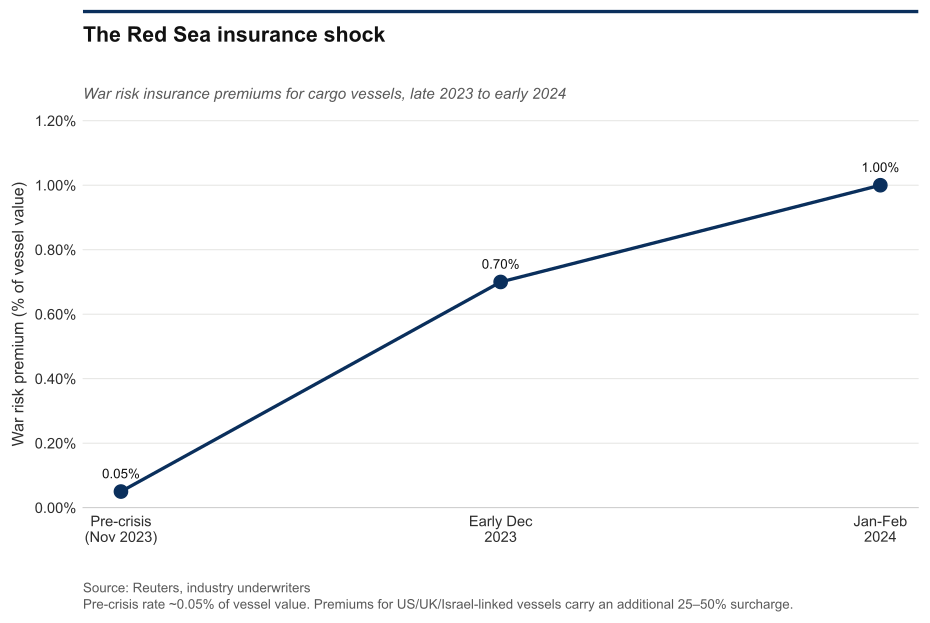
Before the Houthi campaign began in late 2023, the war-risk premium for a Red Sea transit was negligible—around 0.05% of the vessel’s insured value. For a $100 million ship, that came to $50,000. By early December 2023, after the first commercial vessels had been hit, the premium had jumped to 0.7%. By January 2024, as the attacks intensified and American and British warships began retaliatory strikes, it reached 1%. For a ship linked—even tenuously—to American, British or Israeli interests, underwriters added a further 25–50% surcharge. A single seven-day voyage through the danger zone now cost hundreds of thousands of dollars more in insurance than in fuel, crew and port fees combined.
The spike in premiums set off a chain reaction that has reshaped global trade. Most major container lines have abandoned the Suez Canal route entirely, diverting their fleets around the Cape of Good Hope—a detour that adds ten days and roughly $1 million in fuel costs per voyage. The disruption has rippled through supply chains, raising the price of goods from Asian factories to European shelves. And yet the ships that continue to ply the Red Sea are almost exclusively those that can afford the insurance, or that fall below the radar of the Houthi targeters by declaring Chinese crews or no links to Israel on their public tracking profiles.
The episode illuminates a truth that is rarely acknowledged: the insurance industry is not a passive observer of conflict. It is an active gatekeeper, capable of making a war zone commercially impassable with the stroke of an actuarial pen. The syndicates of Lloyd’s, the reinsurance giants of Zurich and Munich, and the government-backed development-finance institutions in Washington collectively decide what risks can be borne, at what price, and by whom. Their decisions determine whether a grain shipment reaches a starving population, whether a power plant is rebuilt after a missile strike, and whether a foreign investor dares to put capital into a fragile state.
The marine war-risk market#
The Red Sea crisis is only the most visible manifestation of a market that has been quietly expanding for decades. Marine war-risk insurance covers physical damage to hulls and cargo caused by war, strikes, terrorism and piracy. It is a separate market from standard marine hull and cargo insurance, which typically excludes such perils. When a conflict erupts, the war-risk market goes into overdrive, with premiums gyrating in response to each new incident.
The market is concentrated in a handful of specialist syndicates. The London market, centred on Lloyd’s, remains the global hub, but it is supplemented by significant capacity in Bermuda, Singapore and the Nordic countries. The underwriters who operate in this space rely on a mixture of open-source intelligence, classified briefings, and their own networks of informants—former naval officers, regional security consultants, and ship captains who have sailed the contested waters. Their pricing decisions are, in effect, a real-time assessment of the probability and severity of attack.
What makes the marine war-risk market so economically significant is its influence over the cost of energy and food. When premiums for Black Sea grain shipments surged after Russia’s invasion of Ukraine, the effects were felt in wheat prices from Cairo to Karachi. When the Red Sea became impassable for many carriers, the cost of shipping a container from Shanghai to Rotterdam roughly tripled. The insurers, in this sense, are not just pricing the risk of war; they are pricing the risk of hunger and inflation for millions of people who will never know their names.
Political risk: insuring the investor#
Beyond the shipping lanes, a quieter corner of the insurance industry shapes the flow of long-term investment into conflict-affected and fragile states. Political-risk insurance (PRI) protects foreign investors against losses caused by expropriation, currency inconvertibility, political violence, and breach of contract by host governments. In the aftermath of war, when a country’s legal and physical infrastructure lies in ruins, PRI is often the only thing that persuades a multinational construction firm or an energy company to commit capital.
The public sector dominates this market. The US International Development Finance Corporation (DFC) can provide up to $1 billion in coverage per project, insuring 90% of an equity investment or 100% of a loan, with terms stretching up to 20 years. Its historical recovery rate is a remarkable 96%, which means that taxpayers have, so far, been largely shielded from losses. The World Bank’s Multilateral Investment Guarantee Agency (MIGA) performs a similar role, typically covering 40–60% of a project’s exposure. Between them, these institutions hold billions of dollars in unobligated balances, ready to be deployed to entice private capital into places where the market alone would not go.
The private market for political-risk insurance has been hardening in recent years, driven by rising nationalism, the resurgence of expropriation risk, and the sheer number of active conflicts. Private insurers increasingly exclude the highest-risk countries altogether, or offer coverage only with substantial deductibles and exclusions. The result is a bifurcation: the riskiest places are insured almost entirely by the public sector, which means that taxpayers in Washington, Berlin and Tokyo are the ultimate backstop for investments in the world’s most dangerous neighbourhoods. When a power plant in a post-coup Sahelian state is seized by a junta, the loss is not borne by a hedge fund in the Cayman Islands. It is borne, ultimately, by the American fiscal ledger.
The moral hazard of parametric bonds#
The frontier of war-risk finance lies in instruments that blur the line between insurance and speculation. “War catastrophe bonds”—parametric instruments that pay out when a predefined conflict-intensity trigger is met—are the newest addition to the armoury. The concept is simple: a bond is issued by a government or a humanitarian agency, and investors receive a coupon that reflects the risk that a specific conflict metric—the number of battle-related deaths, the displacement of a certain number of people, the loss of control over a particular territory—will be breached. If the trigger is hit, the bond’s principal is diverted to pay for emergency relief or reconstruction. If it is not, investors pocket a substantial return.
The appeal is understandable. War is, in financial terms, an uncorrelated risk: it does not move in tandem with stock markets, interest rates or commodity prices, which makes it attractive to portfolio managers seeking diversification. But the moral hazard is acute. An investor who holds a war catastrophe bond has a financial incentive, however remote, for the conflict to intensify—or, at the very least, for the trigger to be hit. The same instrument that is designed to finance humanitarian relief could, in theory, attract capital that profits from the escalation of violence. This is not a hypothetical concern. Critics of similar instruments in the natural-disaster space—earthquake bonds, pandemic bonds—have long argued that they create perverse incentives and asymmetries of information. In the context of war, where the triggers can be influenced by the actions of belligerents, the ethical questions become even sharper.
The fine print: exclusions that leave victims uncovered#
For all the sophistication of the war-risk market, its coverage is far from comprehensive. Standard insurance policies—whether for property, business interruption, or life—contain war-exclusion clauses that are broad, opaque, and rarely tested in court. The exclusions typically encompass “war, invasion, acts of foreign enemies, hostilities (whether war be declared or not), civil war, rebellion, revolution, insurrection, military or usurped power.” In many policies, nuclear, biological and chemical risks are also carved out, as are cyber-attacks attributed to state actors. The effect is that when a missile strikes an apartment block, or a drone hits a factory, the victims often discover that their insurance is worthless. They are left to rely on the state, which in a war zone is usually the least capable of providing compensation.
The legal battles over these exclusions are only now beginning to reach the courts. In Ukraine, businesses whose premises have been destroyed by shelling are filing claims against their insurers, arguing that the attacks are not acts of “war” within the meaning of the exclusion because no formal declaration of war has been made by Russia. In Israel, property owners are disputing whether Hamas’s October 7th attacks constituted “civil war” or “terrorism,” with significantly different consequences for coverage. The outcome of these cases will shape the boundaries of the war-risk market for years to come. But for the families sifting through the rubble, the question is more immediate: who will pay for the roof over their heads? The answer, in too many cases, is no one.
The silent arbiters#
The insurance industry, for all its discretion, is one of the most powerful economic forces in the global response to conflict. It can render a sea lane commercially unnavigable, as it has done in the Red Sea. It can accelerate or stall a post-war reconstruction, by making investment premiums prohibitive or affordable. It can even, in the extreme, shape the strategic calculus of a belligerent: an adversary that knows its oil exports will be uninsurable if it crosses a certain red line may, perhaps, think twice. This is the insurance industry as a silent arbiter of war—not a combatant, but a determinant of the costs that combatants can bear.
Yet the power of the insurers is also their vulnerability. The war-risk market is highly concentrated, and the capacity of the private sector to absorb catastrophic losses is finite. A single major escalation—a blockade of the Strait of Hormuz, a deliberate oil spill from a ghost tanker, a cyber-attack on a major port—could overwhelm the system, forcing governments to step in as insurers of last resort. When that happens, the line between public and private, between the market and the state, will be blurred beyond recognition. The insurers of apocalypse, for all their actuarial precision, are betting that the apocalypse will not arrive. That is a wager with history, and history is not kind to those who underestimate the destructive ingenuity of human beings at war.
This is the fifth article in a six-part series, “The Balance Sheet of Battle.” The final instalment will examine the peace dividend that never came: why so many post-war economies fail to recover, and how the scars of conflict persist for generations.