
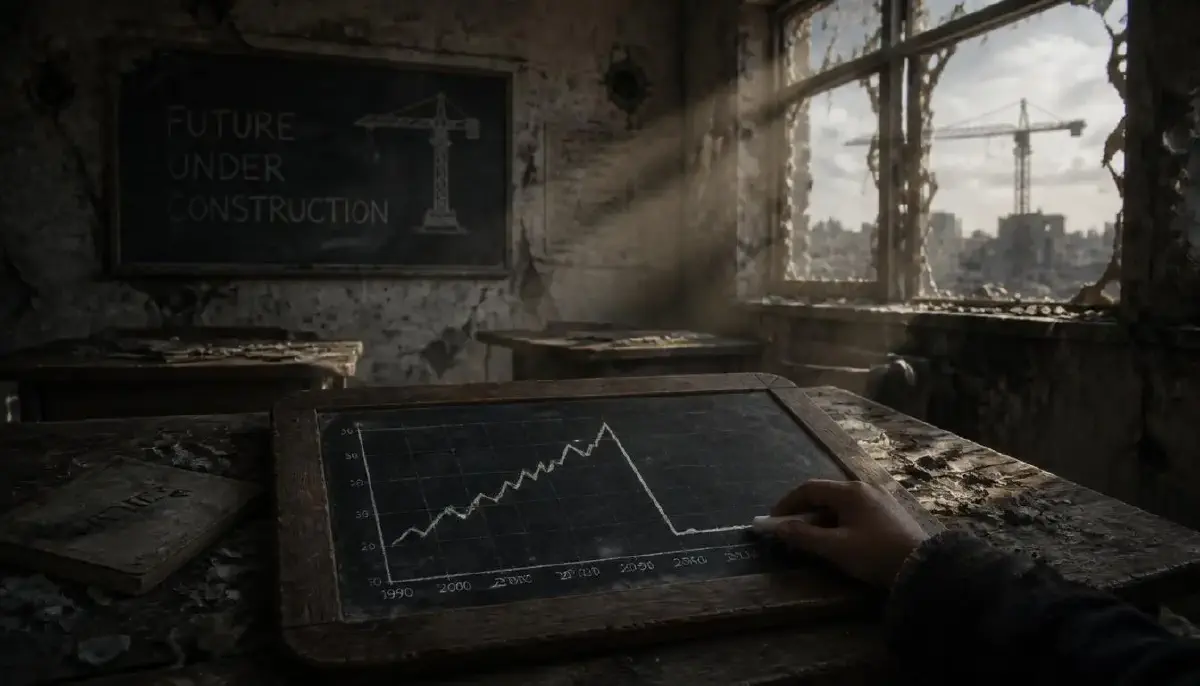
In the spring of 1992, as the smoke cleared over the bombed-out suburbs of Sarajevo, a team of World Bank economists arrived to assess the damage and plan for reconstruction. The civil war that had torn Yugoslavia apart was not yet over, but the outlines of a post-conflict recovery were already being sketched on whiteboards in Washington. The assumption, shared by all the major multilateral institutions, was that peace would bring a swift economic rebound—a peace dividend that would, within a decade or so, return the shattered economies of the Balkans to their pre-war growth trajectories.
Three decades later, the data tell a bleaker story. The average region of the former Yugoslavia saw its per capita GDP fall by 38% relative to what it would have been without war. The most heavily affected areas—those that experienced the worst ethnic cleansing, the most intense shelling, the deepest disruption to social fabric—lost as much as 79%. Even the relatively spared capital cities and the north-western regions suffered declines that persisted long after the Dayton Accords were signed. The peace dividend, in the Balkans as in so many other post-conflict zones, never materialised. The war subtracted permanently from the productive capacity of the region, and the loss compounds with every year that passes.
This article, the final instalment in our series, examines the long-run economic trajectory of societies after war. It asks why some countries recover while others languish, and what the permanent scars of conflict mean for the millions who live in their shadow. The balance sheet of battle, it turns out, never balances. The costs continue to accrue long after the last shell has been fired.
The synthetic control revolution#
For decades, economists struggled to measure the true cost of war. The obvious approach—comparing a country’s GDP before and after a conflict—is hopelessly misleading, because it cannot distinguish the effects of the war from the countless other factors that influence growth: global commodity prices, technological change, demographic shifts. A country might have grown slowly even without a war; conversely, a post-war boom might be simply the resumption of a trend that the war temporarily interrupted.
The breakthrough came with the development of the synthetic control method, a statistical technique that constructs a counterfactual—a “synthetic” version of the war-affected country, stitched together from the economic data of similar countries that did not experience conflict. By comparing the actual trajectory of the war-torn economy with its synthetic twin, researchers can isolate the causal effect of the war itself.
The most comprehensive application of this method to armed conflict was published in 2022 by economists at the European Bank for Reconstruction and Development. They analysed nearly 400 wars over two centuries and reached a set of conclusions that are as robust as they are sobering. Wars fought on a country’s own territory reduce GDP per capita by more than 7 percentage points relative to the synthetic counterfactual within a year of the war’s end. Civil wars are even more damaging than interstate conflicts, and their effects are more persistent—the scars do not fade with time. Wars fought off a country’s territory, by contrast, can actually increase GDP per capita relative to the counterfactual, as the combatant economy benefits from military spending and the absence of domestic destruction.
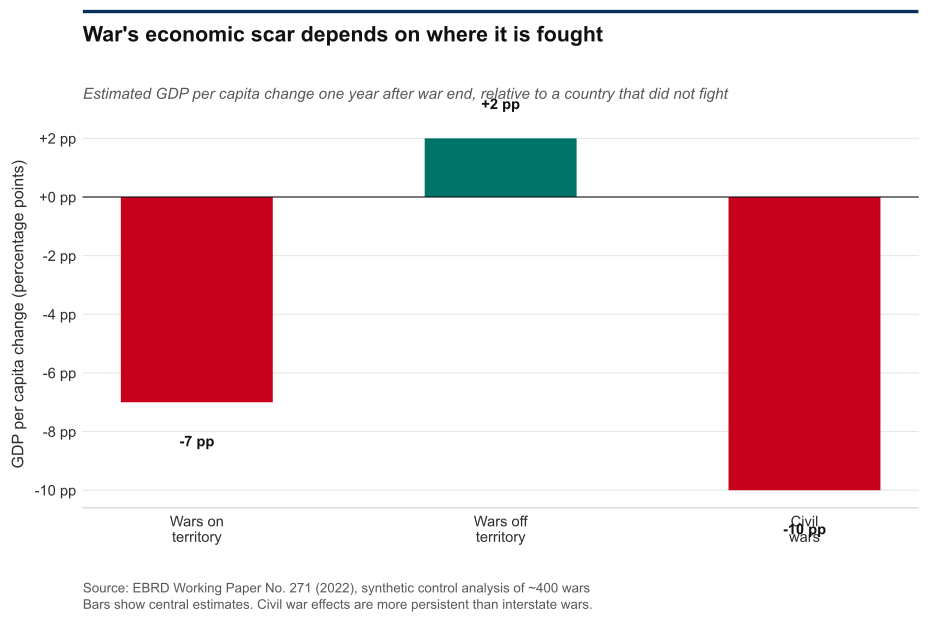
The asymmetry is striking. A war fought on your territory is an economic catastrophe. A war fought on someone else’s territory can be, in narrow GDP terms, a stimulus. The balance sheet of war, viewed from this vantage, is not a zero-sum game: it is a transfer of productive capacity from the battlefield to the distant capital.
The Balkan laboratory#
The Yugoslav civil wars of the 1990s provided a uniquely rich laboratory for testing these ideas. The country’s disintegration created 78 distinct regions—the statistical units that had reported economic data throughout the 1980s—some of which experienced intense violence while others remained largely peaceful. This variation allowed researchers to compare regions that were similar in their pre-war economic structures but diverged dramatically in their wartime experiences.
A study published in 2026 by Kešeljević, Nikolić and Spruk applied the synthetic control method to each of the 78 regions individually, constructing a separate counterfactual for every one. The results, as the chart below shows, revealed a gradient of devastation that closely tracked the geography of ethnic violence. The regions that suffered the most intense population displacement and the deepest ethnic fractionalisation saw the largest and most persistent GDP losses. The regions that were spared the worst of the fighting recovered relatively quickly. The primary driver of long-run economic damage, the authors concluded, was not the physical destruction of infrastructure—which can be rebuilt—but the displacement of populations and the erosion of the social trust on which commercial activity depends.
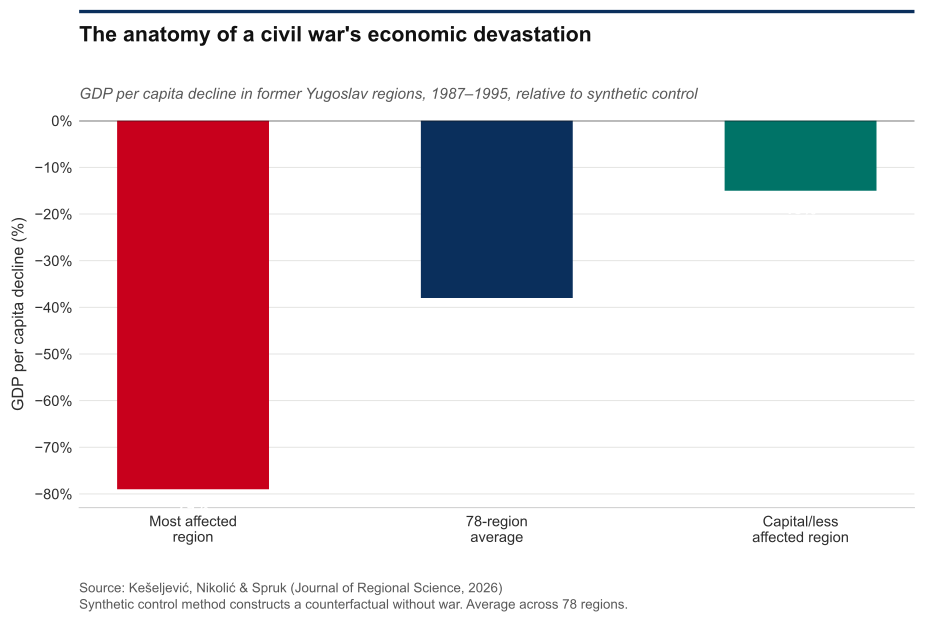
This finding has profound implications for reconstruction policy. It suggests that the billions of dollars poured into rebuilding bridges and power stations, while necessary, are insufficient. Unless the displaced can return and the fabric of inter-community relations can be rewoven, the economic damage of war will persist indefinitely. The balance sheet of battle includes a line item for social capital, and it is almost always written in red.
The rare cases of recovery#
If the Balkan experience represents the norm, there are a handful of cases that offer a glimmer of hope. Mozambique, which endured a brutal civil war from 1977 to 1992, is the most celebrated example. After the Rome General Peace Accords ended the conflict, the country experienced a sustained boom. Average real annual GDP growth between 1992 and 2010 was more than 60% higher than what a synthetic control counterfactual would have predicted had the war continued. Foreign investment poured into the country’s aluminium smelters and natural-gas fields. Agricultural production recovered as displaced farmers returned to their land. By the end of the 2000s, Mozambique had become a poster child for post-conflict reconstruction.
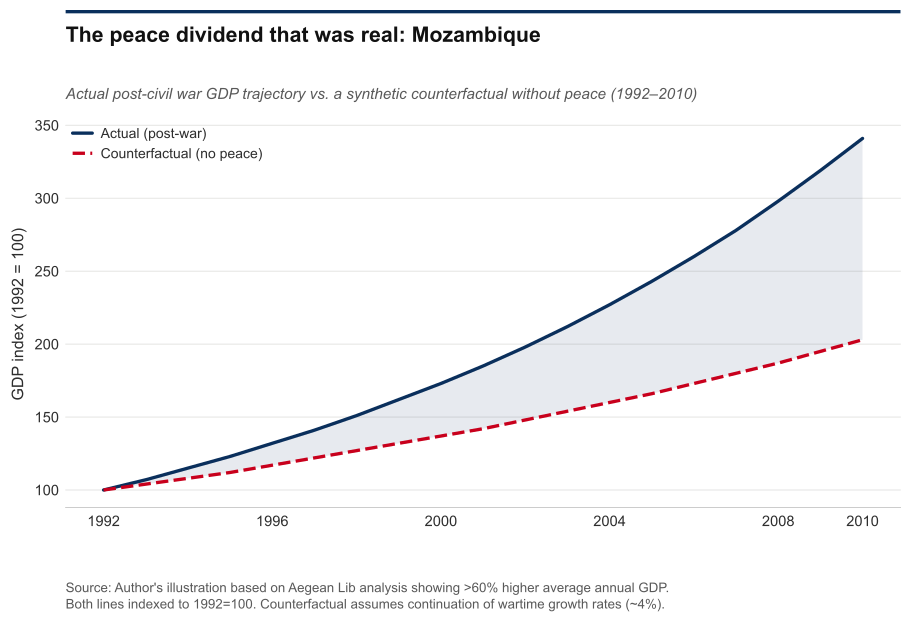
What explains Mozambique’s success? The country was fortunate in its geography—its long coastline and proximity to South Africa made it a natural corridor for trade—but it also benefited from a combination of factors that are rarely present in post-conflict settings. The peace agreement was genuinely comprehensive, disarming both sides and integrating former combatants into a unified army. The government, led by the former rebel movement Frelimo, pursued broadly market-friendly policies and maintained macroeconomic stability. Donors, impressed by the government’s commitment to reform, provided generous and well-coordinated assistance. And perhaps most importantly, the war had not entirely destroyed the country’s social fabric; the displaced returned relatively quickly, and the ethnic cleavages that had fuelled the conflict were less deeply entrenched than in the Balkans or the Middle East.
Mozambique’s experience, unfortunately, remains the exception rather than the rule. For every Mozambique, there is a Syria, a Yemen, a Central African Republic—countries where the war economy has become self-perpetuating, where the displaced remain in camps for decades, and where the state is too weak or too corrupt to channel reconstruction funds into productive investment. A World Bank study of the Central African Republic, using the same synthetic control methodology, estimated that the cumulative GDP loss from the civil war that began in 2013 had reached between $29.7 billion and $32.4 billion by 2022—a sum that dwarfs the country’s annual output many times over. The war had, in effect, erased an entire generation of economic progress.
The human capital abyss#
The most pernicious mechanism of long-run economic scarring operates through human capital. When schools are destroyed, teachers are displaced, and children are conscripted into armies or forced to work, the loss of education compounds over a lifetime. A child who misses three years of schooling during a war is not simply three years behind; she is less likely to return to school at all, more likely to enter informal or exploitative labour, and more likely to raise children who are themselves under-educated. The war becomes embedded in the human capital stock of the country, and the effects ripple outward for decades.
Research on the Syrian conflict has documented this process in agonising detail. Per capita GDP experienced a “rampant but temporary decline,” with a partial recovery to pre-war levels by 2019—only to be hammered again by the COVID-19 pandemic and the collapse of the Lebanese banking system, which had served as Syria’s financial lifeline. But the recovery in GDP masked a deeper erosion: the “missing generation” of Syrian children who lost years of schooling, who now lack the literacy and numeracy skills required for anything beyond subsistence work. These deficits will drag on the country’s productivity for the rest of the 21st century, long after the physical infrastructure has been rebuilt.
The gender dimension adds another layer of complexity. In many post-conflict settings, women are pushed into informal employment—street vending, domestic work, subsistence farming—that is never captured in GDP statistics and provides no social protection. At the same time, widows and female-headed households often gain a degree of economic autonomy that they did not possess before the war, creating a complicated legacy that is simultaneously empowering and precarious. The net effect on long-run growth is ambiguous, but what is not ambiguous is that standard economic statistics systematically undercount the productive contribution of women in the aftermath of war.
The winners and the periphery#
Not everyone loses from war’s long shadow. Some economies profit from proximity to conflict without being consumed by it. Jordan, during the Iraq war, became a hub for contractors, logistics firms, and the intelligence services that orbited the American occupation. Its banking sector swelled with deposits from Iraqi refugees and businessmen seeking a safe haven. Poland, in the first years of the Ukraine war, experienced a similar boom: its cities absorbed millions of Ukrainian refugees, its factories ramped up production for the NATO rearmament effort, and its strategic importance to the West translated into diplomatic leverage and investment flows.
Whether these gains persist beyond the immediate post-war period is less clear. Jordan’s economy, after the Iraq war ended and the American presence diminished, reverted to its pre-war trajectory of sluggish growth and high unemployment. The war dividend was temporary, and the structural weaknesses of the Jordanian economy—dependence on foreign aid, a bloated public sector, water scarcity—reasserted themselves. Poland may yet prove more durable in its gains, but the historical record suggests that the economic benefits of proximity to war are contingent, fragile, and easily reversed when the geopolitical winds shift.
The permanent subtraction#
What does all this mean for the ledger of battle? The concentrated gains that we documented in the first five articles of this series—the arms manufacturers’ soaring order books, the vulture funds’ litigation windfalls, the reconstruction contractors’ cushy contracts, the hawala brokers’ transaction fees, the insurers’ war-risk premiums—are the visible entries on one side of the balance sheet. They are real, they are large, and they accrue to a remarkably small number of individuals and institutions. But on the other side of the ledger, the losses are diffuse, generational, and largely invisible to the standard tools of economic measurement. They are the missing schools, the broken trust, the displaced families who will never return, the children who will never learn to read, the entrepreneurs who will never start businesses because the legal system is in ruins and the banks will not lend.
The balance sheet of battle does not balance. It cannot balance, because war is not an accounting error that can be corrected with a restructuring plan or a reconstruction loan. It is a permanent subtraction from the sum of human welfare, and the subtraction is borne overwhelmingly by those who had no role in starting the conflict, no share in its profits, and no voice in the peace that follows. The economists can construct their synthetic counterfactuals and calculate their GDP losses, but the true cost of war is measured in lives that were never lived, in innovations that were never conceived, in the quiet, cumulative erosion of the capacity for hope.
The men in suits who gather in the Warsaw convention centres, the underwriters who price the Red Sea risk from their Lloyd’s boxes, the hedge-fund managers who buy the defaulted bonds of shattered states—they are not villains. They are rational actors responding to the incentives that the system has created. But the system itself is a machine for converting human suffering into financial returns, and it operates with a brutal efficiency that no peace process has ever succeeded in slowing. The animal proxies of war, which we chronicled in our previous series, are the silent victims. The financial proxies—the contractors, the creditors, the insurers—are the silent beneficiaries. The ledger of battle is written in both their names, and it is a document that no one, in the end, is willing to audit.
This is the final article in the six-part series, “The Balance Sheet of Battle.” The series examined the global arms industry, the sovereign debt traders, the reconstruction racket, the shadow financial networks, the war-risk insurers, and the long-run economic scars that persist long after the fighting stops. The full series is available at economist.com/balance-sheet-of-battle.