
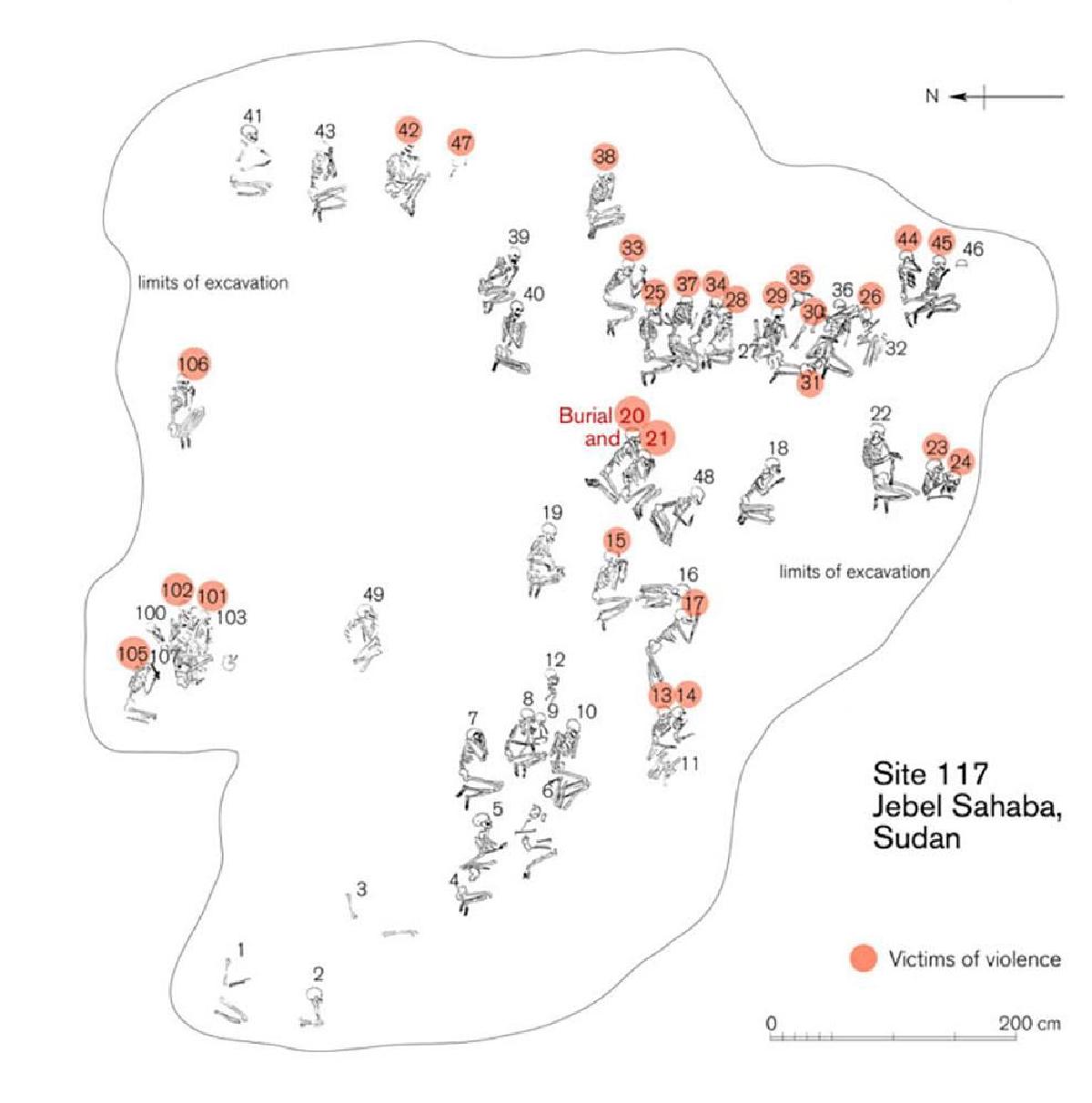
In the early 1960s, a team of archaeologists working near the Nile's Second Cataract in what is now northern Sudan uncovered something remarkable. The Aswan High Dam was about to flood countless ancient sites, and a frantic international salvage operation was underway. Near a rocky outcrop called Jebel Sahaba, excavators found a burial ground that would change the story of human conflict forever.
The skeletons they lifted from the ground were riddled with stone fragments. Pieces of flint were lodged in skulls, ribs, and spines. The site held the remains of 61 individuals: men, women, and children. Many appeared to have died violently. The archaeologists' initial interpretation was dramatic: this was the world's oldest known battlefield, a grim snapshot of a single, terrible massacre some 13,000 years ago. The label stuck, and for decades Jebel Sahaba was recorded in textbooks as the earliest evidence of organized warfare.
But they were wrong.
The First Verdict: Massacre#
The original excavation, led by the American archaeologist Fred Wendorf, made headlines. He described a scene of a group attacked and killed en masse. The press called it the “first war.” Wendorf’s report, published years later, documented dozens of lesions and embedded stone points. His team interpreted the concentration of bodies and similar projectile injuries as proof of a battle: perhaps a clash over dwindling resources as the Ice Age ended and the Sahara dried.
For half a century, that narrative held. Jebel Sahaba became a cornerstone for anyone arguing that warfare was deeply rooted in human nature, that from our earliest days we gathered to slaughter one another. But the bones had secrets that needed more than a 1960s flashlight and a trowel. They needed the tools and eyes of forensic science in the 21st century.
Reopening the Cold Case#
In 2021, a multidisciplinary team led by paleoanthropologist Isabelle Crevecoeur published a complete reanalysis of the Jebel Sahaba skeletons. Using high-resolution CT scans, microscopic examination, and modern forensic trauma analysis, they set out to re-examine every scrap of bone. What they found was staggering: 106 previously undetected lesions, most consistent with projectile wounds. And in a quarter of the individuals who showed signs of violence, they found something that upended the massacre theory entirely.
What the Bones Whispered#
Imagine you are a forensic anthropologist holding the skull of a man who died 13 millennia ago. You see a small, circular hole in the back of his head, unhealed, the edges sharp and fresh. That was the fatal blow. But under magnification, you also notice a depression on his forehead, a healed fracture, the bone remodeled with new growth. He didn’t just die violently; he had survived an earlier attack, perhaps years before, only to fall later to another.
Now multiply that story across the cemetery. The 2021 study revealed that among those with injuries, about 25% had both healed and unhealed wounds. One skeleton, labeled JS 101, had a lithic flake embedded in the neural canal of a cervical vertebra: a shot that would have caused instant death. But the same individual also carried healed trauma on other bones. These were not people killed in a single catastrophic fight. They were people who lived lives punctuated by repeated episodes of violence.
The location of the wounds whispered more details. Many were on the back of the skull, the shoulder blades, the back of the thorax. The trajectory of the projectiles was from behind and often from above. This was not the facing-off of two armed groups in open combat. This was the signature of ambush, of attacks launched from cover, of the hunted.
A Life of Violence, Not a Day of Battle#
The evidence forced a radical reinterpretation. Jebel Sahaba was not a battlefield; it was a cemetery that accumulated over time, the final resting place for a community that lived under constant threat. The violence was real, deadly, and terrifying, but sporadic and small-scale: a pattern of raids rather than a war.
Why would such endemic conflict exist? The climate may hold the key. At the end of the Pleistocene, the Nile Valley was one of the few reliable sources of water and game as the surrounding region turned to desert. Competition for the river’s resources could have driven neighboring groups into lethal competition. Small bands, armed with bows or spear-throwers tipping composite microlithic projectiles, stalked the Nile’s edges. They struck quickly, killed, and vanished. Survivors bore their scars and buried their dead, until the next attack.
This new reading makes Jebel Sahaba even more chilling. A single massacre is a moment of horror; a lifetime of fear is a different kind of darkness. It suggests that the roots of human violence may not lie in grand organized armies but in the grinding, personal, and persistent conflict between small groups of our ancestors.
Epilogue: The Real Story Begins#
The 2021 reanalysis didn’t close the case; it opened a deeper, more troubling one. Jebel Sahaba is no longer the world’s oldest war. Instead, it is something more profound: the earliest definitive evidence that our ancestors could not only kill but also survive, only to be hunted again. The bones tell us that the line between life and death was crossed not once but many times, in the sharp arc of a stone-tipped arrow and the silent grief of a riverbank burial.
In the next article, we will step into the forensic laboratory to see exactly how those stone points were fashioned and what the wounds reveal about the weapons that cut short so many lives. The killing field wasn’t what we thought, but the truth is no less dramatic.