
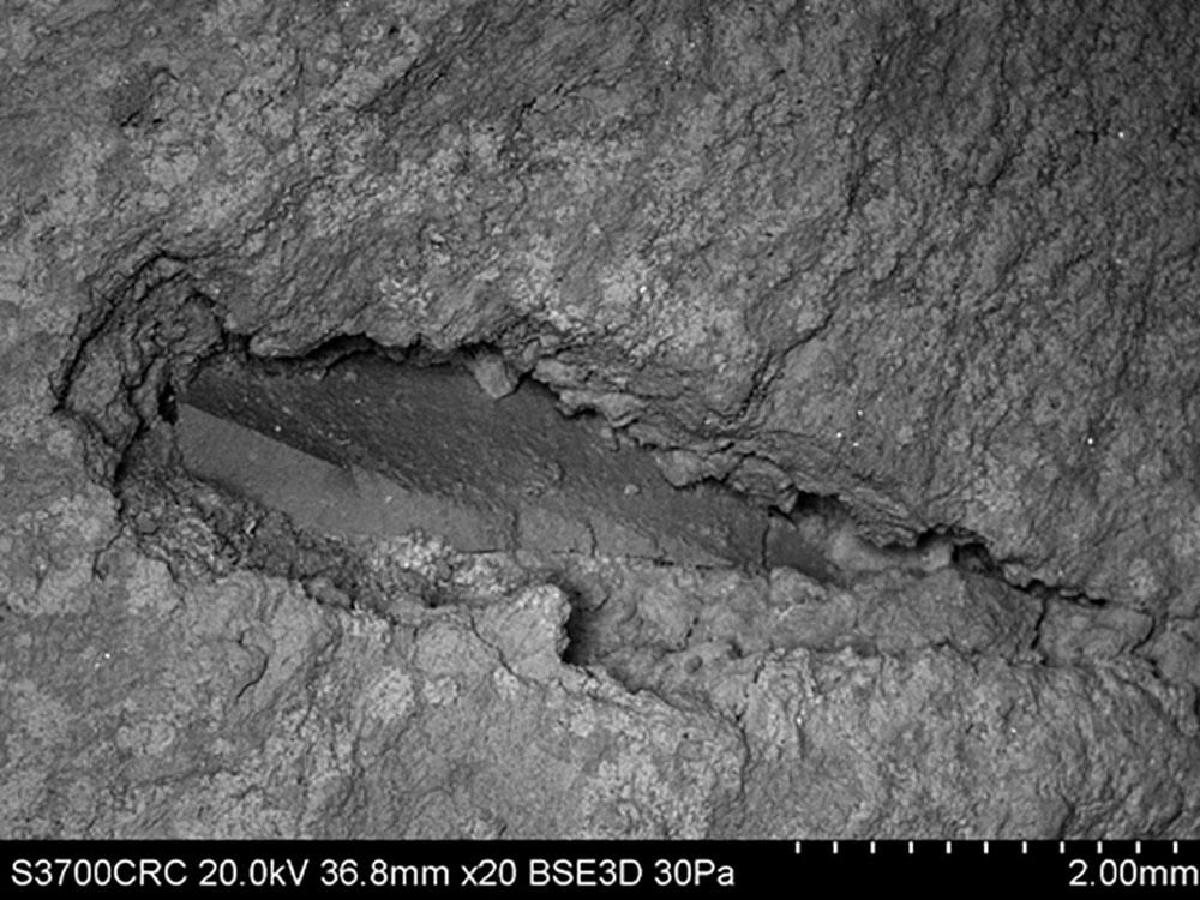
When you hold a 13,000-year-old skull in your hands and see a tiny sliver of flint still embedded where it punched through the back of the cranium, you are not just holding a fossil. You are holding a murder weapon, a moment of violence, and a message from the dead. That flake is a witness that has waited more than a hundred centuries to testify.
In the 2021 reanalysis of the Jebel Sahaba skeletons, the forensic team did not simply count wounds. They performed something closer to an autopsy, using computed tomography, 3D microscopy, and experimental archaeology to reconstruct not just what killed these people but how they were killed, from what direction, and with what weapon. The result is the most detailed portrait ever drawn of prehistoric projectile violence, and it rewrites the technological history of conflict.
Reading a Wound Like a Detective#
Every hole in a bone tells a story. The difference between a healed injury and a fatal one is a matter of cellular activity: remodeling means the person lived; a sharp, unhealed edge means they died. But the shape of that hole, its cross-section, and the telltale radiating fractures around it disclose far more.
The Jebel Sahaba lesions are overwhelmingly consistent with penetration by fast-moving, pointed objects. The entry wounds on the cranium often show internal beveling: a cone of bone punched inward, like a crater on the inside of the skull. That pattern is the forensic signature of a projectile. A blow from a club or a fall onto a rock leaves a different shape. Under magnification, many wounds displayed linear striations and chatter marks left by a sharp stone edge slicing through bone. Some puncture defects were so clean that the team could measure the width and thickness of the point that caused them, despite the point itself having long since fallen out.
In a few extraordinary cases, however, the point never left the body.
A Microscopic Arsenal#
The most dramatic evidence lay in the tiny stone flakes still embedded in the remains. Skeleton JS 101 had a lithic fragment driven into the neural canal of a cervical vertebra, a wound that would have severed the spinal cord and caused instant death. Other individuals carried flakes in the ribs, the pelvis, and deep within the cancellous bone of the skull.
These were not whole arrowheads. They were microliths: small, razor-sharp bladelets, typically one to three centimeters long and a few millimeters thick, made of local chert or flint. The shapes varied: some were backed bladelets with one blunt edge for hafting, others were small points or triangles. What they all shared was their role as components of a composite projectile tip.
Think of a wooden shaft, perhaps the thickness of a pencil, with a groove or slot at the business end. Into that slot, the weapon-maker glued or tied several microliths in a row, edge-to-edge, forming a serrated, cutting head. When the projectile struck flesh, the individual bladelets could break free inside the wound, leaving multiple fragments buried in the body. The Jebel Sahaba bones are a catalog of exactly that kind of damage.
Under a scanning electron microscope, the team identified impact fractures on the microliths that matched experimental shots into animal carcasses. Some flakes had step fractures and burin-like spalls, classic features of a brittle material striking bone at high speed. The stone had performed exactly as it was designed to do.
Ambush by Arrow or Atlatl?#
Knowing the weapon is one thing; knowing how it was delivered is another. The size and depth of the wounds, along with their placement on the body, allow a forensic reconstruction of the attack scenario.
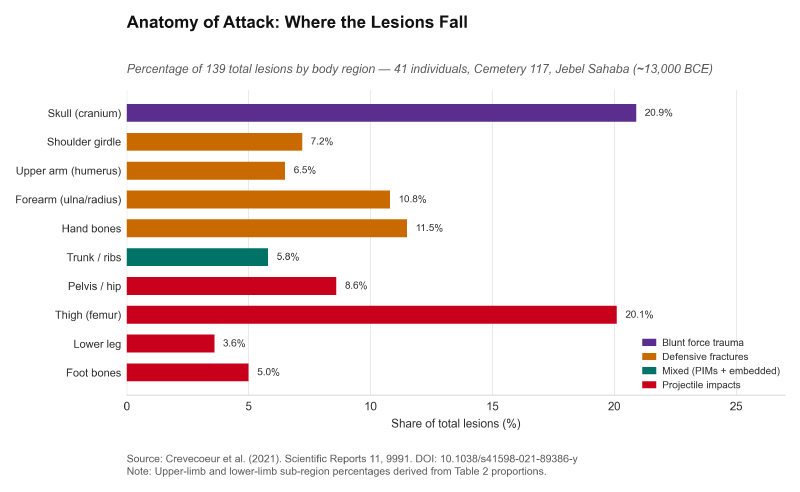
The distribution of lesions is starkly asymmetric. Wounds cluster on the back of the skull, the posterior cervical vertebrae, the shoulder blades, the dorsal ribs, and the back of the pelvis. The trajectories, traced through the bone in three dimensions, consistently angle from behind and above. Some points entered near the base of the skull and traveled upward into the brain. Others pierced between the ribs from behind and ended in the thoracic cavity. In several instances, projectiles struck the humerus or scapula from a rearward direction, as if the victim had been struck while running away, arms swinging.
This is not the pattern of two lines of warriors facing each other in open combat. It is the forensic fingerprint of an ambush: attackers firing from cover or from an elevated position, victims unaware, targets struck in the back. The Jebel Sahaba dead were not soldiers; they were hunted.
But what exactly was the launching device? The archaeological record from the Nile Valley around 13,000 years ago does not preserve intact bows or atlatls (spear-throwers). Both technologies were in use somewhere in the world at this time. The team turned to experimental archaeology for an answer.
They manufactured replicas of the composite microlithic points found at Jebel Sahaba and hafted them onto both arrows and darts. Using calibrated gelatin blocks and pig carcasses, they shot the replicas with bows of varying draw weight and atlatls of varying lever length, then CT-scanned the resulting wounds. The small puncture diameter and the shallow-to-moderate penetration of most Jebel Sahaba lesions matched more closely with light arrows from a bow than with heavier atlatl darts. Furthermore, the tendency of microliths to shed inside a wound was most easily reproduced with high-velocity, low-mass projectiles, exactly the profile of an arrow.
This does not mean the atlatl was absent from the region, but the balance of evidence points toward the bow as the principal weapon responsible for the trauma at Jebel Sahaba. If correct, this would make the cemetery one of the earliest indirect testimonies to bow-and-arrow warfare in human history.
The Laboratory Recreates the Kill#
In a climate-controlled lab in France, Crevecoeur’s team shot stone-tipped arrows into fresh bone. High-speed cameras captured the moment of impact: the microliths biting, the shaft quivering, the fragments spalling away. The damage matched almost perfectly what they saw on the ancient skulls.
One experiment involved a replica of a skull defect found on skeleton JS 117. The original bone showed a small, circular puncture on the occipital, with a radiating crack running toward the base. The experimental arrow, fired from a 40-pound bow at ten meters, struck the occipital of a pig skull at a similar angle and produced an almost identical lesion, complete with the same fracture pattern. The match was uncanny. It told the team that the victim had been shot from behind, at close range, with a bow of moderate draw weight, capable of penetrating the skull and killing instantly.
Other experiments tested the lethality of different hit locations. Shots to the thorax frequently left microliths embedded in ribs, exactly as seen in several Jebel Sahaba individuals. Shots to the back of the neck produced the type of vertebral damage observed in JS 101. The forensic circle was closing: the weapons were light, fast, composite-tipped projectiles, fired from ambush at close to moderate range, designed to fragment inside the body for maximum lethality.
A Chilling Signature#
The weapons of Jebel Sahaba were not crude clubs or crude hand-axes wielded by brutish ancestors. They were elegant, purpose-built killing tools, products of a sophisticated technical tradition. The composite microlithic point was a modular technology: individual bladelets could be replaced when broken, and the same basic design could scale from a small hunting arrow to a larger dart. It represented a deep understanding of materials and ballistics, a lethal ingenuity honed over generations.
But that ingenuity carries a dark message. These weapons were not just for hunting game; they were turned on human beings with devastating effect. The Jebel Sahaba dead tell us that by the end of the last Ice Age, some groups had perfected the tools of interpersonal violence and were using them with chilling regularity. The evidence suggests that these raids were not rare catastrophes but a persistent feature of life along the shrinking Nile.
In the next article, we will leave the laboratory and step into the lived experience of the Jebel Sahaba people themselves. By following the healed injuries, the scars of survival, we can piece together what it meant to live a lifetime under the shadow of the ambush, to recover, to bury your dead, and to wait for the next attack. The weapons have spoken. Now it is time to hear the survivors.