
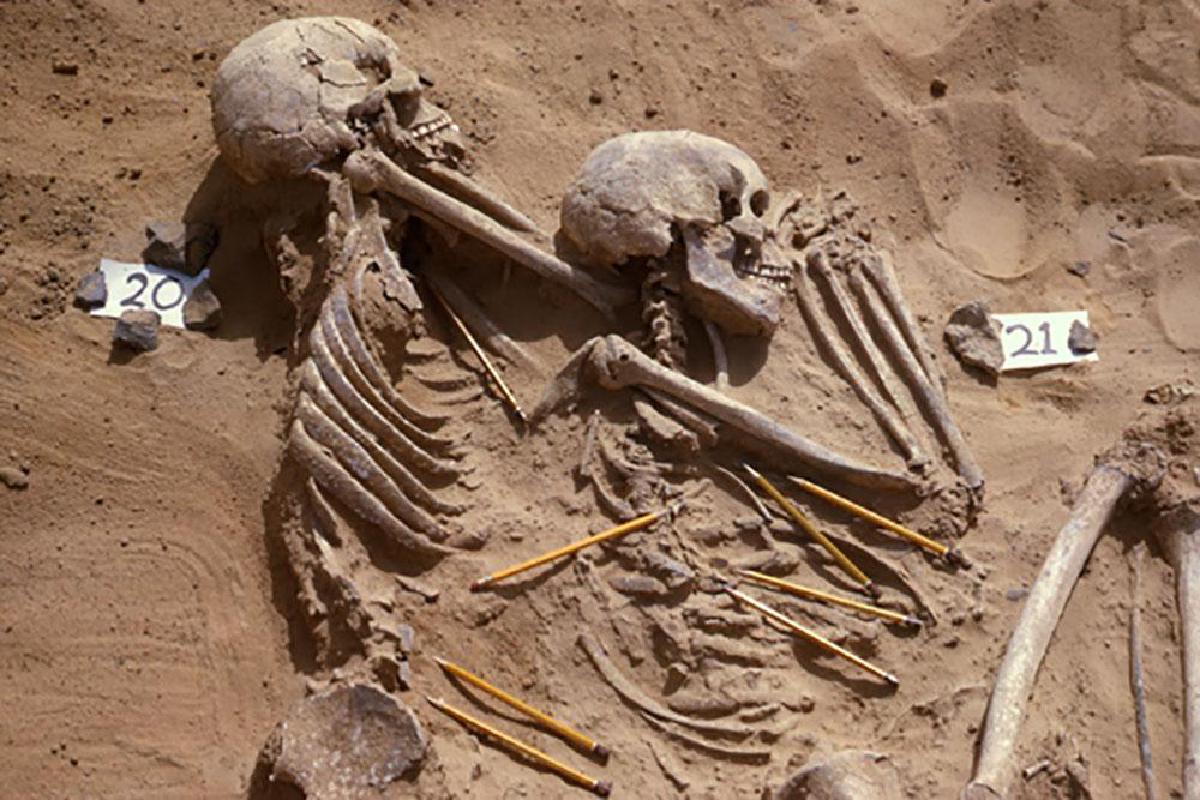
Let us call him Hunter 17.
When the forensic team lifted his skull from the storage drawer in the British Museum, they saw what the original excavators had seen: a neat, round hole in the back of his head, the bone punched inward, the edges sharp and unhealed. That was the blow that killed him, an arrow or dart fired from behind, probably as he ran, probably at close range. For fifty years, that hole was the whole story.
Then they turned the skull over.
The Man Who Died Twice#
On the front of his cranium, just above the left eye, the bone was not flat but gently depressed, the surface smooth and remodeled. A healed fracture. Hunter 17 had been struck in the forehead by something hard: a projectile, a club, a stone. He had lived. Bone takes weeks to months to remodel, which means he survived that first attack by at least half a year, maybe years. He walked, hunted, ate, slept, and perhaps fought again, carrying the dent in his skull like a badge. And then one day, another projectile found him from behind, and this time he did not get up.
Hunter 17 is not an isolated case. He is the face of a pattern. The 2021 reanalysis of Jebel Sahaba found that about a quarter of the individuals with traumatic lesions showed both healed and unhealed wounds. These were people who had been injured, who had recovered, and who were then attacked again, sometimes fatally. The cemetery is not a snapshot of a single horror; it is an archive of recurring terror.
The Scar Tissue of a Community#
Forensic anthropology reads healed injuries like the rings of a tree. When a bone fractures, the body rushes to repair it. Blood clots form, a soft callus of cartilage bridges the gap, and slowly, over weeks and months, the callus hardens into woven bone and then remodels into smooth lamellar bone. The process leaves a permanent mark, a slight thickening or a gentle depression, that says: this person lived.
At Jebel Sahaba, those marks are everywhere. Individuals show healed depressed fractures on the frontal and parietal bones of the skull, healed cuts on the forearms consistent with raising an arm to parry a blow, and healed puncture wounds on the shoulder blades and ribs. One skeleton had a well-healed fracture of the left ulna, the classic "parry fracture" seen when someone wards off a strike from above. The injury had knitted cleanly, the arm still functional. That individual had faced down an attacker, survived, and kept using the arm for years afterward.
Healed trauma is not just a medical note. It is evidence of care. A person with a fractured skull or a broken arm cannot fend for themselves for weeks. Someone fed them. Someone brought them water. Someone protected them while they lay helpless. The Jebel Sahaba community did not abandon their wounded. They nursed them back to health, knowing full well that the attackers might return.
And return they did.
The Child and the Flake#
Among the most haunting remains in the cemetery is a child, buried with a stone flake embedded in the neural canal of a cervical vertebra. The wound would have caused instantaneous paralysis, a tiny body crumpling under the impact of a projectile that struck the back of the neck. The flake, a microlithic bladelet identical to those found in adult wounds, was still lodged in the bone more than 13,000 years later.
That child is a terrible testament. The violence at Jebel Sahaba was not selective; it swept up everyone: old and young, male and female. The cemetery holds infants with trauma, adolescents with healing fractures, elders with multiple healed lesions. The attacks did not distinguish between combatants and non-combatants because these were not battles. They were raids, and a raiding party seeking to inflict maximum damage does not check the age of the person fleeing through the reeds.
The child also challenges a comforting assumption: that prehistoric violence was somehow ritualized, restrained, or aimed only at warriors. The bones say otherwise. Whoever fired that arrow knew what they were hitting. The shot was precise, fatal, and merciless.
The Climate Crucible#
Why did such a pattern take hold? The answer lies partly in the sky and the river.
Thirteen thousand years ago, the world was emerging from the last Ice Age, but the transition was not gentle. In the northern hemisphere, the Younger Dryas event plunged the climate back into cold and arid conditions for over a thousand years. In northeastern Africa, the monsoon rains that once greened the Sahara faltered. Lakes shrank to mudflats. The desert expanded its throat. The Nile, however, kept flowing, a ribbon of life in an increasingly parched world.
Jebel Sahaba sits on a terrace overlooking a former channel of the Nile, near the Second Cataract. The river provided fish, waterfowl, game, and a corridor for movement. As the surrounding landscape withered, the Nile Valley became a pressure cooker. Populations that had once spread across a wide, well-watered territory were funneled into the river corridor. Resources concentrated, but so did people. Competition intensified, and competition, in the absence of strong institutions or enforceable borders, often turns lethal.
The climate did not pull the trigger, but it loaded the weapon. The healed wounds suggest that the violence was not a single catastrophic eruption but a chronic condition, simmering for generations. When the rains fail and the hunting grounds shrink, your neighbors become rivals, and your rivals may decide that your family is easier prey than the disappearing antelope.
The Landscape of a Raid#
Using the wound patterns, the forensic team reconstructed the likely geography of an attack. The concentration of injuries on the back of the skull, the shoulders, and the back of the thorax points to ambushes from behind and above. The victims were not facing their killers; they were fleeing or caught unaware. The angles suggest attackers positioned on higher ground, perhaps the rocky outcrop of Jebel Sahaba itself, or hidden in the dense vegetation along the riverbank.
Imagine a small group of people, perhaps an extended family, coming to the water’s edge to fish or collect reeds. They know the danger; they have buried their dead from previous attacks. They are watchful, but the river is large and the cover is thick. Suddenly, a hail of projectiles arcs out from the bushes or from atop the escarpment. The first shots strike those at the back. People scream and scatter. Some are hit as they run, the arrows burying deep in their shoulders and spines. Others survive the initial volley and dive for cover, later nursing wounds that will heal into the patterns we see on the bones. The raiders, having inflicted their damage, melt back into the landscape. They may take no food, no territory; their goal may simply be to terrorize, to displace, or to avenge a previous raid.
This scenario played out not once but many times. The cemetery itself, used over multiple generations, becomes a record of accumulating grief. Each burial is a layer in a chronicle of fear.
The Psychology of Endemic Violence#
Forensic evidence can only take us so far. It cannot directly read the minds of the survivors, but it can frame the questions that anthropology must ask. What does it do to a person to know that at any moment, the quiet of the riverbank can be shattered by a stone-tipped death? What does it do to a community to bury its children with arrowheads in their spines, not once, but again and again?
Endemic small-scale raiding, as known from ethnographic studies of societies like the Yanomami of the Amazon or the highland New Guinea tribes, leaves deep psychological scars. It fosters a siege mentality, a constant state of hypervigilance. Trust in outsiders evaporates. Alliances become matters of life and death. Revenge cycles spin out of control, each killing demanding a retaliatory killing, until the original cause is forgotten and the violence becomes self-perpetuating.
The healed wounds at Jebel Sahaba suggest that this cycle was already grinding. Men and women who survived one raid became targets in the next, not necessarily because they were identified personally, but because the raids themselves became a predictable feature of life. The young were taught to fight and flee, the old to watch the horizon. Injuries healed because the body is resilient, but the emotional scars may never have closed.
The cemetery may also speak to something else: the need to honor the dead in the face of chaos. The burials at Jebel Sahaba, while not rich with grave goods, are deliberate and respectful. Bodies were placed in the ground, sometimes with personal ornaments of shell and tooth. In a world of relentless insecurity, the act of burying the dead with care is an act of defiance: a declaration that this person mattered, that this community endures.
Survivors, Not Just Victims#
It is easy to read the bones of Jebel Sahaba as a litany of suffering, and suffering there was. But the healed injuries tell a parallel story of resilience. Every healed fracture is a victory, a moment when the body and the community conspired to cheat death. The man with the parry fracture who lifted his arm again. The woman with the remodeled skull depression who lived to bear more children or teach more grandchildren. The child who, despite the embedded flake in another child’s grave, survived some earlier danger and grew older.
The people of Jebel Sahaba were not passive victims of a harsh environment. They were survivors who adapted, who treated their wounded, who buried their dead, and who carried on. Their lives were punctuated by terror, but they were not defined solely by it. They laughed, they loved, they mourned, and they persisted. The healed bones are proof.
But the recurrence of the violence also tells us that their resilience had a limit. Eventually, for too many of them, the next arrow found its mark, and they joined the growing cemetery on the hill. The cycle of survival and death, repeated over lifetimes, is what makes Jebel Sahaba such a uniquely powerful site. It is not a monument to one terrible day; it is a monument to a terrible way of life.
The Dark Gift#
In the next and final article, we will step back from the Nile’s edge to place Jebel Sahaba in a global context. What does this cemetery tell us about the origins of war itself? If this was not the first war, what was it? And why does the distinction matter for understanding who we are today? The survivors of Jebel Sahaba have one more message for us: the roots of organized conflict may be shallower than we think, and the seeds of something far more personal were planted here, in the quiet terror of a riverbank ambush, 13,000 years ago.