
The Wikipedia Problem#
This is not a trivial error confined to an online encyclopedia. The "first war" label has shaped how generations of students, writers, and scholars think about human nature. It suggests that as soon as our ancestors had the means to organize, they organized to kill each other on a large scale. It paints warfare as ancient, inevitable, and baked into our biology.
This is not a trivial error confined to an online encyclopedia. The "first war" label has shaped how generations of students, writers, and even scholars think about human nature. It suggests that as soon as our ancestors had the means to organize, they organized to kill each other on a large scale. It paints warfare as ancient, inevitable, and baked into our biology. The new forensic evidence from Jebel Sahaba dismantles that narrative, but the public record has yet to catch up. The site remains frozen in a pre-2021 understanding, and with it, a whole philosophy of human violence stays frozen too.
It is time to rewrite that entry, and more importantly, to rewrite the story we tell ourselves about the origins of war.
What Is War, Anyway?#
Before we can decide whether Jebel Sahaba was a war, we have to define what war means. Anthropologists and military historians draw a sharp line between interpersonal violence, raiding, and true warfare. It is not simply a matter of body count.
War, in the sense that historians use the word, typically requires several features:
- Scale: Large numbers of combatants, usually organized into groups that extend beyond a single extended family or band.
- Organization: Command structures, coordinated tactics, and a collective goal that goes beyond immediate survival or revenge.
- Duration: Sustained campaigns or a pitched battle that represents a deliberate strategic choice, not a hit-and-run raid.
- Logistics: The ability to supply and equip a fighting force beyond what individuals can carry on their own backs.
- Social complexity: Sedentary or semi-sedentary populations with territorial claims, surpluses to defend, and hierarchies that can order men into battle.
Raiding, by contrast, is small-scale, ephemeral, and often driven by immediate need, fear, or a cycle of vengeance. It is carried out by a handful of individuals who know each other personally. The goal may be to kill a few enemies, steal resources, or simply terrify a rival group into moving away. Raiding leaves different archaeological signatures: no mass graves of battle-ready males, no fortifications, no centralized weapon caches. Instead, it leaves skeletons of all ages and both sexes, killed in ones and twos, their injuries showing a pattern of ambush rather than open engagement.
Using this definition, Jebel Sahaba aligns almost perfectly with the raiding model. The trauma is distributed across age and sex categories. The wounds come from behind, from a distance. There is no evidence of a single catastrophic event; instead, there is a pattern of repeated attacks, with survivors who heal and then fall later. The site lacks any trace of military architecture or specialized weaponry beyond small hunting projectiles used on humans. The dead were not an army; they were a community, buried over time, their injuries accrued across many seasons and many skirmishes.
The Global Context: A Spectrum of Early Violence#
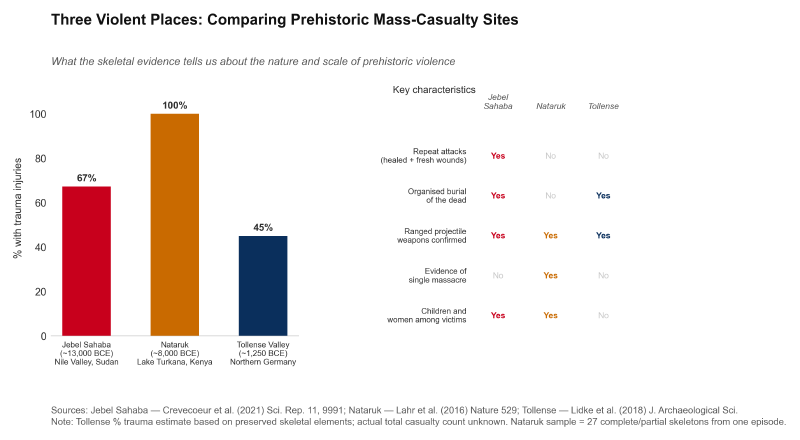
Jebel Sahaba is not the only ancient site that speaks of group violence, but it occupies a specific place on a spectrum that ranges from personal murder to organized warfare. By placing it alongside other key discoveries, we can see where it fits and why the distinction matters.
Nataruk, Kenya (c. 10,000 years ago)#
On the shores of a vanished lake, archaeologists uncovered the remains of 27 individuals, men, women, and children, who had been brutally killed and left unburied. Skulls were crushed, hands were bound, and obsidian blades were embedded in bones. The Nataruk massacre is the closest candidate for a single, violent event that might qualify as a "massacre" rather than a raid. But even here, the evidence points to a one-sided slaughter, not a battle. There are no defensive wounds suggesting armed combat. The victims were likely ambushed by a larger force and killed with extreme prejudice. Nataruk may represent a step up in scale from Jebel Sahaba, but it still lacks the hallmarks of organized warfare between two armed groups.
Arnhem Land, Australia (c. 10,000 years ago)#
Deep in the Australian outback, ancient rock art panels depict human figures arrayed in lines, holding boomerangs and spears, facing one another. Some scholars interpret these as depictions of staged confrontations, perhaps ritualized battles or dispute-resolution ceremonies. The art cannot be dated with pinpoint precision, but it provides a tantalizing hint that in some parts of the world, people were already organizing group violence into formalized patterns. These scenes show what Jebel Sahaba does not: two groups confronting each other directly. Yet the scale remains small, and the ritual context suggests these were not wars of conquest but socially constrained affairs.
Tollense Valley, Germany (c. 1250 BC)#
In a river valley north of Berlin, the first true battlefield emerges. Hundreds, perhaps thousands, of young men fought and died in a single engagement during the Bronze Age. Archaeologists have recovered weapons (bronze and flint arrowheads, wooden clubs, spearheads), along with the remains of horses and the first clear evidence of mounted combat. The Tollense Valley is a genuine battle, with two large, organized forces meeting on contested ground. It represents the arrival of war as we know it: territorial, political, and waged with specialized military technology.
Jebel Sahaba sits at the earliest end of this spectrum, but it is separated from Tollense by more than 11,000 years. That vast gap is not a dark age of missing evidence; it is a long period during which human societies were simply not organized in ways that could produce war. The evidence of violence exists, but it is of the small-scale, personal, and sporadic kind. The inference is clear: organized warfare is not a primordial human condition; it is an invention, one that required the development of larger populations, territorial states, and economic surpluses.
The Absence of Massed Warfare Tells a Story#
The most important thing Jebel Sahaba tells us is not what it contains, but what it lacks. It lacks mass graves of healthy young men. It lacks fortifications. It lacks weapons designed exclusively for war rather than hunting. It lacks the rigid hierarchy and centralized command that a true battle requires. In short, it lacks the archaeological signatures that mark the later emergence of organized conflict.
This absence is a powerful argument against the idea that humans are inherently warlike in the organized sense. The capacity for violence, yes. The capacity to kill, to raid, to ambush, to nurse grudges across generations; all of that was present at Jebel Sahaba, and likely long before. But the capacity to form an army, to march it against another army, and to fight a battle over territory or ideology; that is something else. It is a cultural and organizational achievement, not a biological imperative.
Archaeologist Lawrence Keeley, in his seminal book War Before Civilization, argued that prehistoric violence was pervasive and lethal. But the data from Jebel Sahaba, reinterpreted, do not support the idea of an ancient war. They support something more frightening in its intimacy: a world where your enemy was not an abstract nation but the family camped in the next valley, where you might know their names, where you might see them at a watering hole and smile before you put an arrow in their back. It was a personal violence, and it was terrible, but it was not war.
How the Oldest War Narrative Distorts Our Self-Image#
Why does it matter whether we call Jebel Sahaba a war? Because the label carries immense cultural weight. If we believe that the very first thing our ancestors did when they gathered in groups was wage war, then war becomes destiny. It becomes easy to say that humans are naturally violent, that organized killing is in our genes, and that efforts at peace are futile.
The truth, emerging from the bones, is more nuanced and, in a strange way, more hopeful. Jebel Sahaba shows that our ancestors were capable of violence, and that under environmental stress, that capacity could erupt into cycles of raid and counter-raid. But it also shows that for tens of thousands of years, they did not invent war. War, with its armies and its generals and its ideologies, came later, as a product of specific historical conditions. Those conditions can be studied, understood, and perhaps, in the distant future, undone.
The rewriting of Wikipedia is not just an academic exercise. It is a small act of intellectual honesty that ripples outward. Every student who learns that the oldest evidence of human group violence is not a war but a cemetery of repeated raids learns a different lesson about human nature. They learn that the line between survival and violence is thin, that climate and resources shape our choices, and that the worst thing we can do is mistake a cycle of fear for an inevitability.
The Intimate Face of Earliest Violence#
Let us return, one last time, to the bones themselves. The man we called Hunter 17, with his healed forehead and his unhealed fatal wound. The child with the flake in her neck. The woman with the parry fracture on her arm, who raised that arm to block a blow and lived to see another year. These are not soldiers. They are not numbers in a casualty report. They are people whose lives were punctuated by moments of sheer terror, and who, in many cases, survived those moments only to face them again.
The violence they experienced was personal. The person who fired the arrow that killed Hunter 17 may have known him, may have hunted with him in better times, may have been a cousin or a neighbor from a rival group. The wounds were not delivered by faceless regiments but by hands that shook with adrenaline and eyes that recognized the target. This intimacy is the hallmark of small-scale society. War, when it finally arrives, will abstract violence, turning personal enemies into impersonal targets, replacing the shaking hand with the disciplined volley.
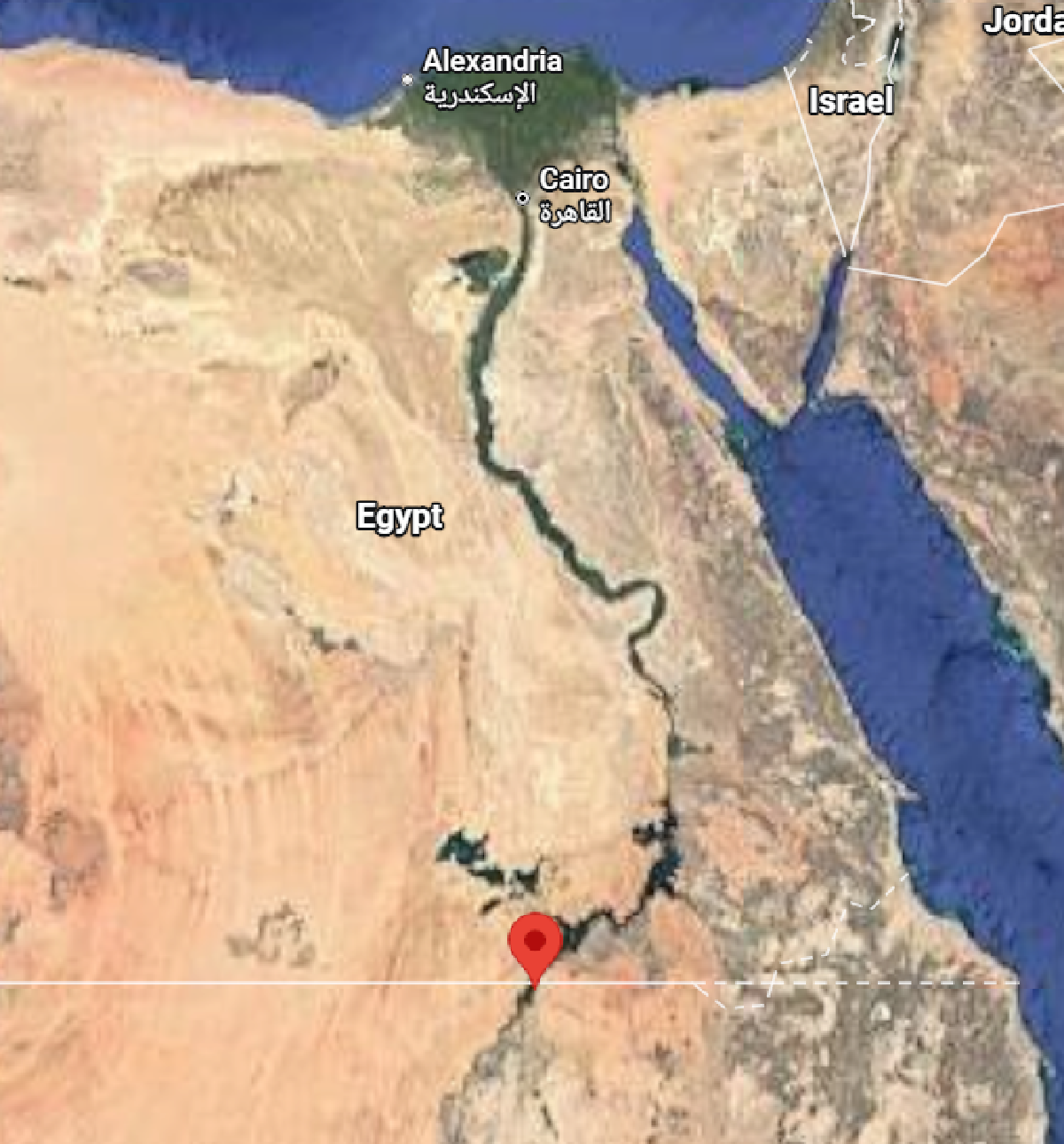
Jebel Sahaba, then, is a window into a world before that abstraction took hold. It is a place where violence was raw and close, but where it had not yet become a machine. The tragedy is real, but the lesson is clear: if war is an invention, then it can be uninvented, or at least contained. The first step is to see the past clearly, to strip away the labels that obscure what really happened on that Nile terrace 13,000 years ago.
A New Beginning for the Story of Conflict#
The 2021 reanalysis of Jebel Sahaba did more than just revise a single archaeological site. It opened a new chapter in the study of human violence. It demonstrated that forensic techniques, applied with patience and precision, can read the stories written in bone and lithic flake, stories that were invisible to earlier generations of researchers. And it gave us a new origin story for conflict, one that does not begin with a great battle, but with a long, grinding sequence of small, personal, and heartbreaking attacks.
In the end, the cemetery at Jebel Sahaba is not a monument to war. It is a monument to survival, to the resilience of a community that buried its dead with care and went on living in a dangerous world. It is a reminder that our ancestors faced the worst in each other and yet endured. And it is a challenge to us, the inheritors of their world, to understand the difference between what is inevitable and what is merely ancient. The oldest strife was not a war. What we do with that knowledge is up to us.
This concludes the series "Bones on the Nile: The True Story of Earth's Oldest Strife." The dead have spoken. It is now our turn to listen.