
The Capital-Coercion Nexus#
In the formative years of the colonial economies, coercion was the decisive propellant. Unable to attract free labour through competitive wages, the colonial states institutionalized unpaid, forced labour—often referred to as chibalo in Portuguese territories, or corvée and prestation in the French zones. Everywhere, the use of compulsory labour was common for the construction of roads, railways, and other public works. The human cost of this infrastructural development was catastrophic. During the construction of the Congo-Océan railway in French Equatorial Africa between 1921 and 1932, for example, 127,250 men were drafted, resulting in an estimated 20,000 deaths before 1928.
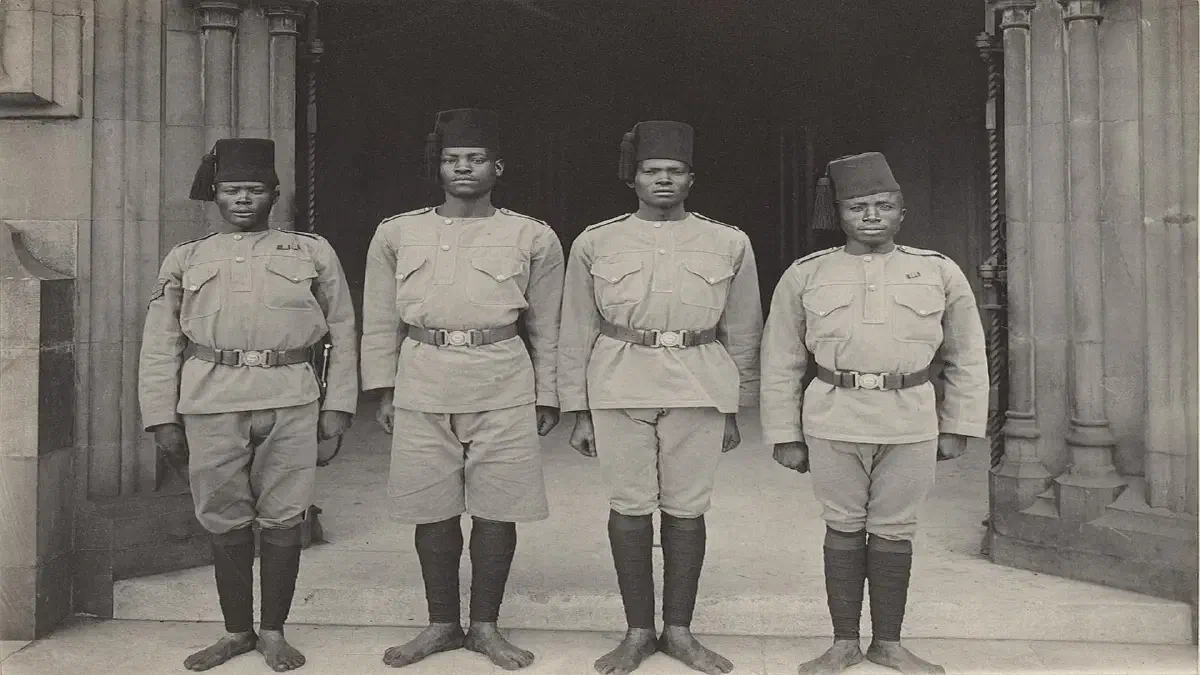
This involuntary extraction of human capital reached its zenith during the First World War. African populations were heavily drained to support the metropolitan powers' global conflicts. Over 2.5 million Africans—representing well over 1 per cent of the continent's entire population—were recruited for war work of some kind, often forcibly. Approximately three carriers were necessary to keep every single fighting soldier in the field, and in total, over 150,000 soldiers and carriers lost their lives in the conflict. The sheer scale of this human extraction was visually captured in contemporary photographs, such as Plate 12.3, which shows the massive Egyptian Labour Corps embarking for service overseas, and Plate 13.4, depicting East African askaris coercing local populations into civil administration labour pools.
Taxation as an Economic Propellant#
While physical force was routinely applied, the colonial state also wielded fiscal policy as a blunt instrument to systematically dismantle indigenous economic autonomy. The introduction of direct taxation, notably the "hut tax" and "poll tax", was explicitly designed to force independent African peasants off their land and into the wage-labour market, effectively creating a semi-proletariat.
The head tax quickly became a pillar of the colonial financial system, frequently accounting for 25 per cent of total budgetary receipts. As the primary mechanism forcing Africans into the monetary economy, the tax burden weighed heavily on their purchasing power. In the Portuguese colonies, the head tax was consistently the heaviest, officially corresponding to three months of labour. The cruel genius of this system was that it functioned independently of the actual economic climate; during the Great Depression, when the prices of agricultural products and wages collapsed, colonial authorities ruthlessly maintained or even increased tax rates to cover shortfalls in customs revenues. In the Belgian Congo, for instance, between 1928 and 1932, a peasant cultivating cotton earned an average of only 165 Belgian francs a year, leaving them in a perpetual state of poverty just to satisfy the tax collector.
The Migrant Labour System and Wage Suppression#
Where local agricultural commercialization was restricted or impossible, the combination of land alienation and taxation drove a massive system of migrant labour. African workers from the interior were funnelled into the mining centres of the Witwatersrand in South Africa and the copperbelt of Katanga in the Belgian Congo. In Katanga alone, over 60,000 labourers were involved in mineral extraction by the 1920s. Desertion rates were staggering due to the harsh conditions; at the Star and Likasi copper mines in 1918, the desertion rate reached 74 per cent and 66.5 per cent respectively, prompting the creation of a pass system and finger-printing bureaus to track "fugitives".
In Southern Africa, the insatiable demand of the mining conglomerates for cheap labour reshaped the demographics of the subcontinent (Plate 16.3 provides a stark contemporary view of these black mine labourers in South Africa). The Witwatersrand Native Labour Association (WNLA), established in 1903, secured the right to recruit heavily from neighbouring Mozambique. Between 1913 and 1930, an average of 50,000 Mozambicans emigrated annually to the South African mines—a total of 900,000 men, of whom 35,000 died in service.
This vast, circulating pool of desperate migrant labour ensured that African wages remained utterly suppressed. In South Africa, the economic gap between white and black widened dramatically as a matter of deliberate policy. Between 1914 and 1934, the average monthly wage of a married African farm labourer stagnated, rising insignificantly from 6s–10s to only 8s–12s. Meanwhile, the average monthly wage for a white farm employee in the Cape soared from £2 18s 1d in 1866 to an astonishing £19 7s 7d by 1952. Africans were systematically eliminated from commercialized farming and frozen into the lowest-paying jobs.
The resulting economic architecture was one of profound structural inequality. By using coercion, taxation, and the migrant labour system, the colonial state successfully subsidized European capital extraction, ensuring that the sweat of the African subject yielded maximum profits for the metropolitan centre while institutionalizing a cycle of underdevelopment and poverty in the periphery.
Next in the series: “The Settler, the Peasant, and the Land: Two Faces of Agricultural Exploitation”—how land alienation and cash-crop manipulation reshaped African agriculture.