
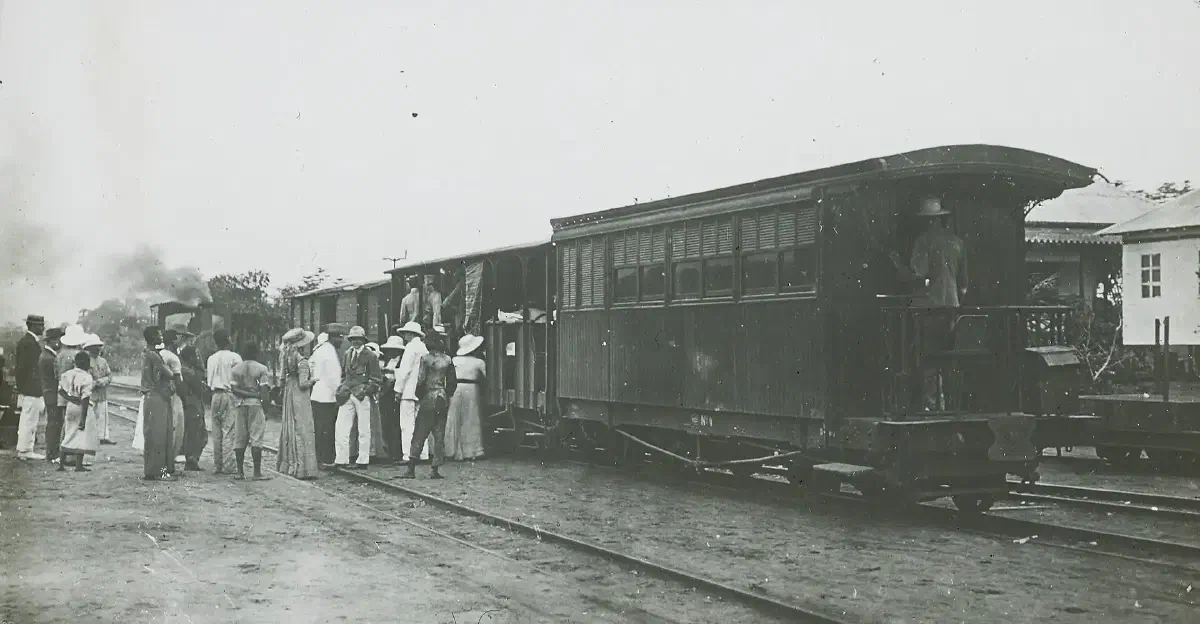
Railways to the Sea#
The physical manifestation of this extractive economy was most evident in the colonial transport network. The construction of railways, roads, and harbours received early attention from colonial administrations, but their location and direction took little account of the general welfare of the dependencies. Instead, most railways ran directly from the coast to interior sources of cash crops or mineral deposits, with almost no lateral or inter-colonial links established. Therefore, these railways served only limited areas and were built primarily to evacuate exports.
The discovery of gold and diamonds in Southern Africa illustrates this perfectly. The sheer distances and sparse populations had previously ruled out railway construction as a viable proposition, but the mining boom made it both necessary and practical. Consequently, the length of railway lines in South Africa surged from a mere 110 km in 1869 to 4,190 km by 1905, connecting the interior mining centres directly to ports like Cape Town and Durban. The extractive focus of these transport networks was mirrored in the export data: by 1913, minerals accounted for an astonishing 93.3 per cent of Southern Rhodesia's domestic exports.
While the introduction of modern transport dramatically reduced freight rates and replaced the heavy reliance on human porterage, African producers rarely benefited. In settler-dominated regions, freight rates were deliberately manipulated in favour of Europeans, effectively forcing the African agricultural sector to subsidize settler agriculture and commercial export firms.
The Cartels of Commerce and Unequal Exchange#
The colonial economy functioned through a system of unequal exchange, orchestrated by large expatriate oligopolies that came to dominate both the import and export markets. Initially operating as wholesale merchants who bought native produce and shipped it in bulk, these great European firms gradually became their own middlemen, pushing indigenous African traders out of the retail and distribution business entirely.
This monopolization ensured that the African peasant was locked into a position of contractual inferiority. Operating within a "milking economy," these cartels exploited the profit margins between the cheap purchase of African-grown agricultural yields and the high-priced sale of imported European consumer goods. Because the commercial functions of purchasing produce, supplying credit, and selling consumer goods were often concentrated in the hands of the same foreign entities, any economic surplus generated by the African smallholder was inevitably transferred to the middleman and expatriated to Europe, rather than remaining available for local reinvestment. In regions like Southern Rhodesia, European landowners even took over the marketing of their African tenants' produce, minimizing African competition and securing a semi-monopolistic position.
Monetization and the Banking Monopoly#
To further cement this dependency, colonial authorities systematically introduced modern European currencies. They deliberately demonetized traditional African currencies—such as gold dust and cowries—and insisted that taxes be paid in cash. This forced Africans into the wage-labour market or cash-crop production and ensured their reliance on European money.
At the apex of this economic structure were the banks. Banks were the pinnacle of early monopoly capitalism in Africa, serving as the principal avenues for the export of African surplus, as there were no obstacles to the free flow of capital funds out of the colonies. The treasuries of the colonizing powers manipulated the currency reserves of the colonies, investing them in metropolitan money markets to benefit finance capital.
Crucially, this banking monopoly was weaponized against indigenous development. European banks readily advanced credit to white settlers and non-African retail traders, but deliberately denied credit to African entrepreneurs on capitalist and pseudo-scientific racist grounds. This financial strangulation was formalized by colonial credit restriction ordinances. As a result, the pre-colonial African merchant class was decimated, and the continent was locked into a structural dependency designed to fuel the industrial engines of Europe.
Next in the series: “The Great Depression and the Colonial Ledger: Growth Without Development”—how the global slump of 1929 exposed the structural vulnerability of Africa's export monocultures.