
The Strait of Gibraltar was a blade of water fourteen kilometres wide at its narrowest, and in 1415 it cut more than geography. To the north lay a peninsula still vibrating with the aftershocks of holy war. To the south sprawled the sultanates of the Maghreb, wealthy, fractious, and as yet untouched by Christian arms. The wind that funnelled through the strait carried salt, the cries of gulls, and the memory of a thousand ships — Phoenician triremes, Roman grain transports, the dhows of the Almohad caliphs. For centuries the current had run both ways. Now it was about to run one way only.
Iberia itself was a mosaic of five rival powers, each with its own frontier obsession. In the centre dominated the Crown of Castile, the largest and most populous kingdom, a land of vast mesetas, sheep flocks that numbered in the millions, and an aristocracy bred for the Reconquista — the centuries-old project of rolling back Islam from the peninsula. Castile’s gaze was fixed south, on the Emirate of Granada, the last Muslim state on European soil. Granada huddled in the shadow of the Sierra Nevada, a kingdom of silk workshops and irrigated orchards, its rulers paying gold tribute to Castile to buy survival. The truce held, but everyone knew it was a countdown, not a peace.
To the east, the Crown of Aragon looked the other way. Its kings ruled a loose federation of territories — Catalonia, Aragon itself, Valencia — and its true capital was the sea. Aragon had already planted its banner in Sicily, Sardinia, and the duchies of Athens and Neopatras. Its merchants were pushing eastward across the Mediterranean, toward the grain depots of the Levant and the slave markets of the Black Sea. The Reconquista for Aragon was a side project. The main event was the contest with Genoa and Venice for the riches of the eastern trade.
Navarre and Portugal#
Wedged in the north, the tiny Kingdom of Navarre clung to the Pyrenees, a dynastic afterthought whose kings survived by marrying into French and Castilian houses. It posed no threat. It posed no opportunity. It simply endured.
And then there was Portugal.
Portugal was the edge of everything — the last kingdom before the void of the Atlantic. It had secured its independence from León in the twelfth century and pushed its borders south to the Algarve by 1249, finishing its Reconquista two hundred years before Castile would finish its own. That early completion left a strange inheritance. Portugal had nowhere left to expand on land. Its back was against an ocean that mapmakers labelled Mare Tenebrosum, the Sea of Darkness, beyond which lay sea monsters and the lip of the world. To a kingdom that had defined itself through crusade, peace felt like stagnation. The warrior class needed an outlet. The crown needed revenue. And the sea, terrifying and unknowable, was the only road left.
The Prize: Ceuta#
Across the strait, the Marinid Sultanate held the African shore. The Marinids were a Berber dynasty that had seized power in Morocco a century and a half earlier. At their height they had sent armies into Spain, sacked Christian towns, and briefly controlled the strait's traffic. By 1415 that power was crumbling. Succession crises fractured the court at Fez. Provincial governors ruled as petty kings. The sultan, Abu Said Uthman III, was a cipher, and the Marinid state bled authority into the Atlas Mountains. Yet the cities of the coast — Tangier, Anfa, Ceuta — remained formidable. None more so than Ceuta.
Ceuta sat on a narrow isthmus jutting into the Mediterranean, its walls rising white from the sea, its towers commanding the strait. It was the terminus of the trans-Saharan caravans that brought gold dust, ostrich feathers, and slaves from the Niger basin to the Mediterranean world. The Genoese had a fondaco there. Merchants from Venice, Barcelona, and the Islamic east crowded its customs houses. Ceuta was also a nest of pirates, swift galleys that slipped out under the cover of darkness to raid Christian shipping and carry captives to the slave pens. The city was an insult and an opportunity wrapped in one.
The Decision#
King John I of Portugal understood this. He was a bastard son of the previous dynasty who had seized the throne in 1385 at the battle of Aljubarrota, crushing a Castilian invasion and securing Portugal's independence. That victory had given him a reputation, but it had not given him a treasury. The court was perennially short of coin. The nobility, swollen with men trained for war, was restless. Three of John's sons — Edward, Peter, and Henry — were coming of age, and in a society where knighthood was the currency of honour, a prince without a war was a prince without a name. João Gomes da Silva, the king's steward, put it bluntly: the young men "needed an undertaking worthy of their station." John's queen, Philippa of Lancaster, English by birth and crusader by instinct, agreed. The target, after years of secret discussion, was Ceuta.
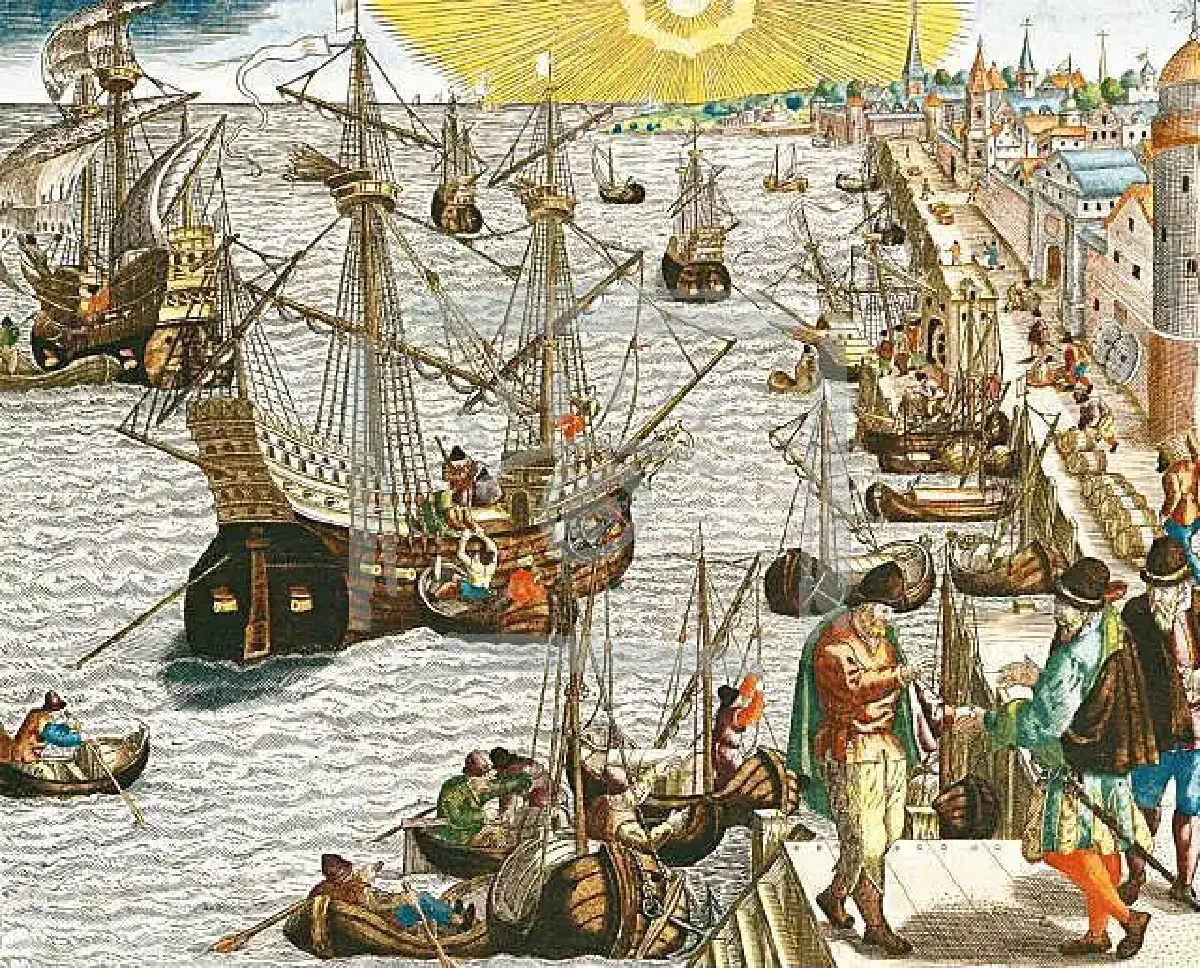
In the spring of 1415, the fleet began to assemble in the Tagus estuary. The scale of the enterprise was unlike anything Portugal had attempted. Shipwrights worked in double shifts, the sound of adzes and mallets echoing across the Lisbon waterfront. Timber was dragged from the royal forests of Leiria. Biscuit ovens burned day and night, producing tons of hardtack. The chronicler Gomes Eanes de Zurara recorded the scene: "The river was covered with vessels, and the shore with men and horses, and the noise of the workmen was such that it seemed as if the whole city was being built anew." The fleet eventually numbered 212 ships: thirty-three royal galleys, twenty-seven round ships for the infantry, and dozens of smaller transports for the horses. Between nineteen and twenty thousand men crammed aboard, including English, French, and German mercenaries drawn by the promise of plunder. The banners of the crusading orders — the Knights of Christ, the Hospitallers — snapped from the mastheads.
The Assault of 1415#
On the twenty-fifth of July, the feast day of Saint James, the fleet received the sacrament. Queen Philippa, dying of the plague, had extracted a promise from her sons before her death: that they would carry the sword to the infidel. Now, as the priests chanted the Veni Creator Spiritus, the army knelt on the docks. The bishop of Viseu raised a fragment of the True Cross, captured from a Castilian army three decades earlier, and blessed the host. Then the trumpets sounded, the drums beat, and the oars bit into the brown water of the Tagus. The fleet moved south, past the headlands of Sagres, into the open Atlantic.
The voyage took six weeks. The ships hugged the African coast, a low line of scrub and sand that offered no welcome. Dysentery swept through the holds. Horses sickened in their stalls. A storm off Cape Spartel scattered the fleet and forced it to regroup in the Bay of Algeciras. Panic rippled through the command. Some captains urged the king to turn back, to abandon the enterprise. But Prince Henry, twenty-one years old and burning for his first taste of war, insisted they press on. "The danger," he said, according to Zurara, "is no greater than the honour."
On the night of the twenty-first of August, the fleet rounded the Almina peninsula and saw Ceuta. The city rose from the sea like a vision from scripture: a tumble of white houses and minarets, flanked by massive walls of rammed earth and masonry, the harbour crammed with the masts of merchant ships. Behind it rose the dark shape of Jebel Musa, one of the Pillars of Hercules. The strait lay calm. The current that had carried so many peoples back and forth across this narrow water was about to reverse.
At dawn, the royal galley lowered a boat. A landing party waded ashore under a hail of arrows from the Marinid garrison. The Portuguese crossbowmen returned fire, their bolts clattering against the battlements. A knight named Rui Gonçalves was the first to plant a banner in the sand. Within hours, the city was in chaos. The garrison, taken by surprise, abandoned the outer walls. John's men poured through the gates, and by evening Ceuta was burning — its great mosque cleared and hastily consecrated as a cathedral, its treasury looted, its warehouses stripped of the pepper, ginger, and cinnamon that spoke of a world far beyond the strait.
That day, a threshold was crossed. Portugal had not merely seized a city. It had stepped off the edge of its own continent, into a realm of gold and spices and unknown horizons. The Reconquista, which for centuries had been a land war fought on Iberian soil, had become something entirely different: a seaborne crusade with no obvious endpoint. The strait, that ancient scar between worlds, was now a Portuguese bridge.
No one standing in the smoke-filled streets of Ceuta could have guessed what the next century would bring. But the direction of travel was set. The conquerors had left the known world behind.