
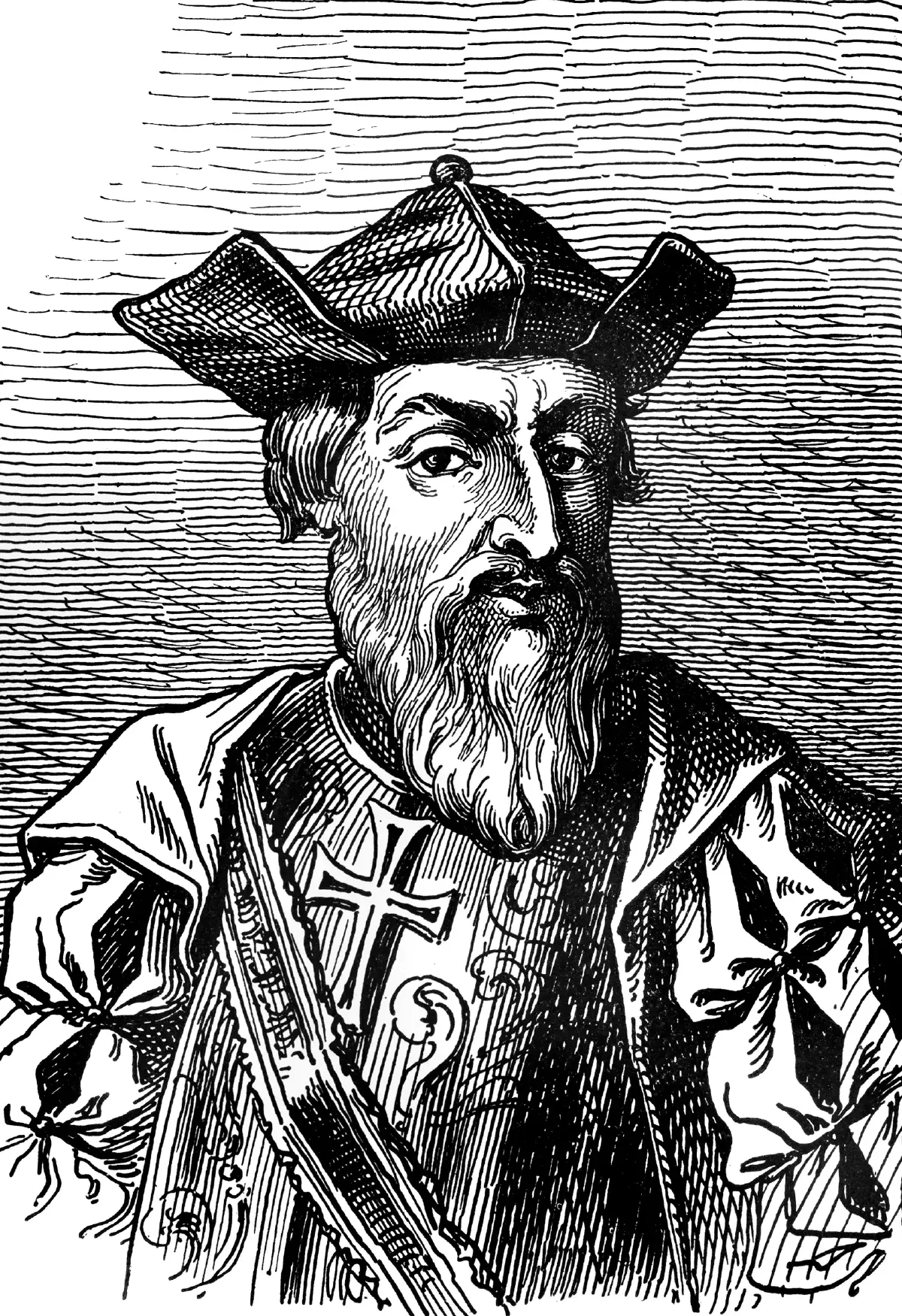
The fleet that would open the sea road to India was modest enough to be mistaken for a coastal patrol. Four vessels rode at anchor in the Tagus on the morning of the eighth of July 1497: two stout, square-rigged carracks, the São Gabriel and the São Rafael, each about 120 tons; a light caravel, the Berrio, lateen-rigged and nimble; and a supply ship, nameless in the chronicles, loaded with biscuit, water casks, and spare cordage. Their combined crews numbered perhaps 170 men. Their commander was a man who had never captained a major expedition, a minor nobleman from the port of Sines, on the Alentejo coast, with a heavy jaw, a volcanic temper, and a capacity for silence that unnerved those who served under him.
Vasco da Gama was not King Manuel's first choice. That had been his father, Estevão, who had died before the fleet could sail. Gama was twenty-eight years old, or perhaps thirty — the records are unclear. He had served in the waters off the Algarve, intercepting French shipping, and he had once been dispatched to Setúbal to seize a vessel in the king's name. Beyond that, little was known of him. The appointment puzzled the court. But Manuel, who had come to the throne two years earlier and felt the weight of his predecessor's unfinished design pressing on him, saw something in the man: an implacability, a refusal to be turned. The chronicler Gaspar Correia recorded that when Gama was offered the command, he said nothing. He simply accepted.
The preparations had been meticulous. Bartolomeu Dias, the man who had rounded the Cape and wept, had supervised the construction of the ships. He had insisted on the heavy carracks, built to withstand the southern gales, their hulls reinforced with extra planking, their rigging heavier than any used on the Guinea run. Below decks, the guns were mounted: twenty brass cannon on the flagship, capable of firing stone balls that could smash a hull at close range. The king had ordered the best cartographers to prepare charts from Dias's logs, from Covilhã's secret letter, from the reports of Arab pilots captured in the Canaries. The Regimento do Astrolábio was issued to the pilots. Zacuto's declination tables were bound in oilskin. The priests aboard carried a fragment of the True Cross, a gift from the king, to be held aloft in moments of crisis.
On the eve of departure, Gama led his men to the chapel of Our Lady of Belém, a small white church on the bank of the Tagus where Prince Henry had once prayed. The crews kept vigil through the night, the candles guttering in the river wind. At dawn, a procession of priests and friars escorted the captains to the waterfront. The shore was packed with the families of the sailors, the women weeping, the children silent. Manuel himself rode down from the palace, gave Gama a silk banner emblazoned with the cross of the Order of Christ, and spoke a few words of blessing. Then the trumpets sounded, the drums beat, and the oarsmen pulled the heavy carracks into the current.
The Long Atlantic Arc#
The fleet slipped past the Tower of Belém, still under construction, its white limestone catching the morning sun. Beyond the bar, the Atlantic opened, grey and empty. The wind was light. The ships made slow progress toward the Madeira archipelago, where they would take on fresh water and timber. Gama himself was already silent, already watchful. An anonymous diary kept by a member of the crew — the Roteiro da Viagem de Vasco da Gama, one of the most extraordinary documents of the age — noted the first days simply: "We left Restelo on Saturday, the eighth of July. May God our Lord grant us a good voyage. Amen."
The Atlantic crossing was designed to avoid the doldrums of the Gulf of Guinea and the contrary winds that had trapped earlier expeditions. Dias had counseled Gama to swing wide, to describe a vast arc into the southern ocean, trusting the westerlies to carry him around the Cape. This was the volta do mar perfected by the Perfect Prince's navigators: not a straight line, but a great looping curve, a parabola of wind and water that required nerves of iron. For three months, the fleet sailed out of sight of land. The Roteiro recorded empty sea, a few whales, a flight of birds. The biscuit grew wormy. The water turned foul and had to be cut with vinegar. The men's gums began to bleed — the first sign of the scurvy that would kill more Portuguese sailors than any enemy. Then, on the fourth of November, a cry from the masthead: land. They had touched the African coast at St. Helena Bay, three months and four thousand miles from Lisbon, having seen nothing but the sky and the sea and the circling albatross.
The bay was a crescent of white sand backed by scrub-covered hills, inhabited by a people the Portuguese had never encountered. The Khoikhoi approached warily. Gama, attempting to make contact, ordered trade goods laid out on the beach: bells, coral, brass bracelets. The Khoikhoi understood nothing. An altercation flared — one of the sailors, Fernão Veloso, a young man with more bravery than sense, wandered inland and was surrounded by tribesmen. Gama, alerted by his cries, led a rescue party ashore. The Khoikhoi retreated, but not before a spear struck Gama in the thigh. The wound was slight. The lesson was not: this coast was not friendly.
They labored for another two weeks to round the Cape, which Dias had named Storms and João had renamed Hope. The wind screamed out of the southwest. The seas were monstrous — "great billows," the Roteiro recorded, "that broke over the bows and filled the waist of the ship with water." The São Rafael lost a yardarm. The crews, exhausted and terrified, begged Gama to put back to the bay and wait for better weather. He refused. He stood on the quarterdeck in the gale, his cloak plastered to his body, his hand on the hilt of his sword. The chronicler João de Barros, writing decades later, captured the moment: "He told them that the sea was not more dangerous than the king's displeasure, and that as long as he lived, no man would turn back." The fleet beat around the Cape on the twenty-second of November, and the coast of Africa fell away to the east.
Now they were in uncharted water. The familiar landmarks — the pillars of Cão and Dias — were behind them. Ahead lay the unknown coast of Natal, the warm current of Agulhas, and the entrance to the Indian Ocean. The fleet hugged the shore, pausing at a river mouth to take on fresh water, at another to cut timber for a replacement yardarm. The land here was green and well-watered, the inhabitants Bantu-speaking farmers who watched the strange ships from the shore and kept their distance. Gama pressed on, past the limit of Dias's voyage, past the pillar at Kwaaihoek that marked the farthest reach of the previous generation.
By Christmas, they had reached a coast they called Terra do Natal — the Land of Christmas. The chronicler noted the date and the name, the simple act of naming that brought the unknown into the Portuguese sphere. The fleet was now leaking badly. The supply ship, which had served its purpose, was emptied of its remaining stores, broken up, and burned on the beach. The crew was redistributed among the three remaining vessels. Gama pushed north, entering the Mozambique Channel, the great funnel of water that separates the African mainland from the island of Madagascar. The air grew thick with humidity. The monsoon, which no European had ever experienced, was beginning to stir.
In March 1498, after four months of crawling up the African coast, the fleet reached the island of Mozambique. The men were skeletal. The scurvy had progressed beyond bleeding gums to grotesque swellings of the legs and arms. The Roteiro recorded the deaths: one man, then another, then a third, slipped over the side at dawn with a brief prayer. The survivors were so weak they could barely haul the sails. And then, at Mozambique, they saw ships.
The Swahili Coast#
The harbor was crowded with dhows — Arab vessels, lateen-rigged, their crews speaking a language that was almost but not quite Arabic. Mozambique was a Swahili city-state, part of a network of trading ports that stretched from Somalia to Sofala, linked by the monsoon, by Islam, and by the flow of gold, ivory, and slaves. The ruling sheikh received Gama warily. The Portuguese gifts — a basin of olive oil, a barrel of honey, some hats — were laughable to men accustomed to the riches of the Indian Ocean. The sheikh's emissaries laughed openly. "They made signs," the Roteiro noted bitterly, "that they did not think much of it."
The relationship curdled quickly. The sheikh, suspecting the Portuguese were corsairs, became hostile. Gama, equally suspicious, hauled his ships out of the harbor under a bombardment of stones and arrows, firing his cannon into the town as he withdrew. He had entered a world far more sophisticated than the Guinea coast, a world of long-distance trade, written languages, and established empires. He had no letter for its rulers, no understanding of its customs, and no patience for its insults. The crusading fury that had fueled Ceuta was now burning on the edge of the Indian Ocean.
Calicut#
At Mombasa, further north, the reception was even worse. The sultan sent gifts of spices and sheep, luring the fleet into the harbor, then dispatched swimmers with swords to cut the anchor cables at night. The Portuguese detected the plot, raised the alarm, and captured two of the swimmers. Torture extracted a confession. Gama unleashed his guns on the city, the cannonballs crashing through the palm-thatch roofs of the waterfront, and fled north again.
At Malindi, the third Swahili port, fortune turned. The sultan, a rival of the rulers of Mozambique and Mombasa, saw an opportunity. He received Gama with a display of respect, sending a gilded palanquin to carry him ashore. The old man in the Roteiro, an elderly pilot from Gujarat, spoke of the winds and the crossing. Gama, for the first time in months, received reliable information. The monsoon, the great alternating wind that governed all trade in the Indian Ocean, would carry him directly across the Arabian Sea to Calicut, the pepper capital of the Malabar Coast. The crossing would take less than a month.
Gama took the pilot aboard. On the twenty-fourth of April, the fleet raised anchor and set out into the open ocean, leaving the African coast behind. The monsoon caught them, a steady westerly that bellied the square sails and pushed them northeast. The sea was warm, the nights phosphorescent. After twenty-three days, on the eighteenth of May, a cry from the masthead of the São Gabriel: mountains. The Western Ghats, the great spine of India, rising blue-green from the sea.
The fleet dropped anchor off Calicut on the twentieth of May 1498. The city spilled down to the water's edge, a dense mass of whitewashed houses, palm trees, and temple spires. The harbor was crammed with ships — Arab dhows, Indian pattimars, Chinese junks. The air smelled of pepper, ginger, and cardamom, the spices that had drawn merchants to this coast for three thousand years. The Roteiro noted the scene with wonder: "The city is large, and built along the shore. The houses are of stone, with high walls; the streets are straight and broad; the people are many, and walk about dressed in fine white cotton, and wear gold and jewels."
Gama sent a convict ashore — one of several on board, carrying a deliberate mission to enter unknown cities and report back. The convict, a man named João Nunes, was met by two Tunisian merchants. Their astonishment was immediate. They approached the Portuguese boat and spoke in Castilian. "May the devil take you!" one shouted. "What brought you here?" Nunes, equally shocked to hear a European tongue, asked what they wanted. The Tunisian replied: "We want Christians and spices."
The Portuguese arrival on the Malabar Coast in 1498 was, from Calicut's perspective, unremarkable. A small fleet. Strange ships with square sails. A captain who spoke no Arabic. What Vasco da Gama carried, however — a letter from a king at the edge of the known world, addressed to a Christian monarch no one in Calicut had heard of — was the first sentence of a correspondence that would last four centuries and cost millions of lives. He did not know this. He was sunburned and scurvy-ridden and trying to find pepper.
The Zamorin, the hereditary ruler of Calicut, received Gama in a sprawling palace complex of courtyards and carved pillars. The Portuguese were carried through the streets in palanquins, surrounded by crowds of curious onlookers. The chronicle described the Zamorin himself: a man of forty, "brown, and large of limb, and well made," reclining on a green velvet couch, chewing betel nut and spitting into a gold basin held by a servant. Around him stood his ministers, his bodyguards, his fan-bearers. Gama knelt and presented the king's letter. The contents were translated by a series of interpreters: Portuguese to Arabic, Arabic to Malayalam. The king of Portugal, the letter explained, had sent this expedition to find Christians and spices. He wished to establish trade, to buy pepper and cinnamon, to sign a treaty of eternal friendship.
The Zamorin listened. He was not impressed. The gifts Gama brought — striped cloth, washbasins, sugar, honey, oil — were insulting. A court official asked bluntly whether the Portuguese had no gold. Gama replied that these were merely tokens, that the real wealth of Portugal lay in the ships themselves. The Zamorin, unconvinced, nevertheless granted permission for the Portuguese to trade. But the permission was hedged with suspicion. The Muslim merchants of Calicut, who controlled the spice trade and had no desire to see European interlopers, whispered to the Zamorin that the Portuguese were pirates, that they would seize the city if given a foothold. The atmosphere thickened.
For three months, Gama tried to negotiate. The Portuguese purchased a small cargo of pepper and cinnamon, but their credit was exhausted and their stores were dwindling. The crews, now suffering again from fever and dysentery, began to fall ill in greater numbers. The Roteiro recorded the growing tension: arrests, skirmishes, the seizure of Portuguese goods. Gama, his patience evaporating, took hostages — a dozen Hindu fishermen — and demanded safe passage back to the ships. The Zamorin, furious, demanded the hostages' return. Gama refused. On the twenty-ninth of August, the fleet raised anchor and sailed west, firing a last salvo of cannon at the pursuing Calicut boats. The first Portuguese embassy to India had ended in suspicion, bad faith, and the smell of gunpowder.
The Long Way Home#
The return crossing was a nightmare. The monsoon, which had carried them east in twenty-three days, was now blowing the wrong way. The fleet spent three months beating against headwinds across the Arabian Sea, the ships leaking, the men dying. By the time they reached the African coast, in January 1499, the surviving crews were too few to man all three vessels. Gama ordered the São Rafael burned off the coast of Mozambique — the second ship lost — and redistributed the crew to the remaining two. The dead were left unburied on the deck; the living were too weak to lift them.
At the Cape of Good Hope, the southern gales returned. The Berrio became separated from the flagship, and Captain Nicolau Coelho, assuming Gama was lost, sailed for home alone. The São Gabriel, with Gama aboard, limped into the Atlantic, its seams gaping, its pumps manned day and night. Scurvy claimed more victims. The Roteiro recorded the death of Paulo da Gama, the commander's elder brother, who had been a steady presence throughout the voyage. He died on Terceira Island in the Azores, where Gama had put in for emergency repairs. The chronicler noted simply: "Here died Paulo da Gama, a man of good and honest condition, whom God our Lord pardon."
Gama reached Lisbon in September 1499, having been away for over two years. The Berrio had arrived earlier, to wild rejoicing. The king received Gama with a procession through the streets, with trumpets and banners and the ringing of every church bell in the city. Of the 170 men who had sailed, fifty-four returned. They brought back a cargo of pepper and cinnamon that did not cover the cost of the expedition. But they had done something far more significant: they had crossed the Indian Ocean and returned to tell the tale. The sea road to India was open.
The consequences were immediate. Manuel, emboldened by the success, authorized a second, far larger fleet — thirteen ships under Pedro Álvares Cabral — to sail within six months. The Portuguese crown was now committed to the Indian enterprise with the full force of the state. The years of reconnaissance were over. The contest was about to begin. And Vasco da Gama, the silent, violent man from Sines, had shown the way.
The anonymous diarist who wrote the Roteiro closed his account with a single line of exhausted wonder: "We returned to our country, and we saw the things that no man had seen before." The known world had doubled in size. The price would be paid later.