
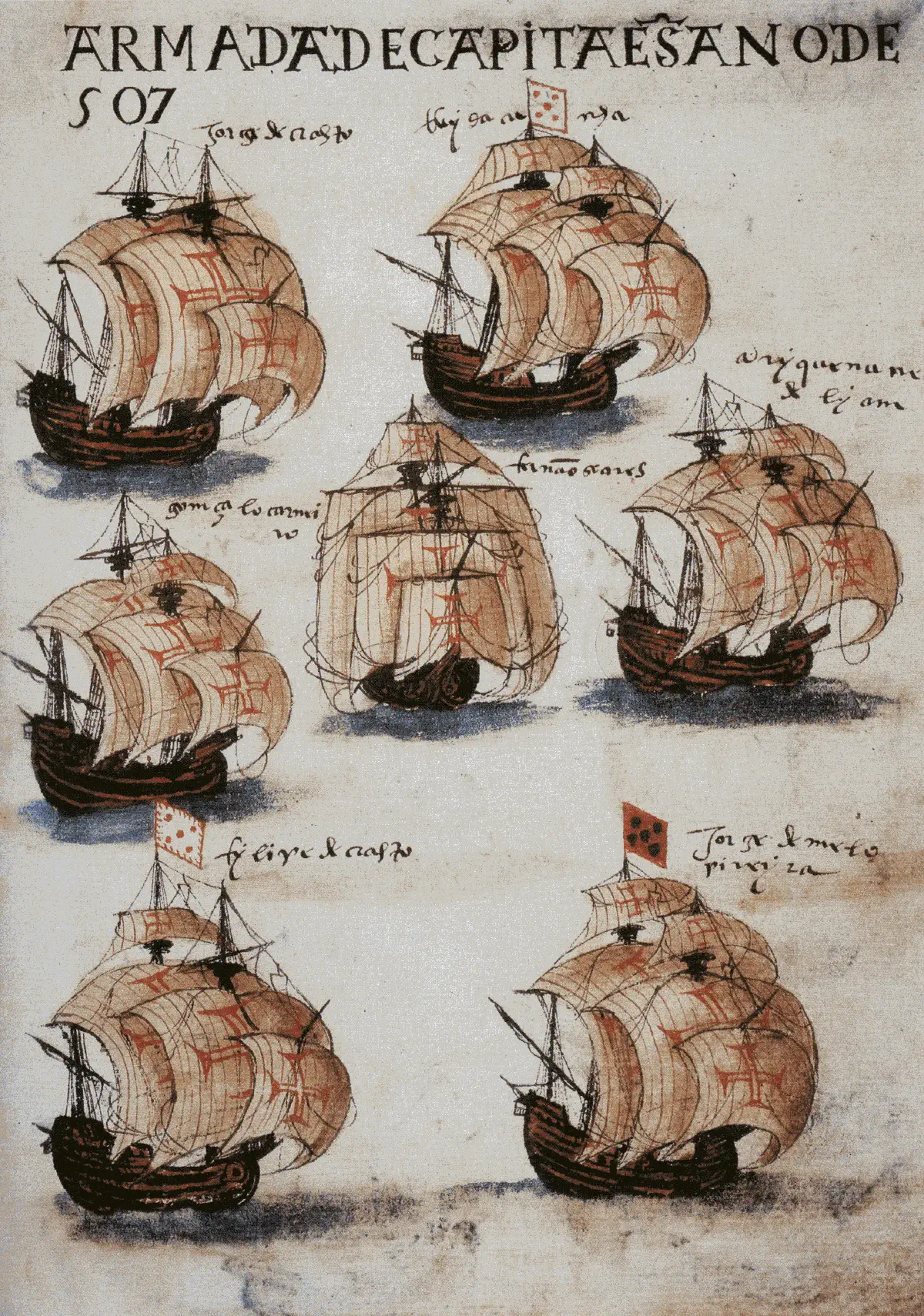
The fleet that left the Tagus on the ninth of March 1500 was the largest Portugal had ever sent to sea. Thirteen vessels, square-rigged and heavy with cannon, their holds packed with salt pork, biscuit, wine, and twenty thousand cruzados in silver coin. Fifteen hundred men, among them Franciscan friars, royal clerks, and a contingent of degredados — convicts whose death sentences had been commuted to the task of being abandoned on unknown shores, to learn the languages and customs of the peoples there, or to die trying. The commander was Pedro Álvares Cabral, a young nobleman of good family and no naval experience, appointed because the new king, Manuel, needed a man who owed everything to the crown. The fleet's orders, sealed and opened only at sea, were simple: follow the route of Vasco da Gama to Calicut, secure a treaty with the Zamorin, and return with pepper. If the Zamorin refused, Cabral was authorised to wage war. The velvet glove concealed an iron fist, and the fist was studded with bronze.
The fleet swung wide into the Atlantic, the caravels heeling under a press of sail, the larger roundships lumbering in their wake. The volta do mar took them far to the west, into the dead latitudes of the Sargasso Sea, where the wind died and the men hung over the rails, staring at the golden weed that stretched to the horizon in unbroken mats. They crossed the equator. On the twenty-second of April, the lookout of the São Pedro sighted a low green hump on the western horizon. It was a coast, uncharted, unknown. Cabral sent a small boat ashore.
They found a land of dense forests and shallow streams, inhabited by people who went naked and painted their bodies with red dye. The Franciscan chaplain, Pero Vaz de Caminha, wrote an ecstatic letter to King Manuel, describing the inhabitants as innocent, gentle, "like birds." A mass was said under a banyan tree. A cross was planted. Cabral named the place the Island of the True Cross and dispatched a ship back to Lisbon with the news. The name would not stick. Within a generation, the land would be called Brazil, after the red dyewood that grew in abundance along its shores. Portugal had stumbled upon a continent, but it was still a sideshow. The goal was India.
The fleet turned east, back into the Atlantic, and began the long, brutal run to the Cape of Good Hope. The southern ocean did not welcome them. A storm of extraordinary violence hit on the twenty-fourth of May, blackening the sky and raising waves that broke over the mastheads. Four ships went down in a single night. The crew of the São Pantaleão saw a waterspout walking across the sea, a twisting column of black water and cloud that swallowed a caravel whole before dissolving into rain. Among the dead was Bartolomeu Dias, the first man to round the Cape, now swallowed by the sea he had opened to the world. Cabral pushed on with the remaining six vessels, rounding the Cape in foul weather and limping up the African coast toward Mozambique.
Calicut: The Ultimatum#
The Swahili city-states received them with the same wary hospitality they had offered Gama. At Kilwa, the sultan refused even to come down to the beach. At Mombasa, the Portuguese fired their bombards into the town to discourage the war canoes that circled the anchorage. At Malindi, the ruler, a calculating old man who saw advantage in a Christian alliance against his Muslim rivals, provided pilots who knew the monsoon. The fleet crossed the Arabian Sea in eighteen days. On the thirteenth of September 1500, the ghats of the Malabar Coast rose from the sea, the same green rampart that had greeted Gama two years earlier. But this time, the Portuguese were not coming as supplicants. They were coming as arbiters.
Calicut was the master key of the pepper trade. Its Zamorin, a hereditary ruler of immense wealth and ritualised isolation, governed a city that was a bazaar for the world. Arab, Persian, Gujarati, and Javanese merchants crowded its waterfront. The monsoon winds delivered dhows from Aden, Hormuz, and Malacca with a regularity that had defined the rhythms of Indian Ocean commerce for a thousand years. The Portuguese, arriving in their square-rigged monstrosities bristling with cannon, did not fit. They were a different species of predator, and their demands were non-negotiable: exclusive trading rights, preferential prices, the expulsion of the Muslim merchants who had run the spice trade for centuries.
Cabral delivered this ultimatum in the Zamorin's palace, a vast wooden hall carved with scenes of gods and elephants, the air thick with incense and the murmur of waiting courtiers. The Zamorin, a man of exquisite diplomatic instinct, prevaricated. He had no intention of expelling his Muslim trading partners. The Arab merchants, for their part, understood the threat perfectly. The Portuguese were not competitors. They were replacements. If they succeeded, the entire network that carried pepper to Alexandria and Beirut, and from there to the warehouses of Venice and Genoa, would collapse. The stakes were existential.
The first weeks were a tense standoff. Cabral seized a cargo ship carrying spice to Jeddah, confiscating its pepper as compensation for unspecified grievances. The Arab merchants protested. The Zamorin hesitated. The Portuguese, increasingly isolated in their factory on the waterfront, began to fear attack. Then, on the sixteenth of December, the tension snapped.
The Burning of the Factory#
A group of Portuguese sailors were ambushed in the market. Cabral demanded justice. The Zamorin, whether complicit or simply paralysed, did nothing. That night, the waterfront erupted. A mob of several hundred men, armed with swords, clubs, and firebrands, stormed the Portuguese factory. The factor, Aires Correia, and fifty-three of his men were cut down. Their bodies were thrown into the harbour. The survivors fled to the ships, their clothes torn, their faces blackened with smoke, their stories incoherent with rage.
Cabral waited twenty-four hours. He could not afford to let the massacre stand. The Portuguese empire, such as it was, rested entirely on reputation. If a mob could slaughter fifty Europeans and go unpunished, the myth of invincibility would dissolve. The response, when it came, was proportionate only to the logic of terror.
On the eighteenth of December, Cabral's fleet moved against the shipping in Calicut harbour. The ships were Arab-owned, mostly sambuks and dhows, deep-hulled and fat with cargo. The Portuguese caravels ran among them like wolves through a sheepfold, their gunwales touching. The gunners loaded stone shot, iron balls, and loose scrap metal packed with gunpowder. The bombards spoke, and the ships began to burn. The crews, trapped between the flames and the water, leaped into the sea. The Portuguese boats moved among the swimmers, lancing them with pikes, cutting them down with swords. It was not a battle. It was an execution. Seven hundred men died in the water that morning. The harbour was so thick with corpses, one chronicler noted, that "the sea was red for a mile."
But Cabral was not finished. The fleet stood off the city itself. For two days, the bombards hurled stone and iron into the dense mass of houses, mosques, and warehouses that crowded the shore. The city, built largely of wood and palm thatch, caught fire in a dozen places. The flames spread, fed by the monsoon breeze, until a great pall of black smoke hung over the coast. The grand pagoda of the Samudri, a repository of centuries of Hindu devotion, took a direct hit. The chronicles record that the Zamorin fled his palace on foot, stumbling through the burning streets, the cannon fire echoing off the hills. By the time Cabral ordered the fleet to weigh anchor and sail south to Cochin, Calicut was a smoking ruin.
The sack of Calicut was a declaration. The Portuguese were not in the Indian Ocean to negotiate. They were there to conquer. The old model of the Reconquista, the slow rollback of Islam on land, had been transposed to the sea, but the sea changed the terms. A single fortress on land could control a valley. A single ship armed with cannon could terrorise a thousand miles of coastline. The Portuguese grasped this faster than anyone. They had few men, but they had iron and gunpowder and a willingness to use both without restraint.
The Burning of the Miri#
The fleet sailed south to Cochin, a rival port city whose raja saw advantage in hosting the Portuguese. Cabral loaded pepper, ginger, and cinnamon into his holds — a full cargo, enough to repay the expedition's costs several times over — and began the long voyage home. Along the way, he encountered a large Muslim pilgrim ship, the Miri, carrying passengers and cargo across the Indian Ocean. What happened next was described by an anonymous Portuguese crewman whose journal survived the voyage:
We overtook her and took her, and there happened one of the most pitiful things that has ever been seen. The Moors threw themselves into the sea and we chased them with our boats and killed them all. A great number of women and children we took, and we burned the ship with those who remained aboard. It was a very great cruelty, and it was done without any necessity.
The Miri burned to the waterline, a pillar of smoke on an empty sea. The women and children taken as captives were distributed among the fleet. Some were baptised; most were sold. The episode was not exceptional. It was doctrine. Terror was a weapon, and it was being wielded systematically. The Portuguese fleet returned to Lisbon in the summer of 1501, six of its thirteen ships remaining, its holds bursting with spice, its decks slick with blood that no amount of seawater could wash clean. King Manuel received Cabral with public honours, but the young commander, shaken by the losses and the violence, retired to his estates and never commanded a fleet again.
The news of Calicut's bombardment spread through the Indian Ocean faster than the monsoon. At Aden, at Hormuz, at Malacca, the sultans and the sea captains heard the same report: pale men in wooden ships had burned the greatest port in India and slaughtered hundreds in cold blood. The stories grew in the telling. The Portuguese were not men, it was said, but devils, immune to fear, indifferent to death. The myth of their invincibility was exactly what Cabral had sought to create. But a myth is a fragile thing. It requires constant reinforcement.
That reinforcement would come soon. The king had already chosen the man who would carry the next fleet east, a man who would make Cabral look like a moderate. His name was Vasco da Gama, and he was returning to the Indian Ocean with twenty ships and a heart full of vengeance. The contest for the spice trade was about to become a holy war.