
The monsoon was the clock of the Indian Ocean. For millennia it had dictated the rhythm of trade, war, and pilgrimage with the precision of a planetary tide. In the summer months the wind blew from the southwest, carrying dhows from the Swahili coast to Gujarat and Malabar. In winter it reversed, driving ships down from Arabia, from Hormuz, from the spice islands of the east. The men who sailed these waters — Arab pilots, Gujarati merchants, Javanese shipmasters — read the wind like a text. They knew its moods, its delays, its sudden violences. They built their lives around it. The Portuguese, arriving in their cannon-laden carracks, could not change the monsoon. But they could seize the places where the monsoon stopped.
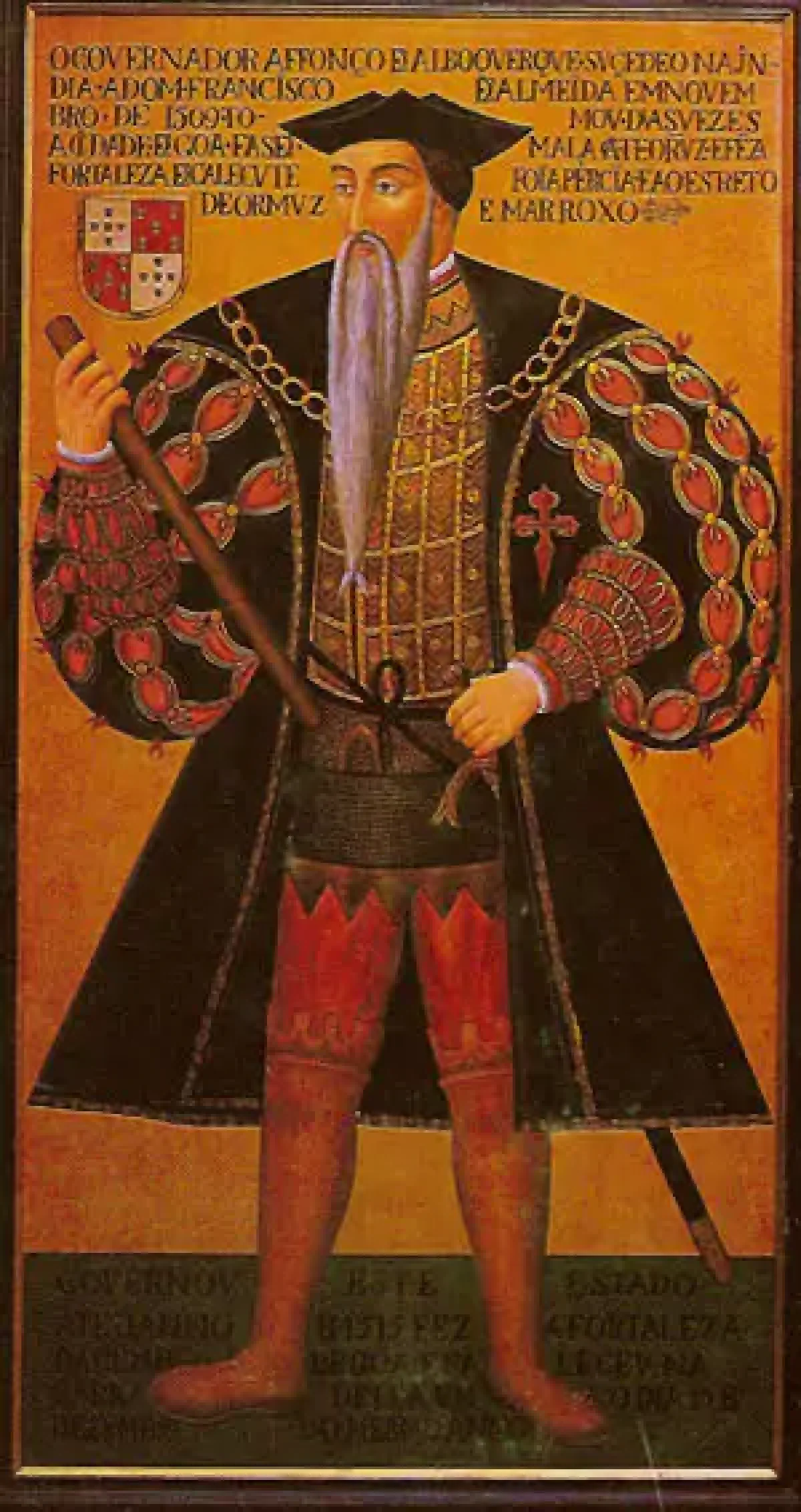
Afonso de Albuquerque understood this with a clarity that bordered on obsession. He was a man in his middle fifties when he first sailed east, already grey, already scarred, with a beard that fell to his breastplate and eyes that the chronicler João de Barros described as “deep-set and restless, as if he were always watching a horizon no one else could see.” He had served ten years in the Portuguese garrisons of North Africa, at Arzila and Larache, where he learned the physics of siege warfare and the calculus of terror. He had fought the Turk in the Mediterranean. He had seen Ceuta, the first conquest, and he had watched the caravans reroute around it. His conclusion was brutal and simple: a port was useless unless you controlled the strait that fed it. To control the Indian Ocean, you did not need an army. You needed a set of keys.
The keys, as Albuquerque enumerated them in his letters to King Manuel, were four. Hormuz, at the mouth of the Persian Gulf, where the silk and pearl routes of Mesopotamia met the sea. Goa, the island fortress halfway up the Malabar Coast, with a harbour deep enough to shelter a fleet and shipyards capable of building a new one. Malacca, the narrows between Sumatra and the Malay Peninsula, through which all the spices of the Moluccas flowed east to China and west to India. And Aden, the gate of the Red Sea, the artery that fed the Mamluk sultans of Cairo and, beyond them, the merchants of Venice. Take these four places, Albuquerque argued, and you could strangle the Muslim trade in one hand and throttle the Venetian in the other. You could redirect the wealth of Asia into the holds of Portuguese ships. You could build an empire without territory, a kingdom of water and stone, held not by settlers but by garrisons, naval patrols, and fear.
The audacity of the plan was matched only by the poverty of the resources. Albuquerque commanded at most a few thousand men, scattered across a dozen fortresses from Sofala to Cochin. The Portuguese population back home was barely a million. Every life lost was irreplaceable. Every ship wrecked was a catastrophe. The strategy therefore demanded not just victory but economy. Each conquest had to be swift, decisive, and so terrifying that it would not need to be repeated. Albuquerque was a master of the sudden assault, the escalade before dawn, the mined gate, the ultimatum delivered at the point of a bombardon. He was also, when the situation required, a patient negotiator. But patience with him was a tactic, never a temperament. His natural register was fury.
Hormuz: The First Key#
The island of Hormuz rose from the Persian Gulf like a heap of salt and ochre, a barren lump of rock twelve miles in circumference, without fresh water, without a single tree, yet fabulously wealthy. The Arab geographer Ibn Battuta had called it “the most beautiful of cities” — a dense cluster of warehouses, bazaars, and noble houses, its port packed with ships from India, Persia, and Arabia, its customs houses so rich that the king’s revenue was accounted in gold by the weight of a mule’s load. Hormuz controlled the narrowest point of the Gulf, the strait through which all the trade of Basra and Baghdad passed. Albuquerque saw it for the first time in September 1507, from the deck of his flagship, the Cirne, and what he saw made him tremble with purpose.
He had only six ships. The king of Hormuz, a young man named Cogeatar, commanded an army of twenty thousand and a fleet of several hundred vessels, including warships built on the European model by renegade Portuguese castaways. The odds were absurd. Albuquerque, standing on the quarterdeck in a breastplate that flared with the late afternoon sun, informed his captains that they would attack the next morning. When his second-in-command, João da Nova, protested that the season was too late, the men too few, the enemy too strong, Albuquerque looked at him with a contempt that silenced the deck. He had not come to count odds. He had come to collect keys.
The assault began at first light. The Portuguese carracks sailed directly into the harbour, their broadsides tearing through the anchored dhows, their cannonballs skipping across the water to smash the wooden piers. The Hormuzi fleet, caught by surprise, scattered. Albuquerque’s infantry landed on the waterfront, formed a square, and drove through the narrow streets toward the palace, their arquebuses cutting down the defenders who tried to block their path. By midday, the city was in Portuguese hands. The young king, surrounded by the corpses of his viziers, sued for peace. Albuquerque dictated terms: Hormuz would become a vassal of Portugal, pay an annual tribute in gold and pearls, and permit the construction of a fortress overlooking the harbour. The king, staring at the smoking wreckage of his fleet, signed.
Then the enterprise collapsed. Albuquerque’s captains, led by Nova, mutinied. They resented his authority, his refusal to share plunder, his insistence on building a fortress in a waterless rock when the monsoon was turning and the crews were sickening with dysentery. Three of them took their ships and sailed away to India. Albuquerque, abandoned and outnumbered, was forced to retreat. He burned the half-built fortress, loaded his remaining men aboard the Cirne, and sailed south with a single companion — his nephew, a boy of seventeen. The humiliation was absolute. But Albuquerque had seen something at Hormuz that he would not forget: the shape of a strategy that could win an ocean.
Goa: The Second Key#
Three years later, Albuquerque returned. In the interval, he had been appointed governor of Portuguese India, replacing the cautious Francisco de Almeida, who believed in sea power without bases. Albuquerque believed the opposite: sea power was an illusion without harbours, and harbours required fortresses, and fortresses required a willingness to kill on a scale that left no doubt about the consequences of resistance. He turned first to Goa.
Goa was the jewel of the Malabar Coast, an island city divided from the mainland by a network of tidal creeks and mangrove swamps. It had been a possession of the Vijayanagara Empire before falling to the Bijapur sultanate, and its harbour was deep enough to accommodate ships of any draft. Its citadel, a massive edifice of laterite stone, was garrisoned by thousands of Turkish mercenaries, many of them renegades from the Ottoman wars in Europe. Albuquerque had reconnoitred Goa the previous year and noted the weakness of its garrison during the monsoon, when the sultan withdrew his main forces inland. He decided to strike in May 1510, at the height of the rains, when the rivers were swollen and the city’s defenders believed no fleet could operate.
The attack was a masterpiece of amphibious warfare. Albuquerque assembled thirty-four ships and fifteen hundred men at Cochin and sailed north in driving rain, the ships groping through fog and thunder, the men soaked to the bone, the gunpowder stored in waxed sacks. They entered the Mandovi River under cover of darkness, the carracks firing their bombards at the citadel walls while the infantry scrambled ashore from longboats and waded through the mangrove mud, their swords tied to their backs. The Turkish mercenaries, caught in their barracks, fought with the desperation of men who knew that surrender meant death. But the Portuguese stormed the gates, and by nightfall the citadel was theirs. The Portuguese flag was raised above the walls, and Albuquerque knelt in the mud to give thanks.
The occupation lasted only three months. In August, the Bijapur sultan, Yusuf Adil Shah, counterattacked with an army of forty thousand men. Albuquerque, outnumbered and blockaded, held out for twenty days, his men reduced to eating dogs and rats, before abandoning the city under cover of darkness, leaving behind a trail of mines and booby traps that turned the pursuing Muslims into a red mist. The retreat was a tactical defeat, but Albuquerque had tasted Goa, and he would not forget it.
In November 1510, he returned. This time, he came with a fleet reinforced from Portugal, and he brought with him a willingness to do what was necessary. The second assault on Goa was preceded by a general amnesty for the Hindu population and a sentence of extermination for every Muslim male of military age. The Portuguese burst through the breaches in the walls before dawn, and for three days the streets of Goa ran with blood. The chronicler Gaspar Correia, who witnessed the aftermath, recorded that the bodies of the dead were piled so high in the market square that “the water of the river ran red to the sea for a league.” Albuquerque ordered the corpses thrown into the river to feed the crocodiles. The surviving Muslim women and children were taken as slaves. The Hindu nobility, who had suffered under the sultan’s rule, were restored to positions of influence. Goa became, from that day, the capital of Portuguese India, a base so secure that it would remain in Portuguese hands for four hundred and fifty-one years.
Malacca: The Throat of the World#
With Goa in his grip, Albuquerque turned east. The target was Malacca, a city at the narrowest point of the strait that bears its name, a dense, sweltering metropolis of a hundred thousand souls, its harbour a forest of masts from China, Java, Siam, and the Moluccas. The Portuguese apothecary Tomé Pires, who visited Malacca a few years later, wrote that “whoever holds Malacca has his hand on the throat of Venice.” Albuquerque saw it as the third key, the eastern anchor of his grand design. In April 1511, he assembled a fleet of eighteen ships and twelve hundred men and sailed for the strait.
The sultan of Malacca, Mahmud Shah, was a formidable opponent. He commanded twenty thousand men, a corps of war elephants, and artillery that included cannon cast by a renegade Portuguese gunsmith. The city was defended by a wooden stockade reinforced with earthworks and a chain of floating batteries anchored in the river mouth. Albuquerque anchored his fleet outside the harbour and sent an envoy demanding the release of Portuguese prisoners, payment of reparations for attacks on Portuguese merchants, and permission to build a fortress. The sultan prevaricated, playing for time. Albuquerque gave him three days. On the fourth day, the bombards opened fire.
The first assault failed. The Portuguese infantry, wading ashore under a hail of arrows and poisoned darts, found the stockade too high to scale and the defenders too numerous to dislodge. Albuquerque ordered a retreat, reformed his troops, and prepared for a second attempt. He spent a week reconnoitring the defences, sending spies among the Chinese merchants who chafed under the sultan’s taxes. A Chinese junk captain, a man whose name the chronicles do not record, told him of a weakness: a bridge connecting the town to the royal quarter, heavily fortified, but vulnerable to a concentrated assault from the sea.
The second attack came at dawn on the twenty-fourth of August 1511. Albuquerque divided his force into two columns. One, under his personal command, assaulted the bridge in a storm of cannon fire and arquebus volleys, the stonework dissolving under the impact of the bombards, the defenders falling back in confusion. The other, led by his deputy, landed further upriver and set fire to the warehouses. The wind caught the flames and drove them through the city, a wall of fire that advanced faster than a man could run. The war elephants, maddened by the smoke and the noise, trampled their own handlers and charged through the streets, crushing everything in their path. By noon, the sultan had fled on the back of an elephant, his treasury burning behind him, his wives and concubines abandoned to the victors.
The plunder of Malacca was staggering. Gold, silk, porcelain, and spice filled the warehouses. The Portuguese cartographer Duarte Barbosa, who was present, wrote that “so great was the weight of the gold and silver that they did not know what to do with it.” Albuquerque ordered a fortress built on the commanding height overlooking the harbour, a great tower of laterite and lime that would anchor Portuguese power in the East for a century. He sent envoys to Siam, to Java, to the Moluccas, announcing the new dispensation. He dispatched a ship to Lisbon with a letter for the king, a cargo of spice, and a pair of elephants as a gift. The letter closed with a sentence that became famous: “All the riches of the world are now in Your Majesty’s hands.”
The Limits of Terror#
The grand design was almost complete. Hormuz, Goa, Malacca — the keys turned in the locks, one by one. But the fourth key, Aden, eluded him. In 1513, Albuquerque launched a major expedition against the Red Sea fortress, the gatekeeper of the spice route to Cairo and Venice. The attack was a disaster. The citadel of Aden, built on a volcanic crater, defied every escalade. The Portuguese, weakened by thirst and dysentery, were repulsed with heavy losses. Albuquerque, wounded in the arm, stood on the deck of his flagship and watched his men fall back from the walls, their armour glittering in the desert sun. He would never take Aden. The Red Sea remained open, and the Mamluks continued to ship pepper to the Mediterranean.
But the failure at Aden revealed something important about Albuquerque’s empire. It did not depend on the closure of every strait. It depended on a reputation for irresistible violence, and that reputation, by 1513, was secure. The sultans of the Indian Ocean had learned a new fact of political life: the Portuguese could arrive anywhere, at any time, and burn a city to the ground before the monsoon changed. The terror was the strategy. The forts were the mnemonic.
Albuquerque governed his scattered kingdom from the deck of a ship, rarely sleeping on land, his body wasting under the equatorial sun. He wrote constantly — letters to the king, instructions to captains, reports on fortifications, requisitions for lime, for cannonballs, for soldiers who would not mutiny. His prose was blunt, tactical, lit by a messianic fire. He believed, with absolute conviction, that God had chosen Portugal to humble the House of Islam and that he was the instrument of that purpose. He was not a pleasant man. He was not a merciful one. But he was, in his sphere, a genius, and the empire he built was a reflection of his mind: lean, hard, and perfectly adapted to its environment.
He died at sea, off Goa, on the sixteenth of December 1515. The cause was dysentery, a slow fever, simple exhaustion. He was sixty-two years old, and the Indian Ocean had broken his body but not his will. The chronicle says that his last hours were peaceful. The ship rocked gently on the swell. The priests chanted the office of the dying. Outside the porthole, the sea stretched to every horizon, shimmering with the reflected light of the monsoon sky. The lion of the sea slipped away without a struggle, leaving behind a network of forts and a legend of ferocity that would endure for centuries. The Portuguese empire in the East was, at his death, a handful of men and a heap of stones. But the stones were placed exactly where they needed to be.