
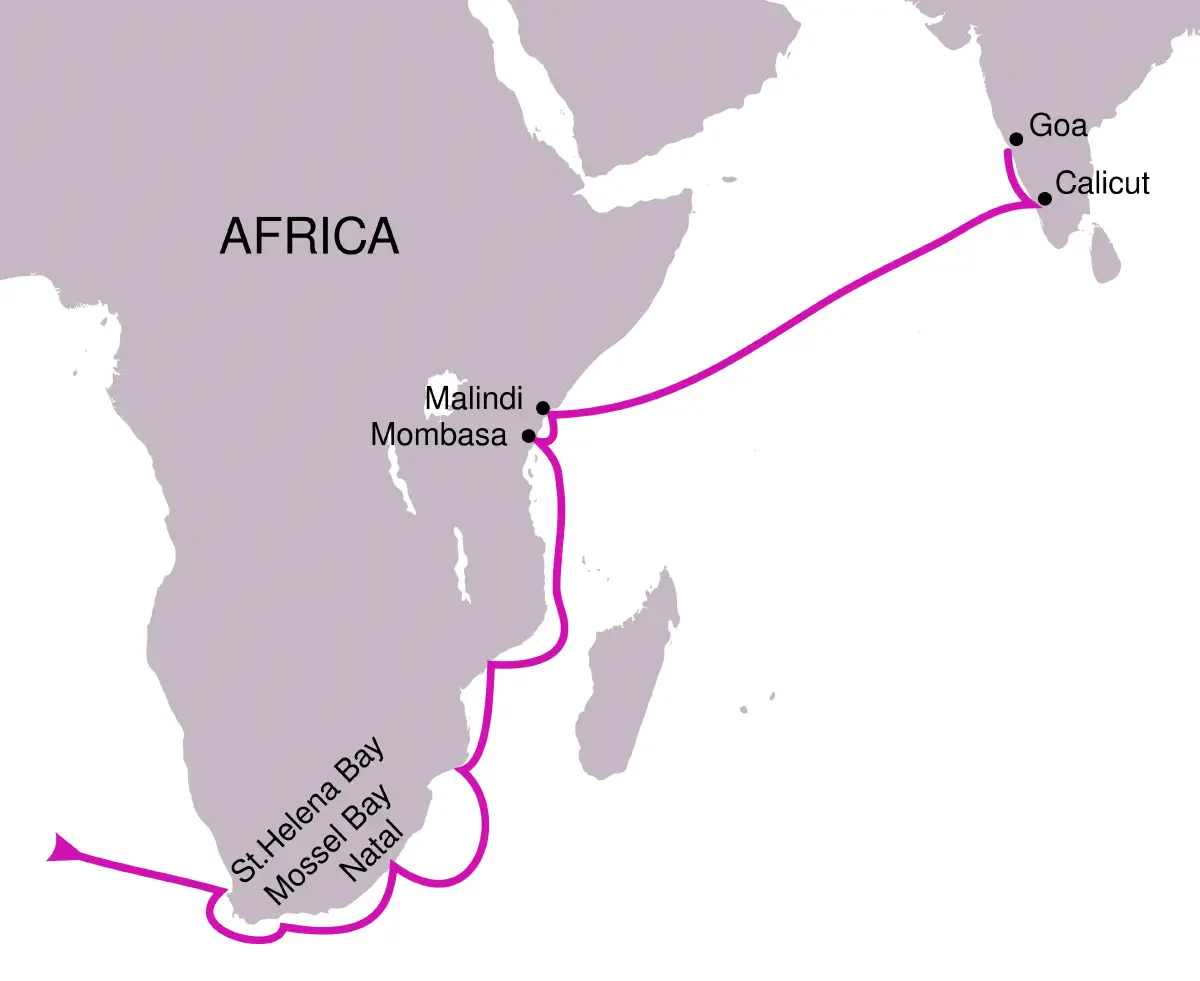
The wind that governed the Portuguese empire began as a temperature difference over the Tibetan plateau. In the northern summer, the landmass of Asia heated the air above it until it rose, and into the vacuum rushed a great river of moisture from the southwest, dragging the Indian Ocean behind it. The wind bent the waves into long ridges, pushed curtains of rain across the Arabian Sea, and drove ships eastward at speeds that medieval sailors had only dreamed of. Six months later, the cycle reversed. The air over the frozen Himalayas grew dense and heavy, and the wind poured back the other way, cold and dry, whipping the sea into whitecaps. For two thousand years, the pilots of the Indian Ocean — Arabs, Gujaratis, Javanese — had built their lives around this alternating pulse. The Portuguese, when they arrived, knew nothing of it. The monsoon became their jailer and their god.
The monsoon was not a single wind. It was a system, a planetary respiration that split the year into two distinct sailing seasons. From May to September, the southwest monsoon howled up the African coast, past Cape Guardafui, and slammed into the Western Ghats of India, unloading a deluge that turned the Malabar Coast into a steaming green tunnel of rain. During these months, the ports of the Swahili coast could dispatch ships east but not receive them from the north. From November to March, the northeast monsoon blew in the opposite direction, a dry offshore wind that carried ships from India down to Africa and across to Malacca. Between the two seasons, brief and perilous, lay the interludes of calm, the changings of the wind, when the sea lay flat as oil and the air was thick with flies.
A Portuguese carrack that reached India in September had until December to load its pepper. If it missed the January departure, it waited a full year. The penalty for error was not delay but death.
Learning the Hard Way#
Vasco da Gama’s first fleet, in 1498, had crossed from Malindi to Calicut in twenty-three days, a swift and uneventful passage carried by the last breath of the southwest monsoon. He did not understand his luck. When he turned for home in late August, he found the wind had shifted. For three months, his three ships beat against headwinds in the Arabian Sea, clawing for every league, the crews dying of scurvy, the pumps labouring, the sun blistering the decks. The anonymous diarist of the Roteiro recorded the ordeal with a brevity that spoke of exhaustion: “The wind was always contrary. The sea was high. Many men fell sick, and their gums grew over their teeth, and they died.” By the time they reached the African coast, thirty men had been thrown over the side. The crossing that had taken twenty-three days eastbound took ninety-three days westbound. The sea had taught them the cost of ignorance.
Cabral’s fleet in 1500 repeated the lesson. Departing Calicut in January, he sailed with the northeast monsoon behind him, but a storm off the Cape of Good Hope scattered his ships and drowned Bartolomeu Dias. The survivors straggled into Lisbon in the summer, their hulls worm-eaten, their crews hallucinating from malnutrition. The court celebrated the pepper, but the pilots understood: the Indian Ocean was a trap. It demanded a new kind of navigation, one that respected not just latitude and longitude but time.
Mastering the Calendar#
The Portuguese adapted with the methodical ferocity of men who had no alternative. By 1505, the fleet’s calendar had hardened into a rigid template. The great armadas left Lisbon in March or April, timing their passage to the Cape to catch the southern winter, when the westerlies blew steadily and the storms were less murderous. They rounded the Cape in June or July, provisioned at Mozambique or Malindi, and rode the dying southwest monsoon across the Arabian Sea, arriving off the Malabar Coast in August or September. The pepper was harvested in October. The loading took weeks — endless boatloads of bulging sacks ferried across the surf, the holds packed tight, the ships settling low in the water. By late December, the fleet weighed anchor for the return, sliding home on the northeast monsoon, passing the Cape in March, and reaching Lisbon in June or July. The whole cycle, Lisbon to Lisbon, consumed eighteen months. A ship that made three such voyages in a row was a veteran. A captain who completed two was a survivor.
The rhythm was unforgiving. At Cochin, the Portuguese factor Duarte Barbosa described the frantic weeks before the January departure: “The ships lie in the harbour with their sails already bent, and the captains are in a great hurry to depart, for if they delay even a few days, the monsoon will change, and they will be forced to winter there.” Wintering — invernar — was the word the Portuguese used for the monsoon season, though the season was anything but winter. It was a period of suffocating humidity, of black clouds that burst without warning, of rivers that overflowed and turned the streets of Goa into canals. The ships, hauled ashore or moored in the mangrove creeks, rotted where they lay. The men, confined to their cramped quarters, died of malaria, dysentery, and a dozen nameless fevers that the tropical rain seemed to incubate. A ship that invernado in India rarely returned with more than half its crew.
The Physics of Empire#
The cost was staggering, but it was also strategic. The monsoon dictated which ports the Portuguese could hold and which they could threaten. On the Malabar Coast, the southwest monsoon made the harbours south of Goa — Cochin, Cannanore, Quilon — accessible only during the summer, when the wind blew directly onshore, lashing the coast with rain and making navigation treacherous. Goa, by contrast, lay slightly north, at a latitude where the monsoon’s force began to weaken, and its harbour was protected by a complex of islands and tidal creeks that offered shelter in any season. Albuquerque’s insistence on seizing Goa in 1510 was not merely a question of prestige or plunder. It was a question of physics. Without a monsoon-proof base, the Portuguese fleet could not remain in Indian waters year-round. With Goa, they could project force in any season, and the Muslim powers who had once retreated inland during the rains now found Portuguese patrols on their rivers even in the height of the deluge.
The same logic applied at Hormuz and Malacca. Hormuz, at the mouth of the Persian Gulf, was a furnace in summer, the heat rising from the salt flats in shimmering waves that warped the distant sea. But its anchorage was deep and sheltered, and its position allowed the Portuguese to control the shipping lanes regardless of the monsoon’s direction. Malacca, straddling the strait between Sumatra and the Malay Peninsula, lay within the doldrums, the equatorial band where the monsoon winds died and the sea grew heavy with heat. Ships could enter the harbour at any time of year, which was precisely why Albuquerque had to take it. If the Portuguese did not hold Malacca, someone else would, and the spice trade would slip through their fingers during the months when the monsoon made chasing impossible.
The Monsoon's Sovereignty#
The monsoon also dictated the tempo of communication. A letter sent from Lisbon in February reached Goa in October, assuming the ship caught both monsoons without loss. A reply sent in November arrived in Lisbon the following July. The round trip was a year and a half. The viceroy in India governed in a vacuum, making decisions that could topple kingdoms based on intelligence that was already outdated by the time it reached his hands. Albuquerque, in his letters to King Manuel, railed against the silence, the endless waiting for instructions that never arrived in time. “I have written to Your Highness many times,” he complained in one dispatch from Goa in 1512, “but I receive no reply, and I am forced to act as I see fit, trusting that God and Your Highness will approve.” The formula was polite. The frustration was volcanic.
This isolation gave the Portuguese commanders in the East an autonomy that was unknown in other European empires. The viceroy was a miniature king, his authority limited only by the reach of his cannon. He could declare war, negotiate treaties, bestow lands and titles, and order the death of anyone who opposed him. The crown, four thousand leagues away, could do little but ratify his decisions after the fact or, occasionally, dismiss him. The monsoon was the true sovereign. It granted power and revoked it with the turning of the wind.
Prisoners of the Rain#
The men who lived by this rhythm came to know it intimately, fearfully, as a living presence. The anonymous Portuguese pilot who compiled the Livro de Marinharia in the 1520s described the monsoon as a beast with two heads: “The one wind is fair and brings rain; the other is contrary and brings death.” Gaspar Correia, in his sprawling chronicle of the Indies, captured the tension of the monsoon’s arrival, the weeks of waiting before the wind turned:
The ships lay at anchor, their sails unbent and their yards lowered, and the men had nothing to do but watch the sky. The heat was so great that the pitch bubbled from the seams, and the water in the casks grew green. They looked to the south for a cloud, a ripple on the water, anything to break the stillness. And when the cloud came, black and low, the whole fleet knew that their lives depended on whether they could outrun it to a safe harbour.
The monsoon was not merely a physical fact. It was a psychological one. It marked the passage of time in a world without seasons, a world where the sun rose and set at the same hour all year and the only change was the rain. The Portuguese in India measured their lives not in years but in monsoons. A man who had “seen five monsoons” was a veteran. A man who had “seen ten” was an elder, his body hollowed by fever, his face seamed with the scars of the climate. The monsoon brought not only wind but mould, rot, and a particular melancholy that the chroniclers called desgosto — a wasting of the spirit that afflicted even the strongest. Men who had survived battles and shipwrecks succumbed to the desgosto of the rains, lying in their hammocks with their faces to the wall, refusing food, dying without a word.
The Flower of the Sea#
There was one catastrophe above all that demonstrated the monsoon’s power with the clarity of an execution. In January 1512, the great carrack Frol de la Mar, the Flower of the Sea, weighed anchor at Malacca bound for Goa. She was Albuquerque’s flagship, a four-hundred-ton monster of teak and iron, and her hold was packed with the treasure of the sultan’s palace: gold statues, jewel-encrusted krises, bolts of Chinese silk, chests of silver coin. The plunder of Malacca, the richest haul in Portuguese history, lay in her belly. Albuquerque himself had boarded her for the voyage, but at the last moment he transferred to a smaller vessel, the Trindade, to attend to some administrative matter.
The Frol de la Mar sailed into the Malacca Strait in perfect weather, the monsoon blowing steadily from the northeast. But the old ship had been patched too many times. Her seams, weakened by shipworm and the stress of battle, began to open. Water poured into the hold faster than the pumps could expel it. The captain, João da Nova, turned toward the coast of Sumatra, searching for a bay where he could beach the vessel. He never reached it. Off the northern tip of the island, in a place the pilots called the Pedras de Aru, the Flower of the Sea struck a reef and broke apart in the darkness.
Albuquerque, arriving at Goa weeks later on the Trindade, learned of the wreck from a fisherman who had seen the debris. The treasure, the records, the irreplaceable trophies of the conquest — all were gone, scattered across the floor of the strait in forty fathoms of water. Albuquerque wrote to the king with the news, his prose stripped of ornament: “The Frol de la Mar was lost on a reef, and all the riches of Malacca went to the bottom. So it pleased God. I was not aboard.” The monsoon had taken its tithe. The sea did not care about treasure.
A Confederation of Harbours#
The Portuguese empire in the Indian Ocean was, in the final analysis, a confederation of harbours linked by a wind. Its strength was not in its fortresses, its cannon, or its admirals, but in its adaptation to the rhythm that governed all movement on the sea. The carracks sailed when the wind allowed. The soldiers fought when the monsoon permitted them to land. The pepper fleets departed on a schedule written not by the king in Lisbon but by the temperature gradient over the Tibetan plateau. For a hundred years, the Portuguese bent their lives to this clock, and in bending, they survived. The cost of survival was inscribed in the crew lists, the hospital registers, the drowned carracks and the men who disappeared into the monsoon sky without a grave.
The wind that carried them east eventually carried them home. But it carried them on its terms, not theirs. They were never its masters. They were, until the final carrack rotted in the Goa roadstead, its prisoners.