
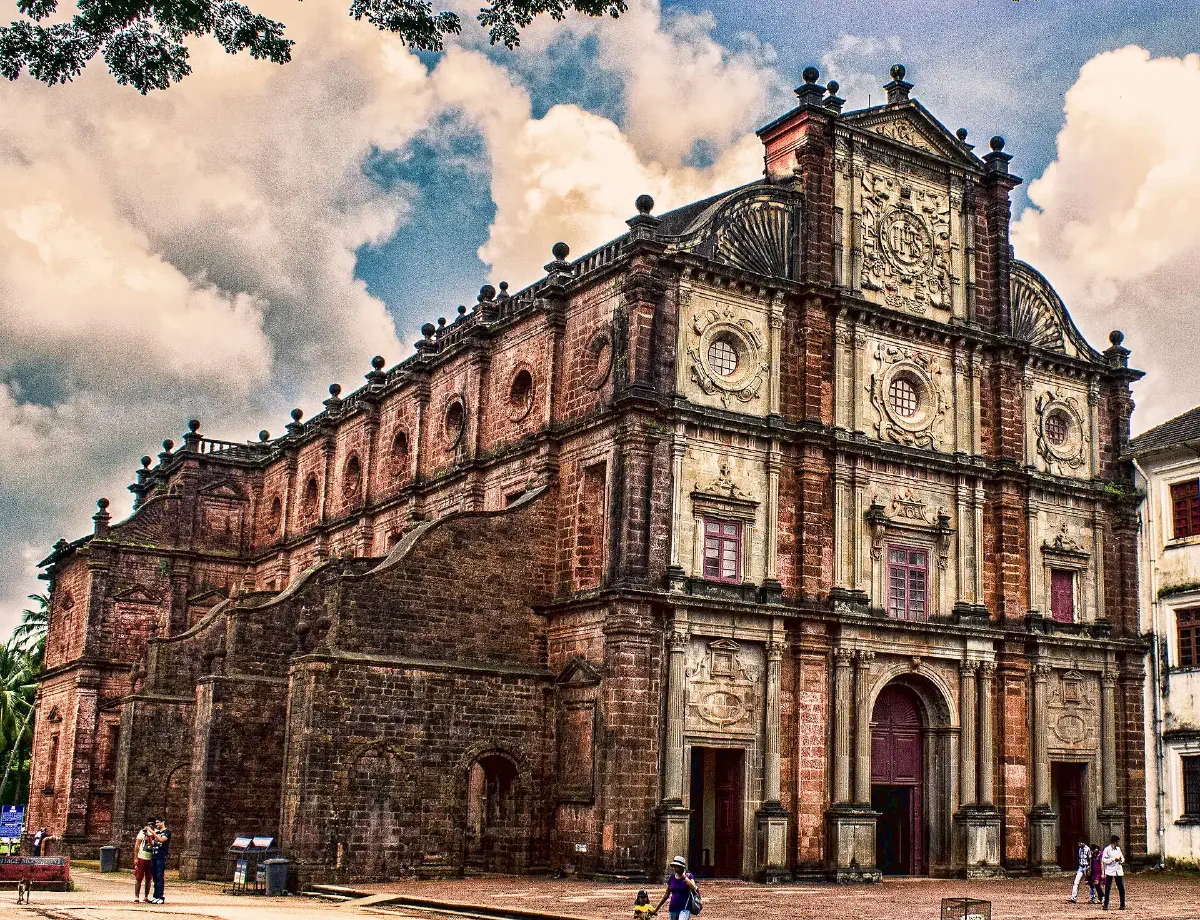
The first baptism in the new cathedral of Goa took place on a morning of suffocating heat, the air thick with the smell of wet laterite and the cloying sweetness of incense. The cathedral was not yet a cathedral — it was a converted mosque, its mihrab chiselled out, its minaret capped with a wooden cross — but the bishop, a Franciscan named João de Albuquerque, cousin to the governor, intoned the Latin of the rite as if he stood in the Sé of Lisbon itself. The convert was a young Brahmin, a man of good family who had watched his city fall to the Portuguese and had made the cold calculation that survival lay in the baptismal font. He knelt on the stone floor, the water running down his forehead, and when the priest asked him if he renounced the devil and all his works, he answered in halting Portuguese that he did. Outside, in the ruins of the bazaar, the bodies of those who had not converted were still being dragged to the river. The Brahmin rose, a Christian, and the governor’s secretary wrote his new name in the parish register: Francisco de Goa. The ink was still wet when the bells began to ring.
The conquest of souls was not a by-product of the Portuguese empire. It was its engine and its justification. The carracks that rounded the Cape carried not only cannon and pepper but priests, and the priests carried a mandate that was older than the empire itself. In the papal bulls that had launched the Portuguese enterprise — Dum Diversas in 1452, Romanus Pontifex in 1455 — the Pope had granted the kings of Portugal the right, and the duty, to “invade, search out, capture, and subjugate” the infidel, and to reduce all conquered peoples to perpetual slavery, all for the greater glory of God and the extension of the Christian faith. The bulls were at once a licence and a commandment. The Portuguese interpreted them as a covenant. They were not merely conquering. They were fulfilling prophecy.
The mechanism that channelled this sacred purpose was the Padroado Real, the royal patronage of the church overseas. In every fortress, in every trading post, the king appointed the bishops, paid the priests, and built the churches. The cross and the crown were fused into a single instrument of authority. The viceroy in Goa governed the bodies of men; the archbishop governed their souls. The two powers were indivisible, and the chroniclers recorded their progress with the same triumphal language they used for naval victories. The conversion of a king, wrote João de Barros, was a greater prize than the capture of a city. A baptized soul was eternal; a fortress was only stone.
The founding myth of the Portuguese enterprise, the bright star that had guided Prince Henry’s caravels down the African coast, was the legend of Prester John. For centuries, Christian Europe had believed in the existence of a vast and wealthy Christian empire somewhere beyond the reach of Islam, ruled by a priest-king who would one day join the crusaders and smash the Muslim world between two Christian hammers. The Portuguese took this legend literally. Every river they explored, every king they encountered, was interrogated for news of Prester John. The reports that filtered back from the African interior — a Christian kingdom in the mountains, a ruler who carried a cross into battle — seemed to confirm the hope. The search for Prester John was not a side project. It was the strategic axis of the entire expansion.
When Pêro da Covilhã finally reached Ethiopia in 1493, he found a Christian kingdom, but not the one he had imagined. The emperor Eskender, the latest in the ancient Solomonic dynasty, received him with courtesy and then confined him to the highlands for the rest of his life. Ethiopia was isolated, impoverished, and surrounded by Muslim sultanates. It could not launch a crusade. It could barely defend its own borders. Covilhã’s reports, smuggled out decades later, confirmed the existence of the Christian king but shattered the strategic fantasy. The Portuguese, however, could not let go of the dream. In 1520, a formal embassy under Dom Rodrigo de Lima arrived at the Ethiopian court, carrying a letter from King Manuel addressed to “the most powerful and excellent Lord Prester John.” The Ethiopian emperor Lebna Dengel received them in a pavilion hung with silks, his face veiled, his throne a platform of gold. The Portuguese were impressed and also disappointed. The emperor did not command vast armies. He did not possess a magical fountain or a fireproof cloak. He was a Christian ruler, isolated and besieged, and the embassy achieved little beyond a deeper mutual incomprehension. The myth of Prester John, which had driven ships down the coast of Africa for a century, slowly dissolved into the thin air of the Ethiopian highlands. But the crusading impulse that had created it did not dissolve. It simply shifted its target.
The Saint Thomas Christians#
On the Malabar Coast, the Portuguese found something that electrified them: Christians. The Saint Thomas Christians of Kerala traced their origins to the apostle Thomas, who was said to have landed at Cranganore in the first century and converted the local Brahmins. They were Nestorians, owing allegiance to the patriarch of Babylon, and their liturgy was Syriac. When Vasco da Gama’s men first heard mass in a church near Cochin, they wept. The chroniclers described the encounter as a miracle. Christendom, it seemed, had already reached India, and the Portuguese were merely completing a circle drawn by an apostle.
The initial encounter was joyful, but it curdled quickly. The Portuguese clergy, Franciscans and Dominicans who had absorbed the militant orthodoxy of the Reconquista, regarded the Saint Thomas Christians as heretics. Their liturgy was wrong. Their theology was suspect. Their priests wore beards and married. The Portuguese archbishop, installed at Goa, demanded that the Indian Christians submit to the authority of Rome, abandon their Syriac rites, and accept the Latin mass. The Indian Christians, who had preserved their faith for twelve centuries under Hindu and Muslim rule, resisted. The result was a long, bitter struggle for the soul of the Indian church, a struggle that ended in the Synod of Diamper in 1599, when the Portuguese forced the Saint Thomas Christians to renounce their Nestorian errors and accept the Pope. The treaty, like all such treaties, was written in the ink of coercion. The Inquisition, established at Goa in 1560, provided the teeth. The cross, which had first appeared in India as a symbol of recognition, became a symbol of submission.
The Architecture of Conversion#
The violence of conversion was not an accident. It was policy. Afonso de Albuquerque, the lion of the sea, was as explicit about souls as he was about fortresses. After the second conquest of Goa in 1510, he ordered the massacre of the Muslim garrison and the enslavement of their families. Then he turned to the Hindu population. Albuquerque offered the Hindus a choice: conversion or exile. The temples were cleared, their idols seized and melted down, their treasures sent to the king. On the site of the principal temple, Albuquerque laid the foundation stone of the Sé Cathedral, the great church that would dominate the Goa skyline for four centuries. The chronicler Gaspar Correia recorded the ceremony with satisfaction: “The governor took a silver trowel and laid the first stone with his own hands, and he said that this house of God would stand forever as a sign that the false gods of the heathen had been driven from the land.” The date, the feast of Saint Catherine, was chosen because the city had fallen on her day. The cathedral was dedicated to her, and every year thereafter, the feast was celebrated with a procession that wound through the streets where the dead had lain.
The Inquisition, when it arrived fifty years later, systematised the violence. The auto-da-fé, the public act of faith, became a regular spectacle in the squares of Goa. Heretics, relapsed converts, and those accused of secretly practicing Hinduism or Islam were paraded before the crowds, the condemned wearing yellow sanbenitos painted with devils and flames. The obstinate were burned. The penitent were imprisoned. The temples of the Konkan coast were pulled down, their statues smashed, their sacred tanks filled with earth. The religion of the land was driven underground, where it survived in the shadows of the coconut groves, waiting.
The Messiah of the Tagus#
The man who embodied the crusading spirit in its most feverish form was not a soldier but a king. Manuel I, who took the throne in 1495, was a man possessed by a vision. He believed, with a certainty that bordered on mania, that God had chosen Portugal to complete the unfinished business of the Crusades. The sea route to India was not a commercial opportunity. It was the prelude to the reconquest of Jerusalem. Manuel studied the prophecies of Joachim of Fiore and the Sybilline oracles, and he saw himself in their verses: the Last Emperor, the monarch who would unite Christendom, destroy the power of Islam, and usher in the end of days. The letters he dispatched to the Pope were thick with this rhetoric, a mixture of piety and grandiosity that bewildered the Roman curia. He sent gifts — gold, jewels, a white elephant named Hanno that knelt before the pontiff and sprayed perfume from its trunk — each one a coded message: the king of Portugal was the instrument of divine will.
The elephant, which died in 1516 and was buried in the Vatican courtyard, became a European sensation. Raphael painted it. The poets wrote verses about it. But the message behind the beast was serious. Manuel petitioned the Pope for a universal crusade, for a fleet that would sail from Lisbon to Suez, for the crown of the Holy Roman Empire. None of it materialised. The other Christian powers were too absorbed in their own wars, too sceptical of Portuguese claims. Manuel’s messianism remained a lonely obsession, confined to the ornate letters he dictated in the palace at Lisbon while the ships came and went from India. Yet the obsession had practical consequences. It infused the Portuguese enterprise with a sense of cosmic urgency. The conquest of the East was not merely profitable. It was holy. Every fortress, every carrack, every baptized convert was a step toward the final victory.
Francis Xavier and the Mission East#
The arrival of the Jesuits in the 1540s injected this messianic energy with a new intelligence. The Society of Jesus, founded by Ignatius of Loyola, was the sharp edge of the Counter-Reformation: disciplined, educated, and utterly ruthless in its pursuit of souls. The first Jesuit to reach India was a Basque nobleman named Francis Xavier, one of the original companions of Ignatius, a man whose fervour burned so brightly that his contemporaries compared him to the apostles. He landed at Goa on the sixth of May 1542, a small, dark-haired man in a threadbare cassock, carrying nothing but a breviary and a letter from the Pope.
Xavier’s methods were simple. He walked through the streets of the Portuguese settlements ringing a handbell, calling the children to catechism. At night, he visited the hospitals, the prisons, the slums where the half-caste orphans of Portuguese sailors begged for food. His letters home, which were copied and circulated across Europe, described a world of spiritual famine. “There is no one to preach the faith,” he wrote from Goa, “and yet the people are so ready to receive it. I have baptized so many that my arm is weary from pouring the water.” The arm-wearying was not a metaphor. On the Fishery Coast, among the Paravar pearl-fishers who had accepted Portuguese protection, Xavier performed mass baptisms, thousands in a single month, the rites administered in a language he did not speak, the theology reduced to the simplest formula: the sign of the cross, the Lord’s Prayer, the renunciation of idols. The Paravars, who had been oppressed by the caste system and who saw the Portuguese as political allies, accepted the new god. Xavier counted the souls and exulted.
From India, Xavier sailed east. In 1549, he became the first Christian missionary to enter Japan, landing at Kagoshima in the company of a Japanese convert named Anjiro, a man of uncertain past who had fled Japan after a murder. Xavier was forty-three years old, and the journey had already consumed him. The storms, the stench of the holds, the months of waiting in Malacca for the monsoon — all of it was recorded in the letters he wrote to his brethren in Goa and Rome. Japan, when he saw it, stunned him. “These are the best people yet discovered,” he wrote, “and it seems to me that we shall never find among the heathens another race to equal the Japanese.” They were courteous, literate, curious. They asked difficult questions. They wanted to know why a good God would create hell, why the Pope had not heard of Japan, what the Portuguese wanted in exchange for their strange religion.
Xavier laboured for two years in Japan, founding communities in Hirado, Yamaguchi, and Bungo. He dressed in silk robes to impress the daimyo, gave gifts of clocks and spectacles, and debated the bonzes in the temples, his arguments translated by Anjiro into a Japanese he could not verify. The results were modest — a few hundred converts, a few seeds planted — but the door was open. The Jesuit mission in Japan would grow into a church of hundreds of thousands within a generation, a flowering of faith that would end in persecution and mass crucifixion. Xavier did not live to see it. In 1552, he died on the island of Sancian, off the coast of China, his body wasted by fever, his eyes fixed on the mainland he had failed to enter. His corpse was packed in quicklime and carried to Goa, where it lay in state in the basilica of Bom Jesus, the flesh miraculously preserved, the right arm detached and sent to Rome as a relic. The mission continued. The shadow of the cross lengthened.
The Padroado's Long Shadow#
The Portuguese empire in the East was, in its own understanding, a work of salvation. The Padroado extended its jurisdiction over every soul from the Cape of Good Hope to Japan. The king appointed the bishops. The viceroy financed the churches. The Jesuits ran the seminaries and the printing presses, translating catechisms into Konkani, Tamil, Malay, and Japanese. The project was immense, and it was pursued with a sincerity that was as genuine as the cruelty that accompanied it. The priests who starved in the monsoon blockhouses, who died of fever in the Moluccas, who wrote their letters home in the knowledge that they would never see Portugal again, were not hypocrites. They believed. The violence they sanctioned, the forced conversions they oversaw, the temples they pulled down — these were not contradictions of their faith. They were expressions of it.
The shadow of the cross fell across the Indian Ocean and left a permanent stain. The cathedrals of Goa, the churches of Cochin, the hidden crypts of the Japanese Christians who kept the faith alive for two centuries without a priest — all of it traced back to the moment when a Portuguese carrack anchored off a strange coast and the friars went ashore with the banner of the Order of Christ. The mission and the conquest were two arms of the same body. The cross and the sword advanced together, and the chroniclers who recorded their progress did not distinguish between them. The chronicler João de Barros, a man of deep piety, wrote of the conquest of Malacca: “Our Lord has given us this city, and with it the souls of the heathen, which are worth more than all the gold in its treasury.” The gold was taken. The souls were harvested. The accounting was left to God.