
The man who called himself João Machado woke in a hut of woven palm fronds on the bank of a Konkani river, the monsoon rain drumming on the roof, the air thick with the smell of wet earth and the smoke of a dung fire. A woman lay beside him, her skin the colour of sandalwood, her hair oiled with coconut. She spoke a language he barely understood, a Marathi-Konkani patois into which a few Portuguese words had drifted like flotsam: pão, vinho, igreja. The children who tumbled through the door, brown and naked, called him pai. He had been a soldier once, a gunner on the carrack Santa Catarina, part of the fleet that took Goa in 1510. He had killed men in the streets, felt the heat of burning mosques on his face, knelt in the mud while Albuquerque gave thanks. Then he had walked away. Deserted. Slipped out of the fortress at night, crossed the river in a stolen canoe, and disappeared into the green anonymity of the Indian interior. That was twelve monsoons ago. The man who remained was not the man who had left. He wore a dhoti. He chewed betel. He had forgotten the words of the Ave Maria. When the Jesuit fathers came upriver, hunting for lost souls, he hid in the palm groves until they left.
He was not alone. The Portuguese empire in the East was held together by a fistful of stone fortresses and a few thousand fighting men, but its shadow self — the empire of deserters, renegades, and half-caste families — was larger, looser, and more durable than any viceroy cared to admit. The crown called these men lançados, the thrown-away, or degredados, the exiled, or simply perdidos, the lost. They called themselves nothing at all. They lived.
The Arithmetic of Empire#
The arithmetic was inexorable. Portugal's population, scarcely a million souls at the start of the sixteenth century, could not sustain an empire that stretched from the Atlantic islands to the Moluccas. Each carrack that left the Tagus carried three or four hundred men; each carrack that returned brought back fewer than half. The rest lay in the sea or under the palm trees of a thousand unmapped shores. The chronicler Fernão Lopes de Castanheda, adding up the butcher's bill in the 1550s, estimated that between 1497 and 1550, over fifty thousand Portuguese men had died in the East, a haemorrhage that no amount of convict labour or impressed peasantry could stanch. The empire was always bleeding men, and the blood could not be replaced.
The official solution was the casado system. A soldier who completed his term of service could choose to settle in India, to marry a converted local woman, to receive a grant of land, a shop license, a small stipend. He became a casado — a married man, a householder, a permanent fixture. The policy had been devised by Albuquerque, who understood that fortresses without wives were barracks, and barracks bred mutiny. He encouraged his men to marry the widows and daughters of the Muslims they had killed, the Hindu women who had been taken in the sack of the city, the orphan girls sent out from Lisbon by the charitable houses. "Settle," he wrote, "and make this land your own." The casados of Goa, Cochin, and Malacca became the connective tissue of the empire, the men who ran the warehouses, crewed the coastal patrols, raised the militias. Their sons, the mestiços, filled the lower ranks of the colonial administration. Their daughters married the next wave of arrivals. The cycle turned.
But the casados were only half the story. For every man who settled with the crown's blessing, another slipped through the cracks. The reasons were as varied as the men themselves. Some deserted because they had committed a crime — theft, murder, sodomy — and feared the viceroy's justice. Some fled from debt, from brutal captains, from the memory of a massacre they could not scrub from their dreams. Some simply preferred the freedom of the world outside the fortress walls. The chronicler Gaspar Correia, who spent years in India and knew its shadows, wrote that many Portuguese "went to live among the Moors and the heathens, and took their customs, and abandoned the faith for the love of women, or for fear, or for greed." The pull of the local was gravitational.
The most notorious of these renegades were men who sold their skills to the highest bidder. The sultans of the Deccan, the zamorins of Calicut, the kings of Burma and Siam, all prized Portuguese gunners, shipwrights, and armourers. A man who knew how to cast a bronze cannon or lay a train of powder was worth his weight in silver. The Portuguese chronicles are full of bitter references to these traitors, these arrenegados, who turned their knowledge against their countrymen. At the siege of Goa in 1510, Albuquerque's men found renegade Portuguese among the defenders, men who had taken service with the Bijapur sultan and now fought behind the same walls they had once helped to storm. Albuquerque hanged them from the battlements. Their bodies twisted in the monsoon wind, a warning that few heeded.
Further east, in the courts of Arakan and Ava, Portuguese mercenaries carved out small kingdoms for themselves, complete with crowns, harems, and private armies. Filipe de Brito, a former cabin boy from Lisbon, seized the port of Syriam in Burma and ruled it for over a decade, styling himself the "King of Pegu," until a Burmese army impaled him on a stake and left his body to rot in the sun. The Great Moghul, Akbar, had Portuguese wives and Portuguese gunners in his service. The king of Siam employed three hundred Portuguese soldiers, who marched under their own banner and heard mass from their own chaplain. The empire could not control its own people. It could only disown them.
The Creole Household#
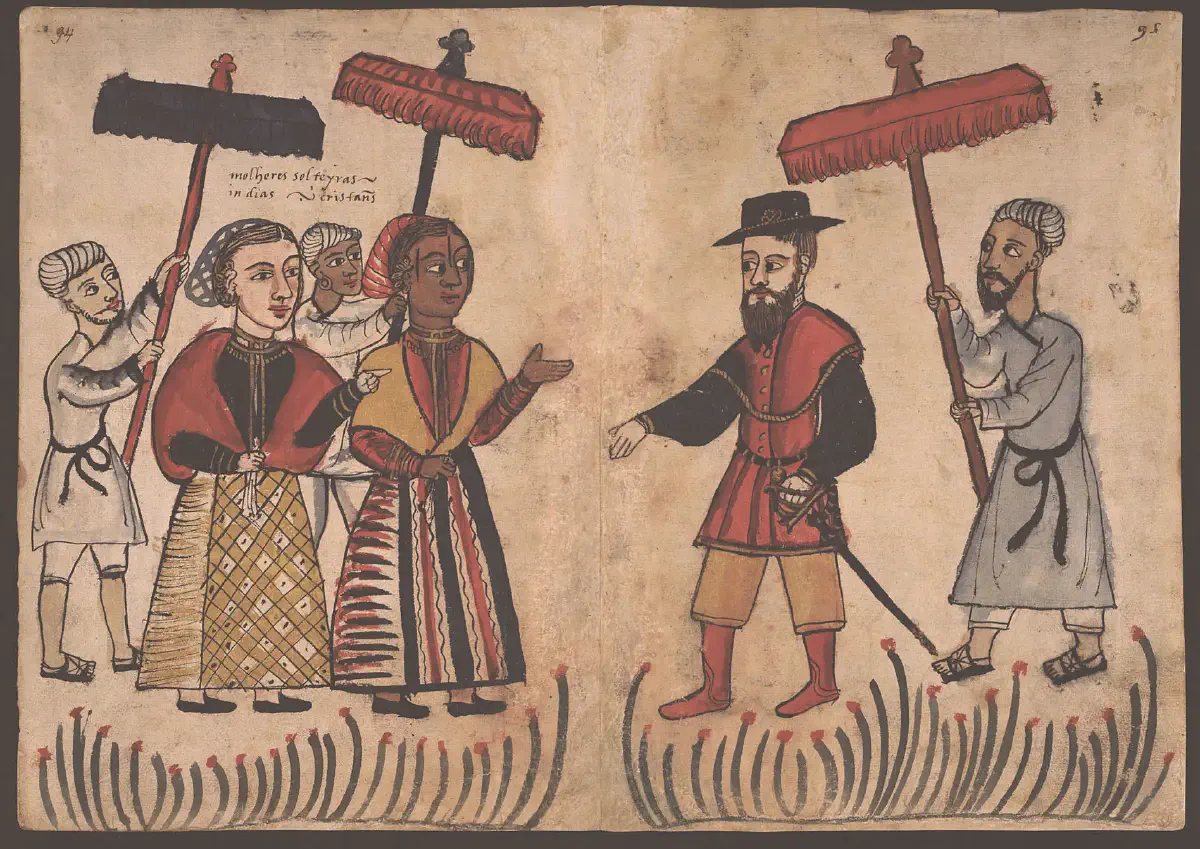
The women who made the creole world were as varied as the men they married. In the early years, before the Órfãs do Rei — the Orphans of the King — began arriving from Lisbon, the Portuguese took local wives and concubines from the communities they conquered or traded with. In Goa, the women were Hindu converts, Konkani-speaking, often from the Brahmin or Kshatriya castes, their families seeking advantage in the new dispensation. In Malacca, they were Malays, Javanese, and Chinese, Muslim and Buddhist, some enslaved, some free. In the African ports, they were the daughters of Swahili merchants or the captives of Guinea raids. The result was a genetic and cultural fusion that would have been unimaginable in Lisbon.
The chronicler Duarte Barbosa, who lived in India for years and took a local wife himself, described the casadas of Cochin with a mixture of admiration and unease. They dressed in silk saris, their heads covered by the white mantilla of Portuguese custom, gold bangles jangling at their wrists. They went to mass in palanquins. They spoke Portuguese with a Malabar accent, or Konkani with Portuguese words stitched through it. Their kitchens, he noted, produced dishes that were neither European nor Indian: rice cooked with saffron and cinnamon, fish stewed in coconut milk and tamarind, pork marinated in wine, garlic, and vinegar — the first vindaloo, its name a corruption of vinha d'alhos, wine and garlic, the sailors' pickle transformed by the spices of the East. The children of these unions grew up bilingual, bicultural, their loyalties divided between the crucifix on the wall and the small shrine in the corner of the courtyard that their mothers still visited after dark.
The Órfãs do Rei, when they came, were an attempt to whiten the empire, to stem the tide of miscegenation with the bodies of Portuguese virgins. The king's ships carried them in batches, girls from orphanages and convents, their dowries paid by the crown, their passage arranged with the grim efficiency of a military supply chain. They were married off within weeks of landing, to men they had never met, in ceremonies conducted by bishops who spoke of duty and the propagation of the faith. Many died within a year of fever or childbirth. Some flourished. Beatriz de Lima, an orphan from the Lisbon house of Nossa Senhora da Piedade, arrived in Goa in 1545, married a casado twice her age, and outlived him by thirty years, becoming one of the wealthiest traders in the city, her fleet of small boats running pepper and rice up and down the coast, her authority in the business dealings of the port unquestioned. She was the exception. Most of the orphans left no trace, their names recorded only in the parish registers, their bones mingled with the laterite soil of the Indian graveyards.
The children of all these unions — the mestiços, the castiços, the half-castes and the quarter-castes — became the middle stratum of the colonial order. They were the clerks, the interpreters, the junior officers, the priests who manned the rural parishes. They were indispensable and distrusted in equal measure. The pure-blooded Portuguese, the reinol from the kingdom, looked down on them as mongrels, their loyalty suspect, their blood tainted by heathen ancestry. The chronicler Diogo do Couto, himself a product of the Goan milieu, wrote that the mestiços "have the virtues of both races and the vices of neither," but he was defending them against a prejudice that was already hardening into law. By the end of the century, the crown was issuing decrees restricting the highest offices to those with pure European blood. The creole world was being walled off from power even as it did all the work.
Beyond the Inquisition's Reach#
The frontier of this creole society was porous, and the missionaries who pushed beyond it found a world that defied their categories. The Jesuits, who arrived in the 1540s, quickly grasped that the Portuguese presence in Asia was a thin crust floating on a deep ocean of older cultures. Francis Xavier, in his letters from the Fishery Coast, lamented the behaviour of the Portuguese settlers among the Paravar pearl-fishers: "They keep concubines openly, they extort money from the poor, they set the worst example to the heathen." The language of conversion was being spoken, but the grammar of daily life was something else entirely. The Paravar converts baptized by Xavier continued to observe caste distinctions, to consult astrologers, to propitiate local spirits. Their children bore Christian names and wore Hindu amulets. The priests railed. The people nodded and continued.
Further afield, beyond the reach of the inquisitors, the fusion was even more radical. In the Spice Islands, Portuguese traders married into the local ruling families, adopting the dress, the diet, and the political alliances of their wives' clans. In the Bay of Bengal, a community of Portuguese renegades and half-castes controlled the salt trade, answering to no king. In Macau, the Portuguese settlement on the Chinese coast, the merchants lived in houses that were half-European, half-Cantonese, their courtyards filled with the sound of Portuguese fado and Chinese opera. They ate with chopsticks. They worshipped in churches built by Chinese masons. Their children spoke a creole that would survive for centuries, a linguistic fossil of the first encounter.
The Inquisition, when it came to Goa in 1560, was an attempt to police this frontier, to draw a hard line between Christian and heathen, Portuguese and Indian. The inquisitors interrogated the mestiços, the converts, the slaves, looking for evidence of secret Hindu practices, crypto-Islam, Judaizing. The autos-da-fé were meant to purify the creole world, to burn away the syncretism that had grown up in the cracks of the empire. But the Inquisition could not reach the interior, could not stop the man in the palm hut from chewing betel, the woman in the kitchen from chanting a Konkani prayer over the rice pot, the child in the village from learning both the catechism and the stories of the Ramayana. The shadow empire was too large, too diffuse, too deeply rooted in the soil of the monsoon. It endured.
The Gunner's Grave#
The true monument of the Portuguese expansion was not the fortress at Hormuz, the cathedral at Goa, or the spice contracts at Antwerp. It was the body of a man like João Machado, the gunner who became a villager, the renegade who forgot his Portuguese and learned to love the rain. He died of fever in his forty-fifth year, surrounded by his Indian children, and he was buried without a priest, his grave marked by a wooden cross that the jungle swallowed in a single season. His sons did not remember his face. His daughters married local men. But the Portuguese language they had spoken to him survived in the vocabulary of the village, a few dozen words — for bread, for wine, for church — that would be passed down through generations, their origin forgotten, their meaning altered. The empire of the sea had dissolved into the land. The conquerors had become the conquered, and in that transformation, they had achieved a permanence that no fortress could guarantee.