
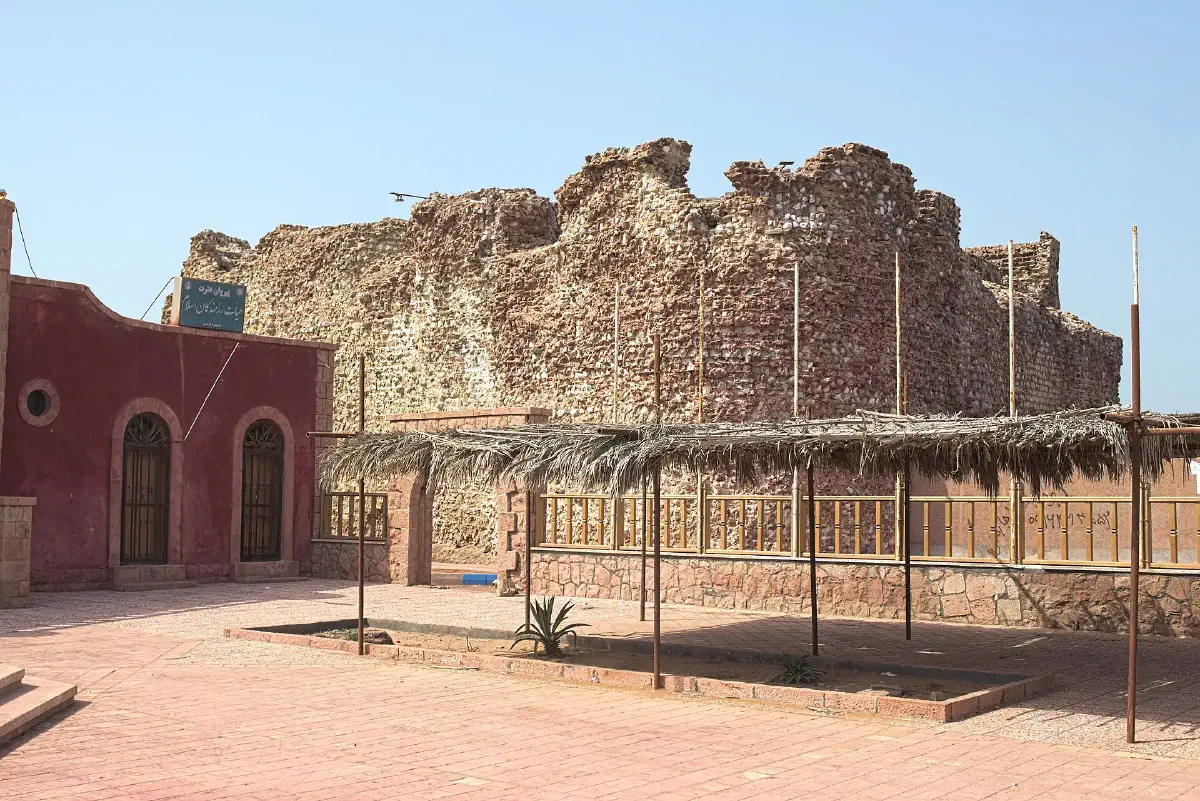
The fortress of Hormuz had been built by Albuquerque to command the narrows of the Persian Gulf, and for a century it did. It rose from the salt-scoured island in a mass of ochre stone, its bastions mounting fifty-three bronze cannon, its cisterns cut deep into the rock, its chapel adorned with the spoils of a dozen captured mosques. The caravans of Basra and Shiraz paid their tolls in silk and silver. The pearl fisheries of the Gulf filled the treasury. The Portuguese captain of Hormuz styled himself the equal of kings, and the kings, for a time, accepted the insult. Then, in the spring of 1622, the sea delivered an answer.
On the ninth of February, five English ships rounded the headland of Qeshm and anchored off Hormuz in a line of battle. They flew the cross of Saint George, and they had come at the invitation of Shah Abbas of Persia, who wanted the Portuguese out of the Gulf and was willing to pay in silk and cannon for the privilege. The English commander, a blunt Yorkshireman named John Weddell, had no orders to attack. He had orders to trade. But the prospect of prize money and the chance to humble a Catholic power in the service of a Protestant king proved stronger than any parchment from the East India Company's directors in London. The guns were run out. The powder was measured. The Portuguese, watching from the walls, counted the English broadsides and understood that the arithmetic had changed.
The captain of Hormuz was Rui Freire de Andrade, a man of fifty summers, his face pitted by smallpox, his beard gone white in the service of an empire that no longer sent him reinforcements. He commanded fewer than four hundred soldiers, many of them sick, all of them hungry. The cisterns were low. The gunpowder was damp. When the English ships opened fire on the morning of the tenth of February, the fortress replied with a roar that shook the island, but the Portuguese gunners were firing stone balls from guns cast in the previous century. The English fired iron shot from new-minted demi-culverins, and their broadsides tore great gaps in the Portuguese battlements. The siege lasted ten weeks. The Persian army, camped on the mainland, sent wave after wave of infantry across the narrow channel in fishing boats, and the Portuguese, manning the water batteries, cut them down with arquebus fire until the barrels warped from the heat. The English chaplain, Edward Monnox, watched from the deck of the London and wrote in his journal: "The Portuguese fought with wonderful resolution, and would not yield, though their walls were broken and their men fell daily."
The Fall of Hormuz#
The Persian general, Imam Quli Khan, rode into the fortress at the head of his cavalry, and the Portuguese colours were hauled down from the central tower. Rui Freire, his sword still in his hand, was given the honours of war and permitted to sail for Muscat with his surviving men. The Persian chronicler Iskandar Beg Munshi recorded the fall of the fortress with the satisfaction of a man who had waited a lifetime: "The Franks who had tyrannised the Gulf for a hundred years were cast out, and the hand of the Shah closed upon the strait." Hormuz, the first key of Albuquerque's grand design, was lost. The empire had begun to unlock.
A Kingdom Too Small for Its Empire#
The fall of Hormuz was not a bolt from the blue. It was the fruition of a rot that had been eating the Portuguese enterprise for half a century, a rot that had many names but one cause: the kingdom was too small to hold what it had seized, and the world was too large to be held by a single pair of hands. The chronicler Diogo do Couto, who served the Estado da Índia for fifty years as soldier, archivist, and historian, watched the decline unfold with a clarity that sharpened into despair. In his Décadas da Ásia, the great unfinished chronicle of Portuguese deeds in the East, he wrote a sentence that became an epitaph: "We conquered the world with a handful of men and we are losing it with a handful of thieves."
He meant the phrase literally. The captaincies, the trading posts, the customs houses of the Indian Ocean had become a feeding ground for the fidalgos, the minor nobility who sailed east with empty pockets and returned, if they returned, with fortunes built on extortion, bribery, and the sale of offices. The viceroys appointed their nephews to the mint. The factors skimmed from the pepper contracts. The judges took bribes to release convicted murderers. Couto, who had seen the ledgers, recorded the damage in precise and bitter detail: "Everything is for sale in India, even the king's justice. A man may kill and be free the next day, if he has gold." The gold ran out. The pepper profits, which had once filled the Lisbon treasury to overflowing, dwindled as the cost of maintaining the fortresses grew and the market in Europe was glutted by Dutch and English interlopers. By 1570, the crown was borrowing at ruinous rates to finance the India fleets. By 1580, it was insolvent.
In that year, the catastrophe deepened. The young king Sebastian, Manuel's great-grandson and the last of the Avis dynasty, died on a Moroccan battlefield at Alcácer Quibir, his body never recovered, his army annihilated. The Portuguese throne passed, through a tangle of dynastic claims, to Philip II of Spain. For sixty years, the Portuguese empire was governed from Madrid, and the enemies of Spain became the enemies of Portugal. The Dutch, who had been fighting their own war of independence from the Spanish crown since 1568, looked at the Portuguese seaborne empire and saw a vulnerable flank. The English, smarting from the defeat of the Spanish Armada in 1588, saw an opportunity. The spice trade, which Albuquerque had torn from the hands of Venice and the Mamluks, was about to be torn from the hands of the Portuguese.
The VOC and the Spice Islands#
The instrument of the tearing was a joint-stock company. The Dutch East India Company, the Vereenigde Oostindische Compagnie, was chartered in 1602 with a capital of six and a half million guilders, a fleet of over a hundred ships, and a charter that gave it the power to wage war, negotiate treaties, and govern territories in the name of the Dutch Republic. The VOC was not a trading house; it was a state within a state, a corporation armed with cannon, and its directors, the Heeren XVII, had studied the Portuguese weakness with the cold precision of accountants. The Portuguese empire was a string of fortresses, each one isolated, each one dependent on the monsoon for reinforcement and resupply. The VOC's strategy was simple: pick them off one by one, in the season when the wind was wrong for rescue.
They began in the Spice Islands, the source of the cloves, nutmeg, and mace that had drawn the Portuguese to the ends of the earth. In 1605, a Dutch fleet under Steven van der Hagen captured the Portuguese fortress at Ambon without firing a shot; the garrison, unpaid and starving, handed over the keys. The Banda Islands, where the nutmeg grew in groves of glossy green, fell next. The Dutch commander Jan Pieterszoon Coen, a man of granite Calvinism and total conviction, determined to secure the nutmeg monopoly by any means necessary. In 1621, he landed a force of two thousand men on the island of Banda Besar and, over the course of several weeks, systematically killed or enslaved its entire population. The English merchant Nathaniel Courthope, who had been holding out against the Dutch on the nearby island of Run, was murdered; his body was thrown into the sea. The Bandanese were replaced by Dutch planters and enslaved laborers. The nutmeg monopoly was sealed in blood, and the Portuguese, who had once claimed the archipelago, could do nothing but protest from Goa.
The losses mounted with the rhythm of a funeral drum. In 1619, the VOC established its Asian headquarters at Batavia on the island of Java, a city built on the ruins of the port of Jayakarta, with walls of coral stone and a canal system modelled on Amsterdam. From Batavia, the Dutch fleets could strike in any direction, and the monsoon, which the Portuguese had once mastered, became their enemy. In 1638, a Dutch fleet blockaded Goa itself, the capital of the Portuguese East. The siege lasted six years, on and off, the Dutch squadrons cruising off the Mandovi bar while the city slowly starved. The Jesuit chronicler Francisco de Sousa described the blockade in a letter home: "There is no rice in the market. The poor die in the streets. The great houses are silent." Goa held, but it never recovered.
In 1641, the blow fell that finished the Portuguese century. Malacca, the key to the strait, the city that Albuquerque had stormed in a wall of fire, surrendered to a Dutch siege after a blockade of five months. The Portuguese captain, Manuel de Sousa Coutinho, had fewer than four hundred European soldiers against a Dutch army of two thousand. The walls, weakened by earthquakes and neglect, collapsed under the Dutch bombardment. The defenders ate the rats, then the leather of their belts. When the end came, in January 1641, the Dutch found the streets lined with the unburied dead and the surviving garrison so weak they could not stand. The Portuguese chronicler António Bocarro, who recorded the fall of the city, wrote simply: "Thus was lost the noble city of Malacca, which had cost so much blood to win and was now given up for want of men and money." The Straits of Malacca passed into Dutch hands, and the pepper fleets that had once sailed for Lisbon sailed instead for Amsterdam.
Ceylon fell over the following decades, its cinnamon groves stripped from the Portuguese by the combined force of the VOC and the Kandyan kingdom. The fortress of Colombo, besieged from 1655 to 1656, surrendered after a defence that the Dutch commander, Gerard Hulft, called "the most stubborn we have ever seen." Hulft himself was killed by a Portuguese musket ball two months before the capitulation, his body shipped home in a cask of arrack. The Portuguese captain, Gaspar de Figueira de Serpa, marched out of the shattered gates with the tattered remnants of his garrison, and the cinnamon trade, like the nutmeg and the cloves before it, vanished into the holds of Dutch fluyts.
The English and the End#
The English, slower to enter the eastern theater, made their own incisions. After the fall of Hormuz in 1622, the East India Company established a factory at Surat and began to nibble at the western flank of the Portuguese empire. The Treaty of Westminster in 1654, forced upon a Portugal still recovering from its war of independence against Spain, granted the English trading rights that the Portuguese had once reserved for themselves. In 1661, as part of the dowry of Catherine of Braganza, the Portuguese queen of Charles II, the crown ceded the island of Bombay to the English king. The name meant "Good Bay," and the English, who had never been given a city by the Portuguese in all the years of alliance, accepted the gift with the quiet satisfaction of heirs entering into an inheritance. The Portuguese chronicles record the transfer in a single line, as if speaking the name of a dead child: "Bombay was delivered to the English."
The human cost of the decline was measured not in treaties but in bodies. The carreira da Índia, the great spice road that had once sent a dozen carracks east each year, shrank to a trickle. The ships that did sail were often over-laden, undermanned, and poorly provisioned. The scurvy that had killed Vasco da Gama's men returned with a vengeance. The shipwrecks multiplied. In 1592, the carrack Santa Maria Madre de Deus, a thousand-ton monster carrying the year's pepper cargo and a fortune in porcelain and silk, was captured off the Azores by an English privateer squadron. The prize was so rich that it glutted the London market for a year, and the English chronicler Richard Hakluyt wrote that "the pepper was sold for a song." The Madre de Deus was towed into Dartmouth, its captors fighting over the spoils with drawn swords, and the Portuguese, reading the report in Lisbon, understood that the sea had turned against them.
The demographic hemorrhage never healed. By 1650, the Portuguese population of the Eastern empire had fallen below fifteen thousand, scattered across a handful of decaying fortresses. The creole families, the casados and the mestiços, continued to marry, trade, and worship, but they were living on borrowed time, their world shrinking toward the walls of Goa, Diu, and Macau. The messianic fire that had driven Manuel and Albuquerque had guttered to ash. The Inquisition still sat in Goa, still held its autos-da-fé, but the crowds that gathered to watch were thinner, the sentences more perfunctory. The last great pagan temples had been destroyed, the last crypto-Muslims burned or exiled. The faith had triumphed, and the triumph was a hollow chamber.
The Last Carrack#
The final collapse came in the 1660s, though no one marked the exact date. The Dutch had taken the spice islands, the English the Persian Gulf, the Omanis the Swahili coast. The Portuguese galleons that still limped into Goa carried less pepper than private trade goods, and the carracks that sailed for home often foundered on the sandbars of the Tagus, their hulls worm-eaten, their crews reduced to skeletons. The viceroy in Goa governed a shadow kingdom, his authority extending no farther than the range of his cannon. In the taverns of the Alfama, old sailors told stories of the conquests of Albuquerque, of the riches of Malacca, of the day the Frol de la Mar went down with all the gold of the Sultan's palace. The young men listened, and then they signed on with the Dutch or the English, or they stayed home and worked the vineyards of the Alentejo, the sea a memory.
The chronicler Diogo do Couto had died in 1616, before the worst of the losses, but his Décadas contained a passage that read like a prophecy and was, in fact, a diagnosis. He had served the empire all his life, and he had seen the rot spread from the counting houses to the captains' quarters to the decks of the ships. "The empire is like a candle burning at both ends," he wrote. "The flame gives light, but the wax is consumed, and soon there will be nothing left but smoke." The smoke lingered over the Indian Ocean for decades, the black pall of the Portuguese century, before the wind took it and scattered it into the empty sky.
One carrack, the Nossa Senhora da Conceição, built in Goa of teak and iron, sailed from Cochin in the winter of 1655, her holds heavy with the last pepper crop of the Malabar factories. She rounded the Cape of Good Hope in a gale that tore her foresail and stove in three of her portside gunports. She made the Azores in the spring of 1656, her crew reduced by fever, her pumps labouring day and night. When she came up the Tagus on a grey morning in May, the customs officers who boarded her found a cargo that barely covered the cost of the voyage. Her captain, a man whose name the records do not trouble to record, dropped anchor off the Terreiro do Paço and went ashore without ceremony. The sea behind him was empty. The pepper was unloaded and sold. The empire of the Conquerors had entered its long twilight, and the carrack, like the kingdom that built her, would never sail again.