
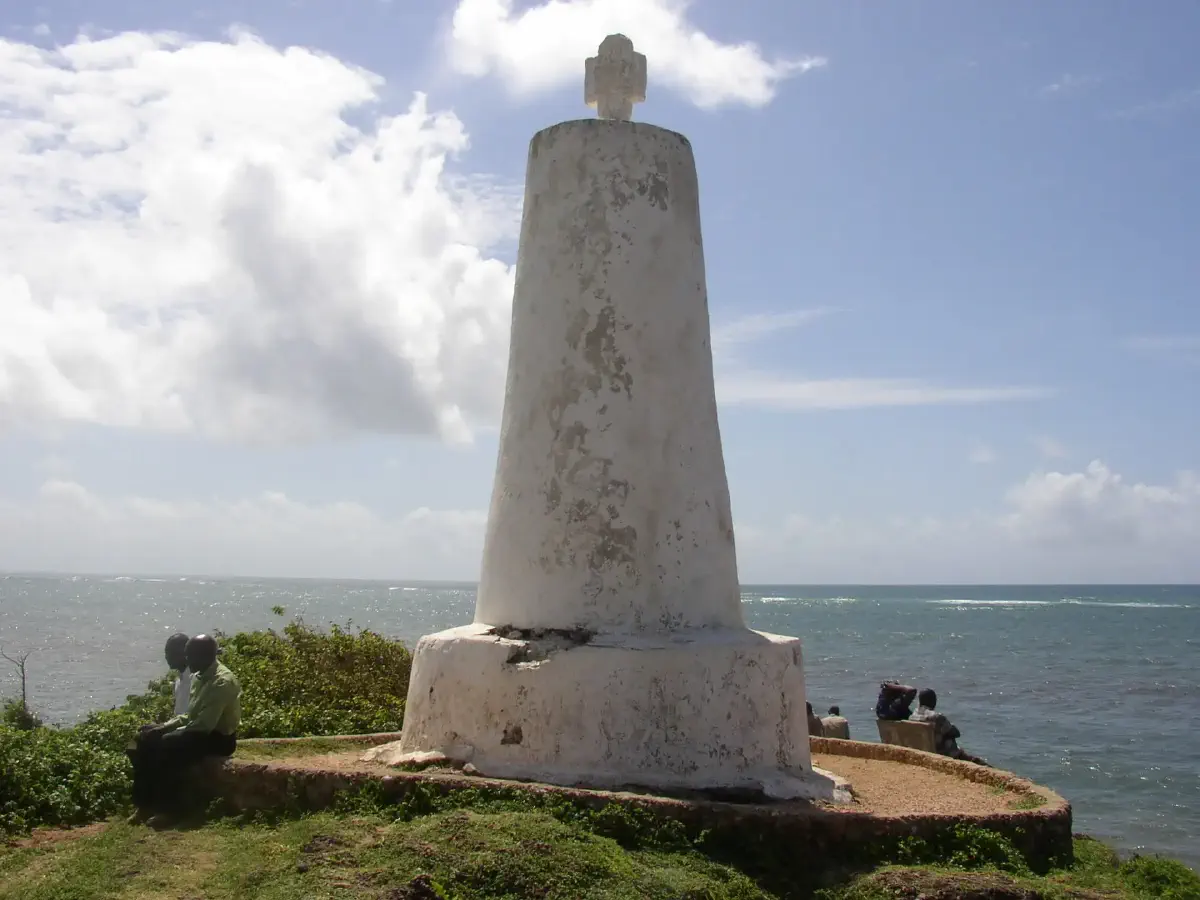
The stone pillar stood on a headland of black rock at the southern extremity of Africa, a place where the Atlantic and Indian Oceans met in a perpetual grinding of cold and warm currents, and it had stood there for three hundred years. It was a padrão, one of the limestone sentinels that the Portuguese had planted on every coast they claimed, and its surface was pocked by salt wind and scarred by the beaks of cormorants. The cross at its summit had long since vanished. The coat of arms of King João II, carved into the stone by a mason whose name had evaporated from the records, was barely legible. But the pillar remained. The Khoikhoi herders who drove their cattle past it in the dry season left offerings of shells at its base, believing it to be a marker left by the ancestors. The Dutch colonists who settled the Cape in the middle of the seventeenth century saw it from their ships and recorded it in their logs as a curiosity, a relic of an empire that had already passed its zenith. The English captain James Cook, anchoring in the bay in 1775, noted it in his journal with the detachment of a man who had no stake in its meaning: "A stone cross, said to have been erected by the Portuguese." The pillar had outlasted the carracks, the captains, and the kingdom that had sent them. It was a ghost, but a ghost of stone.
The Portuguese empire dissolved, but it did not vanish. The fortresses crumbled, the fleets rotted, the names of Albuquerque and Vasco da Gama faded from the maps that the Dutch and the English drew over the old Portuguese charts. But the empire left behind a sediment that settled into the cultures of four continents, a layer of language and blood and belief so deeply embedded that those who carried it often forgot its origin. The padrão at the Cape of Good Hope was the most visible of these remnants, but there were thousands of others, invisible and indestructible, scattered across the globe like the seeds of a plant that had been torn from the soil but continued to germinate in the cracks of other people's gardens.
The Kristang Coast#
On the Malabar Coast, in the villages behind Cochin and Cannanore, the descendants of the casados still went to mass in churches built of laterite and whitewashed lime, their altars adorned with the same blue-and-white tiles that lined the palaces of Lisbon. They called themselves Kristang, a word that began as the Portuguese cristão and had become, over the centuries, the name of a people. Their mothers had taught them to cook pork in vinegar and garlic, a dish that had once been the sailor's vinha d'alhos and that the world now knew as vindaloo, though the chillies and the coconut milk and the tamarind had long since altered it beyond recognition. Their fathers had taught them to sing the old Portuguese ballads, the cantigas de amigo, though the words had drifted into a Konkani-Portuguese patois that no one in Lisbon would have understood. The Jesuit missionary Francisco de Sousa, travelling through these villages in the 1690s, wrote in a letter to his superior that "the people speak a language that is neither Portuguese nor Indian, but a mixture of both, and they keep the faith with a devotion that puts us to shame, though they know nothing of the Pope or the councils." The letter was filed in the Jesuit archives in Rome and forgotten. The villages remained.
In the bazaars of the Konkan coast, the goldsmiths who had once made reliquaries for the Portuguese churches now made jewellery for Hindu brides, but the techniques they used — the filigree, the granulation, the setting of uncut rubies in gold — had been taught to their ancestors by a Florentine goldsmith who had sailed with Cabral and stayed behind when the fleet departed. The mestiço families of Goa, the descendants of those unions that Albuquerque had encouraged and the Inquisition had tried to police, survived the collapse of the empire with the resilience of a mangrove. They became lawyers, clerks, and interpreters for the British East India Company. They carried Portuguese names — de Souza, de Mello, da Cunha — that marked them as members of a vanished world. When the British Raj absorbed the Portuguese possessions in the nineteenth century, the names remained, floating like driftwood on the tide of a new empire.
Words in the Water#
The shadow of the padrão fell across the islands of Southeast Asia, where the Portuguese had once controlled the flow of clove and nutmeg. In the Moluccas, the sultanates that had warred with the Portuguese and been conquered by the Dutch still harboured communities of Christians who traced their faith to the first Jesuit missions. They called themselves Orang Serani, the Nazarene people, and their churches were adorned with statues of the Virgin that had been smuggled past Dutch Calvinist patrols in the holds of fishing boats. The Dutch, who had expelled the Portuguese from the spice trade, could not expel the faith. The Serani prayed in a creole that mixed Malay with Portuguese, and they sang hymns that had been translated from the Latin by Francis Xavier's companions. When the Dutch East India Company collapsed in turn, the Serani were still there, a living anachronism, a testament to the stubborn persistence of the Portuguese sediment.
Further north, in the scattered islands that would become Indonesia, the Portuguese language had infiltrated the Malay tongue so thoroughly that a modern speaker, ordering coffee with sugar, would unwittingly use words that had been carried east on a carrack: meja for table, bendera for flag, garpu for fork, mentega for butter. The words were lexical fossils, the debris of a shipwrecked empire, and they had outlasted the cannon, the fortresses, and the galleons that had brought them.
The Hidden Christians of Japan#
The most extraordinary ghost of the Portuguese expansion lived in Japan, where the Jesuit mission had been obliterated in the great persecution of the early seventeenth century. In the years after the Shimabara Rebellion of 1637, the Tokugawa shogunate had crucified thousands of converts, crushed the Christian communities of Kyushu, and sealed the country against foreign contact with an edict of iron. The last Portuguese ambassador, sent from Macau in 1640 to plead for the reopening of trade, had been executed with his entire entourage, their bodies burned, their ashes thrown into the sea. Japan was closed. The faith was dead. Or so it seemed.
In 1865, ten years after Commodore Perry's black ships forced the opening of Japan, a French missionary named Bernard Petitjean was celebrating mass in a new church at Nagasaki, a gothic structure of whitewashed stone that the Japanese authorities had permitted as a concession to the foreign powers. A group of Japanese peasants approached the church, their faces weathered by sun and poverty, and one of them, an old woman, stepped forward and spoke to the priest. She asked three questions, the words of which would be recorded in the annals of the Paris Foreign Missions Society with the breathless wonder of a miracle: "Is your church the church of the Pope? Do you honour the Virgin Mary? Do you have the sacrament of marriage?" Petitjean, stunned, answered yes. The woman and her companions knelt on the stone floor and wept. They were the Kakure Kirishitan, the Hidden Christians, and they had kept the faith for two hundred and fifty years without a priest, without the sacraments, without a single Portuguese ship on the horizon. Their prayers were a garbled Latin that had passed through so many generations of whispered memory that the words no longer corresponded to any known language. Their baptisms were performed with water and a formula that might or might not have been the Trinity. Their calendar of feast days had drifted from the Gregorian year, their fasts were observed on the wrong days, and their saints had merged with the Shinto kami and the Buddhist bodhisattvas. But they were Christians. The seed that Xavier had planted, the shadow of the cross, had survived the greatest persecution in the history of the church. The Portuguese empire had vanished from Japan, but its ghost had remained, invisible, in the villages of the Urakami valley.
Brazil: The Accidental Heir#
Across the Atlantic, on the continent that Cabral had stumbled upon in 1500, the Portuguese legacy was not a ghost but a living body. Brazil, the accidental discovery that had been an afterthought in the spice-obsessed sixteenth century, became the true heir of the Portuguese expansion. The sugar plantations of the northeast, the gold mines of Minas Gerais, the coffee estates of São Paulo — all of it was built on the labour of enslaved Africans, carried across the Atlantic in Portuguese ships in numbers that dwarfed the horrors of the Indian Ocean slave trade. The padrão was not planted on Brazilian soil; the Portuguese built cathedrals there instead, and the cathedrals were filled with gold leaf stripped from the mines, and the mines were worked by men whose descendants would become the majority of the Brazilian population. The Portuguese language, which had been carried to India and the Moluccas as a tool of command and commerce, became in Brazil the mother tongue of an entire continent-sized nation. By the twenty-first century, Brazil would have more Portuguese speakers than any other country on earth, and the words of Camões, the poet of the Lusíadas, would be recited in schools in São Paulo and Rio de Janeiro by children who had never heard of Vasco da Gama but who spoke his language as their birthright.
The genetic map of the Portuguese expansion was written in the faces of the Brazilian people: the European, the African, the indigenous, the mestiço and the caboclo and the mulatto, the whole spectrum of human skin and hair and bone that the empire had thrown together and that had, over centuries, fused into something new. The historian Gilberto Freyre, writing in the 1930s, called Brazil a "laboratory of civilisation," and the phrase was both true and evasive. The laboratory had been a slave colony, its experiments conducted without the consent of the subjects, its results measured in profit and mortality. But the result, however stained by its origins, was a nation that carried in its blood the memory of every shore the Portuguese had touched.
The Price of the World#
The padrão at Cape Cross, the pillar that Diogo Cão had planted on the coast of present-day Namibia in 1485, was removed by a German naval expedition in 1893 and shipped to Berlin, where it was placed in the Museum für Völkerkunde. A replica was erected on the original site, and tourists now photographed themselves beside it, their backs to the sea that Cão had crossed. The original pillar survived the fall of the German Empire, the rise of the Nazis, and the bombing of Berlin; it was still standing in the museum in the twenty-first century, a piece of Portuguese limestone in a German vitrine, its inscription worn to a whisper. The text, when it was legible, read: "In the year 6685 of the creation of the world, and 1485 of the birth of Our Lord Jesus Christ, the most excellent and serene King Dom João II of Portugal ordered this land to be discovered and this pillar to be placed by Diogo Cão, knight of his household." The pillar was a statement of possession, and the possession had expired. The land did not belong to Portugal. The sea did not belong to anyone. But the pillar remained, a ghost in a museum, and the world that the Portuguese had opened continued to turn.
The true legacy of the Portuguese expansion was not the pepper in the Lisbon treasury, nor the fortress walls that crumbled into the Indian surf, nor the galleons that rotted in the mud of the Tagus. It was the irreversible entanglement of the human species. Before the caravels rounded Cape Bojador, the world's civilisations had been largely separate, each island of culture floating in its own sphere of ignorance. After the Portuguese, there was no separation. The Portuguese had not invented globalisation; the Arab, Chinese, and Indian traders had been moving goods across the Indian Ocean for centuries before Vasco da Gama's arrival. But the Portuguese had connected the Atlantic to the Indian Ocean, the spice trade to the silver of the Americas, the demand of Europe to the supply of Asia, in a single continuous circuit. They had created, for the first time, a genuinely planetary economy, and they had done it with a handful of ships and a ferocity that the world had never seen.
The cost of that achievement was written in the crew lists of the carracks, the slave registers of the Guinea coast, the shattered temples of the Konkan, the burned mosques of Hormuz, the bodies that floated in the harbours of Calicut and Malacca. The chronicler João de Barros, whose Décadas da Ásia was the great monument of Portuguese imperial history, never flinched from recording the price. "The sea," he wrote, "is a field of graves." The graves stretched from the Azores to the Moluccas, from the Cape of Good Hope to the coast of Japan, and they contained the bones of men who had died for pepper, for gold, for the cross, for a king they had never seen. The empire was built on those graves, and the graves were the foundation stones of the modern world.
In the end, the Portuguese expansion was an explosion of energy so intense that it could not be sustained. The kingdom was too small, the ocean too vast, the rivals too many. The Dutch and the English, wealthier and better organised, took the spice trade and made it their own. The fortresses fell one by one. The language survived in scattered communities, a few hundred words embedded in the Malay tongue, a few surnames in the phone books of Bombay and Jakarta, a Portuguese creole spoken by a diminishing handful of old women in the kampungs of Malacca. The faith survived in the Serani churches of the Moluccas, the Kristang villages of Kerala, the hidden crypts of the Urakami valley. The genetic legacy survived in the faces of millions, the children of the children of the children of those first encounters, the mestiços who had once been despised and who were now the norm.
The padrão at Cape Cross, the replica that stood on the empty Namibian headland, was a monument to an empire that had died, but the empire had died into life. The world that the Portuguese had made was still being made, and the ghosts of the conquerors walked through it, silent and invisible, in the pepper that seasoned the food of every continent, in the words that drifted through the languages of the East, in the faces of the people who had never heard of Prince Henry or Albuquerque but who carried their legacy in their blood. The sea that had carried the carracks was the same sea that now carried the container ships and the oil tankers and the cruise liners. The winds had not changed. The monsoon still blew. And the stone pillar, battered by salt and wind and time, still pointed toward the horizon that the Portuguese had been the first to cross.