
The Desecration of Kumasi: A Speech that Ignited a Forest#
On March 25, 1900, British Governor Frederick Mitchell Hodgson marched into the capital city of Kumasi with a small force. The local population initially received the imperial representative with traditional honors and songs. However, the diplomatic atmosphere shattered when Hodgson ascended a public platform to deliver an address to the assembled Ashanti leaders. This address became one of the most self-destructive speeches in the history of the British Empire.
The Governor demanded an immediate payment of £160,000 in annual interest to satisfy a twenty-six-year-old treaty. He then turned his focus to the Golden Stool, the ultimate symbol of the Ashanti kingdom's leadership. Hodgson demanded that the chiefs produce the sacred stool so that he could sit upon it. He openly questioned why they had relegated the representative of the Queen to an ordinary chair.
A heavy, suffocating silence immediately descended upon the assembled Ashanti leadership. The British administrators viewed the Golden Stool as a simple physical object representing material wealth and governance. In stark contrast, the Ashanti revered the artifact as a metaphysical vessel containing the collective soul of their nation. Hodgson's demand was not seen as a test of loyalty, but as an existential desecration of their spiritual sovereignty.
The chiefs quietly dispersed from the meeting to begin rapid and comprehensive war preparations. Anthropologist Edwin Smith later characterized the Governor's words as a singularly foolish speech. Hodgson's ignorance of the African mind had transformed a delicate colonial occupation into an immediate armed uprising. Within days, a complex imperial system faced a massive, highly motivated, and asymmetric military threat.
The Blindspot of Power: Symbolic Value and Asymmetric Defiance#
This military engagement exposes a critical vulnerability in rigid colonial administrative systems. Imperial networks frequently succeed at managing material resources, yet they fail to calculate the power of metaphysical symbols. By treating a spiritual anchor as mere physical property, the British triggered an asymmetric response that overwhelmed their garrison. This case study proves that cultural ignorance can completely disable superior physical force.
Analyzing this conflict reveals how symbolic values dictate physical reality on the battlefield. The subsequent war cost the British Empire over one thousand fatalities and significant political embarrassment. Understanding this dynamic is crucial for evaluating both historical empires and modern organizational structures. True strategic assessment must account for the intangible forces that drive human systems to resist domination.
Deconstructing the Clash: Metaphysical Systems, Asymmetric Sieges, and Tactical Relief#
The Metaphysical Mechanism: The Golden Stool as the Soul of the State#
To analyze this systemic breakdown, one must understand the socio-political structure of the Ashanti Empire. The Golden Stool was not a functional throne for monarchs to sit upon. Instead, the sacred relic represented the spiritual cohesion and collective soul of the entire population. No human, not even the Asantehene himself, was ever permitted to sit upon its golden surface.
The British colonial system operated under a highly materialist and hierarchical framework. Governor Hodgson assumed that possession of the stool would allow the British to govern the country for all time. This assumption ignored the metaphysical reality that the stool's authority could not be captured or transferred. By demanding to sit on the relic, Hodgson committed a profound and irreversible category error.
This category error disrupted a fragile political equilibrium that had existed since January 1896. The British had occupied Kumasi and exiled the traditional king, Prempeh I, to the distant Seychelles. The Ashanti tolerated this physical occupation because their spiritual center remained untouched. Hodgson's speech threatened to sever their connection to their ancestors, forcing them to choose war over submission.
The imperial administration failed to realize that authority is co-created through mutual recognition. When the British demanded the physical stool, they attempted to dominate a spiritual system they did not comprehend. The Ashanti hid the sacred stool deep within their dense forests for the duration of the war. This simple act of concealment preserved their ultimate sovereignty, even as their territory faced physical invasion.
The conflict demonstrates that physical conquest is distinct from spiritual or political subjugation. The British could capture cities and deport leaders, but they could not seize the metaphysical soul of the empire. This structural blindspot meant that the British were fighting a physical war against a metaphysical opponent. Consequently, their standard military doctrines were fundamentally misaligned with the nature of the resistance.
The Crucible of Context: Log Barricades and the Amazon Battalions#
The subsequent mobilization highlights how social dynamics and innovative engineering can reshape a conflict. When male leaders hesitated, Queen Mother Yaa Asantewaa of Ejisu delivered a powerful war speech. She famously shamed the men and promised that the women of Ashanti would fight to the death. This leadership transition mobilized a highly motivated force of twenty thousand active warriors.
European accounts soon confirmed that Yaa Asantewaa had assumed supreme command of the insurgent forces. Her army included a formidable battalion of Amazons and a one-thousand-man elite Sacred Band. This interdisciplinary fusion of spiritual devotion, female leadership, and traditional military structures created an unpredictable adversary. The British force of five hundred Hausas and eighteen Europeans was quickly surrounded.
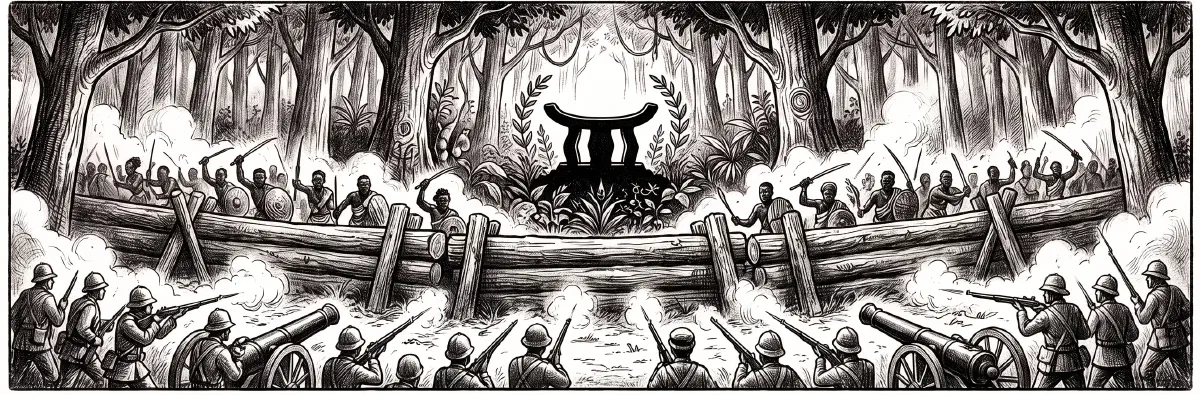
The Ashanti forces demonstrated remarkable engineering adaptability by constructing twenty-one massive log barricades. These defensive structures were six feet high, hundreds of yards long, and filled with loop holes. Built from solid timber, these barricades proved completely impervious to British artillery fire. This innovative engineering system effectively neutralized the technological advantage of the British Maxim guns.
The blockade of Kumasi cut telegraph lines and systematically choked off all incoming food supplies. Captain Cecil Armitage's search party was ambushed and barely escaped back to the fort during a rainstorm. The British defenders were trapped inside a tiny fifty-yard-square stockade under constant sniper fire. This siege system forced the British to survive on minimal rations as disease depleted their numbers.
Only a sudden escape on June 23 allowed Hodgson and his wife to evade the trap. They fled with over a hundred Hausas, leaving a small garrison behind to hold the fort. The escapees avoided a force of twelve thousand Ashanti warriors summoned to intercept them. This desperate retreat highlights how asymmetric tactical innovations can completely paralyze a wealthy, industrial empire.
Tracing the Ripple Effects: The Cost of Conquest and the Hidden Relic#
The war entered its final phase when Major James Willcocks assembled a rescue column of one thousand men. Willcocks's force engaged in constant skirmishing while maintaining a fragile supply route through hostile territory. His troops suffered heavy casualties at the well-defended stockade of Kokofu before reaching Bekwai. On July 15, the column finally relieved Kumasi, just two days before the garrison's surrender.
In September, Willcocks launched highly aggressive flying columns to crush the remaining pockets of resistance. His troops defeated the Ashanti at the decisive skirmish of Obassa on September 30. Captain Charles John Melliss was subsequently awarded the prestigious Victoria Cross for his bravery. The British officially annexed the Ashanti territories as a Crown Colony by conquest in 1901.
Despite their military victory, the British failed to achieve their primary strategic objective. The Golden Stool was never captured, remaining safely hidden deep within the forests. British forces continued their expensive and fruitless search for the relic until 1921. The Ashanti successfully protected their spiritual sovereignty, rendering the British conquest hollow.
The high material and human cost of the campaign triggered severe political consequences in London. Member of Parliament David Lloyd George fiercely criticized the war in parliamentary sessions in 1901. He denounced the foolish policy of Governor Hodgson and the mounting financial burden on taxpayers. Lloyd George openly admonished Colonial Secretary Joseph Chamberlain for his dismissive attitude toward casualties.
In 1921, construction laborers accidentally uncovered the hidden stool and stripped its golden ornaments. An Ashanti court sentenced the looters to death, though British officials commuted the sentence. Recognizing the persistent power of the relic, the British eventually allowed Prempeh I to return in 1924. Thousands of residents gathered to celebrate the king's return, demonstrating the enduring strength of Ashanti identity.
Lessons in Sovereignty: Why Metaphysical Value Outlasts Military Might#
The War of the Golden Stool provides an enduring lesson on the limits of material power. Modern strategic frameworks often equate control of physical infrastructure with actual political authority. However, as the events of 1900 demonstrate, physical domination is fragile without cultural legitimacy. The Ashanti lost their physical sovereignty but successfully preserved the spiritual core of their society.
This historical conflict proves that symbolic resilience can outlast rigid military systems. The British deployed modern artillery, Maxim guns, and thousands of disciplined troops to secure Kumasi. Yet, they could not locate or capture the wooden stool that held the nation's soul. True systemic robustness requires an understanding of the intangible, metaphysical values that bind communities together.
In an increasingly interconnected world, leaders must prioritize cultural intelligence over raw physical coercion. Organizations that ignore the core identity of their constituents remain highly vulnerable to sudden, systemic shocks. The legacy of Yaa Asantewaa and her warriors teaches us that some values cannot be quantified. When a system attempts to sit on the soul of a people, resistance becomes inevitable.