
The Shroud of Osowiec: A Dawn of Corrosive Terror#
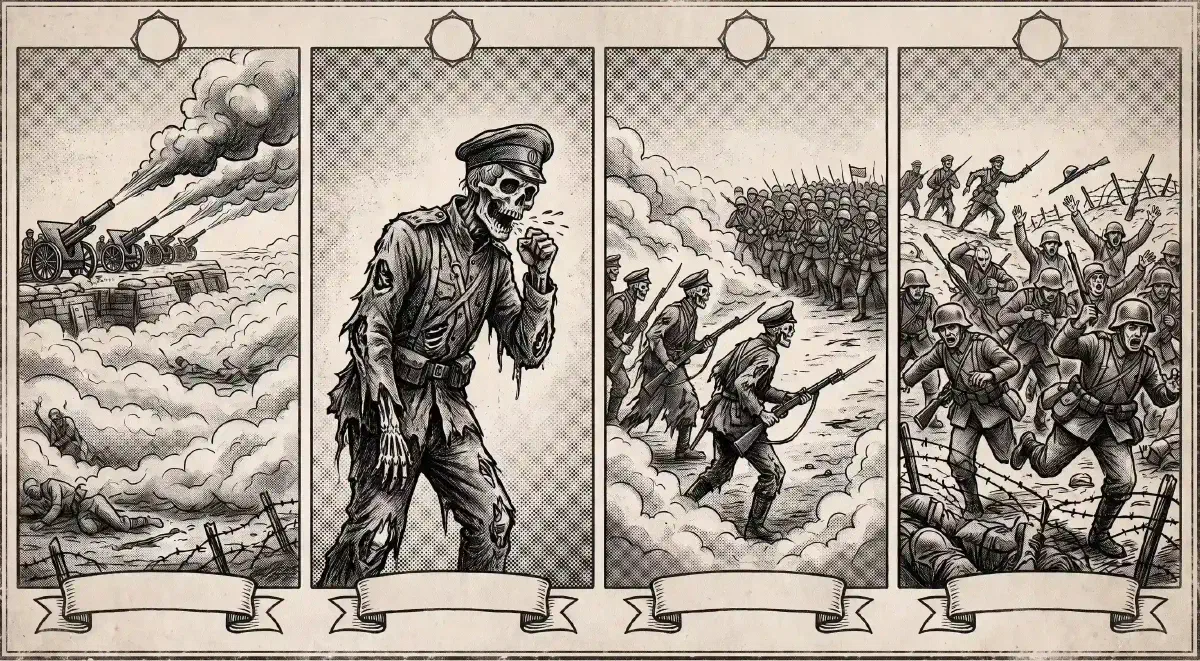
At 4:00 AM on August 6, 1915, the morning air at Osowiec Fortress turned green and yellow. For ten days, German forces under Paul von Hindenburg waited for favorable winds to release their weapons. Thirty gas artillery batteries deployed along the front lines unleashed thousands of gas shells filled with chlorine and bromine. The toxic cloud drifted across the Russian positions, expanding to eight kilometers wide and twenty kilometers deep.
The chemical wave devastated the landscape, turning grass black and withering trees upon exposure. This gas attack decimated the Russian defenders, who lacked adequate gas protection or masks. Out of the original eight hundred men in the garrison, only one hundred gasping survivors remained. The ninth, tenth, and eleventh companies were completely annihilated, leaving only a handful of combatants alive.
From the twelfth company, only forty men survived, while sixty defenders of Białogronda escaped death. These remaining defenders suffered severely from acute gas poisoning, coughing up blood and pieces of lungs. To the advancing seven thousand German troops, the silent fortress appeared to be an easy, ready-made capture. The German commanders expected minimal physical resistance from the poisoned and dying Russian garrison.
This strategic fortification was located just twenty-three kilometers from the hostile border of East Prussia. The fortress defended a vital corridor protecting the crucial Nemen and Vistula-Bug river channels. Previous German assaults in September 1914 and February 1915 had failed to breach this bottleneck. This third assault aimed to break the stalemate through the systematic application of modern chemical warfare.
The Triumph of Human Agility Over Technological Absolute#
The dramatic battle at Osowiec Fortress reveals a fundamental truth about industrial military strategy. Superior military technology and chemical weapons cannot guarantee victory when they ignore human psychological resilience. The German offensive relied on the absolute lethality of toxic gas to clear defensive fortifications. However, by failing to anticipate the psychological impact of a desperate counteroffensive, they suffered a major tactical defeat.
This historical engagement demonstrates that human adaptability remains the ultimate variable in complex military systems. Technological supremacy often creates a false sense of security that blindsides tactical planning. When systems fail, the psychological willingness of individuals to resist can override physical limitations. Understanding this dynamic is crucial for analyzing both historical conflicts and modern organizational systems.
Deconstructing the Chemical Battlespace: Mechanisms and Breakdowns#
The Science of Destruction: Chlorine, Bromine, and the Mechanics of Gas#
To understand this engagement, one must analyze the chemical and environmental mechanisms of the weapons used. The German assault deployed thirty specialized gas batteries to release a toxic mixture of chlorine and bromine. When inhaled, these gases react instantly with moisture in the respiratory tract to form corrosive acids. These acids destroy delicate lung tissues, causing severe chemical burns, internal bleeding, and rapid suffocation.
In 1915, the Russian soldiers lacked effective gas masks, leaving them entirely exposed to the chemical wave. The lingering gas cloud corroded copper equipment instantly and killed all foliage in the impact zone. The chemical reaction liquefied the soldiers' lungs, explaining why they coughed up blood during the charge. The physical devastation was mathematically calculated to render any organized defense physically impossible.
However, systems analysis shows that technological systems must interact with biological and environmental factors. The favorable wind conditions required ten days of waiting, showing the system's reliance on external variables. Secondary gas clouds lingered over the battlefield, claiming more lives but also creating tactical confusion. The material breakdown of weapons and environment forced both sides to adapt to unpredictable conditions.
Ultimately, the physical destruction of the garrison created an unexpected, highly volatile defensive response. The loss of ninety percent of their comrades left the survivors with no traditional options. Their desperate physical condition drove them toward an immediate counteroffensive rather than passive surrender. This biological and chemical crucible transformed dying men into a formidable, unpredictable combat force.
The physics of gas dispersion also highlights the inherent unpredictability of chemical weapon systems on battlefields. Winds can shift suddenly, potentially blowing toxic clouds back onto the very troops who deployed them. Furthermore, the extreme humidity of the Polish marshlands accelerated the acid formation within the human lungs. This environmental complexity made the chemical system highly unstable, despite the detailed planning of German engineers.
The Crucible of Confrontation: Strategic Blunders and Psychological Panic#
The subsequent collision on the battlefield introduces complicating forces that transcended raw military technology. Over twelve battalions of the German eleventh Landwehr Division, numbering seven thousand men, advanced. They marched in tight, organized formations, assuming chemical warfare had fully cleared the fortress. Instead, they encountered a grotesque spectacle of active, mutilated soldiers charging directly toward them.
This sudden encounter shattered the psychological stability of the German troops, triggering an immediate mass panic. In cognitive psychology, sudden deviation from expected reality frequently paralyzes disciplined groups. The sight of blood-soaked men with faces covered in rags completely broke the Germans' tactical cohesion. The advancing force, despite their seventy-to-one numerical superiority, turned and fled in absolute terror.
In their haste to escape, the German regiments broke ranks and ran blindly backward. Many became entangled in their own barbed wire traps, suffering heavy casualties under their own obstacles. The surviving Russian artillery batteries capitalized on this chaos, opening concentrated fire on the retreating lines. This psychological collapse proves that fear can disable even the most disciplined military systems.
This breakdown highlights the limits of rigid tactical systems when facing highly adaptive human behavior. The German commanders assumed their technological solution had eliminated all defensive capabilities. They failed to account for the psychological transition from absolute despair to desperate defiance. The resulting tactical panic demonstrates that human emotion remains a decisive factor in warfare.
The German commanders Rudolf von Freudenberg and Paul von Hindenburg underestimated their opponents' resilience. They assumed that technical efficiency and chemical power would replace the need for physical infantry combat. This overconfidence blinded them to the tactical vulnerabilities of their own marching formations. Their rigid adherence to chemical doctrine ultimately led to a catastrophic failure of leadership under stress.
The Cascade of Tactical Shock: The Bayonet Charge of Poisoned Men#
The tactical consequences of this counterattack reshaped the immediate campaign and left a lasting historical legacy. Lieutenant Vladimir Kotlinsky rallied the remnants of the thirteenth company to launch a counteroffensive. His aggressive assault along the railway line forced the eighteenth German regiment into a rapid retreat. Though Kotlinsky was mortally wounded, his actions successfully initiated the collapse of the German advance.
Following Kotlinsky's injury, Władysław Strzemiński assumed command of the remaining defensive forces. Leading the second Osovetska Sap Company, Strzemiński rallied the gas-poisoned troops for a final bayonet charge. By 11:00 AM, the Russian defenders had successfully reclaimed the vital Sosnenskaya defensive positions. The German troops were completely driven out of the defences, securing a temporary victory.
Although the Russians evacuated the fortress on August 18, the defense achieved its primary strategic objective. The delay allowed the Russian army to conduct an orderly regional withdrawal and prevent encirclement. The fall of Kaunas and Novogeorgievsk eventually forced the retreat, but the defenders demolished much of the area. This deliberate destruction ensured that the German forces inherited only ruins from their pyrrhic campaign.
In the decades since, this dramatic engagement has deeply influenced global popular culture and historical memory. Swedish metal band Sabaton and Russian metal band Aria have commemorated the battle in their music. Video game developer Wargaming produced a detailed short film showcasing the tactical details of the assault. These cultural artifacts ensure that the legacy of Osowiec remains an important study in resilience.
The strategic lessons of Osowiec also forced military academies to re-evaluate the role of fortresses in warfare. Concrete walls alone could not stop modern heavy artillery or chemical attacks without active human defense. The survival of the garrison depended on their willingness to launch offensive maneuvers from defensive positions. This tactical shift proved that defensive architecture must remain dynamic and integrated with human initiative.
Legacy in the Soil: The Limits of Industrial Slaughter#
The defense of Osowiec Fortress challenges the modern assumption that technology is the sole determinant of victory. Modern organizations frequently invest in advanced technological systems, expecting predictable and automated outcomes. However, the events of August 6, 1915, show that human agency can disrupt the most sophisticated designs. Relying purely on technology without considering human and psychological variables creates dangerous systemic vulnerabilities.
This historical case study offers critical lessons for modern organizational design and systems thinking. When building complex systems, leaders must look beyond technical specifications to consider psychological and environmental factors. Over-reliance on rigid systems often creates a false sense of security, leaving organizations vulnerable to unexpected shocks. True systemic resilience requires both physical robustness and the adaptive capacity of the human elements within.
Ultimately, the muddy trenches of Osowiec demonstrate that human agency remains the ultimate check on industrial systems. The sixty Russian soldiers who charged through the toxic fog did not win with superior equipment. They triumphed by weaponizing psychological shock against an overconfident, rigid adversary. In an increasingly automated world, the lesson of Osowiec remains vital: the human spirit cannot be easily quantified.
Modern systems designers must remember that human variables will always disrupt mathematical models and automated plans. When designing security frameworks, safety protocols, or strategic initiatives, leaders must prioritize cognitive flexibility. Organizations that rely solely on automated algorithms remain fragile when confronted with unexpected human responses. The legacy of the dead men teaches us that resilience is defined by human adaptability under pressure.