
The Pneumatic Division: When Canvas and Compressors Confronted the Wehrmacht#
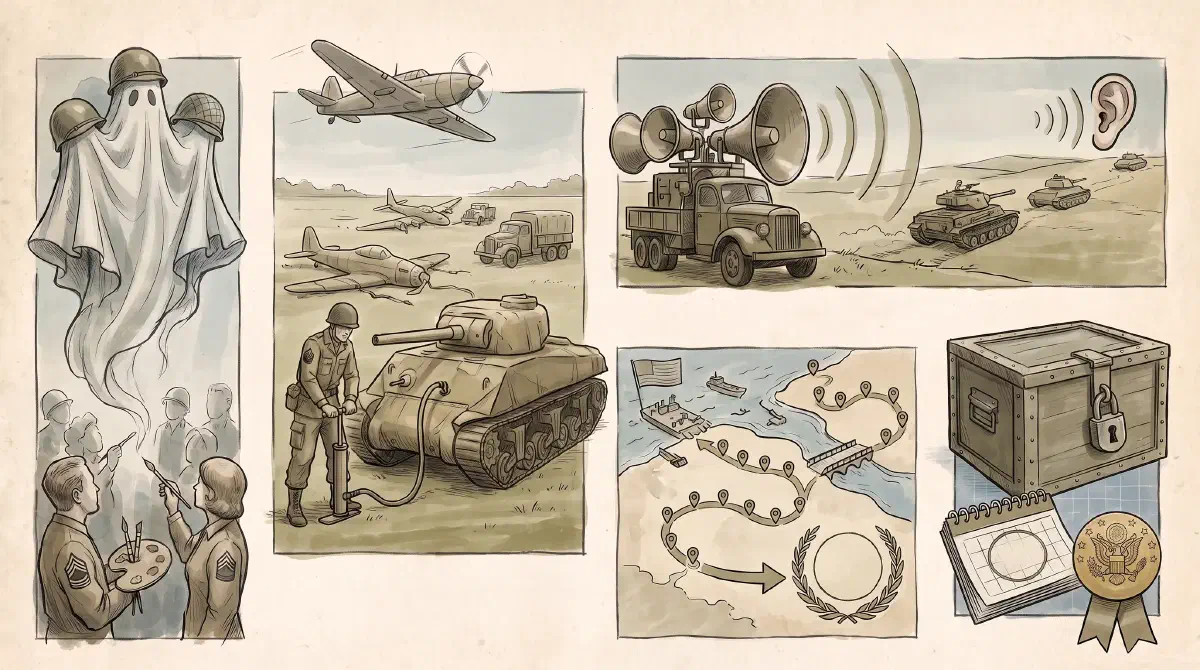
On a desolate, mist-shrouded battlefield in Western Europe, a handful of American soldiers did something that seemed to defy the laws of physics. Using small, noisy pneumatic air compressors, they rapidly inflated a ninety-three-pound rubber envelope until it stood as a fully detailed, imposing Sherman tank. To any German reconnaissance pilot flying high above, or to a forward observer peering through binoculars, the illusion of military mass was absolutely flawless. This tactical sorcery was the signature craft of the 23rd Headquarters Special Troops, a highly specialized and classified unit.
This extraordinary unit, later famously known as the Ghost Army, represented a radical departure from traditional military organization and doctrine. Created by U.S. Army planners Ralph Ingersoll and Billy Harris, and led by Colonel Harry L. Reeder, the unit was designed to win battles through intellectual surprise rather than raw violence. The planners drew direct inspiration from British deception techniques honed during Operation Bertram at El Alamein in late 1942. After fully forming at Camp Pine, New York, the secret unit sailed for the United Kingdom in early May 1944 to prepare for the European campaign.
The group brought together a highly unusual collection of creative minds, draftsmen, fine artists, and advanced acoustic specialists. Rather than being trained solely for standard infantry combat, these specialists were instructed in the art of multi-sensory illusion. By projecting fake military assets and simulated maneuvers across the front lines, they manipulated the German high command's strategic calculations and defensive alignments. Their accomplishments demonstrated that the ultimate battlefield of World War II was not the mud of Europe, but the internal minds of enemy commanders.
For decades after the Allied victory, their heroic exploits and innovative techniques remained a closely guarded secret. The members of the unit returned to civilian life and swore an oath of silence, keeping their stories hidden from families and historians alike. This long-standing silence highlights the strategic value that military planners placed on these pioneer deception operations. It was only in 1996 that their records were finally declassified, revealing a masterclass in tactical misdirection that saved thousands of lives.
The Sovereignty of Perception: Why Tactical Illusion is a Force Multiplier#
While strategic military success has historically been evaluated through physical metrics such as firepower, armor, and logistical capacity, the operations of the 23rd Headquarters Special Troops proved that perception is the ultimate strategic territory. Deception is not merely a passive defensive shield, but an active, offensive capability that systematically exploits the cognitive vulnerabilities of the adversary. By actively managing and distorting the sensory inputs of enemy analysts, a small, specialized force can dictate the movements of entire hostile divisions. This strategic leverage transforms illusion from a temporary tactical trick into a decisive force multiplier.
This analytical study deconstructs the systematic mechanisms that made the Ghost Army's deceptions so effective against a highly professional German military apparatus. We will examine how pneumatic engineering, advanced acoustic recording, and artistic discipline converged to exploit specific vulnerabilities in German intelligence networks. By exploring their operational history, we uncover the fundamental principles of information warfare that continue to shape modern tactical doctrines. Analyzing this unique unit reveals how psychological manipulation can neutralize physical superiority and redefine battlefield sovereignty.
Deconstructing the Mirage: The Mechanics, Constraints, and Echoes of Tactical Illusion#
Engineering the Phantom: The Multi-Sensory Architecture of Simulated Force#
The visual deception framework of the Ghost Army was engineered by the 603rd Camouflage Engineers, who specialized in rapid physical simulation. This unit was equipped with inflatable rubber tanks, cannons, jeeps, trucks, and airplanes that could be deployed and inflated within a few hours. Once inflated, these decoys were deliberately camouflaged with a calculated level of imperfection to bait enemy observers. This deliberate sloppiness ensured that German aerial reconnaissance and forward scout teams would easily spot the decoys and report them as massive, active troop concentrations.
To complement the visual illusions, the 3132 Signal Service Company Special engineered a sophisticated acoustic deception program. Collaborating with sound engineers from Bell Labs, a team from the 3132 went to Fort Knox to record the exact mechanical noises of armored and infantry units. These sound effects were pressed onto specialized records and brought to the European theater to be mixed dynamically during operations. This program was recorded on state-of-the-art wire recorders, which were the technological predecessors to the modern tape recorder.
The team played these customized soundscapes back using powerful, heavy-duty amplifiers and speakers mounted on mobile halftracks. These simulated vehicle movements produced highly realistic acoustic signatures that were audible up to fifteen miles away under optimal atmospheric conditions. This sonic projection allowed the Ghost Army to convince German forces that massive armored columns were moving through sectors where there were actually no Allied tanks present. The psychological effect of these loud, mechanical sounds in the middle of the night was deeply disorienting to enemy commanders.
To complete the sensory illusion, the 406th Combat Engineers handled security and simulated realistic human activity. Under the command of Captain George Rebh, the 406th maintained a strict security perimeter and trained extensively in infantry tactics. They created dummy airfields, motor pools, and active troop bivouacs, complete with fake laundry hanging on clotheslines to simulate daily army life. This visual-acoustic-security synergy created an unbroken, three-dimensional illusion of real divisions that successfully deceived the Wehrmacht.
The Friction of Reality: Artistic Sensibilities and Acoustic Constraints in a Combat Zone#
The visual effectiveness of the 603rd Camouflage Engineers relied heavily on the unique, professional talents of its personnel. The military actively recruited talented artists from prominent art schools in New York and Philadelphia to staff the unit. Future cultural icons such as Bill Blass, Ellsworth Kelly, wildlife artist Arthur Singer, and Art Kane served in the 603rd. These soldier-artists used their understanding of light, shadow, and perspective to make flat canvas and rubber structures appear three-dimensional.
However, executing these artistic designs in active combat zones introduced massive physical, logistical, and environmental friction. Pneumatic tanks were highly vulnerable to punctures, and a single stray bullet or sharp branch could deflate an entire simulated armored column. Furthermore, acoustic deception was highly dependent on complex environmental variables that lay entirely beyond the engineers' control. Factors such as wind direction, humidity, temperature, and local topography could severely distort or block the projected sound waves.
If the wind shifted unexpectedly, the sounds of rumbling tanks might appear to originate from an impossible or empty location, exposing the trick. This physical dependency required the sound engineers to constantly monitor local weather patterns and make real-time adjustments. Additionally, the unit had to operate under complete radio silence and extreme secrecy, knowing that a single captured decoy would compromise the entire Allied deception apparatus. The constant pressure of maintaining a perfect illusion under active enemy fire created immense psychological strain on the troops.
Organizational integration also created severe internal friction within the U.S. Army's hierarchical structure. Balancing the bohemian, creative culture of art school recruits with rigid military discipline was a constant leadership challenge. Captain George Rebh and his officers had to transform these artist-soldiers into disciplined combatants capable of executing infantry tactics. They had to ensure that the bohemian artists could secure their own perimeters and survive the harsh conditions of the front lines.
The Ripple of Deception: Normandy Decoys, the Siege of Brest, and the Postwar Legacy#
The practical application of these tactical deceptions yielded immediate, life-saving consequences on the battlefields of Europe. Just two weeks after the historic D-Day landings, elements of the Ghost Army deployed to Normandy to simulate a fake Mulberry harbor. Under the cover of darkness, the unit used complex lighting arrays to draw German artillery fire away from the real, vulnerable logistics harbors. This operation successfully preserved vital Allied supply lines and allowed reinforcements to land with minimal disruption.
Following the Normandy campaign, the entire unit assisted in tying up German defenders during the Siege of Brest. By simulating a massive, heavily armed force, the Ghost Army convinced the German garrison that they were completely encircled by superior numbers. This illusion neutralized thousands of German troops who could have otherwise reinforced critical defensive lines across France. Throughout their European deployment, the unit consistently managed to manipulate German troop movements and minimize Allied casualties.
The strategic significance of the Ghost Army's achievements was so profound that their operations remained strictly classified for more than fifty years. The secret was finally declassified in 1996, allowing the world to recognize their unconventional contributions to the war effort. On February 1, 2022, President Joe Biden signed into law S. 1404, the Ghost Army Congressional Gold Medal Act, to honor their service. Today, the modern psychological and Information Operations communities continue to use the unit's ghost patch as an informal symbol of their pioneering legacy.
On November 3, 2022, the 23rd Headquarters Special Troops were made Honorary Members of the U.S. Army Psychological Operations Regiment. This recognition solidified their position as the founding pioneers of modern military influence and tactical deception. No active Army unit traces formal lineage from the 23rd, but their spirit lives on in modern Information Operations. Their unique integration of art, physics, and strategy remains a gold standard for tactical deception in modern conflicts.
Sovereignty of the Unseen: Lessons in Modern Information Warfare#
The legacy of the 23rd Headquarters Special Troops fundamentally challenges the traditional, materialist view of military power. Their historic success proves that capturing the enemy's mind is often more decisive than defeating their physical assets on the battlefield. By treating perception as a dynamic system to be engineered, the Ghost Army achieved massive strategic delays and resource diversions. They demonstrated that a handful of creative specialists could match the strategic impact of an entire army corps.
This historical case study highlights the critical value of interdisciplinary collaboration in solving complex strategic challenges. The operational synthesis of Bell Labs' acoustic engineering and New York art schools' creative talents created a highly effective deception system. It proved that technical capability is only as effective as the human creativity guiding its application. Organizations that foster diverse perspectives are consistently better equipped to identify and exploit an opponent's systemic vulnerabilities.
As modern conflict increasingly shifts into the digital and psychological arenas, the lessons of the Ghost Army are more relevant than ever. The core principles of visual, acoustic, and electronic deception have transitioned into cyber and information operations. The line between physical reality and simulated illusion continues to blur, making cognitive security a paramount national priority. The legacy of the 23rd reminds us that the ultimate territory of sovereignty remains the human mind.
Ultimately, the story of the Ghost Army is a testament to the power of human ingenuity over brute force. A small group of artists, engineers, and soldiers changed the course of World War II using nothing but paint, canvas, and sound. Their recognition with the Congressional Gold Medal in 2022 ensures that their contribution will never be forgotten. In the theater of war, the most powerful weapon is sometimes the one that does not exist.