
The Corpse in the Sea: A Fictional Major with a Real Destiny#
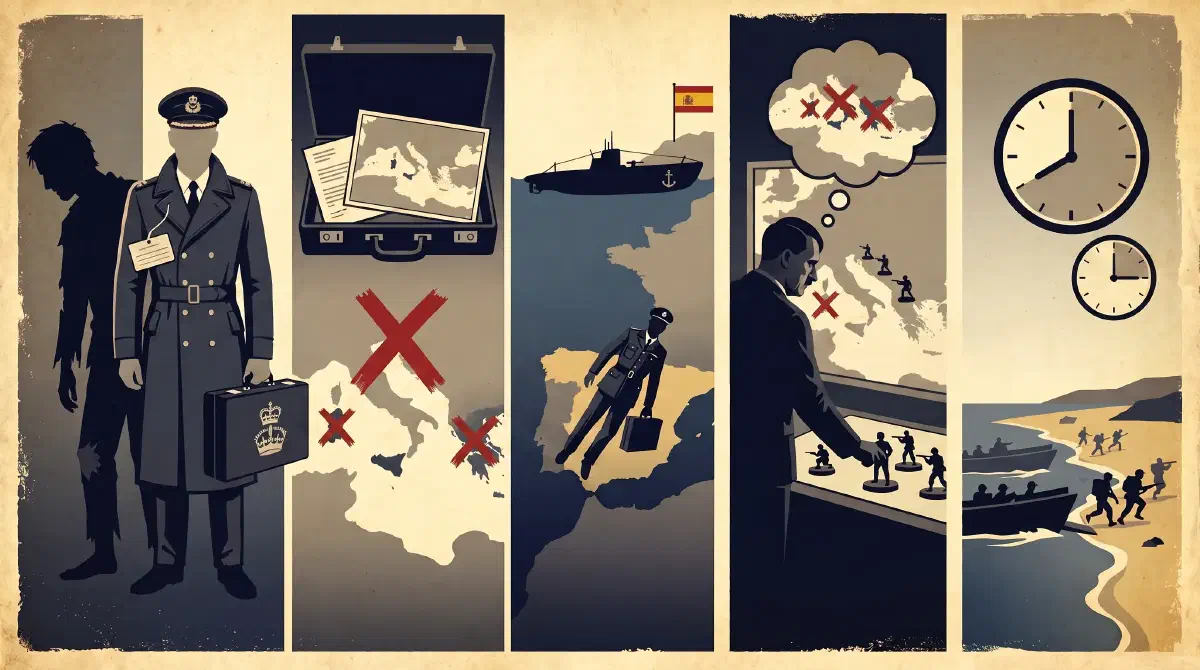
On April 30, 1943, a Spanish fisherman recovered a body floating near the coast of Huelva. The corpse was dressed in the battledress of a Royal Marines officer, carrying identification for Captain (Acting Major) William Martin. Attached to the trench coat was a briefcase containing highly sensitive strategic documents. These papers detailed a massive Allied invasion of Greece and Sardinia, framing Sicily as a mere diversion.
In reality, the body belonged to Glyndwr Michael, an undernourished homeless Welshman who died from eating phosphorus-laced rat poison. British intelligence officers Ewen Montagu and Charles Cholmondeley had obtained the unclaimed body from a London mortuary. They engineered a meticulous, fictitious identity to deceive the German high command. The Allies wanted to obscure their actual objective, which was the invasion of Sicily.
This strategic deception represents a masterpiece of psychological warfare in the Mediterranean theater. The Allied plan exploited the specific cognitive vulnerabilities of Adolf Hitler and his intelligence analysts. By feeding the German military apparatus exactly what it feared, the deception successfully diverted critical Axis resources. The operation proved that the most decisive battlefield is often the internal mind of the opposing commander.
Cognitive Hijack: How Systemic Vulnerabilities Enable Deception#
The success of Operation Mincemeat exposes a critical vulnerability in rigid intelligence networks. Strategic deception succeeds not through physical perfection, but by exploiting pre-existing cognitive biases. The Allied planners designed a fake reality that perfectly aligned with Hitler's strategic obsessions. German intelligence accepted the bait because it confirmed their deepest fears about a Balkan invasion.
This analysis deconstructs the systemic mechanisms that made the German high command vulnerable to disinformation. By studying the operation, we uncover how cognitive filters shape the interpretation of physical evidence. Raw data is rarely neutral, as analysts constantly bend facts to fit established narratives. Understanding these mental mechanisms is essential for evaluating both military histories and modern intelligence frameworks.
Deconstructing the Illusion: From Refrigerator to the Reich's High Command#
The Engineering of a Legend: Pocket Litter and Meticulous Details#
To build an authoritative deception, Montagu and Cholmondeley created a highly detailed "legend" for Major William Martin. They selected the rank of acting major because it was senior enough for sensitive documents but not prominent enough to attract personal scrutiny. They dressed the corpse in standard Royal Marines battledress, which was easily obtainable in precise sizes. They secured a leather-covered chain from his briefcase to the belt of his trench coat.
The planners understood that genuine human identity is composed of mundane, personal details. They filled Martin's pockets with "pocket litter" to simulate an active personal life. This litter included a photograph of his fictional fiancée, Pam, who was actually an MI5 clerk named Jean Leslie. They added two love letters from Pam and a receipt for a £53 engagement ring.
The intelligence team went further to establish Martin's financial and social reality, including a demanding overdraft letter from Lloyds Bank for £79 19s 2d. They also added ticket stubs from a London theater, Gieves shirt receipts, and a lodging bill. MI5 scientists conducted rigorous tests on various inks to ensure the letters remained legible after seawater immersion. This pocket litter established an unbroken, logical itinerary of Martin's activities from April 18 to April 24.
The critical cargo consisted of a personal, unofficial letter from Lieutenant General Sir Archibald Nye to General Sir Harold Alexander. This letter casually revealed that the Allies would reinforce landings at Kalamata and Cape Araxos in Greece. It explicitly mentioned Sicily and the Dodecanese as mere "cover targets" for the assault. They also included a letter from Vice-Admiral Lord Louis Mountbatten containing a deliberate joke about "sardines" to suggest Sardinia.
The Crucible of Context: Forensic Hazards and Spanish Interception#
The execution of the plan faced immediate physical, forensic, and diplomatic hazards. Forensically, the British had to ensure a Spanish pathologist would not uncover the true cause of death. Pathologist Sir Bernard Spilsbury advised that air crash victims often die from shock rather than drowning. He noted that Spanish doctors rarely performed detailed autopsies unless the death was of massive political importance.
The physical logistics of transporting the body introduced severe technical challenges. The body had to be preserved without freezing, so Bentley Purchase stored it in a mortuary refrigerator at exactly 4 °C. On April 17, 1943, the team defrosted Martin's frozen feet with an electric heater to fit his boots. They packed the body in a customized steel canister filled with 21 pounds of dry ice to exclude oxygen.
The submarine HMS Seraph transported the canister under the guise of carrying a meteorological device. Commander Bill Jewell surfaced off Huelva on April 30 to release the corpse. The location was chosen because the tides would carry the body to a shore monitored by an active German Abwehr agent. The Spanish fisherman José Antonio Rey María recovered the body later that morning.
The diplomatic phase required a delicate play of pre-scripted, breakable communications. The British sent urgent, encrypted messages demanding the return of the briefcase, knowing the Germans had broken this code. Haselden suggested that the Spanish autopsists close the examination early for lunch due to the heat. The Spanish doctors agreed, attributing death to drowning.
German Abwehr agents quickly moved to exploit the Spanish recovery of the diplomatic pouch. While the Spanish Navy officially held the briefcase, German sympathizers photographed the documents. In Madrid, Abwehr agent Karl-Erich Kühlenthal persuaded Admiral Wilhelm Canaris to intervene. Spanish officials used a thin probe to roll the damp papers out from the envelopes without breaking the wax seals.
The British had hidden a single black eyelash inside Mountbatten's letter to verify if it had been opened. When the Spanish returned the briefcase on May 11, forensic analysts noted the eyelash was missing. Tests proved the paper fibres were damaged from folding, and the documents dried in a rolled shape. The Allies knew the Germans had successfully extracted, read, and accepted the fake plans.
Tracing the Ripple Effects: Strategic Collapse and the Overthrow of a Dictator#
The strategic consequences of the operation rippled across the entire Mediterranean theater. On May 14, GC&CS decrypted a German military message warning of an imminent Balkan invasion. Brigadier Leslie Hollis immediately informed Winston Churchill that the German high command had swallowed the deception completely. Grand Admiral Karl Dönitz met Hitler, who insisted that Greece and Sardinia must be defended.
Hitler's strategic fixation on the Balkans became a fatal obsession for the Axis alliance. He ordered the immediate transfer of the elite 1st Panzer Division from France to Salonika, Greece. The Germans doubled their troop strength in Sardinia to 10,000 active soldiers. They moved torpedo boats from Sicily and deployed seven new divisions to Greece, raising the Balkan garrison to 18 divisions.
When the Allies launched Operation Husky on July 9, 1943, the deception continued to paralyze German reactions. Four hours after Allied troops landed on Sicily, German commanders dispatched 21 fighter aircraft to reinforce Sardinia. Hitler remained convinced that the Sicilian landings were a feint. He even sent General Erwin Rommel to Salonika to prepare defenses for a non-existent Balkan campaign.
This strategic paralysis allowed the Allies to conquer Sicily much faster and with fewer losses than predicted. The British expected up to 10,000 casualties in the first week, but actual losses were only one-seventh of that number. The Royal Navy anticipated losing up to 300 ships, yet they lost only 12 vessels. The predicted 90-day campaign was successfully concluded in just 38 days.
The political shockwave of the Sicilian invasion quickly shattered the Italian fascist regime. On July 25, 1943, the Grand Council of Fascism voted to strip Benito Mussolini of his powers. King Victor Emmanuel III dismissed Mussolini as prime minister and ordered his immediate imprisonment. The new Italian government entered secret peace negotiations, effectively removing Italy from the Axis alliance.
The diversion of German forces had profound, global consequences for the Eastern Front. On July 13, Hitler was forced to suspend the massive Kursk offensive. This decision was driven partly by Soviet resistance and partly by his desire to preserve troops for the Balkans. By abandoning the initiative at Kursk, Germany permanently lost its offensive capabilities on the Eastern Front.
Lessons in Sovereignty: Why Metaphysical Value Outlasts Military Might#
Operation Mincemeat remains a classic case study in the strategic manipulation of information systems. Modern military analysts often prioritize physical force and technology over cognitive alignment. However, the conquest of Sicily proves that capturing the enemy's mind is more effective than defeating their armies. The Allies defeated a highly fortified defensive position by weaponizing the cognitive biases of its commanders.
This historical operation demonstrates that information security is a psychological challenge rather than a technical one. The German Abwehr possessed an extensive network of effective agents and broken codes. Yet, they failed because their strategic filters only accepted data that confirmed their pre-existing biases. True strategic resilience requires organizations to actively challenge their own assumptions.
The human element remains the ultimate variable in any complex strategic system. A homeless Welshman, who died in obscurity, became the phantom major who altered the course of World War II. In 1997, the Commonwealth War Graves Commission recognized this reality by adding Glyndwr Michael's name to Major Martin's gravestone in Huelva. His legacy proves that in the theater of war, an empty uniform can be more powerful than a panzer division.