Series Overview
#This series offers a comprehensive analysis of Khaled ibn al-Walid, one of history's most brilliant and controversial military commanders. Known as the "Sword of Allah," Khaled's career spanned the early Islamic conquests, where he achieved unprecedented victories against formidable adversaries. Through a rigorous examination of his battles, leadership style, and the political context of his era, this series aims to separate myth from reality and provide a nuanced understanding of his legacy. Each article delves into specific aspects of his military genius, from tactical innovations to operational art, while also addressing the ethical and political controversies that surround his figure. By the end of the series, readers will have a well-rounded perspective on Khaled ibn al-Walid, appreciating both his strategic brilliance and the complexities of his historical impact.
Infographic
#An infographic showing the key strategic hallmarks of Khaled ibn al-Walid, including operational art, tactical flexibility, and decisive maneuver.
⚔️ Timeline: Khalid ibn al-Walid (592–642 CE)
#March 625 CE
Pre-Islamic
Battle of Uhud — Khalid, commanding the Quraysh cavalry, exploits a gap left by Muslim archers and executes a decisive flanking maneuver, turning the battle into a rout and inflicting a severe defeat on Muhammad's forces. This engagement reveals the tactical instincts that would later define his career.
627 or 629 CE
Conversion
Conversion to Islam — Khalid embraces Islam in the presence of the Prophet Muhammad in Medina, who inducts him as an official military commander and bestows upon him the title Sayf Allah ("Sword of God").
September 629 CE
First Command
Battle of Mu'tah — After three senior Muslim commanders are killed, Khalid assumes command and organizes a successful fighting withdrawal against a much larger Byzantine force. He reportedly breaks nine swords during the battle.
630 CE
Conquest
Conquest of Mecca — Khalid leads Bedouin contingents under the Muslim army during the bloodless conquest of Mecca.
630 CE
Campaign
Battle of Hunayn — Khalid commands Muslim forces against the Hawazin and Thaqif tribes, securing victory after initial setbacks.
632–633 CE
Ridda Wars
Ridda Wars — Following Muhammad's death, Abu Bakr dispatches Khalid to suppress widespread tribal rebellions across Arabia. Key engagements include:
- Battle of Buzakha (September 632) — Defeat of the false prophet Tulayha.
- Battle of Yamama (December 632) — Bloodiest battle of the Ridda Wars; Musaylima, a rival prophet, is killed and his army destroyed.
The campaigns forge the Arab tribes into a unified military instrument and establish Khalid's reputation as the caliphate's premier general.
April–July 633 CE
Iraq Campaign
Persian Front Opens — Khalid enters lower Mesopotamia with 18,000 men and wins four consecutive victories: the Battle of Chains (April 633), Battle of the River (April 633), Battle of Walaja (May 633), and Battle of Ullais (mid-May 633).
At Walaja, Khalid executes a brilliant double envelopment — a maneuver often compared to Hannibal at Cannae — annihilating a larger Sassanid force. By July, the regional capital of al-Hira capitulates, and Anbar falls after a siege.
Spring 634 CE
Strategic Crossing
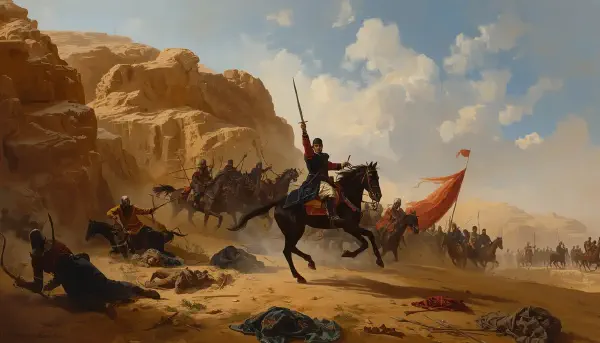
The Desert Crossing — Ordered by Abu Bakr to reinforce Muslim armies in Syria, Khalid leads his force on a daring 5-day, 600-km march across the waterless Syrian Desert. Using camels as mobile supply platforms and tribal guides to locate hidden wells, his army arrives undetected on the Byzantine flank — a feat of operational art that transforms the strategic situation in Syria.
634–636 CE
Syria Campaign
Conquest of Byzantine Syria — After assuming unified command of Muslim forces, Khalid wins a series of decisive engagements:
- Battle of Ajnadayn (July 634) — First major pitched battle against the Byzantines in Syria; decisive Muslim victory.
- Siege of Damascus (634–635) — Khalid breaches the city walls and negotiates its surrender.
August 636 CE
Decisive Victory
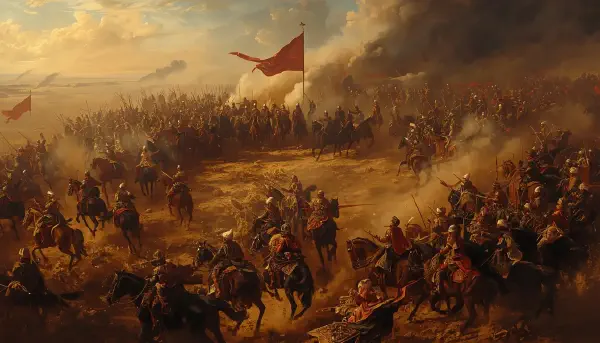
Battle of Yarmouk — Khalid's masterpiece. Over six days, his outnumbered army of 24,000–40,000 men destroys a Byzantine force nearly twice its size. On the final day, a cavalry charge into the Byzantine flank, combined with the seizure of a bridge in the enemy rear, turns retreat into annihilation. Byzantine casualties are estimated at 40,000.
Strategic consequence: The battle permanently breaks Byzantine military power in the Levant. Emperor Heraclius, upon hearing the news, reportedly cries, "Farewell, Syria," and withdraws beyond the Taurus Mountains. Jerusalem surrenders the following year.
637–638 CE
Final Campaigns
Sieges of Homs, Aleppo, and Qinnasrin — Despite being demoted from supreme command by Caliph Umar and replaced by Abu Ubayda ibn al-Jarrah, Khalid serves loyally as a subordinate commander. His leadership remains decisive in these final operations, which complete the Muslim conquest of Syria.
638 CE
Dismissal
Dismissal from Command — At the height of his fame, Caliph Umar removes Khalid from his military command and the governorship of Qinnasrin. Umar later clarifies: "I have not dismissed Khalid because of my anger... I have dismissed him because the people glorified him and were misled." Khalid accepts the decision without protest, demonstrating the political subordination that preserved the unity of the caliphate.
642 CE
End of an Era
Death — Khalid ibn al-Walid dies of illness at the age of approximately 50, either in Homs (Syria) or Medina. He is buried at the Khalid ibn al-Walid Mosque in Homs.
Legacy: In over a decade of campaigning, he fought dozens of battles and never suffered a single defeat. His tactics at Walaja and Yarmouk are studied in military academies to this day. He is universally regarded as one of history's greatest cavalry commanders and the finest general of the early Islamic conquests.
References
#- Akram, A. I. (1970). The Sword of Allah: Khalid bin al-Waleed, His Life and Campaigns. National Publishing House.
- al-Azdi, M. ibn A. (2020). Futūḥ al-Shām [The Conquests of Syria] (M. S. El-Khatib, Trans.). Routledge.
- al-Baladhuri, A. ibn Y. (2022). Futūḥ al-Buldān [The Conquest of the Lands] (H. Kennedy, Trans.). I.B. Tauris.
- Al-Jallad, A., & Sidky, H. (2024). A Paleo-Arabic inscription of Khalid ibn al-Walid from the early Islamic period. Journal of Near Eastern Studies, 83(1), 1–15.
- Bury, J. B. (Ed.). (1913). The Cambridge Medieval History, Vol. 2. Cambridge University Press.
- Donner, F. M. (1981). The Early Islamic Conquests. Princeton University Press.
- Gök, B., & Zeybek, M. (2023). The war tactics of Khālid b. al-Walīd. Samer, 10(2), 41–58. http://yerbilimleri.cumhuriyet.edu.tr/en/pub/samer/issue/78041/1290200
- GPTKB. (n.d.). Battle of Uhud. GPTKB. https://gptkb.org/entity/Battle_of_Uhud/
- Gould, N. G. (1970). The Ridda Wars: A study of the early Islamic conquests [Master's thesis, University of Michigan].
- Kaegi, W. E. (1992). Byzantium and the Early Islamic Conquests. Cambridge University Press.
- Kennedy, H. (2001). The Armies of the Caliphs: Military and Society in the Early Islamic State. Routledge.
- Kennedy, H. (2022). Futūḥ al-Buldān [The Conquest of the Lands] (Translation of al-Baladhuri's work). I.B. Tauris.
- Republika. (2020, May 12). Perang Uhud, Ajang Pembuktian Khalid bin Walid Sebelum Islam. Republika Online. https://republika.co.id/amp/qa7oyv320/perang-uhud-ajang-pembuktian-khalid-bin-walid-sebelum-islam
- Sehgal, I. (2020, August 14). Khalid Bin Waleed Leader Extraordinary. Daily Times. https://dailytimes.com.pk/653521/khalid-bin-waleed-leader-extraordinary/
- U.S. Army Command and General Staff College. (2012). General Khalid Bin Waleed: Understanding the 7th Century campaign against Sassanid Persian Empire from the perspective of operational art (ADA580381). Defense Technical Information Center. https://archive.org/details/DTIC_ADA580381
- Wikipedia contributors. (2024, June 13). Battle of Walaja. In Wikipedia, The Free Encyclopedia. https://en.wikipedia.org/wiki/Battle_of_Walaja
- Wikipedia contributors. (2024, August 3). Battle of Uhud. In Wikipedia, The Free Encyclopedia. https://en.m.wikipedia.org/w/index.php?title=Battle_of_Uhud&curid=3095594&diff=1238418459&oldid=1238418072