
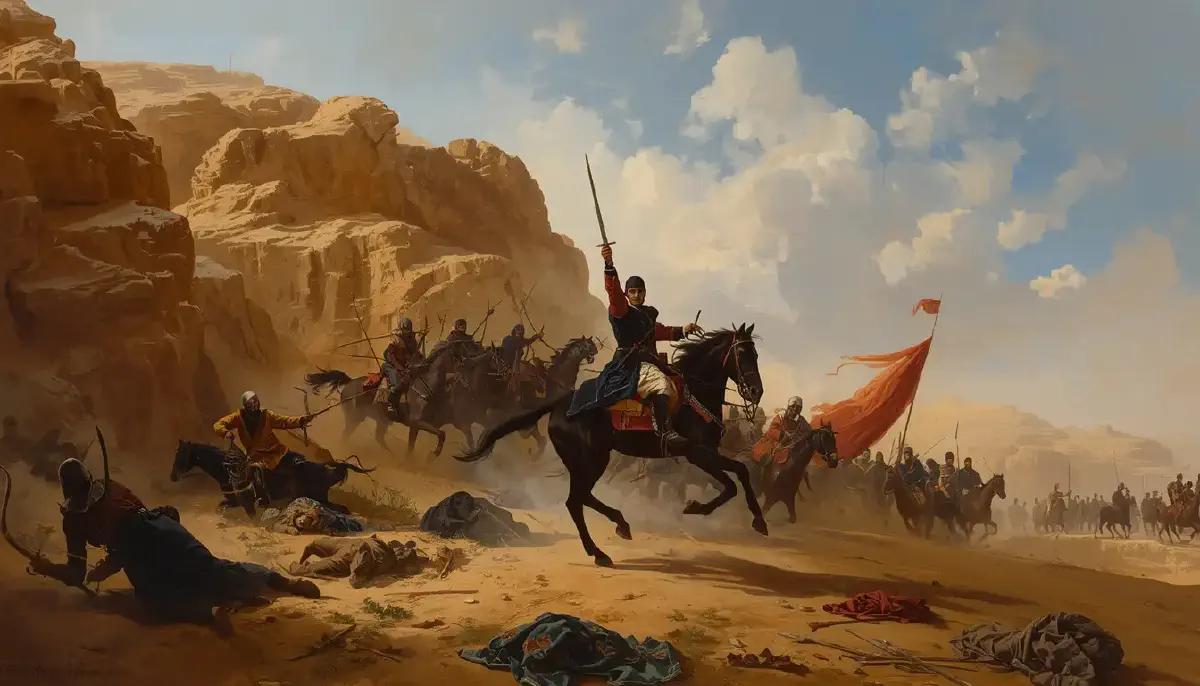
The Quraysh of Mecca had marched on Medina with 3,000 men, burning to avenge their humiliating loss at Badr a year earlier. Among their number, Khalid commanded the mounted contingent, a force he had drilled to move fast and strike hard. But when the two armies clashed, the Muslims surged forward with a ferocity that caught the Meccans off guard. The Quraysh lines buckled; their vanguard fled. For a moment, it looked as though Muhammad’s outnumbered defenders would repeat their earlier miracle.
Then came the moment that separates the competent from the truly gifted. The Prophet had stationed a detachment of 50 archers on a small rise to protect his army’s exposed flank, with explicit orders not to abandon their post “whether we win or lose.” But as Quraysh spoils littered the field, greed dissolved discipline. All but a handful of the archers scrambled downhill to join the looting. To any casual observer, this was simply the chaos of battle. To Khalid, it was the opening of a door.
What happened next can be described in a single sentence, yet its components reveal a mind operating at a different tempo. Khalid wheeled his cavalry around the hill, led them through a defile that the archers had been guarding, and fell upon the Muslim rear with the speed of a thunderclap. The Muslim army, utterly surprised, splintered. Muhammad himself was wounded, a tooth broken, his face bloodied. By dusk, some 70 of his followers lay dead on the field, their bodies mutilated by a jubilant enemy.
This was not luck. It was the cold application of two principles that would define Khalid’s career long before he ever heard of the God he would later serve. The first was recognition of the decisive point: in the swirling dust of battle, he alone grasped that the archers’ hill was not a minor feature but the keystone of the entire Muslim position. The second was relentless exploitation: he did not hesitate, did not consult, did not pause to savour the moment. The gap appeared, and his horsemen were already in motion.
Historians who later chronicled the Islamic conquests would marvel at Khalid’s ability to turn a retreat into a trap, a stalemate into an annihilation. At Uhud, we see the embryo of that ability. The Quraysh did not press their advantage to destroy the Muslim community—that strategic failure belongs to their leader, Abu Sufyan—but Khalid had demonstrated a tactical genius so sharp that it cut through the confusion of the day like a blade. It is a grim irony that the man who inflicted Muhammad’s most painful battlefield defeat would, within a few years, become the “Sword of Allah” who carved out an empire for his former enemies.
The pre-Islamic Khalid is often treated as a footnote, a brief darkness before the dawn of conversion. But the Battle of Uhud demands we see him otherwise. It was here, on the slopes of a hill outside Medina, that the essential elements of his military system—patience, terrain exploitation, speed, and the ruthless identification of the enemy’s vulnerability—first took shape. The same mind that would later orchestrate the double envelopment at Walaja and the six-day chess match at Yarmouk was already at work, albeit in a simpler form, at the age of perhaps 25.
For the Muslims, Uhud was a bitter lesson in the price of disobedience and the fickleness of fortune. For Khalid, it was a proof of concept. He had not yet embraced Islam, but he had already perfected the art of winning. In the end, the faith that he would later adopt did not make him a great general. It gave him a cause. The genius was already there, waiting, on the wrong side of history.
Uhud: The Forge of a Mind#
Context and Background#
The Battle of Uhud, fought on March 23, 625 AD (3 AH) (Bury, 1913, p. 318; Kennedy, 2022), was a direct consequence of the Quraysh's humiliating defeat at the Battle of Badr. The Quraysh, led by Abu Sufyan, sought to avenge their losses and restore their prestige by marching on Medina with a coalition force (Bury, 1913, p. 318; Wikipedia contributors, 2024).
Khalid's Tactical Masterstroke at Uhud#
The battle was a masterclass in disciplined opportunism. Khalid, commanding the Quraysh cavalry, demonstrated the core tactical tenets that would later define his career: patience, terrain exploitation, and the identification of the critical vulnerability. The following table details the key events and analysis:
Table 1: Khalid ibn al-Walid's Tactical Maneuver at the Battle of Uhud (625 AD)
| Phase | Events | Khalid's Tactical Genius |
|---|---|---|
| Initial Muslim Success | The Muslim infantry pushed the Quraysh back, and victory seemed imminent. The Quraysh vanguard faltered. (Wikipedia contributors, 2024) | Patience and Discipline: Khalid held his cavalry back from the initial rout, waiting for an opening rather than committing his forces to a doomed frontal assault. (Sehgal, 2020) |
| The Critical Failure | Muslim archers, positioned by Muhammad to guard the rear flank, abandoned their posts to collect spoils, leaving a gap. (Kennedy, 2022; Wikipedia contributors, 2024) | Recognition of the Decisive Point: In a split second, Khalid recognized that this abandonment was not a minor event; it was the decisive point that would determine the battle's outcome. |
| The Flanking Maneuver | Khalid led his cavalry in a rapid, wide encircling movement around the hill, attacking the Muslim army from the now-undefended rear. (Wikipedia contributors, 2024; Bury, 1913, p. 318) | Speed and Decisive Action: His attack was instantaneous and overwhelming, leaving the Muslims no time to correct their fatal error. The result was total confusion and a rout. (Republika, 2020) |
| Aftermath | The Muslims suffered a severe psychological and military setback, with about 70 men killed (Bury, 1913, p. 319). Muhammad was wounded. Quraysh morale was boosted. (GPTKB, n.d.) | Strategic Outcome: Though a tactical defeat for the Muslims, it hardened their resolve. For Khalid, it was a proof of concept for his doctrine of maneuver warfare. |
This infographic shows an analytical reconstruction of Khalid ibn al-Walid's tactical maneuvers at the Battle of Uhud (625 AD).