
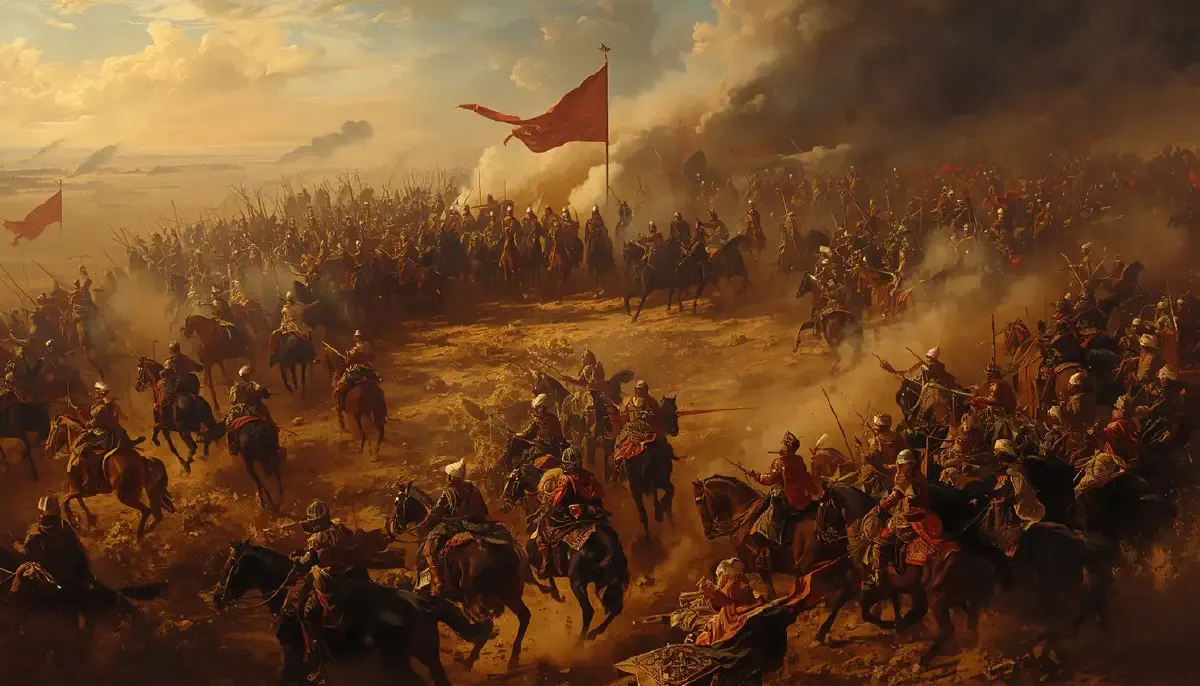
If the Prelude revealed the embryo of Khalid’s genius at Uhud, the campaigns in Iraq and Syria show it in full maturity. Two battles, Walaja and Yarmouk, serve as the pillars of his reputation as an “annihilator”—a general who did not seek to push the enemy back but to erase him from the field entirely.
Walaja: The Eastern Cannae#
In May 633 CE, Khalid led a force of roughly 15,000 men deep into the Sassanid-ruled territory of lower Mesopotamia. Awaiting him at Walaja was a Persian army of comparable or greater size, commanded by Andarzaghar, a seasoned satrap who had chosen his ground carefully. The Persians expected a frontal assault of the type Arab raiders had always favoured. Khalid gave them something else entirely.
He began with a probing attack, drawing the Persian centre forward. Then, as the enemy committed, two flanking columns of cavalry—one of which had been concealed behind a ridge after a night march—sprang the trap. The Persian army was hit from three sides simultaneously. The result, recorded in both Arabic and Persian sources, was a slaughter from which few escaped. Modern estimates suggest Persian dead numbered around 20,000 (Akram, 1970, p. 189). The Sasanian hold on lower Mesopotamia never recovered.
The comparison with Cannae (216 BCE) is not poetic licence. The following table sets the two engagements side by side, revealing the structural parallels.
Table 1: Tactical Comparison — Cannae (216 BCE) vs. Walaja (633 CE)
| Variable | Battle of Cannae (Hannibal) | Battle of Walaja (Khalid) | Analysis |
|---|---|---|---|
| Force Ratio (Aggressor:Defender) | ~50,000 vs. ~86,000 (approx. 1:1.7) | ~15,000 vs. 15,000–30,000 (approx. 1:1 to 1:2) | Both faced a numerically superior enemy. |
| Core Tactic | Classic double envelopment with a convex infantry centre and strong cavalry on the flanks. | Variation of the double envelopment using a detached flanking force to strike the enemy’s rear. | Both achieved annihilation by collapsing the enemy’s flanks and rear. |
| Key Enabler | Superior Carthaginian cavalry under Hasdrubal. | Superior mobility and the use of a reserve force to spring the trap. | Cavalry was the decisive arm; Khalid’s version showed greater tactical flexibility. |
| Outcome | Roman army virtually destroyed; 50,000–70,000 killed. | Persian army shattered; ~20,000 killed. Sasanian control in lower Mesopotamia permanently weakened. | Classic battles of annihilation. |
| Innovation | A perfectly timed, coordinated manoeuvre never executed on this scale before. | Khalid is believed to have developed his version independently, drawing on desert raiding traditions. | Tactical genius transcends culture and era. |
This infographic shows the tactical comparison between the Battle of Cannae and the Battle of Walaja.
Sources: Akram (1970), p. 189; Wikipedia contributors (2024).
Yarmouk: The Six-Day Chess Match#
If Walaja was a lightning stroke, the Battle of Yarmouk (August 636 CE) was a week-long symphony of attrition, deception, and final, crushing resolution. The Byzantine emperor Heraclius had assembled an army estimated by some medieval sources at over 100,000 men—though modern historians, including Hugh Kennedy (2001), consider figures between 40,000 and 80,000 more plausible. Khalid commanded a united Arab force of perhaps 24,000 to 40,000 (Kennedy, 2001, p. 56). The strategic stakes could not have been higher: a Muslim defeat would have extinguished the nascent caliphate’s ambitions in Syria; a victory would shatter Byzantine power from Antioch to Jerusalem.
Khalid’s opening move was unorthodox and politically delicate. Upon reaching Syria after his epic desert crossing from Iraq, he took de facto command of the various Muslim armies already in the field. He then reorganised them into a structure of centre, right wing, and left wing, each with a designated commander—a system that the historian al-Azdi (2020) describes as a novelty for the Muslim forces. Crucially, he created a mobile cavalry reserve under his personal control, a striking arm that would move to wherever the line threatened to buckle.
For five days, the battle took the form of a grinding struggle along the Yarmouk plain. Byzantine heavy infantry and Armenian contingents pushed hard against the Muslim flanks, and several times the line nearly collapsed. Khalid’s reserve cavalry plugged each gap with what the military historian A.I. Akram (1970, p. 415) calls “the instinct of a master chess player, thinking several moves ahead.” The Arab sources record that on one of these days, 700 Muslim soldiers who had been blinded by Byzantine arrows stood their ground and fought until killed—an indication of the desperate courage on both sides.
On the sixth day, Khalid sprang his trap. He had lured the Byzantine army into a position where its left flank rested against a steep ravine. At dawn, his cavalry slammed into the Byzantine horsemen on that flank and drove them into the chasm. Simultaneously, a detachment he had moved by night seized a bridge in the Byzantine rear, cutting off the line of retreat. The Byzantine army, hemmed in and leaderless after its commander Theodore fell, disintegrated. Thousands were cut down; thousands more perished in the ravines (al-Baladhuri, 2022, p. 204). Heraclius, receiving the news in Antioch, is said to have cried, “Farewell, Syria,” and withdrew beyond the Taurus Mountains.
The Tactical DNA#
From these and a dozen other engagements, a distinct tactical doctrine emerges. It can be distilled into four principles that Khalid applied with ruthless consistency.
First, tactical flexibility. A 2023 study by Gök and Zeybek notes that Khalid rarely used the same tactic twice. Against the Persians at Walaja, he employed a set-piece double envelopment. Against the Byzantines at Ajnadayn, he used hit-and-run attacks to weaken a larger force. At Firaz, where he faced a combined Byzantine-Sasanian garrison, he caught the enemy in a pincer by a ruse. “He was a master of adaptation,” the study concludes, “consistently surprising enemies who expected conventional desert warfare” (Gök & Zeybek, 2023, p. 45).
Second, economy of force. Khalid’s armies were almost always outnumbered, yet he concentrated his limited resources at the decisive point. The cavalry reserve at Yarmouk was the instrument of this principle—a small fraction of his total strength that, applied at the right moment, proved lethal.
Third, annihilation over attrition. A U.S. Army monograph from 2012 stresses that Khalid’s objective was “not simply to defeat the enemy but to destroy his ability to wage war” (p. 12). This pursuit of decisive battle—rare in the tribal warfare of Arabia—explains the catastrophic casualty rates suffered by his opponents. Battles were not raids; they were endings.
Fourth, independent thinking. The comparison with Hannibal is apt not because Khalid copied Carthaginian methods—there is no evidence he knew of Cannae—but because both men broke free of the tactical conventions of their time. The same monograph argues that Khalid “exhibited characteristics of modern operational art, including the setting of objectives that served the caliph’s strategic aims and the maintenance of initiative through swift, sequential operations” (U.S. Army, 2012, p. 18).
In 634 CE, within a year of Walaja, a Sassanid commander is said to have asked a captured Arab soldier, “Who is this Khalid, and where did he learn to fight like this?” The prisoner’s reply, recorded in the annals of al-Tabari, was simple: “He learned in the desert, and the desert is his teacher.” It was an incomplete answer. The desert gave him mobility and endurance; a mind of rare quality gave him the rest. In the next article, we shall see how that mind extended beyond the battlefield to the operational art of supply, movement, and the strategic use of a landscape that his enemies considered impassable.
Next: Article II — The Desert as a Weapon: Operational Art, Logistics, and the Mobility Revolution of the 7th Century.